


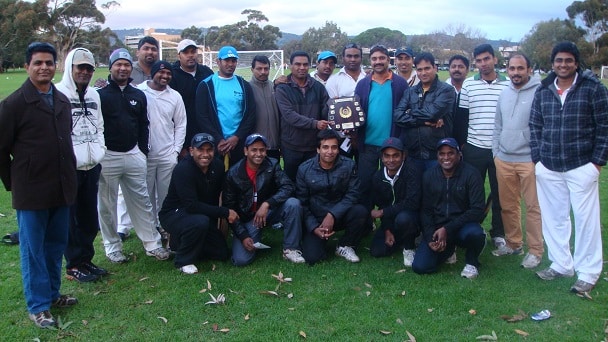
The Telugu Association of SA recently organised the Dr. Raj Thalluri Memorial Cricket Tournament for the third year in a row. The Malayalee team AMMA took the trophy yet again, just as they did in the first two series, making it a grand hat-trick for themselves.
TASA put up its own team, as did the Tamil association ATA.
The trophy was presented to the winning team by TASA president Adireddy Yara and past President Prasad Malladi.
TASA has been organising the contest since 2011 and numbers have been gradually increasing. It is hoped that in coming years the popularity of this community cricket series continues to grow.
Community cricket series thrills
Reading Time: < 1 minute
Striving to serve

Reading Time: 4 minutes
The official Samarpan launch outlines a raft of services for PWDs and their families and carers

‘Samarpan’ is a Sanskrit word meaning ‘giving yourself completely’. As such, it is an apt title for an organisation dedicated to improving the quality of life of people with disability, of Indian and South Asian origin in NSW.
Samarpan Inc was launched as an organisation in late June. Secretary Rajni Chandran told Indian Link nearly 200 people gathered at Epping Community Centre for the official ceremony.
Amongst the invitees were politicians, cultural organisations, high profile members of society, service providers, members and their families. The attendees were treated to audio-video presentations describing the services, goals and aspirations of Samarpan. There were talks by health care professionals on issues of intellectual disability, the importance of support networks for persons with disability, and multicultural community support. Impressive performances and presentations by persons with disability won everyone’s heart. Sidharth, Rajni’s 25-year-old son with autism prepared a presentation based on a poem he composed. Also featured were shots of his swimming accomplishments and camp trip. Another commendable presentation was that of Raishav on netball, along with songs by Preshant and Arun.
There are 3000 persons with severe disability from South Asian backgrounds in Sydney alone, requiring ongoing care. Rajni pointed out that informally the organisation has been operating for many years. It was started by two mothers in Sydney in 2002, as a support group for families of children with disability. By 2008, a small group had formed, and in June 2012 Samarpan was registered as an association. The year that followed allowed board members to work out the roles and goals of the organisation to best address the needs of South Asian families with People With Disabilities (PWD), before officially launching this year.
The aim of Samarpan is to provide opportunities for people with disability of South Asian origin to socialize and form long-term relationships amongst themselves. Samarpan especially aims to help children facing developmental disability that starts at an early age, and continues through life. The organisation is trying to build a support network for families of such children and to develop culturally appropriate services to suit their needs.
One of the most important services planned by Samarpan is the development of an accommodation model that will meet the long-term care needs of the disabled adult child of a Samarpan family. The project has been named ‘Aashray’.
Further explaining the project, Rajni said, “The accommodation that we envisage will cater to the needs of individuals who need round the clock care or supervision, who have an established relationship, and who are of South Asian background. Ashray as a project is in its budding stage. We are looking at setting up a blueprint for the type of accommodation we think will meet the needs of our clients. The blueprint will then be presented to various agencies and individuals to enlist their support. We hope to soon provide people with disability of South Asian culture a purpose-built, safe and permanent place to live with their families, maintain links with the community, stay connected with their culture, and have employment, leisure and other opportunities”.
Samarpan also runs ‘Aadhaar’, a support group for families which meets once a month for organised activities like bowling and picnics. The idea is to let families enjoy time together with their child with disability, in order to strengthen family ties. Aadhaar celebrates carers week every year, with the next meet on July 28 at AMF Bowling in Castle Hill, and anyone of South Asian background with a PWD is welcome to attend.
‘Mitralay’, another Samarpan initiative is a social club for people with disability which meets once a month. Field games, excursions and other activities are organised to help members socialise. Mitralay is supported by the Hornsby Council.
Samarpan’s advocacy program ‘Aagrah’ endeavours to represent its members in community forums, submissions to government and providing information on disability funding, services and benefits available.
At the same time, ‘Udyog’ is the program run by Samarpan to help people with disability find meaningful work to raise their self-esteem and help them contribute to society in a positive manner.
Samarpan Inc is an independent organisation which relies on various funding sources to run its programs.
“We hope private donors, government funding and community philanthropists will help make our goals a reality, and judging by the response to the inaugural ceremony, there is tremendous goodwill in the South Asian community,” Rajni said optimistically.
Samarpan is planning an information session on diet and nutrition for mothers and carers of PWD towards the end of the year. The meeting will include information and help on modifying common South Asian recipes to make them wholesome for people with disability. The date of the session is yet to be decided, but next on Samarpan’s calendar is an information session on the National Disability Insurance Scheme/ Disability Care on August 31 in North Parramatta. Barbel Winter, Executive Director of Futures Upfront will help South Asian families of persons with disability have a better understanding of the new NDIS which is now called Disability Care Australia.
Rajni Chandran can be contacted on 0432 798 938 or call Caroline on 0402 596 813 for registration of attendance.
Programming 101

Reading Time: 3 minutes
Getting familiar with the basics in a world literally being eaten up by software could be helpful, writes HASNAIN ZAHEER

In one of the recent issues of Indian Link (Issue 2, July), I had made a case for why kids should be taught programming. Today, I am going to argue why you, an adult business owner or employee, should also learn programming. Like last time, I would like to mention that learning programming is not limited to learning the syntax or the rules of a programming language. Or to learning how to configure a system such as SAP, although that kind of knowledge is not bad to have either.
My recommendation is to be capable of understanding general principles of how internet and mobile applications work, what factors can make them succeed or fail, and knowing how to work with IT, mobile and internet vendors and workers – to understand what they are saying and their scope of work and limitations, and to be able to provide them great requirements. As business owners, you should understand online business. As employees, you should know how to automate part of your work that is manual or repetitive, so you can be more productive.
But before we venture further, let me clarify why I am making this recommendation.
About two years ago, Marc Andreessen, a pioneer of commercial internet wrote how ‘software is eating the world’. He argued that internet and mobile communication and their convergence with commerce, entertainment and business models, is disrupting and taking over entire industries. This is contrary to the general belief in which today’s popularity of Facebook and other dominant websites are seen as just another ‘bubble’.
As proof of his assertion that all industry is going online, Andreessen cited Amazon and the way it transformed the books retail business and even the way we read books now (on Kindle, rather than paper). He also cited streaming music services such as Spotify and Apple iTunes and their effect on the music industry, Linkedin and its effect on recruitment etc. The point is, whole industries are being eaten alive by software and the internet. Your industry may just be waiting in line. Get ready to meet the new reality of an IT-driven world before the business or job is eaten by it (or IT – pun unintended). It does not matter whether your industry is content, media or software driven; many employees of banks, insurance and mining would find their skills inadequate to deal within the new environment.
If Mark Andreessen has convinced you enough to give software a shot to preserve your career or do better in business, here are a few resources to enhance your skills.
To get a feel of programming in an entertaining way, check out amateur game development platform developed by MIT – Scratch (scratch.mit.edu). This is as good for adults to have a flavour of software development, as for kids.
When you are ready for serious stuff, then you can learn programming online interactively at Codecademy (www.codecademy.com). General Assembly (generalassemb.ly/sydney), an educator of start-ups and entrepreneurs, offers classes in web development, computer science fundamentals, data science among others. Classes are held in Ultimo near Sydney CBD. Before enrolling into one of their comprehensive courses, you can attend a few of their workshop sessions that are offered for as low as $40 for a 2 hours session. They also have several videos online (generalassemb.ly/online) that are offered to paid members (about US$25 per month).
Do you think your Excel skills needed a little update? Need to brush up Powerpoint skills? Head over to udemy (www.udemy.com), enter what you want to learn and you would have a choice of dozens of online courses offered by other people like you and me, not necessarily colleges, and who are experts and experienced users. You may subscribe to their courses and complete on udemy’s platform.
Interested in learning how to build an online strategy for your business? Attend Internet business strategy (cce.sydney.edu.au/course/IBST) at the Centre for Continuing Education (CCE) in University of Sydney to learn about business models online, work on the new business for a month and then come back to learn how to implement it (cce.sydney.edu.au/course/IBst). Other one- day workshops at CCE (cce.sydney.edu.au) include mobile strategy, social media and project management. All these are reasonably priced and are quality courses.
Whether you have a preference for planning and strategy, or you are creatively inclined, love numbers, play with data, or create great art, there is a role and an area waiting for you in online, software and mobile. So, polish your programming skills and let’s develop that game. And I am not saying this to kids!
Once was a genius…

Reading Time: 3 minutes
Reiterating four basic values to children can help them discover and manifest their true ability

I have a certificate, therefore I am
There was a time once, when participation was valued for itself. These days, putting on a shirt at an athletics carnival wins house points and bonuses. Entry into a mathematics competition gets a certificate of participation, and in sporting contests the ‘player of the match’ is rotated so that every child is a ‘winner’, regardless of the effort they have made. Over praise leads to underachievement and undermines resilience.
Underachievement
It is common nowadays for parents to report that a child is underperforming. That is, they believe that their child has far more ability than is being manifest. They will say to the child, “Why don’t you just see that if you tried harder, you would see how good you can be”. In saying this, the parent hopes to ‘transmit’ a value that will become intrinsic to the child. Alas, it is rarely the case that what a parent values will be what their child also values, particularly while the child is still in school. Why, for example, should a school child ‘listen’ if the teaching is insipid and uninspiring? Why should a child value 95%, when 82% or 73% is good enough to them?
Why too, should a child enjoy training for sport when a coach favours the children who appear to have greater ‘natural’ ability? In this context, parents need to understand that children best learn when there is broad understanding of the factors likely to encourage and engender success.
There are four values that all children and young adults must be taught if they are to consistently manifest to their true ability, or even if they are to uncover what they are truly capable of. These values are discipline, openness, structure and coachability.
Discipline
Never fret for the child who works hard, but does not achieve. Educators find hardworking students who achieve quite easy to mentor. However, the students most admired are those who work hard but do not achieve to the standard they desire. The key factor that is admired is tenacity. Why? Because success in life comes to those who are consistent and disciplined. Discipline begins projects and finishes them off. Discipline sees something through to the end, and builds resilience and strength. It also builds self-confidence. Incidentally, also never fret for the child who can focus for hours on things that matter to them, but do not matter to you. The capacity to focus for hours is a facet of discipline.
Openness – willingness to try new things
A second key factor to build in young people is a capacity to be open to new things. Risk-taking can be scary, particularly for children to whom things come easily. To take risks requires allowing oneself to be open and to be humble. Humility makes a person learn empathy, understand others, learn from their mistakes and also the mistakes of others. Humility is the basis of forgiveness when there are misunderstandings. Of course, humility cannot be taught through self-righteousness, arrogance or the intellect. Humility is the stuff of an open heart.
Structure
The greatest of all achievers, the ones who sustain success, have one thing in common. Ability and the capacity to apply structure that develops, applies and hones that ability. Structure is, in effect, an extension of discipline. Structure requires a person to have thought about goals and what is possible. Structure invests time in improvement and says, “This matters, and I am prepared to coalesce other things in my life around the goals that I value”.
Coachability
Underachievement is overcome when people are ‘coachable’. This means that they believe they can learn from the expertise of others, and they seek it out. In essence, all people seek mentors and guides through their life. However, finding such a person can be hard.
Underachievement and the key values
Too often parents say that their children are underachievers – that they are not manifesting to their full ability. However to have such an expectation may be misplaced. Achievement should not be seen as an end, but rather as intrinsic to the process of learning.
If parents focus on instilling values such as discipline, structure, humility and coachability in their children, they are giving them all of the tools they need to utilise their natural talents at their highest capacity. In this way, the means takes care of the end. Success in life is not found solely in a school report, or in a trophy, ribbon or Speech Night list.
Sometimes, true success comes from time and experience – from the stuff of life. Experience helps children to integrate the values that engender success.




… and yet another Romeo and Juliet!

Reading Time: 3 minutes

Film: Issaq
Starring: Prateik, Amyra Dastur, Ravi Kishen, Rajeshwari Sachdev, Makarand Deshpande, Prashant Kumar and Prashant Narayanan
Director: Manish Tiwary
Rating: ****
Nothing prepares you for this. Wonder what Shakespeare would have thought of director Manish Tiwary’s desi Varanasi must-see adaptation of one of his most famous works.
With considerable support from his co-writers Padmaja Thakore-Tiwary and Pawan Soni, Manish Tiwary has written a raw and rugged Romeo and Juliet, which has no balcony scene (thank god!) and yes, Juliet remains a proud virgin till the end. The deviations apart, Issaq is a frightfully fertile film filled with images of rancour and tenderness.
Tiwary wastes no time in getting into the thick of Montague-Capulet feud. Here they are named the Mishras and the Kashyaps – but what’s in a name? These are families teeming with gun-toting leery men whose voracious appetite for killing is matched by their libidos.
But, if Tiwary chooses not to tamper with the original Shakespearean ending (down to the apothecary’s potion working cruel deceptions on the couple’s turbulent destiny), he makes radical changes in the play’s politics.
Naxalism and Maoism are interwoven into the courtship, while the couple in love couldn’t care less if the world around them is going up in flames. Manish Tiwary manages to make his lead pair look so much in love and so oblivious to its damning repercussions that we wonder if this pair’s karma is engendered by despair.
Indeed doom has seldom seemed so desirable on screen. Tiwary’s brilliant production designer Ashwini Shrivastav gives to Varanasi a look of lived-in and loved-in splendour. We’ve been through the crowded bylanes and river ghats of the holy city in a number of films. But somehow Varanasi looks… born again! Vishal Sinha’s cinematography is plush and passionate and yet never garish.
Romeo and Juliet’s turbulent togetherness comes across well.
Rahul and Bachi, Tiwary’s desi Romeo and ghar ki Juliet, meet at a Holi bash. As they stroll in a bangles market, the loud vibrant colours of the glass ornament screaming out a riot of lovelorn messages.
This lush sequence transpires right after Rahul’s two sardonic friends (one of who will die a gangwar-infused fearless death soon after) discuss how nowadays Rahul has lost his machismo.
But we are jumping the gun. Can’t help it. Guns blaze all across this choleric love tale… Manish Tiwary knows his Shakespeare as well as he knows the rugged north Indian hinterland of blood savagery and abuses!
Tiwary cleverly holds back the boorishness. There’s little or no vulgarity in the script. Issaq manages to project the perky innocence of first-love without getting over-cute, cloying or cheesy.
Much of the endearing and enduring impact of the romance comes from the two players.
Prateik’s smitten Romeo is so good that you tend to forgive his past embarrassing performances. There’s a marked improvement in his diction delivery. The UP accent does fall off, but what the heck! This Romeo is real. So are the songs, which mesh fluently into the plot.
Amyra Dastur, a prized find, is precocious, pretty, expressive and agile, a star in her very first film. True, she does come across as slightly too ‘convent’ to be a Varanasi girl, but her radiant sincerity simply melts your misgivings.
Among the rest of the fine cast, Ravi Kishen is outstanding as Amyra’s protective, angry, violent uncle. Rajeshwari Sachdev as Amyra’s stepmom steps into a randy role with relish, bringing in a sexual frankness and a moral ambivalence on which hangs the impact of the tragedy.
Love and war come together in a passionate embrace.
Subhash K. Jha
Another big fat eventful shaadi…

Reading Time: 2 minutes

Film: Rabba Main Kya Karoon
Strring: Arshad Warsi, Riya Sen, Raj Babbar, Paresh Rawail, Sushmita Mukherjee, Tinu Anand, Himani Shivpuri, Shakti Kapoor, Akash Chopra and Tahira Kochar
Director: Amrit Sagar Chopra
Rating: ***
Mira Nair’s Monsoon Wedding proved it once for all. Only Greek weddings need not be big and fat, Punjabi Indian weddings don’t lag far behind either.
Bollywood has over the years developed a peculiar partiality towards romantic-comedies set during wedding celebrations. Aditya Chopra’s Dilwale Dulhania Le Jayenge did it too. And got away with it with spectacular success.
Director Amrit Sagar Chopra, who has to his credit that very fine war epic 1971, returns to direction after six years. He certainly has not lost his spark as a storyteller, who can frame his characters in postures of flattering self-revelation even when caught with their pants down.
And pants certainly slip repeatedly to the ground in this sex comedy where no one really gets down to having sex. They just speak about sex, and that too in hushed wink-wink-nudge-nudge tones. This “sex comedy” is astonishingly and refreshingly free of smut and suggestiveness.
Even when Arshad Warsi, that natural-born scene-stealer, asks his kid-brother (newcomer Akash Chopra) if he had ever “done it” before his wedding, it’s done with wit, and a certain innocence.
The tale of a virgin-groom and his determination not to lose his cherry no matter how much he gets provoked by his randy brother, is told with a tongue-in-cheek flair. The narration is easygoing and casually stylish. The going never gets garish or gross. And that, during these alarming times of grand masti, is a relief.
The wink and the smirk remain the prevalent moods until midway when, like most Bollywood comedies, the bantering boisterousness of a band-baaja baarati runs out of steam…and scream.
The second half whittles down to a whimper. The climax with Akash dangling from a window in a fortress is perhaps indicative of where the scriptwriter finds himself at this delicate juncture when all the noisy confusion must seek a way out.
Nonetheless, the theory that “all” men cheat on their wives is interestingly explored through the slimy characters played by Paresh Rawal, who proves his wife, the brilliant Sushmita Mukherjee, is clinically unhinged to get away with his womanising; Shakti Kapoor, who euphemistically describes fornicating as smoking, and Arshad, who fools his gullible wife Riya Sen into believing he is faithful to her.
The narrative remains faithful to the theme of unfaithful husbands. There are perky moments in the first-half where the writing outdoes the impending mood of sluggishness that creeps into the second-half.
With a cast that seems to have a blast, Akash makes a comfortable and confident debut. Arshad Warsi’s incorrigible ‘Bade Bhaiyya’ act and his counseling on hormonal freedom are the film’s USP.
Arshad doles out brotherly advice like Gandhian wisdom, even bringing in a reference to ‘Bhagwan Ram’ that would have the director’s grandfather, the tele-serial Ramayan maker Ramanand Sagar, blush.
Cinematographer Aseem Bajaj films the festivities with restrained gusto. Amrit Sagar is fully in control of the comic chaos in this big fat eventful shaadi.
Rabba, this is one helluva joyride!
Subhash K. Jha
Another Gandhi’s experiments with truth

Reading Time: 4 minutes

Film: Ship Of Theseus
Starring: Aida Al-Kashef, Neeraj Kabi and Sohum Shah;
Director: Anand Gandhi
Rating: *****
Sometimes ailing and healing become a unified process. Just as suffering is a precursor to wisdom, so too a film about the curative process can, and in this case, does, provide some profound insight into the workings of the human heart.
There are three stories of infinite reverberations in debutant director Anand Gandhi’s film. And what a debut Gandhi has made! Ship Of Theseus is so luminously layered, so spectacularly segmented, and yet so cohesively assembled, that you fear the entire burden of existence would weigh down the narrative. But no. The ‘Gandhian’ miracle is that there is a sense of lightness running through the three stories.
We can comfortably say, this is the neo-Gandhi’s ‘experiments with truth’.
Anand Gandhi doesn’t fear the unknown. He explores the darkest areas of the human soul and waits patiently for answers to emerge in the questioning light. Often we see the three protagonists walk that talk to an area of enlightenment through intersectional interactions that don’t subscribe to basic rules of engaging cinema.
The film’s three editors – Adesh Prasad, Sanyukta Kaza and Satchik Puranik (presume each edited one of the three stories), don’t prune down the shots to get our attention. Instead, we are invited into this world of spatial scrupulousness where cinematic rules of time-management are undermined for the sake of something much larger and vital.
Hence, when in my favourite story, the ailing monk (played with inscrutable veracity by Neeraj Kabi) speaks to his young beatnik lawyer-friend as they walk briskly across the bustling streets of Mumbai, the camera trails their dialogue without cuts.
No one would dare interrupt a discourse on the exigencies and practicalities of a non-violent protest against medical experiments on animals when two such iconoclasts are at it with an extempore exuberance.
The importance of this film lies in its complete eschewal of self-importance. Anand Gandhi takes on questions that echo across eternities. Rather than assume a position of infinite disposition, the film’s tone is one of contained exposition.
As a writer and director, Gandhi doesn’t get carried away even when his characters do. Not that they are susceptible to extravagant self-expression. The one trait that connects all three protagonists is their aversion to overt emotional display.
In the first story, the very beautiful Aida El-Kashef plays Alia, who in blindness, discovers an inner incandescent vision that enables her to become an outstanding photographer. Alia tends to get argumentative with her patient boyfriend in her state of non-visibility.
Even when Alia loses her cool, she loses it coolly. Very coolly. The disposition to allow the characters an emotional and spiritual freedom is pre-empted by a stark austere state of expression which doesn’t encourage self-indulgent narrative devices. The images that run through the film are qualified by a minimalist beauty. Even the streets, sights and sounds of Mumbai are not used to convey the overpowering desolation of the dispassionate bustle that we saw in, say Kiran Rao’s Dhobi Ghat.
Monks walking bare feet through acres of windmills, or the solitary monk barely able to walk through his illness plodding through Mumbai’s compromised hinterland…For some reason, the best visual images occur in the monk’s tale.
Cinematographer Pankaj Kumar (what a maestro of the lens!) is given the daunting task of visually manifesting a series of abstract intangible images of suffering and redemption that run through the director’s head. The camera never lies. This film wouldn’t allow it to, even if it tried.
The visuals constantly assume positions that manifest the lost inner world of the characters while making sure not to lose sight of the ambience that fosters their individual space. As the characters seek to find a centre to their fractured conscience, we are privy to an extraordinary process of filmmaking where the director builds a connecting bridge between the world of ideas and their outward manifestation.
The most straightforward and the least lyrical of the three stories is the third story where Sohum Shah (born to play his character) is a stockbroker, who sets off on trail to Stockholm to retrieve the stolen kidney of a poor chawl dweller.
Retrieval and redemption run across the length of this unconditionally nourishing cinema. Gandhi’s narration is so devoid of cinematic affectations and so emphatically rooted to a reality that shuns coyness, that we straightaway become a part of the world that the director has built brick by brick into this edifice of uncluttured beauty.
Indeed, the more profound the ideas get in Gandhi’s narration, the less complicated is the storytelling. Finally, when the three stories come together through the theme of organ transplant, we are no longer looking at and for binding threads. Ship Of Theseus takes us so far away from the acceptable prerequisites and definition of ‘good cinema’ that we forget that so far, we have never forgiven cinema that dares to be self-indulgent.
Ship Of Theseus is a cinema of self-indulgence at its most sublime. Gandhi weaves his ideas into coiled urgent vignettes that tell us so much about the quality of life without engaging us in unnecessary polemics. This is a film of ideas.
What we come away with is a sense of loss even as the film weaves a hypnotic tale of repair, redemption and renewal.
This is a sombre, meditative, profound and yet weightless work of unfettered beauty. A life-changing experience. No less. Anand Gandhi defines life’s mysteries in mysterious ways, showing a command over his mammoth philosophical world that Mani Kaul and Jean-Luc Godard would have envied.
Subhash K. Jha
SRK for Sydney! The making of Madras Cafe and more

Reading Time: 7 minutes

SRK for Sydney!
So the rumours are true! Shahrukh Khan, Bollywood’s most loved personality, is due to come to our shores for Parramasala.
There was much buzz about this, with the Indian Link office taking a few calls by fans who wanted to find out if this was true. The authorities when asked until were tight-lipped, giving us the feel that something was abuzz.
Apparently, SRK was asked, and the Sydney authorities were waiting for him to get back to them.
So, get set for SRK, Sydney!
The mighty King Khan will be here for Parramasala 4-7 October, the Premier of NSW Barry O’Farrell announced today.
He will headline a two-hour Indian variety show of music, dance and comedy – Temptation Reloaded as part of the Festival.
Parramasala is NSW’s arts and culture festival centred around Sydney’s South Asian population which was launched two years ago. It includes free concerts and performances, exhibitions; food and handicrafts markets, and a communities stage.
While it started off with much promise, last year’s event was decidedly lacklustre, and no doubt the message was brought home loud and clear that a ‘celebrity’ was needed to infuse more enthusiasm.
Well, who better than SRK to bring in the bums on seats!
Mr O’Farrell observed at the announcement on July 31,“Shahrukh Khan’s show will attract an audience not only of Indian origin, but will also appeal to his fans overseas including Fiji, Singapore, Indonesia and Malaysia. In addition to international visitors, we are also expecting SRK and the Temptation Reloaded show to attract more than 5,000 people from Sydney and interstate”.
“Temptation Reloaded offers a unique cultural experience and it is a great event for Western Sydney with many hotels and restaurants expected to reap the tourism rewards,” Mr O’Farrell added.
SRK’s popularity is not lost on the Premier, a Twitter fan himself, who could not help noting that “Shahrukh Khan has more than four million Twitter followers and is one of the most popular and influential Bollywood actors”.
SRK will no doubt be a coup for Dr Hari Harinath, Parramasala Chairman, who has been looking at ways to make the event more profitable since taking over last year.
Temptations Reloaded will be held at Allphones Arena Homebush on Monday 7 October.
The making of Madras Cafe
It’s a long awaited spy thriller with loads of action, but will appeal only to a selective audience, admits John Abraham when describing his soon-to-be released second co-produced film.
With no confusion or ambiguity in his mind, model-actor-producer John Abraham is aggressively promoting Madras Cafe, saying it is not a multiplex movie and that he is targeting a selective audience who can appreciate it.
After his first successful production venture Vicky Donor, this is his second film and he is also acting in it.
“We are not trying to make our film a mass entertainer,” John said recently. “I am an actor and can make 10 other mass entertainers, but this film is to reach out to a specific audience and I don’t have a problem with that”.
The political thriller is directed by Shoojit Sircar. Explaining the concept, John stated, “This is not Welcome Back or Dostana where you get your audience. For this film, you have to search for your audience. I am sure people will appreciate the effort that we have put in; at least that’s the intention with which we have done it. I hope it does not go unnoticed”.
Describing the movie John said, “I am sure people down south will appreciate what we have done. It’s a story about an agent and the story is told from his point of view. We researched for it for six years and it has honest content. The 30-plus audience will relate to this film immediately”.
Meanwhile, Nargis Fakhri is excited about her lead role in which she plays a war journalist. She says it was wonderful to learn about the real women who risk their lives on war fronts to get truth across to people.
“My experience of working on Madras Cafe was intense and interesting, like doing a lot of background work on what these women do… I think most of us watch the news and we don’t really care what’s going on in the world,” said the 33-year-old in an interview recently.
“It was great for me to do so much research on certain events that happened… as well as learning about these amazing women that are out in the field, in a war zone risking their life to get truth out to us,” she added.
Nargis believes Madras Cafe is very different from typical Bollywood fare.
“It was a wonderful experience where I play a journalist, an on-field war correspondent. This film is very different from typical Hindi films,” she added.
Also part of the cast is model-turned-actress Raashi Khanna, a tinseltown beauty, but by her own admission, a geek. This graduate in English Honours from Delhi’s Lady Shri Ram College is currently doing her masters in psychology. Raashi plays the wife of an army officer (John Abraham) in the film.
John is obviously proud of Madras Cafe, but doesn’t want to use Bollywood’s new yardstick of the Rs. 100 crore club to measure its success.
“All Rs.100 crore films are not the greatest films. There are Rs.20 crore to Rs.30 crore films that are brilliant,” he said.
Well, good luck to Madras Cafe, let’s hope it’s a thriller at the box office.
Naseer nugget
Naseeruddin Shah has always been one of the most revered and respected veteran actors in Bollywood. So when he makes a pronouncement about anyone else in the pack, people sit up and take notice. This time Naseer had something to say about actor Arshad Warsi, with whom he worked in Ishqiya.
“Arshad is one of the finest actors we have today. He is the most secure actor in Bollywood. He is very sure about himself,” Nasser said in an interview recently.
Nasser, who will once again be seen with Arshad in Ishqiya sequel Dedh Ishqiya, said his co-star doesn’t take himself too seriously, a trait that he finds admirable. The Abhishek Chaubey directed 2010 Ishqiya featured Vidya Balan in the lead role, but for the sequel the director has roped in Madhuri Dixit for the female lead. He has also cast Huma Qureshi in it. Talking about the sequel, Naseer said, “We have shot almost the entire film, now the climax portion is left, which will be shot soon. The sequel has nothing to do with the first one. It’s altogether a different story.”
So will Dedh Ishqiya be as popular as the original, with these two bigwigs in it? Well, let’s wait and see…
Riteish the romantic!
Lucky Genelia D’Souza, she seems to have found a winner in hubby Riteish Deshmukh. Their love story is as Bollywood as it can get – the Masti star made sure he sent a telegram to his wife on the day that the 160-year-old service came to an end.
“Received my 1st telegram on the last day of its service from my navra (husband). Thank u Riteish #happy me,” Genelia posted on her Twitter page.
She even posted a part image of the special telegram sent by her romantic and thoughtful hubby! The telegram service faded into history on July 15.
Riteish and Genelia were rumoured to have been a relationship since they featured together in their debut film Tujhe Meri Kasam in 2003. Neither of them confirmed their romantic liaison, but they finally sealed their relationship by tying the knot in 2012. Theirs certainly seems to be an enduring love story. Apart from Tujhe Meri Kasam, the duo has worked together on the big screen in Masti and the more recent Tere Naal Love Ho Gaya. The boys of Bollywood could pick up a few romance pointers from Riteish, I’m sure!
Al’s a pal, says Akshay
Of all the unlikely people watching Bollywood’s buzz, would you believe Al Pacino has actually seen Akshay Kumar in a promo of Once Upon Ay Time In Mumbai Dobaara!? And apparently, Akshay’s role reminded Hollywood superstar Al Pacino of his own blockbuster, The Godfather.
Naturally, Akshay is thrilled that a person of Pacino’s stature noticed his film.
“It feels good that such a big star talks about our film and it’s a big thing for our industry,” the 44-year-old said recently.
Al Pacino played Michael Corleone, son of Vito, played by Marlon Brando, in 1972.
Meanwhile, Akshay feels that comparing him with Ajay Devgn, who played the lead in Once Upon A Time In Mumbaai, is unjust.
“We make a film for the sake of filmmaking and not to pull down someone else. I don’t work thinking that I have to do better work than Ajay Devgn, I think only about my work,” Akshay said.
“You should do your own work and that’s important. I have never thought this way and I don’t believe in competition. We are not horses that you can bet on us,” he added.
Directed by Milan Luthria, Once Upon Ay Time In Mumbai Dobaara! will release soon, and also stars Imran Khan and Sonakshi Sinha.
Well, at least Al’s a pal, if Ajay isn’t!
Prateik’s passionate pal
Actor Prateik’s gently intense performance in Issaq has received rave reviews from some critics and been savaged by some others. But the one person who stands firm by the young actor’s talent is Ravi Kishan, who plays a pivotal role in the film. In Ravi, Prateik has found not just an unlikely ally, but also a mentor and advisor.
Ravi, who plays a powerful role in Issaq, was resoundingly vocal against negative reviews to the film, which is director Manish Tiwary’s rugged adaptation of Romeo & Juliet.
“Not liking a film is every critic’s right and prerogative. Please feel free to dislike our film by all means. But why these personal comments? Why hit out at Prateik just because he has had some setbacks lately?” asked Ravi recently.
“Other actors too go through a lean phase. Prateik has worked really hard on his body language, voice and performance in Issaq. I think he has a very bright future,” said the actor.
Ravi, who has assumed the role of a protective brother in the younger actor’s life, feels there is a lobby operating against Prateik.
“I don’t know how or why he has offended people. But there is a lot of hostility towards him. Maybe because he is not media savvy. He likes to keep to himself. That isn’t a crime. Don’t punish the boy for nothing. Look at the way the audience reacts to him in the theatres,” he said.
For Prateik, Ravi has been “a great source of strength and support”.
“I’ve no words to describe how much strength I’ve derived from just being in his company,” Prateik said.
Well, good actors enjoy each other’s company, so don’t worry, Prateik, you’ve got a friend!
Prateik Babbar