


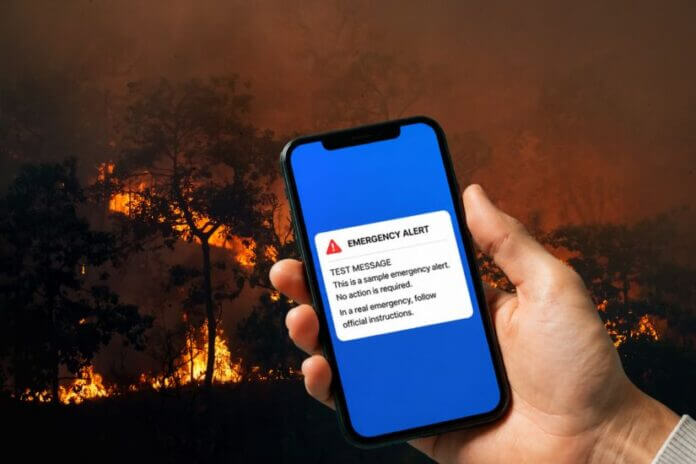
Next Monday, millions of people in Australia will feel their phones buzz with a message and hear a loud, siren-like warning.
It’s a preview of how the country plans to warn its population when the next bushfire, flood or cyclone comes down. The system is AusAlert, Australia’s most significant overhaul of disaster warning infrastructure in a generation.
AusAlert uses “cell broadcast” technology, sending a signal from the phone tower itself to every compatible device nearby, without needing a phone number or app. This approach is already in place in New Zealand, the United States, United Kingdom, Japan, and more than 30 other countries.
AusAlert does need mobile reception, but it doesn’t get clogged by network congestion like text messages (SMS), and can reach anyone passing through a danger zone. Community testing wrapped up in June 2026, with a national test on July 27 around 2pm AEST. The system will be fully operational from October.
It’s a significant improvement to how Australia sends emergency warnings, but the question isn’t just “does it work?”. It’s also “what do I do next?” and “who does it work for, and who does it leave behind?”
Not a ‘one size fits all’
More than one in five Australians speak a language other than English at home. People with disability are up to four times more likely to die in a disaster than those without, and this is exactly where most warning systems start to fail.
Warning systems are usually built on a one-size-fits-all assumption – this is what we learned after reviewing 70 disaster apps, 48,000 user reviews, and discussions with disabled communities and emergency agencies.
Most warning systems are built in the majority language (such as English for Australia), leaving culturally and linguistically diverse communities at a loss.
Age is another barrier. In one of our recent studies, older participants struggled to navigate back to the home page after following an external link.
Vision issues add another layer: small text, colour-coded warnings and live maps can all be inaccessible depending on someone’s visual impairment.
Australia adds a structural issue on top of these: there’s no single national digital platform (website or app), with each of the eight states and territories running its own warning system with their own digital platforms.
AusAlert, but make it adaptable
Our research points to one answer: a single national platform that adapts to each person’s combination of needs – language, literacy, vision.
A broadcast alert such as AusAlert is a great place to start. However, instead of being a generic message for everyone, such an alert should guide people to a single platform where they can set preferences in a few clicks, and receive warnings and next-step advice tailored to those preferences and needs.
This isn’t just our view. The global Early Warnings for All initiative, spearheaded by the World Meteorological Organisation and UN Office for Disaster Risk Reduction, emphasises that inclusive warning systems are every country’s responsibility by 2027.
Does AusAlert measure up to this? On delivery, yes. The cell broadcast fixes network congestion that historically affected SMS alerts.
The government has also produced tailored awareness materials for eight different groups, including non-English speakers, explaining what AusAlert is and how it’s expected to behave. But this is only awareness material. It doesn’t say what to do when disaster strikes.
Where to next?
A sample AusAlert reads:
An Emergency Warning message has been issued for [area/disaster]. Leave now if you receive this message. Visit nema.gov.au for more information.
But the National Emergency Management Agency (NEMA) website functions more like a directory; its state pages redirect to state and territory emergency websites.
That’s at least three jumps between the alert landing on your phone and finding out what to do next: first the alert, then to NEMA, and then to a local state website, depending on where you happen to be located.
If a real disaster is underway, that’s a lot of steps – especially if you have access difficulties to begin with. And state-based websites are not yet up to scratch, as we know from our research group’s work on the inclusivity of Australian warning systems.
For now, the best thing you can do is check your state or territory emergency preparedness website before you need it, and build an emergency plan tailored to your needs. And the July 27 national test is a real opportunity for the public to give feedback while the system is still adjustable.
Being warned and being ready to act are different things. Australia has built an excellent version of the first: AusAlert can wake up every phone in the country almost instantly.
But it can’t yet tell every person – inclusive of their access needs – what to do once they’re awake. That’s the gap that matters now. A warning system that ends at “leave now” is only the beginning.
This article was first published in The Conversation and is authored by , Lecturer, Software Engineering, at Deakin University.
Read more: Burning Questions: Vijay of UWS studies forest fires across two worlds