

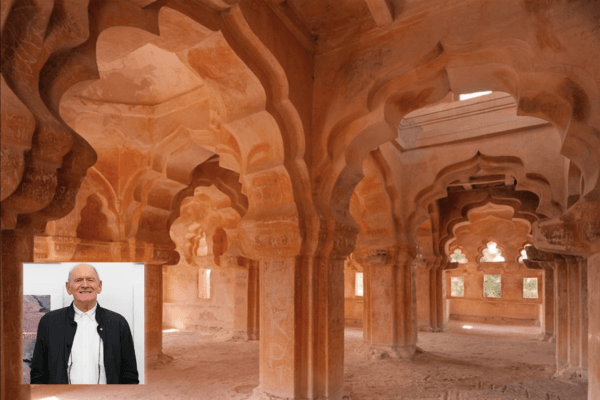
When three Melbourne creatives – two photographers and a painter – travelled to Hampi, India, earlier this year, they could scarcely have imagined the artistic collaboration that would follow. Looking at the photographs by John Gollings and Charlotte Schaller alongside Mark Schaller’s watercolour paintings, currently exhibited at The Lennox, it is hard to believe the works were not conceived together from the outset. Gollings v Schaller Hampi
Each piece is a visual travel journal in its own right, chronicling a different encounter with the UNESCO World Heritage Site. Together, the three complementary artistic voices paint richly textured portraits of Hampi.
Decades of dedication: John Gollings
On display are more than 20 of John Gollings’ photographs -both black-and-white and colour – selected from a vast body of work spanning four decades. They capture the shifting interplay of light and shadow across Hampi’s boulder-strewn landscape, rugged granite hills, soaring temple gopurams, intricate sculptures, stepwells and the evocative ruins of the former Vijayanagara capital.
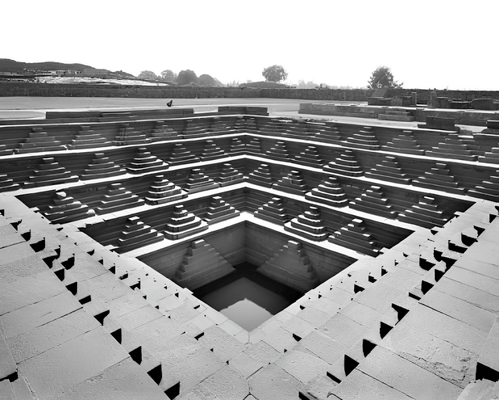
The precision and artistry of Gollings’ images are the result of a relationship with Hampi that stretches back more than 40 years. “I first heard of Hampi from veteran architectural historian Dr George Michell,” said Gollings, one of Australia’s best-known architectural photographers, whose work spans the Asia-Pacific region. “I’ve been visiting the city every January since the 1980s to photograph and document it. It’s home, and my tour guide now is fifth generation.”
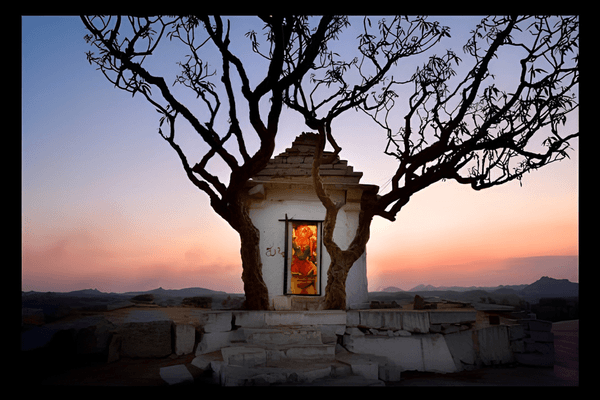
That enduring connection has also found a permanent home in India. The Kaladham Museum in Hampi houses Gollings’ extensive archive documenting the site. “My work was featured at Melbourne’s Immigration Museum in 2008 as an exhibition entitled PLACE-HAMPI – Inhabiting the Cultural Imagery. The exhibition was later acquired by Jindal Steel Works for the Kaladham Museum,” he said.
Love at first sight: Mark and Charlotte Schaller
For Mark and Charlotte Schaller, the journey marked their first visit to India. Travelling through Hampi under John Gollings’ guidance offered an immersion into the site’s history, architecture, and living traditions.
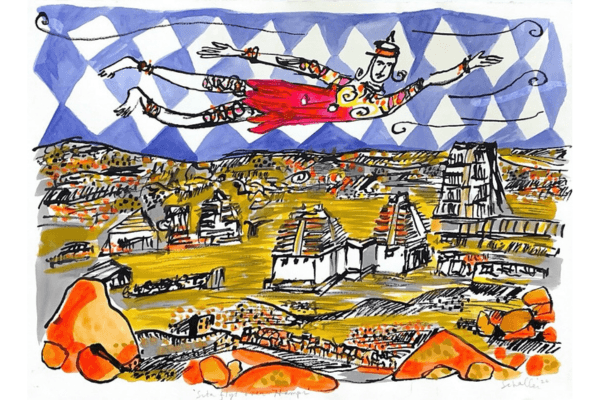
“It’s an incredibly joyful place to be,” said Mark Schaller, whose distinctive watercolours are celebrated for their fluid line work.
“I was captivated by the enchanting musical pillars, the Indo-Islamic monuments, the animated carvings and, most of all, the Elephant Stables.”
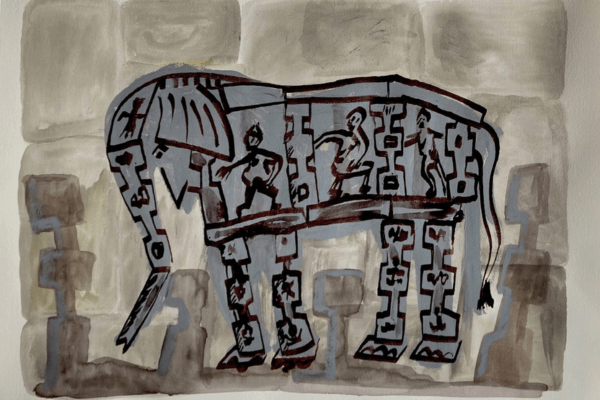
His long-standing fascination with elephants naturally found its way into the series. One painting depicts an elephant carrying stone pillars with its trunk, while a mahout rides atop; in another, the animal’s legs transform into the columns of Hampi’s pillared halls. “My hypothesis is that these animals would have done much of the heavy lifting during the construction of the empire,” he said.
Gollings recalled watching the elephant at the Virupaksha Temple grow from a calf into one of the site’s most recognisable living symbols.
Mark Schaller’s series of en plein air watercolours embraces a free-flowing approach to form and colour. Bold, expressive brushstrokes imbue Hampi with an almost dreamlike quality, offering an emotional response to the landscape rather than a literal record. In contrast, John Gollings’ photographs are grounded in architectural precision, documenting the site’s monuments with the clarity and discipline of a visual historian.
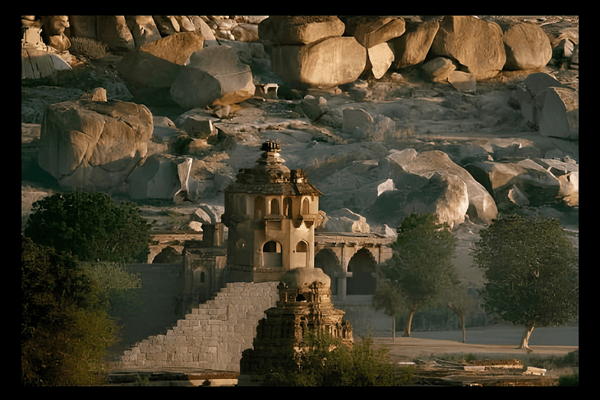
The dialogue between the two artists is especially striking when their interpretations of the same landmarks are displayed side by side. The Zenana Enclosure watchtower, the stone chariot of the Vitthala Temple, the Lakshmi Narasimha monolith, and the intricate reliefs of the 15th-century Hazara Rama Temple all appear in both collections.
A living landscape: Charlotte Schaller
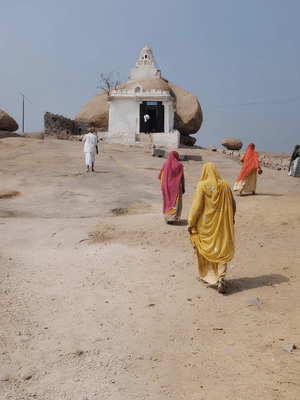
Charlotte Schaller’s photography offers yet another perspective. Rather than focusing solely on the monuments, her lens turns to the people who inhabit them today. Her images capture the quiet dialogue between past and present, as pilgrims, tourists and locals – some steeped in tradition, others unmistakably contemporary – move through the ancient ruins, reminding viewers that Hampi is not merely a relic of history but a living cultural landscape.
The enduring mystery of Hampi
The work of the three artists is a testament to the enduring power of a civilisation whose legacy continues to inspire.
For Gollings, however, Hampi’s allure lies partly in what remains undiscovered. “Many excavations and some restorations are ongoing. While that’s encouraging, the closer you get to reconstructing the lost city, the more it risks losing its mystery,” he reflected. He hopes to continue taking students and heritage enthusiasts to the site, encouraging them to experience its magic firsthand.
View this post on Instagram
Schaller agrees that Hampi rewards curiosity. “There’s a joy in discovering the history you’ve been told about. People are becoming more aware of its significance, and the potential for archaeological tourism is enormous,” he said. Gollings v Schaller Hampi
Perhaps exhibitions like this remind us that it sometimes takes an outsider’s eye to help us see the extraordinary value of our shared heritage – and the importance of preserving it for generations to come.
Gollings v Schaller: Photographs and Paintings from Hampi is on display at The Lennox, Richmond, until 22 July 2026.
READ MORE: When Gods Walk the Gallery