


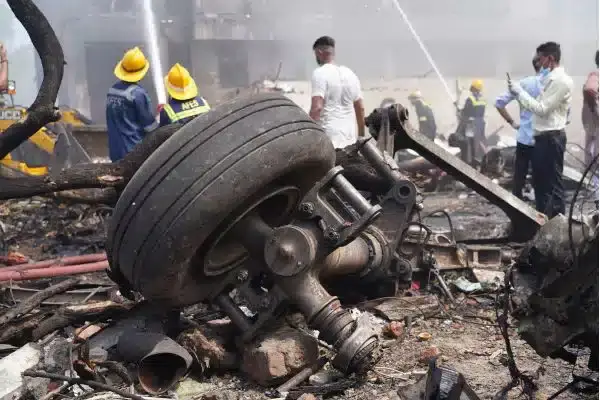

On June 12, 2025, Air India Flight AI 171, a Boeing 787‑8 Dreamliner, crashed shortly after takeoff from Ahmedabad, killing 260. The Aircraft Accident Investigation Bureau’s (AAIB) preliminary findings revealed that both engine fuel‑control switches moved from “RUN” to “CUTOFF” seconds after liftoff. Amid heightened scrutiny, questions now turn not only to pilot action but also to Boeing’s long‑standing safety issues and software vulnerabilities.
-
Fuel Cutoff and Cockpit Confusion
The cockpit voice recorder captured a chilling exchange:
“…why did you cut off the fuel?”
“…I didn’t.”
First Officer Clive Kunder, who was at the controls, questioned Captain Sumeet Sabharwal, who replied, “I didn’t.” If Sabharwal had deactivated the switches, the cause might have been resolved. Yet scepticism remains – would a pilot consciously flipping such critical switches (within seconds) then also deny it so swiftly? Or was there a mechanical or electronic fault?

-
Boeing’s Troubled Legacy
Air India’s findings appear to lean towards pilot error. But Boeing’s record complicates the narrative:
- Over 26 crashes since 2000 have resulted in more than 100 fatalities each, such as:
- China Airlines Flight 611 (2002),
- Lion Air Flight 610 (2018),
- Ethiopian Airlines Flight 302 (2019)
- Boeing has accumulated 32 whistleblower complaints, in contrast to Airbus (two), and Pratt & Whitney, Rolls Royce, GE (all under four). Two Boeing whistleblowers died under murky circumstances.
-
Past Cases: System Faults Masked as Pilot Error
Boeing has repeatedly blamed pilots, only to later admit system faults:
- 737 MAX MCAS crashes (2018–2019)
Initially, the Lion Air and Ethiopian Airlines crashes were attributed to pilot error. Subsequent investigations revealed the Maneuvering Characteristics Augmentation System (MCAS) consistently pushed the nose down due to a faulty angle-of-attack sensor – forcing manual override effort beyond expectations.

- Jeju Air 737‑800 (Dec 2024)
South Korea’s Jeju Air Boeing 737 suffered dual engine birdstrikes; investigators first assigned fault to pilot error – shutting down the operational engine. Pilots and families demanded further scrutiny, citing possible display or automatic system malfunctions. No mechanical fault was confirmed yet
- Sriwijaya Air Flight 182 (Jan 2021)
Pilots were blamed for mishandling a faulty autothrottle system on a Boeing 737‑500, causing thrust asymmetry. Investigation later confirmed that the design flaw – specifically a Cruise Thrust Split Monitor issue – led to erroneous throttle response
- Alaska Flight 1282 (Jan 2024)
A Boeing 737 MAX 9 lost a door plug midflight. Initially, pilot error was implied, but NTSB later identified missing bolts and a manufacturing oversight at Boeing’s factory.
- SilkAir & United Rudder Hard‑over (1997–2000)
These crashes were originally attributed to deliberate pilot action. Discoveries of rudder servo malfunctions later shifted blame toward faulty Boeing design.
-
Similarity to AI 171 Case
In AI 171, the fuel‑cutoff switches are mechanically secured to prevent accidental activation. Notably, an FAA advisory in 2018 had warned of potential issues with these systems – though Boeing dismissed them as safe. It would be difficult (and unlikely) for any pilot to turn them off within seconds. The quick denial of responsibility by Sabharwal echoes earlier cases where pilots were blamed while root causes remained undiscovered.
Aviatio attorney and former Department of Transportation Inspector General Mary Schiavo has raised concerns about software faults in Boeing’s 787, potentially mirroring earlier autopilot/autothrottle failures

-
Pilot Profiles and Airline Response
Captain Sabharwal and First Officer Kunder were both experienced professionals, with no prior major incidents. Sabharwal, while having dealt with depression, was medically certified to be fit. Air India confirmed the aircraft was up to date on maintenance, and inspections of 787 and 737 fuel‑switch locks returned no faults.
Yet the sequence – first blame on pilots, then Boeing system revelations – is a familiar pattern.
-
Ongoing Investigation: Pilots or Systems?
The AAIB, backed by Indian, US, and UK authorities, is rigorously examining:
- Pilot action – intentional or inadvertent toggle of cut‑off switches
- Software/autopilot malfunction – undetected systems engaging the switches
- Hardware or assembly defect – echoing Boeing’s past oversights
As in MCAS and autothrottle cases, QAR/black‑box data from AI 171 may reveal anomalies beyond pilot control.

Conclusion
Final question: if Boeing were a Chinese manufacturer, would regulators proceed so quickly to pigeonhole blame on pilots? Critics argue that similar willingness to accept systemic failure as plausible explanations remains lacking. The Boeing‑case patterns highlight an urgent need for transparency: regulatory frameworks must address design, software, and human factors in parallel – not sequentially.
Air India’s preliminary report on AI 171 attributes the disaster to fuel‑switch activation – an act that may signal catastrophic pilot error. Yet Boeing’s checkered record of hiding system faults behind initial pilot blame cannot be ignored. From MCAS to autothrottle failures, door‑plug oversights, and rudder defects, multiple incidents reversed course on early pilot culpability.
AI 171 now stands at this inflection: is this another case of pilot error or yet another system‑driven catastrophe? Only a full, open investigation – encompassing hardware, software, human behavior, and organisation – can ensure accountability and safety.
Read more: Racism rears its head after Air India crash “We grieve, they troll”