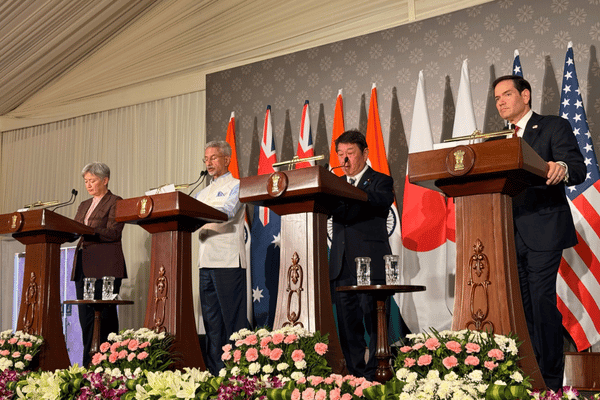

New Delhi has had a busy fortnight in diplomacy. Just two weeks after India hosted the BRICS Foreign Ministers’ Meeting as the 2026 chair – where member and observer states came together to discuss global trade and supply chain resilience on the backdrop of US-Iran tensions – India hosted Quad Foreign Ministers’ Meeting in New Delhi. Foreign Minister Jaishankar, Australia’s Penny Wong, Japan’s Toshimitsu Motegi and US Secretary of State Marco Rubio gathered in what Rubio called the “linchpin” of US’s global strategy. The meeting produced four concrete outcomes: a maritime surveillance initiative expanding to the Indian Ocean, a port infrastructure pilot in Fiji, critical minerals framework covering mining to refining, and an energy security initiative responding to the fuel crisis.
The Quad grew from a disaster response coalition formed after the 2004 Indian Ocean Tsunami. After years of dormancy, leaders met at the ASEAN Summit in 2017, the first Foreign Ministers’ Meeting followed in 2019, and the first Leaders’ Summit came in 2021, kickstarted by COVID-19 and India-China border tensions.
Ministerial by design
Why does it matter that India’s hosting Quad if its institutionalism is no longer reliable? The lack of a Leaders’ Summit since 2024 alongside emboldened tensions over US tariffs on Quad members has led people to call Quad’s time of death. However, since its establishment in 2007, the grouping has survived leadership changes across all four members. But with no Summit in the cards, its significance is being questioned – and rightfully so. With President Trump’s re-election came a highly volatile world order, and his actions have caused concern regarding the centrality of the Quad grouping. However, Rubio’s first act as Secretary of State was to attend a meeting with Quad members’ foreign ministers on the day of his inauguration. After that, two more meetings followed in just sixteen months.
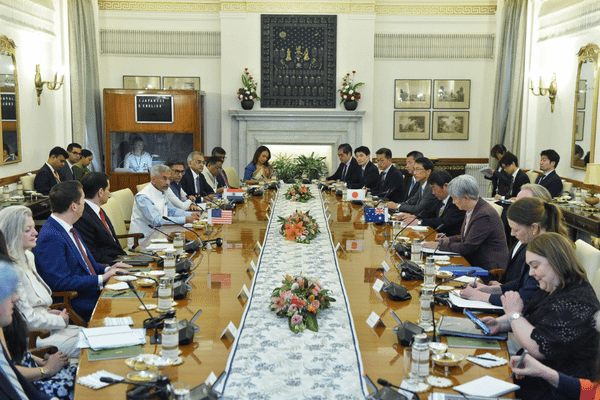
Hosting both meetings gave India agenda-setting power; it was used deliberately. It secured BRICS endorsement – including China’s – condemning the Pahalgam attack and steered the Quad’s maritime expansion into the Indian Ocean. Whether this constitutes a new foreign policy direction or skilled opportunism, is yet to be known.
Rubio, in his closing remarks at Quad, framed the collective goal plainly: to turn Quad from “a place where we get together every now and then and discuss problems” into “a forum of action towards collective interests.”
Action items
Maritime security was the headline. The newly launched Indo-Pacific Maritime Surveillance Collaboration (IPMSC) initiative will coordinate the four nations’ surveillance capabilities and expand maritime domain awareness in the Indian Ocean, providing almost real-time satellite tracking data to partner countries to combat illegal fishing, trafficking and support disaster response. India committed to hosting the next Quad Coast Guard Cooperation exercises later this year.
The Quad Ports of the Future partnership launched its first pilot in Fiji, collaborating in infrastructure building. Wong, who visited Fiji weeks earlier, called it the grouping’s “strongest ever commitment to the Pacific.” Fiji’s geographical significance in the South Pacific alongside its long-standing support for Beijing’s Belt and Road Initiative (BRI) and Global Development Index (GDI) has situated Fiji as an essential Pacific Island partner for the states.
The Critical Minerals Framework covering mining, process and refining provide an opportunity for member states to coordinate investment with the goal of strengthening critical minerals supply chains – producing an opportunity for India to leverage its domestic minerals ambitions into Quad’s collective interests. Whether India’s infrastructure is ready to meet that ambition is a separate question.
The Iranian closure of the Strait of Hormuz has created acute economic stress across the region. The Indo-Pacific Energy Security Initiative with the US Department of Energy holding a fuel security forum for Quad member states later this year is a direct response to the global fuel crisis.
The bet
India chaired a BRICS document condemning unilateral tariffs as damaging to global trade. Days later, it hosted the Quad, welcoming the representative of the government that imposed them. Hosting two meetings and signing two documents isn’t a foreign policy architecture, just a fortnight in diplomacy. The Quad’s maritime expansion into the Indian Ocean and BRICS’s submarine cable task force are beginning to overlap geographically, and the two will eventually require careful navigating.