

Cricket is India’s exclusive insignia into a world of money, love of the sport, and sadly, corruption
 With the cricket season well under way in India and the world, it is perhaps apt that we look at a book that looks at cricket. Written by James Astill, The Great Tamasha: Cricket, Corruption and the Rise of Modern India is about much more than the sport itself, as it is a metaphor for modern India, and its rise over the past two decades is told through the prism of the glitzy, lucrative and even sleazy Twenty20 cricket tournament, the Indian Premier League (IPL).
Contemporary cricket and modern India are synchronous with the opening up of the nation to satellite television: for two months of the year, IPL is watched more than anything else on Indian TV. The emergence of the IPL in many ways is also a harbinger of the rise of India in the global economy. When Lalit Modi, a businessman with a criminal record and history of failed business ventures, came up with the idea of creating a Twenty20 cricket league in India in 2008, few took him seriously. International Test cricket was still being controlled from London, and India was not a high achiever in the game. Modi put together a highly commercial model, melding three powerful forces in India, viz politics, Bollywood and business, throwing in come scantily-clad American cheerleader types into the mix to provide the masala, and he succeeded in creating the most successful domestic cricket competition.
The success of the IPL is a remarkable feat in itself; however, what India achieved as a consequence of that success is truly ground-breaking, for that success catapulted the country to the position of an ‘economic superpower of cricket, providing 80% of world cricket’s income’. It was a game changer (pardon the pun) in a way that was different and significant; the paradigm shift that Indian supremacy engendered in the world of cricket puts to shade in many ways China’s hosting of the Beijing Olympics in 2008 or Brazil’s dominance of football. The Olympics, like all sports played in the world, remain firmly under Western control; Brazil’s players may dominate football, but the nation does not control it economically. India’s economic rise in the world of cricket has changed the way both, the country and cricket are perceived. Take Australia, for instance. While Australian media and the cricket fraternity may be focused on the forthcoming Ashes series, as the cricket commentator Mihir Bose observed astutely, cricket administrators in both this country and England know “they will have to kowtow to India to generate the television income necessary to keep their cricket going”. This ‘rupee takeover’ of a Western sport is what is unique and sets cricket apart from all others.
But the takeover cannot hide India’s chronic problems of corruption, cronyism in business and politics, to name just a few. The way the powerful, newly rich BCCI administrators, the Srinivasans and the Shuklas, have ruthlessly pursued their interests on the world stage, is perhaps the way the leaders of a newly powerful and rich India may do. Astill writes, “India is becoming powerful… [however] it will be a long time before it forgets how it felt to be weak”. Set against this, the most touching stories in the book are of men in dirt poor parts of rural India, in small towns and slums, who coach aspiring stars with such dedication and selflessness. What it tells us is this: what is true of cricket is true for Indian democracy as well: it is the selfless dedication, sacrifice and integrity of a few, a handful, that keeps the game and Indian democracy alive at the grassroots level. Anyone who is interested in cricket and/or India will enjoy this book immensely, and forgive the author a few rather glaring mistakes.
James Astill was the Economist’s correspondent in India between 2007 and 2010.
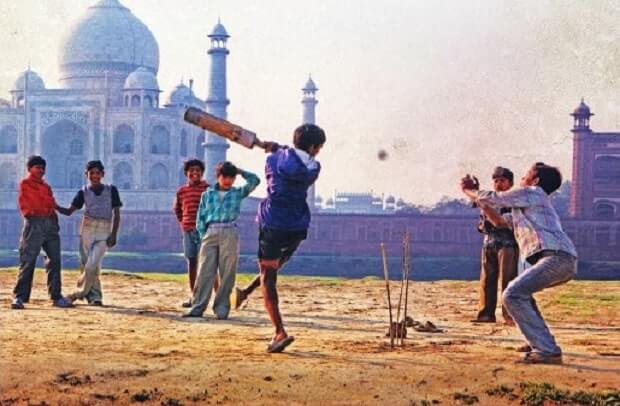
Sporting strength of a nation
Kennedy and me
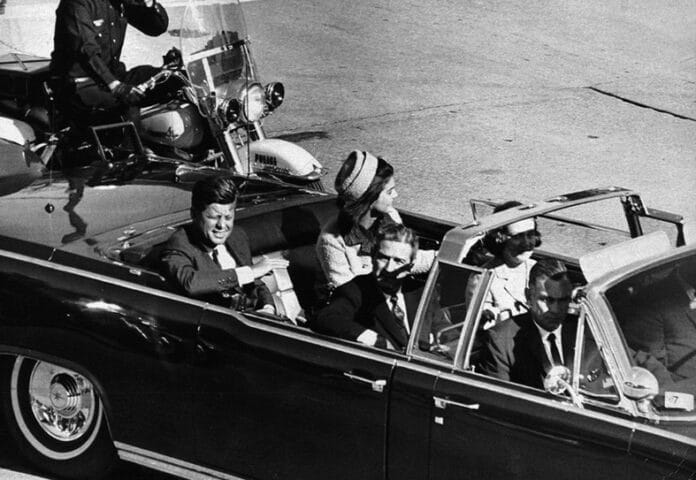
John F Kennedy’s assassination on 22 Nov 1963, changed the course of LP AYER’s life

President Kennedy’s assassination propelled my migration journey to Australia. Sounds incredible?
Major tragedies often create a ripple effect, affecting people living far removed from the scene and not even remotely connected with the event, like 9/11 or the tsunami. Kennedy’s death was one such event, in my case.
I was a journalist with the Financial Express, the first financial newspaper started in India in 1960 as part of the Indian Express group. After gaining my Honours degree in Economics, I joined this paper from day one of its planning stage.
In that set-up, the News Desk was responsible for editing news items, designing page layout and producing the paper. It worked in two shifts, with a chief sub-editor in charge for each shift. The night shift Chief sub-editor was the sole arbiter of what stories would go on the front and other overflow pages, as well as their layout.
Promotion came to me reasonably quick. Just a couple of months before that fateful Friday night in 1963, I was made Chief sub-editor. And that week in November it was my turn as the night shift in-charge chief sub-editor.
Being a financial daily with a small print-run, it was printed first around midnight, before the Group’s other two papers, the Indian Express and Lok Satta in Marathi, with a quarter of a million print run each, all on the same rotary machine.
Every night after checking the front page proof, I would give the go-head to the printing room. While waiting to see the first printed copy, the sub-editors would have a card game, then sleep on our office desks as there was no public transport after midnight, and none of us could afford a vehicle. We used to be woken up by the cleaners early next morning to return home.
Friday, November 22 was like any other day. Things went smoothly with good local stories breaking early, and the pages were ready on time for printing. We sat down to our card game a couple of metres from the teleprinter (a typewriter-like device in a glass-topped cabinet) that used to send out stories from the news agency. Usually the agency would give a couple of rings on the machine to indicate it was closing for the night and no more stories were to come. If some important news was about to break, it would sound longer and louder. But that was rare.
As the cards were about to be dealt, there was a loud ring a few minutes past midnight. The line on the teleprinter read: ‘Flash …..Flash…..Flash’. It was a regulation line to warn of a major story coming.
‘PRESIDENT KENNEDY SHOT’.
I nearly froze in my seat, only for a few seconds though. I asked one of the sub-editors to type out a few paragraphs on Kennedy, another to get a grim looking picture of him from the paper’s library, and a third staff to keep watching the teleprinter. I rang the printing room foreman to stop the press and rushed down to the composing room to retrieve the front page stone (a metal frame encasing news items cast in metal). Those were the days when each line was set in molten metal on a linotype machine; even changing a few lines would mean major layout changes to the page. There were no computers or cut-and-paste magic then.
As soon as the new paragraphs were composed, I placed the story and the picture on top of the page, removing parts of another story. All this took thirty minutes. The printing foreman was getting anxious as the papers would miss the delivery vehicles. I was equally nervous. The page was ready to go.
‘KENNEDY DECLARED DEAD’, the staff watching the teleprinter rang me at the composing room.
A quick re-editing, re-setting, a new bold headline and layout change. After another 15 minutes the rotary printer was spewing thousands of copies with the grim story. I returned to my desk. As a journalist I felt a sense of ‘pride’ in handling such a challenge in only my third month as a probationary Chief sub-editor. Kennedy was then a hero to most Indians, including me. I broke down and wept – a thing journalists are not expected to do in their line of duty.
Next morning I found out that only the Express Group of papers had covered the story and other ‘rival’ groups missed it. It was a sense of victory in that moment of great sadness.
I wrote an article on how I handled the story for the Indian Press Institute’s quarterly magazine Vidura. I submitted this as my entry and was selected by the Institute for a scholarship program in journalism at Cardiff in the UK, run by the Thompson Foundation, founded by Lord Thompson owner of The Times in London before Rupert Murdoch.
On that course there were twelve journalists from nine different countries, including the editor of a major regional newspaper in South Australia, Mr. Don Winton of Whyalla News. He and I became good friends. After the fourteen-week course we returned to our respective posts. I got a promotion and later moved to Public Relations at Tata Steel, thanks to my overseas stint. It is in this steel city that I met my future wife.
Don and I corresponded regularly. I took him to a few interesting places during his first visit to India. Our friendship grew and so did my interest in Australia, and at his urging I decided to migrate here. His support added weight to my application. I arrived with my wife in1972 and Don was there at Adelaide airport to greet us. Since then, Don visited India a dozen times until his death a few years ago. He was our guest during many a Christmas at our Adelaide home. In the 40-odd years since, Australia and our family of four have treated each other with great love and affection.
I often wonder if, were I were not present at that particular time when news came through of Kennedy’s assassination, would I have got that scholarship, met Don and come to Australia? Should I cry at the tragedy or feel happy at the turning point in my life, or simply assign that to my karma?
PS: In the years gone by, I learnt that out of those dozen journalists on that Cardiff course, four had met with tragic ends – two from Uganda became the victims of dictator Idi Amin; one handsome leftist Brazilian joined a guerrilla force somewhere in Africa and was killed in action; one from Egypt, the Deputy Editor of Al Ahram, the mouthpiece of President Nasser, died in a car accident. Don Winton too, was hit by a car but lived with broken leg, and died a couple of years later.
Fun-filled fundraiser for WGD
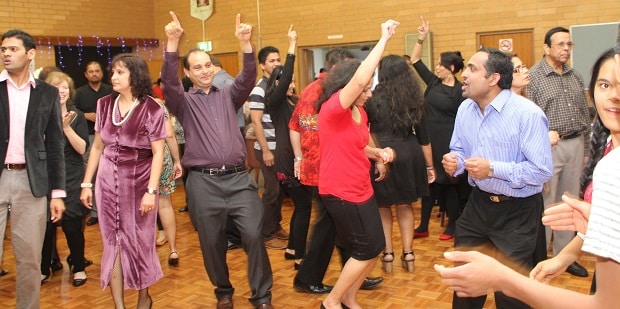
Youngest Goan and family present Beth-Beth-Lehem Association with profits from celebrations

The third World Goa Day celebrations in Adelaide, an annual event organised by Goans, continued to make great waves, drawing a large gathering who were treated to some great family entertainment. It was a lively community fundraiser event, and was an instant hit with participants of all ages who enjoyed Goan music and food until midnight. The celebration was a party not just for Goan migrants, but also for their Indian and Australian friends who were treated to some excellent Goan hospitality. The event was held to raise funds for The Beth-Beth-Lehem Association, a not for profit organisation situated in Karwar, a rural area just near Goa. This residence cares for dozens of homeless and mentally ill men rescued from the streets of the big cities.
The Chief Guest for the evening was Rev Fr Salvador Gomes Coutinho, Superior General of Beth-Beth-Lehem who thanked the gathering for their generosity and care shown to the Association. Fr Coutinho offered prayers and blessings to all the people of Australia and thanked the Goan community in South Australia and others who undertook this project to raise funds for the association. He said that the funds would go a long way in providing basic amenities to residents of Beth-Beth-Lehem. Fr Coutinho informed the gathering that money collected during the previous two years of World Goa Day celebrations in Adelaide went towards the construction of the hospital project. City of Charles Sturt Councillor from Findon ward, Chev Joe Ienco – OSJ, CMC, JP was a special invitee who appreciated the work carried out by the organisers to support a genuine cause that has affected so many people. During the event, the youngest Goan present, one month old baby Bernice Silveira, along with her parents Serling and Janice, and sister Swizel, presented a purse containing the handsome profits from the show to Rev Fr Coutinho. A kaleidoscopic toon titled ‘Good Old Goa’ by renowned Indian cartoonist Alexyz Fernandes was also auctioned, in addition to a bottle of the ever-popular Goan cashew feni. The toon was picked up by well-known Adelaide-based doctor Agnelo DeSouza and his wife Mathilda.The feni went to Daniel Colaco.
The capacity audience was treated to a sumptuous Goan spread which included the famous pork vindaloo and other delicacies. Leonard Carter, Shelvin Roswan, Ashton D’sa, Allan Pinto, Ghyan Pinto, Peter Lobo and Tony Hendricks enthusiastically relived the Goan musical past with their band The Music Revival, formed just for the evening. Old Konkani songs so popular in Goa, brought back nostalgic memories until DJ Nick Fernandes brought the crowd back to the present with top dance tunes to end the night on a high. WGD is intended as a day for Goans worldwide to focus on and take pride in their identity, culture, language, traditions, music and cuisine.
The first World Goa Day was held on August 20, 2000 in the UK. Its objective was to unite Goans all over the world in a day of common celebration. Today WGD is celebrated by over 40 organisations across the globe including Goa, Canada (Toronto, Vancouver, Quebec, Montreal, Calgary), Australia (Adelaide, Melbourne, Brisbane, New South Wales), New Zealand, United States (New York, LA, New Jersey, Houston, California), Kenya, Mombasa, Tanzania, Mozambique, Dar es Salaam, Zanzibar, Tanga, the Middle East, Portugal, Spain, Pakistan and Germany.

Disappointing start to PBD in Sydney
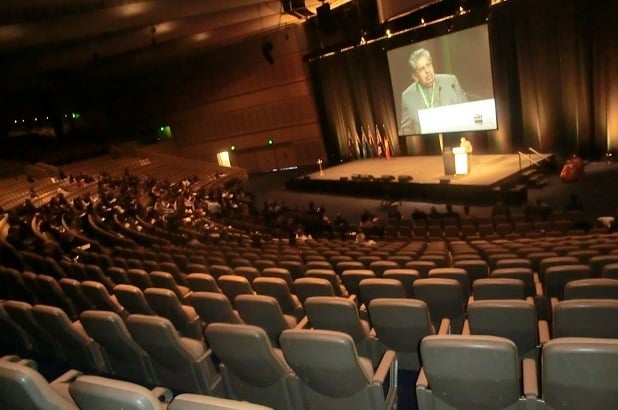

PAWAN LUTHRA reports on the first day of the Regional Pravasi Bharatiya Diwas convention held at Sydney
With more than 800,000 Indian diaspora in Australia, New Zealand and the Pacific Island nations, the Indian government’s regional Pravasi Bharatiya Diwas (PBD) has been able to attract no more than a mere 350 delegates. The event was inaugurated on Nov 11 at the Sydney Convention Centre.
With over 140 speakers expected to take part in various panel discussions over the three days it is being held, it was disappointing to note that the organisers could not promote the positive message of connecting the diaspora.
Attendees at the opening day of PBD Sydney were disappointed and appalled by the lack of planning and the poor attendance for this much anticipated event.
The common grievances bandied about at the event were the lack of input sought by the Indian High Commissioner in Australia from the local diaspora on issues of interest to them in their lives as pravasi bharatiyas (overseas Indians).
Instead the program seems to have been hijacked by business interests which were more focused on business issues, rather than people-to-people concerns.
“This was meant to be about the regular Indian in overseas countries, not about trade and business which seem to be the main focus of these three days”, one attendee commented.
The other point of contention was the decision to run the event on weekdays, rather than over a weekend. This meant that many could not attend due to work commitments.
Participants who had attended previous PBDs were also not impressed with the delegate admission fee of $425. This is almost double that of previous regional PBDs, Manish Gupta, Managing Editor, PIO TV, a delegate from the US noted. Break-out sessions were also poorly attended with an average of between 20-50 people in each session, almost a quarter of them being speakers.
Choice closer to home
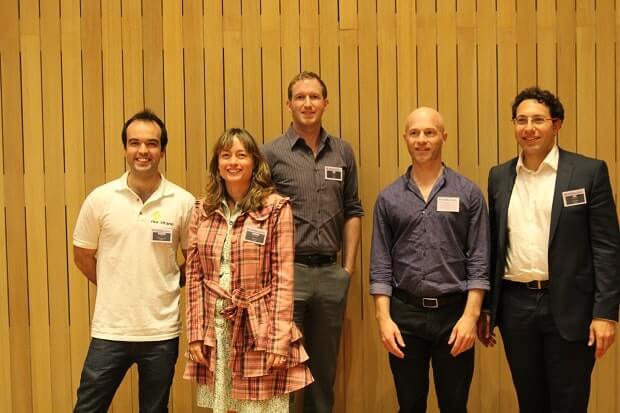
TIE Conference encourages Australian entrepreneurs to focus on Asia

Technology entrepreneurship is red hot today. Recent wild success stories of new ventures in websites and mobile apps especially in SoLoMo (made from the first two letters of social media, local and mobile) has made ‘start-up’ a desirable term. This is equally the case in Silicon Valley, Australia and India.
And why not? The previous five years has seen a 24 year old hit pay dirt with a venture worth billions of dollars. We are talking about Mark Zuckerberg, the founder of Facebook.
A company that was less than one year old and with no revenue was sold for a billion dollars and spare change. This was Instagram, which allows its users to share photos via their mobile.
And Redbus.in, a Bangalore based start-up that helps customers book their bus travel was recently sold for $100 million.
Suddenly, entrepreneurship and start-ups are no longer taboo in the conservative Australian job market, which has traditionally rewarded a consistent career ladder.
There are start-up co-working spaces galore. Fishburners in Ultimo that hosts more than 100 start-ups, is one of the leading ones, but there are several more in Sydney, Melbourne and Brisbane. Lawyers and consultants are bending backwards to provide free services to entrepreneurs to get a piece of the action. And investment in start-up companies is picking up.
One long term, consistent player in this space is TIE Sydney. Originally founded as The Indus Entrepreneurs (TIE) by technology entrepreneurs of Indian origin in America’s Silicon Valley, TIE has now expanded to 57 locations, including Sydney and Melbourne.
TIE has now broadened its scope to being a network of entrepreneurs, mentors, investors and other players in the entrepreneurship ecosystem. It is now a mainstream network, no longer an Indian professional club, although one can still discern active participation by Indian business people.
TIE Sydney, located at http://sydney.tie.org is active in Sydney’s start-up environment since 2001. It organises free and paid meetings and sessions on starting up, scaling and exiting businesses, mentoring sessions and pitching competitions, but its central event is its annual conference, TIECON.
In TIECON 2013, the theme was Go Asia. More than 250 delegates were exposed to a diverse range of ideas and insights on opportunities in Asia and how to tap those opportunities for their start-up’s growth. A few of the highlights of the introductory panel sessions were
Dr. Jana Mathews describing the working of her 13 weeks accelerator that she runs in Adelaide. ANZ Innovyz selects start-up teams several times a year, puts them through an intense mentoring programme during which time they work on their product-market fit, customer validation, product development and scaling issues. The start-up team doesn’t pay anything for this service; rather, they are paid $20,000 during this period.
Alfred Lo manages Optus Innov8 Seed Programme, a corporate venture arm of Optus that invests in Australian technology ventures. He mentioned start-up momentum is building up in Australia and throughout Asia.
Julian Tol, who is an Australian based in Singapore described his experiences of building the company in Asia while raising capital locally in Australia.
Ahmed Haider, a Western Sydney-sider, UTS boy, is a co-founder of Zookal, an educational technology start-up that enables students to rent textbooks among other services. He recounted his experiences of raising capital in Silicon Valley. He went against the traditional wisdom of raising capital in the home market and mentioned that exceptions can be made.
After all, start-ups are created because their founders wanted to do something different and it’s acceptable to go against traditional wisdom.
The rest of the conference was divided into three areas of Asia where Australian start-ups can go to explore opportunities, India, China and South East Asia. Panelists in these sessions were entrepreneurs and executives who had experience of setting up or running businesses in these regions. A few highlights from the India related sessions were, Joshua Mackenzie, CEO of Development Beyond Learning emphasising that family is everything. He recommended to develop informal networks of personal and family networks in India.
Other tips:
- Make use of the Indian consulate in Sydney which provided a great service to one of the panellists.
- Almost all panellists realised the need for due diligence when assessing partners and their promises.
- Know your customer, whether it is the industry, individuals and the legal environment.
These panel sessions were followed by a pitching session in which start-up companies presented their business to the audience. One of the highlights was a Bangalore based start-up Lumos, that pitched via a video call. Lumos makes bags that have solar panels and helps the bag make its own electricity to charge phones and other devices.
Australia’s start-up eco-system is highly US and Silicon Valley focused. TIECON 2013 helped Australian entrepreneurs realise the nearer-home opportunities in China, India and South-east Asia.
Indian Link would like to thank TIE office bearers and volunteers for their assistance, particularly Dilip Rao, Manishi Dave and Ambika Malvia.
Mayura students live up to their name!
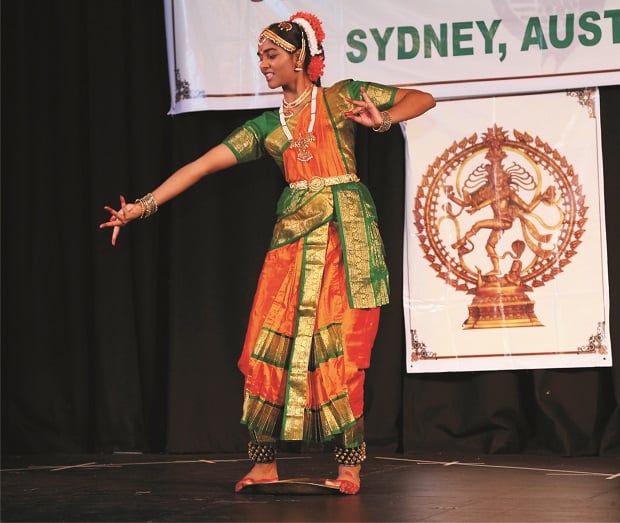
The guru-shishya parampara tradition is best displayed through excellence of performance

There are not enough words to describe the beautiful, elegant and enchanting traditional Kuchipudi dance performance by the students of Mayura Academy Sydney on their annual day performance held on October 19, at the Baha’i Centre in Silverwater. Guru Venkata Ramana has been a very dedicated and committed Kuchipudi guru and the performances of the students vouch his greatness, and the hard work and efforts he has made with them. Mayura Academy indeed follows the ancient tradition of Guru-Shishya parampara where the students who attend the classes are trained to preserve, nourish and promote the elegant Kuchipudi dance tradition.
The blissful evening started with lighting of the lamp and a short speech by none other than Sri U Ve Thirukoshtiyur Madhavan Swamy, a famous scholar of Sri Vaishnava philosophy, followed by the performances.
This program was a wonderful primer for even those who are unfamiliar with the art form of Kuchipudi, thanks to the helpful narration of each piece that clearly explained its context and history, and the use of basic steps, jathis to slokas, and items.
The first performance was Vinayaka Koutam performed in praise of Lord Vinayaka who wards off impediments and ensures success in human endeavours. And believe me, it was beautifully performed by young students, 9 and 10 years of age! The steps or adugulu were performed by students aged 5 years and up, and it was a feast for the eyes to watch such young children perform with grace and uniformity.
A dance sequence can never be complete without praising the god of dance, Lord Shiva. This was a performance by a mother-daughter team as Jayasree and Saakshi danced in praise of the Lord, seeking His blessings. The highlights of the performances were Tarangam and Dasavathara Sabdam. Tarangam is a unique item in the Kuchipudi repertoire taken from Sri Krishna Leela tarangini, written by Narayana Thirtha. Here Meghna showed her expertise by dancing on the rims of the brass plate to mridangam beats. There was complete silence in the auditorium as everyone was mesmerized by this captivating performance.
Last but not the least was the masterpiece, Dasavatharam. The dancers provided a visual delight by expressing the ten different avatarams of Lord Vishnu. Narasimha avataram performed by Vandana and Deepthi was breathtaking.
In the traditional Pavamana all the performers gathered in the stage to perform the mangalam. The students who participated in this event were Aditi, Dhatri, Lohita, Saakshi, Sriharshitha, Anannya, Divik, Maanasa, Samhita, Sriveda, Chaitanya, Gamya, Meghna, Shilpa, Sushma, Chaitra, Harshitha, Mythri, Sree Harsha, Swetha, Deepthi, Jayasree, Richa, Sree Lekha and Vandana.
All the participants were presented with a certificate and a memento by guest of honour, Dhayalan Moodley. Friends of JET Australia were commended for their diligence in organising the dinner where the proceeds would be donated to a 6-month-old boy undergoing treatment for eye cancer.
To quote from NatyaShastra: ‘Na Tath Gnaanam, Na Tath Shilpam, Na Saa Vidyaa, Na Saa Kalaa, Na Sow Yogo, Na Tath Karma, Natyesmin Yannadrushyathe’ (There is no wisdom or knowledge, no art, no craft, no device or action that is not found in Natya), and that is what the students of Mayura Academy under the guidance of their Guru Venkata Ramana, proved with their performance.
Anitha Venkataraman
Market reforms and education

Will the new reforms proposed by the Coalition make a perceptible difference to student performance?

In Britain there is a policy think tank called the Centre for the Market Reform of Education (CMRE). As can be guessed from this title, this independent body seeks to find market-based solutions to problems arising in education. The CMRE has been created in response to the British government and many other parts of the world, seeking to find improved ways to manage school and schooling, and to boost schooling outcomes. In Australia there has been much discussion recently about the Coalition’s education policy. The policy has been characterised as privatising public schools and debate has been heated.
In essence, the Coalition’s education policy seeks to give greater autonomy to public schools and to allow them a greater degree of independence, including in financial matters. Advocates who favour public schools have criticised the plan, while those who favour market-based reforms see them as sensible. However, there are several justifications for the shift to apply market-based reforms to mainstream public education. These are accountability, performance-based pay, localised control including parental input; improved capacity to employ and choice.
Accountability
There is a general feeling that teachers, as professionals, are not accountable enough. This stems from the following observations: most teachers talk to parents only once per year at parent-teacher night. Secondly, they have a closed-door approach to classrooms and rarely have any external party observe their teaching. Thirdly, if a student performs poorly, it can lead to teachers labelling their student as lazy. In this way a teacher can always deflect criticism or outsource responsibility.
While there has been a general raise in accountability over time, the push towards giving principals greater autonomy is on part to allow them to hold poor performing staff to account.
Performance-based pay
Related to accountability is the notion of rewarding high performing teachers with some form of flexible pay or performance-based pay. Of course, this is highly controversial amongst teaching unions. The problem with performance-based pay is how to measure performance. How can the impact of a teacher be quantified? This is particularly difficult to measure although there are sophisticated notions of ‘value adding’ that have been developed. Value adding is premised on a base line of ability within a cohort as measured by external national tests such as NAPLAN. Future performance is then mapped against this baseline, the implication being that performance in excess of the measure must be due to schooling and the efforts of teachers.
Localised control including parental input
Most parents would be familiar with parent bodies such as the P&C (Parents and Citizens) and P&F (Parents and Friends). Indeed, many parents would have had the experience that the most active parents on such bodies tended to find their children were elected into school leadership positions and won the most merit awards! One aspect of the privatisation plan espoused by the Abbot government includes a greater voice for community and parental input. The idea is that schools are within communities and reflective of communities. The community is a stakeholder in the school. Therefore, a greater place for representation of community interests in schools is intended to both, make the schools more locally accountable and integrated, as well as more closely reflective of local needs.
Improved capacity to employ
The Coalition plan is to increase the level of school autonomy. Note, this does not give a school total freedom, but rather relaxes some of the rules around, for example, employment. Included on the panel for the employment of staff would be a parent representative and/or a community representative.
The problem with current staffing arrangements are that often a centralised body will reassign a teacher to a school even when the school wants to appoint a person who has been acting in a relieving capacity or as a casual over an extended time. The external appointments can be very disruptive to students and also can demoralise staff who have been acting in a position and then miss out to someone else.
The capacity to employ and thus manage budgets better will give a principal greater flexibility to shape staff and if renewal is required upon retirement, the cheaper, younger staff with skills reflective of contemporary teaching methods can be taken on.
Choice
It is said that the move towards a quasi-privatisation of the nature detailed here will give parents greater choice. That is, as schools take on a more localised flavour and as autonomous principals apply their vision to their school with greater freedom and fewer constraints, the difference between schools will become more marked. The best schools will be clearly evident and underperforming schools could be subject to performance management of the type currently seen in private enterprise.
Will it work?
The market-based reforms being promoted by the government are similar to changes made in Britain, New Zealand, the USA, France, Germany, Canada and India. There is no doubt that the private market can adjust more quickly to changing demands and will act upon a need to be accountable than the present structures can. However, there is also no hard evidence that the changes make any tangible difference to student performance.
Fortitude through Facebook

One has the choice of letting the networking site discourage and destroy, or inspire and initiate

Antoine de Saint-Exupéry’s The Little Prince has always represented for me the need to find what you are passionate about and invest in that love and passion to make your life worth living. A year that was started by me with so much fervour and passion has dwindled to an apathetic state from which I needed respite. But now I seem to have gotten it from the unlikeliest of sources – Facebook. Generally, I dislike this social networking site and here’s why.
1. It’s killing privacy. There is no such thing as the public and private sphere anymore. At a global level the CIA use it to ‘do their thing’ (YouTube CIA and Facebook). At a local level, every ‘aunty’ and ‘uncle’ is now on Facebook and wants to be your friend. And at a personal level, we are all now at risk of oversharing and becoming the annoying people we like to whinge about.
2. It’s bad for the economy. When one person (Mark Zuckerberg) earns a record $2.3billion a year and more than half the world is dying of hunger, poverty, warfare or all three at once, it really makes you wonder at how your tacit involvement is helping this world go to ruin. It’s easy to dismiss your contribution as minute, but it is our collective minute contributions that are widening that gap between the rich and the poor, and creating a discrepancy in the division of wealth in society, a precursor to many of the issues plaguing society at large.
3. It’s a waste of time. A study found that more than a third of women check Facebook first thing in the morning. We check the site several times a day, in the middle of the night, even before we go to the bathroom in the mornings. What could possibly be happening that you are missing out on that is more important than your time to live your life yourself, rather than living vicariously through the Facebook status updates of others?
4. It causes depression. Facebook users are more and more lonely. Studies find that people are depressed by the ‘Facebook world’ of their friends which show that their world is unicorns and rainbows, and leads to the inevitable comparison with one’s own life. Those carefully filtered, poised and cropped pictures hide the rain that came before the rainbow, and the crap that the unicorn leaves behind. It creates a sense of rejection, despondency and fear in us that we would otherwise not experience, had we a more rounded insight into the lives of those we ‘befriend’. Facebook allows us to ‘befriend’ more than we would ever do in person, and the larger our circle of ‘friends’ becomes, the more at risk we are to falling off the proverbial Facebook cliff. We become like the lemming looking for the pot of gold in the form of that perfect Facebook status update to outdo all the ones in our newsfeed.
That’s is why I dislike Facebook. But recently I went onto the site and my newsfeed educated me. It inspired me. It made me shake off my cloak of apathy and put on the cloak I always wanted to wear – the one that will let me save the world. I don’t open Facebook to read news, I have my news apps for that, but almost every second post on my newsfeed today had me moving from the couch potato position in my brain and realising that the time to act is now! A recent study shows that 78% of Facebook users get news on the social network while they are there for other purposes, such as catching up with friends or sharing photos.
While Facebook has its shortcomings, it is a tool that can be used to great benefit, should I chose to do so. Beyond my choices of deactivating my Facebook account and living in ignorance of the great wealth of information out there, or immersing myself so wholly in living through the status updates of my friends, that my own life passes me by… but there is a third option in which I recognise the tool for its capabilities and use it only in a way that is useful to me. Facebook has now evolved from merely a stream of what my friends had for lunch and their outfits of the day, to a stream of updates on life, education, world events, politics, charity and education so that when I am on the site, I am inspired to shake off the apathy and make a change.
But how does reading articles linked on Facebook and ‘sharing’ them with friends catalyse change in the real world? One’s search for answers can be more important than the answers themselves. Go on that journey to find what you are passionate about and articulate it, pursue it, paint it into your reality and onto your Facebook page – so that one day we actualise our longing for the meaning of life by filling that hole in our hearts with love and contentment. Enjoy the journey, for sometimes it is far more telling than the answer waiting at the end.
Here’s a video showing what if would be like were we to act like we do on Facebook in real life…
The Goa trance music revolution

A renowned international composer brings the uniqueness of Goa trance to his performance, writes NOEL G DESOUZA

Every generation produces its own genre of music such as the rock-&-oll generation of the late 1950s and early 1960s. In those years, another well-publicised revolution was simultaneously taking shape in Goa, on the west coast of India. It was generated by the gangs of hippies who had descended on its shores and lived in communes amidst the palm trees.
These hippies were known for their inelegant appearance and behaviour, and particularly (in the eyes of Goans) for their lack of hygiene. The three important ingredients of the original hippie culture in Goa were mantras, drugs and so-called ‘free love’.
Whilst the elderly people in Goa frowned on the behaviour of these hippies, the young were not as much scandalised; they looked upon the motley lot of mostly American and West Europeans as individuals who were displaying their freedom and their revolt against materialistic Western values.
Since then, the outcome of some two decades of musical development has resulted in the Goa psychedelic trance music of the 1980s. Today Goa trance music has moved far from its origins in the hippie culture in Goa. The state does occasionally host former hippies, who are now middle-aged and ‘normal’, in a nostalgic search of the past.
Goa now hosts other foreign groups. It has become the refuge of large numbers of Israelis and Russians (each of these groups are said to number around fifty thousand) who have adopted a carefree lifestyle which contrasts with their troubled homelands.
Goa trance music has become an industry. Numerous music discs make their appearance every month. The pictorial covers of the discs show their Indian direction, figuring covers with highly coloured kaleidoscopic geometric shapes with Indian motifs like the universal mantra ‘Om’ and Shiva, Lord of Yoga, and his trident.
Goa trance music had, till a decade ago, acquired a low-level status and belonged to a marginal group. But the time was ripe for Goa trance recordings to be replaced by something at a higher level and to become part of the mainstream. This we saw achieved in a concert at the Sydney Opera House by Ludovico Einaudi (a closely-related Italian in-law of mine).
Einaudi is a prolific composer who has composed the score for several films and television series, some of which have excelled. His Una Mattina, for example, was featured in 2011 in the Intouchables, which turned out to be the biggest box office movie in France. He has produced several best-selling records. His prolific musical output ranges from the traditional classical to the very modern. Recognised by the Italian government for his work, he has been bestowed with the prestigious Senior Order of Merit of the Italian Republic.
At the time that Ludovico gave his Sydney concert, the packed concert hall (which seats over 2600 people) had been totally sold out, which is rare event for a debut concert. His music was apparently known to a whole generation of young people. The manner and dress of the audience confirmed that this was no hippie show. The clothing was elegant. People sipped champagne which was far removed from the native drinks of Goa in which the hippies used to indulge.
Einaudi has evidently managed to transcend the once marginal nature of Goa trance. Drugs were no longer needed as in the bygone hippie days. This reminded one of the words of the nineteenth century French poet Baudelaire, who was enamoured with India, and who had stated that a true poet has no need of drugs. Ludovico, an admirer of the composer Puccini, had discovered the elegance that resides in Goa trance and had transferred it to his performance.
Knowing the background of Ludovico, one would have expected him to perform music inclined to the Western classical. His maternal grandfather, Wando Aldrovandi (who Ludovico had never personally known) was a famous conductor who had directed orchestras in many parts of the world. In his late years he had conducted operas in Australia for the ABC. His paternal grandfather was the President of Italy!
The entire Sydney concert had images projected on the screen in kaleidoscope-style which rolled along, in glorious harmony, as the music was played by six accompanying musicians. The pulsating rhythm that permeated the hall created a collective feeling which was almost ritualistic. One experienced the performance through vibrations in one’s nerves and cells. This is the music of the new generation; at specific points the audience reacted to show their appreciation. Ludovico accepted the applause with namastes.
During the concert I heard some lines of a well-known Goan folk song incorporated into one of the compositions. Ludovico has told me that he is an admirer of Rabindranath Tagore and that he used Tagore’s writings to inspire some of his musical compositions.
The entry of technology into the Goa trance scene has revolutionised its music and the stage scenario. By doing so it has taken its adherents to a new level of experience.
In Nobel Nagar
A tour through the city that host the annual Nobel Prize ceremony is an enlightening experience, reports SYDNEY SRINIVAS

The Nobel Prizes for 2013 have just been announced, naturally bringing to mind Stockholm in Sweden where the prizes are distributed. I visited the city recently and felt that it should be called ‘Nobel Nagar’ instead of Stockholm. The only interesting places to see there are connected with the Nobel Prize, barring the ABBA museum which, of course, is very vibrant. From many on offer, we took a city tour called ‘In the Footsteps of Alfred Nobel’.
First, we were driven to view the property where the Nobel family lives, but only from outside. The compound was big and it was difficult to see the house inside. Visitors are not allowed within, as the family prefers peace and quiet. Alfred Nobel (1833–96) was a Swedish chemist and engineer who made an abundant amount of money by making dynamite. He instituted the Nobel Prize that is awarded in physics, chemistry, medicine, literature, peace and economics. Only the prize for economics is not funded by the Nobel Trust. In 2012, each prize was awarded with US$1.2 million, and this could go to an individual or a group of no more than three.
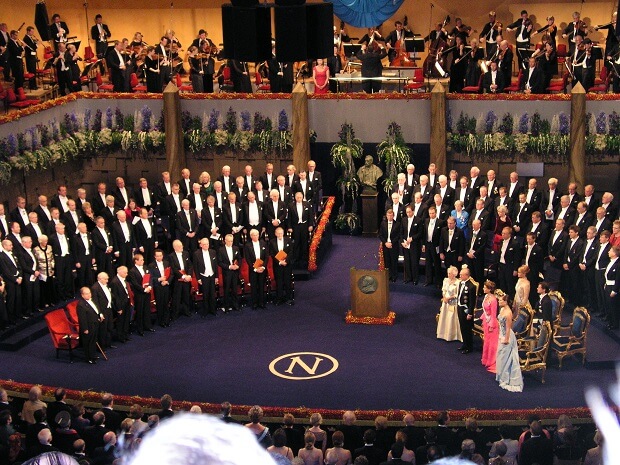
December 10 of every year is a day of festivity in Stockholm. All the Nobel Prizes except the one for peace, are distributed on that day. The peace prize is presented in Oslo, Norway. The Swedish award ceremony takes place in the Concert Hall at about noon. On any normal day, the building is surrounded by vendors, but its status is elevated on the awards day.
By tradition, the awardees usually stay in the Grand Hotel in Stockholm, which offers them rooms at a very low price or at no cost. Normally room rental would be US$400 a night.
The event starts with the national anthem of Sweden, while in the presence of the Queen, the King of Sweden hands over the prizes. Before each prize is presented, there is a citation. The awardee makes an acceptance speech after receiving the gold medal and certificate. Then there is a musical interlude played by the Royal Swedish Philharmonic Orchestra. The ceremony lasts about two hours in all and following this, awardees retire to their hotel for a break. Essential as some prize winners could even be in their 80s or 90s, or even in wheelchairs.
The same evening, the awardees and other guests gather at the City Hall for the Nobel Banquet. This impressive red brick building is visible from almost anywhere in Stockholm, and houses the office of the council of the city, which also takes pride in hosting the banquet.
The banquet itself is held in a big hall on the ground floor of the building. A large table at its centre, about 100 feet long, houses the awardees and the dignitaries. Smaller tables at right angles to this seat the others. The number of invitees are usually about 1300. Space is at a premium, with a person clamped to the seat, making it difficult to move. There is another condition as well, you cannot get up or move away from your seat till the king finishes eating and rises. Thou shalt not even visit the restroom!
There is a strict dress code; however, the exception is for awardees attired in their national dress, which is most welcome. The food is prepared in the kitchen upstairs and brought down in lifts.
The awardees enter the hall in a procession led by the King and Queen. When the food service starts, royalty is served first, but immediately every guest has been served. The idea is that everyone should eat at the same time as the royalty.
After dinner, guests gather in the Golden Hall upstairs. The walls and the paintings in this room are clad with 18 million pieces of gold. Dancing begins and the dignitaries have a chance to socialise.
It was pointed out to us repeatedly that the King and Queen of Sweden participate in the proceedings with utmost humility, deeming it an honour to be with a handful of people who have contributed exceptionally to mankind and its welfare.
The Nobel Museum situated in the old part of the city, is all about the Nobel Prize and its winners. It is a must for anyone who respects knowledge, and is always full of students wanting to know more about science or literature.
The foyer of the museum contains portraits of the 840 prize winners, accompanied by a short write up on each just below each frame. Next comes an exhibition on peace organised by the International Peace Bureau (winner of the 1910 peace prize). Rejoice Indians, Gandhi gets a prominent position there. His words, “Earth provides enough to satisfy every man’s need, but not every man’s greed” stand out. It is a shame that was not awarded the globally expected peace prize in 1947/48, for which the Nobel committee has apologised profusely. Another Indian features, Vandana Shiva, an environmentalist who took on multinational companies engaged in malpractices hindering the development of countries such as India. She was awarded the Sydney Peace Prize in 2010. Another person that stands out is Albert Einstein with his words, “Peace cannot be kept by force. It can only be achieved by understanding”.
Although there is a wealth of information about the Nobel Prize winners in science and literature, there seemed no specific display for CV Raman or Rabindranath Tagore.
A big display area contains donations from awardees. Amartya Sen, who was awarded the 1998 prize in economics, donated his bicycle and the mathematics books he used as a student in India. There is the original of a letter Einstein wrote to his son; the crude DNA model belonging to Linus Pauling (winner of Nobel Prizes for Chemistry and Peace); and the chemical balance that Marie Curie used in her experiments. Interestingly, the Curie family, including her husband, daughter and son-in-law has bagged five Nobel prizes!
Chairs in the restaurant at the museum are signed by awardees, so you may be sitting on some Nobel Laureate’s signature! We had a look underneath all, and found the signature of US President Barack Obama.
Eight Indians, CV Raman, Rabindranath Tagore, Har Govind Khorana, Mother Theresa, Subramanian Chandrasekhar, Amartya Sen, Naipaul and Venkataraman Ramakrishna have been awarded Nobel Prizes. Among these, only Raman and Tagore did their prize-worthy work in India.
Taking this trip and learning of the achievements of these Nobel Prize winners, one feels like asking, “What have I done after all? How insignificant is my life?!”