

From the Beatles to the harbour, resounding nightlife and architectural wonders, the city has many exciting avatars

Hamburg is like a pilgrimage site to many rock music fans, because it was from here that a bunch of young singers from Liverpool in England shot into fame in the sixties, creating an unforgettable name for themselves in the music-world as the ‘Beatles’.
According to records, in August 1960, a completely unknown band comprising of John Lennon, Paul McCartney, George Harrison, Pete Best and Stuart Sutcliffe arrived at this second largest city of Germany to play at the Indra Club in the Reeperbahn district, famous for its pulsating nightlife. Being good, it didn’t take them much time to impress the local audience with their rock ‘n’ roll gigs. Soon they began performing at other clubs in the area, and their rising popularity gave them their first recording break. The rest, as we all know, is glory-filled history.
Hamburg acquired a special place in the heart of Beatles and naturally amongst their worldwide fans. “We were born in Liverpool, but grew up in Hamburg,” John Lennon once remarked with emotion. Later they went back to Hamburg for concerts which were sold out as soon as the ads came out. Many who didn’t ever go to Reeperbahn clubs for a beer or two, were happy to pay any price for a ticket to their recitals.
The relationship between Hamburg and Beatles over the years has grown to become a major attraction of the city, even if you are not that high on rocky rhymes. Commemorating their stint at Reeperbahn, a Beatles Memorial featuring stainless steel sculptures draws huge crowds, some of whom, driven by nostalgia, start singing their favourite Beatle’s songs. Local tour companies offer Beatles Tours that take you to the nightclubs where they performed, show you the places where they lived and tell you many stories of their hard life in the city. Till recently there was also Beatles Museum in the area housing numerous star memorabilia, unfortunately its doors closed due to lack of interest.
Most visitors add the Beatles odyssey to their itinerary during their visit to Reeperbahn; a visit to Hamburg isn’t complete without browsing this domain. It’s the city’s most famous and exciting thoroughfare that comes to life only after sundown when Hamburgers, joined by thousands of visitors, storm into this quarter to party. You will find here many great bars, restaurants, theatres, and nightclubs, the eclectic mix of which makes the quarter interesting. Even just walking along the main street and sideways is fun-filled. The neon-lit signs of the establishments, the loud music from the bars, the aroma of grilling sausages from wayside stalls and the cheering and jeering of the crowd creates a magical atmosphere. But be aware that there is one particular street in the area where women visitors are not welcome. If someone goes there by mistake, she is likely to be rewarded with a bucket of water!
Hamburg’s dynamism and vibrant character stem from its long-standing maritime history. Arriving here, the first thing that catches the eye is water everywhere – the Elbe River, the Alster lakes and canals criss-crossing the cityscape make water the city’s lifeline.
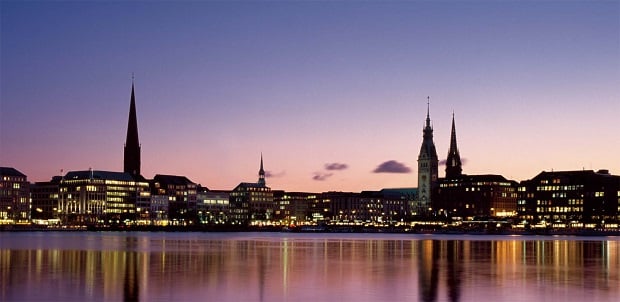
Water makes Hamburg special, and for that reason harbour cruising becomes priority for first-time visitors to understand the metropolis from where it grew to become a modern urban settlement, occupied presently by a cosmopolitan population of 1.8 million. While water-faring, you can view historic vessels and giant container ships, maritime memorials, romantic piers and a stunning architectural silhouette of old and new, dominated by the tall spires of Hamburg’s several churches.
Like its European counterparts Rotterdam and Antwerp, trade through this port for the last 800 years has made the city wealthy enough to become one of the richest metropolitan areas of European Union. The docks have also witnessed large movements of people. After the two World Wars, millions of Europeans voyaged to the newer world from here, giving the city its other name, ‘The Getaway to the World’.
The attractions of Hamburg to an outsider, go much beyond its water boundaries. The cityscape is powdered with architectural wonders, many of which have been rebuilt after allied force bombing during World War II reduced the city to almost rubble. The city lives around its medieval Rathaus, one of Europe’s most opulent edifices. This neo-renaissance structure dominates a paved square bustling with shops, eateries and people, both locals and tourists, proclaiming that this is where the heart of the city beats.
There are historic churches nearby, the most significant being the St Nikolai Church, famous for its towering steeple, once recognized as the tallest in the world. The edifice burnt down to its wall during the war in 1943, and its remnants today serve as a memorial for the victims of war. A newly installed lift takes visitors’ to a platform 250 feet above the ground from where the outside vista is breathtaking, while a collection of historic photographs of wrecked Hamburg after the war provides an idea about the scale of transformation. However Hamburg’s signature building is the baroque-styled St Michael Church. According to guidebooks, a visit here is almost mandatory. The large white and golden interior is more impressive than its imposing exterior.
A good place to chance a bit of raw encounter with Hamburg culture and the opportunities to rub shoulders with locals is at the Fish Market, which opens only on Sundays mornings at the crack of dawn. Planning a visit there will also give you a good excuse to party all Saturday night. In fact, its routine for many local night-owls to stay up at Reeperbahn the whole of Saturday night, and finish the night or start the day with a hot German breakfast at this high energy marketplace which has been operating since 1703. The stars here are the market criers who hawk their wares at full volume while competing with live entertainers, their old German pop songs bursting out from high volume loud speakers.
India and Hamburg have a very special relationship. Every three to four years the city hosts India Week, during which a multitude of cultural programs showcase India to the Hamburg citizens. They love it; they learn more about India, taste hot curries, watch Hindi and regional movies, dance to the lively tunes of Bollywood music and keep enquiring when the event will be held again.
TRAVEL NOTEBOOK
Getting there: Singapore Airlines (www.singaporeair.com) to Frankfurt from where convenient train connections (www.raileurope.co.in) to Hamburg
Accommodation: Adina Apartment Hotel Hamburg Michel (www.adina.eu) is located close to the harbour
More information
Historic Hamburg
Special Olympics: Eight participants, fourteen medals – An impressive tally
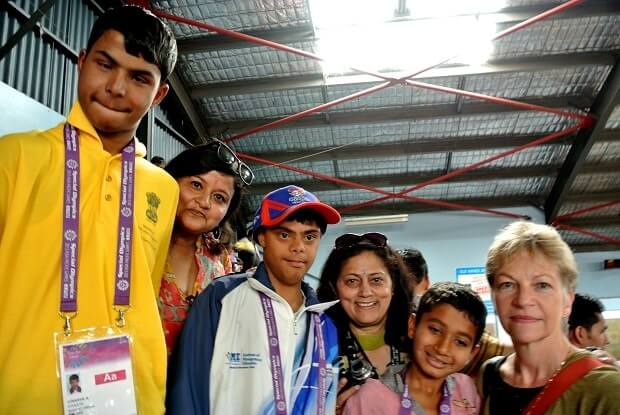
Students from Tender Heart School are proud winners at the Special Olympics in Newcastle

Sometimes life brings you the company of fellow human beings who are such an inspiration, that you feel rejuvenated and proud to be one. Meeting Renu Bali, Kakoli Mukhejee and Katy Fitzgerald, has been one such encounter. Unfortunately meeting their wards, the eight participants of the Special Olympics Asia-Pacific’s Team India from Tender Hearts School, was not possible as they were flown straight to Newcastle and back. Tender Heart School is in Bhatola, Haryana, a small village situated 10kms from Faridabad, near Delhi. That these children have overcome their disability and participated in these Games with such success, is something you would like to shout from the rooftops to anyone who cares to listen!
It has been an immense effort on the part of these three women to bring eight children to Australia. Katy, an Australian with a passion for photography and for India, sold her pictures taken in India to raise funds for the travel of these children to the Special Olympics, held at Newcastle from 1 to 7 December (Her inspiring story was featured in the July 1, 2013 edition of Indian Link). At the opening ceremony, an enthusiastic crowd greeted the smallest teams of athletes from Cambodia and Mongolia, with as much noise as the 398 athletes in the Australian team. Governor-General Quentin Bryce, welcomed 2500 athletes from more than 32 countries.
Tender Heart is a non-government, not-for-profit organisation started 15 years ago, with the aim of providing social and educational opportunities for disadvantaged children. It provides education to ‘normal’ children from around Bhatola, those with physical and mental disabilities who need special education, and works on women empowerment. 200 children and 50 special needs students study and play together in this inclusive school. “With the special needs children, the emphasis is not only on providing an education, but also to make these often rejected people a part and parcel of society,” says Renu Bali, founder of the Tender Hearts School. “I observed a tendency of these children to feel rejected and depressed, and consequently uninclined to participate in any activity. This resulted in low self-esteem and obesity,” explains Renu. Also observing that given the opportunity, these kids were happy when playing games, Renu wrote to the Special Olympics Bharat committee and got the children started on a games training program organised by them. The first camp at Jammu attended by these children who had never left home, was a big challenge. Most of them hardly spoke, but Renu says on the second day, she received a call saying that a child wished to speak to her. “Yahan ka paneer bahut acchha hai,” (the water from here is really good) said the child. Renu was stunned to hear this from a child who apparently had no logical thinking, and hardly spoke before. She realised that the travel and participation in games had made this big difference. “After this, I stepped up participation in training camps. These were often held inter-state and I had a tough time convincing parents of children to let them go, but my efforts paid off,” claims Renu. “Each time they came back with new words in their vocabulary and started doing very well at district, state and then national level games,” she adds. Two and a half years later and the doors to international level competition were opened to them, so here they were now – in Australia!
There couldn’t have been a prouder set of people than Renu, Katy and Kakoli (a special educator at Tender Heart School), when the final medal tally was announced. They had no sponsors initially but kept up with the practice for participants, egged on with a strong determination to make it happen for this special contingent. Amongst themselves, the eight participants won 14 medals! Team Bharat made up of 381 participants, won 387 medals in all. A tremendous achievement considering that able-bodied sportsmen at normal Olympics struggle to win a single medal for India!
Renu wishes to make the efforts of these participants known to the whole of India. “They need to get a hero’s welcome,” says Renu. It is a pity that such adulation is reserved for cricketers and Bollywood stars only, she rues. “My aim is to make these children stand on their feet and sustain themselves. I am advocating hard for these participants to get cash awards like other Olympic medal winners. This could provide some support, as well as encouragement,” she avers. Speaking of hardships, Renu tells the story of when the school had an opportunity to send a student for the shot putt activity. The problem was, they did not have one. So she asked the child to start by throwing stones, found in abundance around the school. At first he wasn’t happy doing this. “Kyon mujhse patthar phekwate ho,” (‘Why are you making me throw stones?’) he complained, but this practice stood him in good stead and he was ecstatic when he won at shot putt at the state level, and received a Rs.15,000 cash prize!
One of the participants was Bhupender, and his forte is athletics. Though on the IQ scale, his ability may be only 55, on the running scale, he beat able-bodied people to win the gold medal at the Delhi Marathon. ‘Don’t DISmyABILITY’ is what these achievements cry out.
Not all students from Tender Heart School are ‘children’. The oldest and sole female participant is Aarti who is 32. Participation in each of the sports category is based on ability. Piyush who won the 100m, only wanted to play cricket but Renu’s gentle coaxing worked. “Naye joothe doge to main bhagoonga,” (‘I will run only if you buy me new shoes’) said Piyush, and Renu was more than willing to oblige him with a pair! Other athletes were Deepak, Uttkarsh, Vishesh, Vikram and Keshav, the youngest at 8.
Renu has a bank of ‘success stories’ about these children, and this is what drives her to aim higher. Given the opportunity, these special children can achieve anything. Vikram dropped out of school in Year 7 as his wheelchair was hard to navigate on muddy roads when it rained. He asked Renu if he could learn a vocation. The girls at the school made soft toys and he started with drafting and cutting templates, which the girls then stitched. During the course Vikram said he wanted to study again, and so Renu got him a better wheelchair from Red Cross. Vikram has completed his graduation this year in spite of many hurdles. Now international volunteers at Tender Heart are training him in computers as he has been promised in a job at Convergys, an IT company, if he is able to upskill in MS Excel.
“We need partners on this hard journey. Our projects should be able to sustain themselves, and only then can they be successful,” says Renu.
Indians in Australia can help these children and many others in their situation by becoming a volunteer at the School, buying products made by them or donating to the Tender Heart Foundation (www.tenderheartngo.org). “There have been many volunteers from Australia and with their help we are trying to upskill our teachers to use better training methods for special needs students. I realise we have a long way to go,” says Renu. “When I saw Australian children speak on the mike before huge crowds at the Special Olympics opening ceremony, all I thought was that I want to make my children do that!” We can all try to make this happen and we don’t have to dig deep into our pockets. As Kakoli put it, “A dollar a day is more than enough to bring up a single child in India”.
Colour, creativity and craft
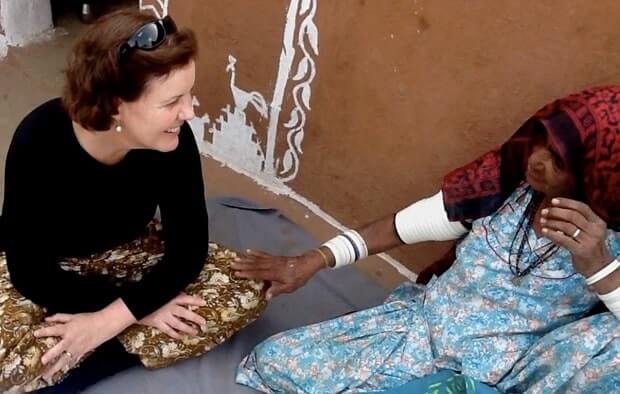
Deborah Emmett’s inspiring designs are brought alive by traditionally skilled Indian artisans

After graduating in Adelaide with a Fine Arts Degree, Deborah Emmett worked as a Graphic Designer. While travelling through South East Asia, she became more interested in textiles, but it was only on arriving in India that Deborah was so inspired by the vivid colours and intricate designs of the textiles there, she knew her life was about to change course.
While in New Delhi, Deborah came up with the idea of importing embroidered Kashmiri jackets. A friend introduced her to the owner of a shop that sold the quality jackets she was looking for. It was to become a lifelong partnership, for they married and became business partners, developing a business centred on their mutual interest of designing clothing and soft furnishings using traditional techniques of dyeing, weaving, crewel embroidery and wood block printing.
Since then, Deborah has divided her time between Sydney and New Delhi, where her textile design business, Tradition Textiles, is based. Integral to the design process is the creative and practical input provided by the artisans she collaborates with, while the inspiration for the designs is drawn from her observations in India; for example, the geometric patterns found in latticework for which the city of Jaipur is renowned.
From New Delhi, Deborah travels to remote villages in Rajasthan where skilled artisans practice their craft. Here the woodblocks are carved and used to produce printed textiles. In the village of Saganer she meets with Dinesh who carries on the family tradition of woodblock printing. Garment stitching is done by Bhukhu and other women who are all highly skilled in appliqué in a village near Jaiselmer.
Since Tradition Textiles began 14 years ago, Deborah has worked together with the artisans to achieve incremental improvements. Based on the concept of micro financing, equipment and machinery was purchased to enable Dinesh to increase production. For Bhukhu, ongoing work has allowed her to pass on her craft to several family members. Another family of artisans Deborah works with were able to send their daughter to University and after graduating with an MBA, the family business has expanded.
While many international designers come to India to incorporate printing and appliqué in an upcoming season’s collection, they generally visit only once and instead engage agents to seek out the artisans; rarely, if ever, meeting with them in person. Deborah travels to India twice each year, spending several months there to finalise the summer and winter collections. Early on she recognised the importance of explaining the design process from start to finish. Bhukhu had never met a foreigner before and while she had produced appliqué at the request of agents, Bhukhu had no knowledge of the end product. “Once you explain this the artisans understand what the consumer would want them to make. Going out to the villages and meeting with the artisans is crucial. It is also empowering as the artisans are encouraged to participate, so that the design process involves both the designer and the artisans who are encouraged to make suggestions and give creative expression to their designs,” says Deborah.
And while they find Deborah’s design aesthetic very different, the artisans can appreciate that traditional textiles are equally suited to modern living, thereby keeping those traditions alive. From beautiful scarves woven from natural fibres, designs printed on cotton and silk kaftans, woodblock patterns on table linen and embroidered fabrics for furniture, the designs offer new opportunities for their craft.
Based in both, New Delhi and Sydney, Deborah finds her neighbours in each city very different. When I ask her to characterise how, she responds that people in New Delhi have a wonderful sense of humour and are used to working collaboratively with friends and family. Australians by contrast, live in a more isolated way, often working alone. But the cities have similarities too. Both are multicultural with people drawn from different cultures who live together.
With a busy lifestyle that also involves lecturing in Graphic Design and completing a Masters Degree at the University of NSW, Deborah is also working with several Indian textile artisan groups to design a range of textiles for an exhibition to be held in 2014. When I spoke to her about next season’s collection, she advised that she had a plane to catch bound for New Delhi.
Deborah recently spoke at the Museum of Sydney on New Delhi as part of the 52 Suburbs around the World exhibition.
War clouds are gathering in Asia
While China has aggressively appropriated islands in the Pacific Ocean, festival spending in Australia continues, comments NOEL G DESOUZA

While Xmas is approaching, there are two dissimilar trends gathering pace in East Asia. One is the anticipation of big pre-Xmas sales in large stores. The other is the perplexing flexing of muscles by China in two theatres of operation. China has declared a large chunk of the Pacific Ocean close to Japan, Taiwan and the island of Guam as a restricted maritime zone in which ‘intruding’ ships and aircraft will have to report their presence to China. The other is a set of islands in the southern seas.
In both cases, the marine theatres with the islands in question are mostly rocks that just jut out over the sea during high tides. But whether these islands can be inhabited is not the point; they could be just dots in the sea, but the resources around them is what matters. Troubles in the past used to be over fishing rights, but the prize now is much higher. It is the much more valuable petroleum and gas deposits. It is believed that billions of tons of such fossil fuels lie embedded in exploitable geologic structures.
China’s restricted identification space in the northern Pacific brings the country into direct confrontation with Japan and the USA, who have chosen to ignore the Chinese diktat by flying large planes over the so-called ‘exclusion zone’. This style of engagement possibly reminds the Chinese of the gunboat diplomacy of the nineteenth century when China lost Hong Kong and Macau to the British and the Portuguese respectively. At that time around the mid-19th century, Japan was forced, by use of an American naval fleet, to open to the USA. During that time Japan and China had to face flotillas from Western nations, and were on the losing side. This time there are gunboats with all the nations involved. Both China and Japan have modern naval ships. One by-product of the decision made by the United States is an agreement between Japan and South Korea to be on the same side. In a sense it is an evenly matched situation, but one which could go out of hand if not delicately handled.
For example, in the northern exclusion zone, Japan has traditionally been the guardian of the Ryukyu island chain which lies between Japan and Taiwan.
The other exclusion zone lies in Southeast Asia where numerous islands are claimed by China and by several Southeast Asian nations. Part of the blame might have to be lain at the feet of Western geographers. The southern zone lies in what European cartographers of the eighteenth and nineteenth centuries denominated as the ‘South China Sea’.
The argument that whichever islands lie in the South China Sea are Chinese, has as much validity as saying that whichever lands lie in the Indian Ocean belong to India. China has recently warned the Philippines against asserting its rights in this maritime area. The most important group of islands in this area is called the Spratlys.
Under such war-like circumstances which have been well publicised, one would expect that there would be an atmosphere of saving and living frugally. But the reverse has been the case. China has amongst the largest holdings of foreign money. It has a well-controlled manufacturing sector. It is in China’s interest to keep that machine moving, as well as to protect its sources of raw materials and its markets.
Retail figures show that sales in big stores are doing quite well (a rise of 0.4per cent). The Chief Executive of the Australian National Retailers Association, Margy Osmond is pleased with the figure, specially as it was during a period leading up to an election.
Osmond also points out to the positive effect of the Reserve Bank of Australia rate cut in early August. She notes, “This is a result of the cash rate cut in early August, a more buoyant share market and consumers responding to the prospect of a new government with a clear mandate, coming into power.” We can also point out to the increase of house prices during that period.
There is optimism in the retail market. Children will have to be satisfied with acceptable presents and young people with fashionable, and perhaps expensive clothes. Religious places strive to offer attractive events, and so do offices and localities. All these events need good clothes. The singing of songs and particularly hymns lends a feeling of being soothed.
As these events were proceeding, the world was awed by the passing away of the greater-than-life figure of Nelson Mandela. World leaders paused to express their admiration and grief for a man who had made the unthinkable a reality; he joined forces with a government that had been originally wedded to the concept of apartheid, to form a government of unity where all races were equal. He had shown the value of reconciliation.
Now is the hour when reconciliation is what the waters of East Asia need.
Holiday traditional sweet treats

Homemade sweets during Christmas make the season more enjoyable for your taste and tummy, says ELEANOR D’SOUZA

This year, Christmas Day is fortunately mid-week on a Wednesday, and the rest of the family will be home from the weekend. Which gives us enough time to indulge in some serious sweet-making, that we have missed out on in past years, because of the lack of time. Growing up in India, making sweets for the festive season was akin to a social event, with all the family members gathering around after dinner a few evenings before Christmas Day, to make delicacies in abundance like kulkuls and neoris, among others. Each family increased its array and households good-naturedly competing with each other to create the best and most tasty, created from recipes handed down by at least a couple of generations of enterprising mums.
These days we are all too busy with children, home and work, and even more so during the festive season when we rush to buy presents, decorate the home and meet deadlines. We tend to take the easy option buying a variety of good quality chocolates and shortbread biscuits to display on the sweet tray when family or friends come calling.
But this year, I will be making some of my traditional favourites which were so popular among family and friends in Mumbai. They do take a bit of effort, but the end result will be worth the challenge. I only hope they last until Christmas Day!
Bolings
These delicious coconut biscuits have a wonderful flavour and are particularly special to the Goan community
¼ (125gms) fresh grated coconut
200gms semolina (suji)
100gms sugar
3 egg yolks
1tsp baking powder
1tsp butter
2tsp caraway seeds
¼ glass water
Place the grated coconut in a thick bottomed vessel, add the sugar and water and bring to a boil over medium flam. When the mixture melts and forms a sticky mass, remove from fire. Add 1 tsp butter and stir well. Keep aside. When cool, add egg yolks to the mix one at a time and stir thoroughly until completely blended with the mix. Next, add the semolina, baking powder and caraway seeds and stir through thoroughly until a dough-like mass is formed. Keep overnight in the fridge. The next day, when ready to bake, make small oval balls of the mixture and place on a flour-dusted baking tray. Bake for about 20 minutes at 150c, and until the bolings are tinged with brown. Take care not to overcook. Remove from oven, cool and store in an airtight container until Christmas Day.
Marzipan
A rich blend made from cashew nuts and rose water
¼ kg cashew nuts, ground to a fine paste
250gms icing sugar
2 egg whites
100mls rose water
5 drops almond essence
Food colouring (optional)
Moulds of different shapes
Beat the egg whites until slightly stiff, then place in a thick bottomed vessel. Add icing sugar, ground cashews, rose water and essence and mix together until well-blended. Place on a slow flame and stir continuously until the mixture cooks and begins to form a mass, leaving the sides of the vessel. Mix together thoroughly on a slow fire, stirring continuously until it forms a mass and leaves the sides of the vessel. It is very important that the mixture should be fully cooked. To ensure this, form a small ball of the dough and drop it into a bowl of cold water. If it is firm, the marzipan is done.
Empty out the mix on a lightly greased large plate when still warm and knead for a few minutes. Divide the dough into small portions and mix in the colours you need, kneading well to ensure even colouring. Then mix and match when placing the dough carefully into the moulds to get the desired shape. So for a strawberry shape, the stem could be green and the main fruit could be red. Prepare the entire batch of marzipan and store in an airtight container.
Milk cream toffee
Homemade chocolate that’s the first to disappear
1 litre full cream milk
2¼ cups icing sugar
2tbsp cashew nuts, ground to a fine paste
½tsp butter
1tbsp vanilla essence
Moulds for shapes
Boil the milk on high fire, stirring continuously until it reduces to half its quantity. Reduce the fire, continue stirring add sugar, the cashew nut paste and butter. Keep stirring until the mix leaves the side of the vessel. Place the batter on a greased plate, divide the mix into small balls and gently press into the moulds to get the desired shape.
Chana dal doce
A simple, sweet favourite, but you need a strong arm for stirring
250gms gram flour (chana dal)
2½ cups sugar
200gms fresh ground coconut
In a pressure cooker, cook the dal till soft, then cool and place in the blender to grind to a fine paste. Add coconut and blend into the mix. In a thick bottomed vessel, place the mix, add sugar and cook on a low flame, stirring constantly. You will be stirring for quite a while, until the mixture leaves the sides of the pan and is cooked through. Pour the batter into a lightly greased plate or board, wait for it to cool and then gently cut into diamond shapes. The mixture will solidify and set, and can be then placed into an airtight container.
R… Rajkumar: Rumbustious raga of the rowdy

R… Rajkumar
STARRING: Shahid Kapoor, Sonakshi Sinha, Sonu Sood
DIRECTOR: Prabhudheva
Rating: ***

‘Silent hoja, nahin toh main violent ho jaaonga,’ says our rowdy-side Romeo hero. This clangourous film’s besotted hero Romeo Rajkumar is fond of blurting out the silent-violent catch-line at the most inopportune moments… maybe he likes the sound of the words and doesn’t care to hold up its relevance in his deeds.
His demand for silence in a film that revels in raucousness is as irrational and morally untenable as seeking salvation in Asaram’s ashram.
R … Rajkumar is a very noisy film. Empty aerated bottles fly across the colourful kitschy frames hitting hard surfaces, mainly skulls and shattering every shred of the equilibrium that might have existed if Prabhudheva’s kingdom of anarchy before heroes and villains with knives (never guns in this film) decided to get so mad, they had to get even against all odds.
Welcome to the world of wacky wickedness where Shahid Kapoor lords with ludicrous loudness over characters who don’t know where to stop. And Prabhudheva’s direction follows suit. The plot is wafer-thin, certainly slimmer than the film’s large-built leading lady.
There is an immensely endearing moment between Sonakshi Sinha and Shahid Kapoor where she makes fun of his height. He retaliates by taking a dig at her weight. It’s a decisive moment in the storytelling where the parameters of impunity are well set for the couple as well as for the script’s dynamics regarding the love relationship between the two.
These two lovebirds will go to any lengths to be one-up on their adversaries. Sonu Sood plays the arch-villain as a delicious mix of the mean and the mirthful. This guy deals in danger and yet somehow he doesn’t mean to be so mean.
If you know what I mean!
The violent love story streaks across a horizon of hectic action sequences topped by a monstrously over-the-top climax where Shahid and Sonu beat each other to a pulp. This 20-minute climax (and still counting) could have been cut by half, as too the songs which though interestingly filmed (Prabhudheva, after all) add only splashes of flamboyant colour on an already over-cluttered canvas.
Prabhudheva’s comic-book energy is back in action in this fast furious and funny cocktail of mirth and mayhem. A heady unsteady mix of humour and rowdyism that only Prabhudheva can pull off. Yeah, we’ve seen it all in Wanted and Rowdy Rathod. But there is something sexily bullish about Prabhudheva’s cinema.
Yes, the mystery of the asterisks in the title is slyly revealed. Romeo and not Rambo is the flavour of the season. We saw a very violent Romeo in …Ram Leela recently. Now we see a very love-struck Rambo in R… Rajkumar.
To their credit, director Prabhudheva and Shahid Kapoor have a lot of fun with the feisty hyper-ventilating material which is often short of breath, but proudly so. Neither silent nor offensively violent, R… Rajkumar is a fun take on the hero and the tyrant.
Australia honours Aung San Suu Kyi
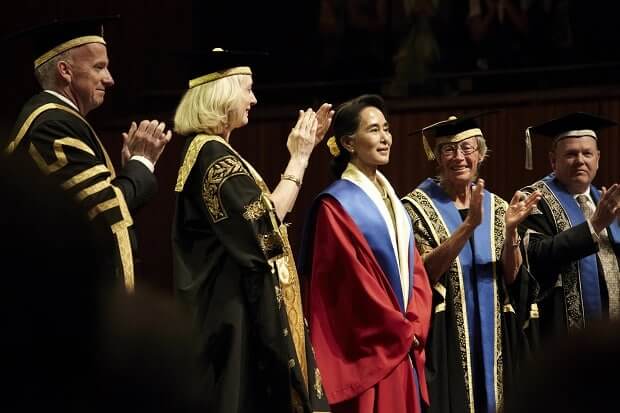
A renowned human rights activist expresses her thoughts and feelings during a felicitation by leading universities

“My attitude to peace is rather based on the Burmese definition of peace – it really means removing all the negative factors that destroy peace in this world,” once remarked Nobel Peace Prize winner and pro-democracy activist Daw Aung San Suu Kyi. The essence of this quote of Ms Suu Kyi was reflected in almost all the addresses she delivered during her recent maiden visit to Australia, to encourage global interest in democratic reform in her country Myanmar, formerly known as Burma.
As expected, Ms Suu Kyi’s six day official schedule from November 27 upto December 2 was packed with engagements that included meeting Prime Minister Tony Abbott, Foreign Minister Julia Bishop, Governor General Quentin Bruce, members of Myanmar community and receiving honorary doctorates from three top universities – Sydney University, University of Technology, Sydney and Australian National University in Canberra.
Sydney University and UTS jointly conferred the respective honours at a function held at the concert hall of Sydney Opera House where every available seat was filled, signifying the immense popularity of a person who has dedicated her life to peace, human rights and democracy. It is interesting to note that the last time the two universities held a joint degree ceremony was to honour another global inspiration leader, Nelson Mandela.
Ms Suu Kyi now 68, is fittingly compared with Gandhi, Mandela and Martin Luther King. Like them, she is a keen follower of non-violence, liberation, equality and justice. Her strength to lead and inspire people naturally comes from her father General Aung San who fought for Burma’s independence from the British in 1947, but was unfortunately assassinated in 1955.
After her father’s death Ms Suu Kyi lived abroad in India, England and United States and returned Burma in 1988 to take care of her ill mother, leaving behind her husband and two sons in England. At that time, Burma was passing through a period of great political turmoil and stood behind the people fighting for their democratic rights. She was soon held under house arrest and achieved unconditional release only in 2002.
Many of Ms Suu Kyi’s thoughts and feelings came out when she spoke at the Sydney Opera House after receiving the university honours. She talked about relationship with her father, the choices she opted for in her personal life and about the three pillars on which she sees Myanmar united and reformed – democracy, human rights and national reconciliation. When questioned on Australia’s asylum seeker policy, she said justice should be tempered with mercy, reflecting again her thoughts on peace and humanity.
Sustainability: Home of the future

An ecologically sustainable house designed by an Indian engineer has won accolades across Australia, reports EMIE ROY

Ever thought ‘luxury and comfort’ and ‘health and sustainability’ are two mutually exclusive groups? I thought the same too, before meeting Sanjiv Gosain at his 9-star energy rated (ACT House Energy Rating Scheme) insulated concrete thermal mass house, which is beyond carbon neutral. The house is listed in the zero emission category, and produces enough clean renewable energy to supply all its operating needs. And the best part is that it is affordable too!
Recalling how he embarked on the idea of building a house like this, Sanjiv shares a personal anecdote about how his father-in-law gave his wife some ‘Vastu shastra’ (science of construction) notes when they were planning on building a house in Canberra. Based on those instructions, a plot of land which faces north with a water-body in front was most appropriate for constructing a house. But going by Australia’s geographical location, it was impossible to build a very high energy rated house on this. And that set him thinking. Being an engineer, the best thing for Sanjiv to have his wish materialise, was to adapt a technology that would help him.
“The technology didn’t exist at the time, so I decided to invent it, it’s as simple as that,” he reveals. And thus came a design with thermal walls, named ‘econ wall,’ which changed the whole scenario. “In terms of saving energy, the thermal mass property of concrete was utilised to absorb, store and release energy and that not only saved energy, but improved occupant comfort levels too,” explains Sanjiv. The proof of the principle comes from the fact that the home’s expected operation has been declared close to carbon neutral by Beyond Neutral, a specialist greenhouse, energy and environment-related service provider.
The home is airtight, unlike most of the Australian homes, to avoid uncontrollable air leaking, in line with the new mantra in building architecture which says to ‘build tight, ventilate right’. Another interesting feature is the use of five layered insulated curtains with radiant barriers and layers of fabric which are used in snow jackets, that shuts out the outside temperature.
“Saving energy is not just about making alterations on the building, it is about personal discipline as well,” says Sanjiv. “Even with innovative design, construction, energy and water conservation facilities in place inside the house, the timely, wise decisions from the occupants will make all the difference. For instance, LED downlights light up the building and a lighting control system has been installed which can be controlled from an iPad, yet the decision to switch it off as you go to bed is yours”.
A passive solar design is used, along with the active one. The sun’s warmth is used to heat up rooms, with windows installed in the northern direction. As part of the active design, solar energy is absorbed in the roof’s solar hot water collector which is further circulated into the hydronic heating system. DC ceiling fans which use 40% less electricity than AC fans, are used throughout the building which can be reversed in winters to circulate warm air.
“Just like ears of the human body get cold first, the external elements of the building like driveways conduct a lot of heat,” explains Sanjiv. “Thus, many elements of the building like driveways, alfresco slabs and pergolas have been installed with thermal breaks to prevent heat from getting conducted to the house. Even the awnings, gates, down pipes, solar inverters and lightings have been connected to the house using thermal break fasteners and the house has an insulated garage too,” he adds.
The design and construction of the building can be well localized too, in any part of a country like Australia with its varying climate zones. The high bushfire survival rating of the building makes it the answer to one of the burning necessities faced here.
In terms of affordability, Sanjiv believes the basic thermal mass walls will cost the same as brick veneer technology. Certainly it makes much more sense to build such a sustainable abode, than spending thousands of dollars to enhance your kitchen! The technology which has been used is very practical, and the numbered panels of the econ walls ensure that the construction can be done quickly.
The concept has been well received by Australia, and the accolades that the technology has received are an attestation to this. After becoming a finalist in HIA National Green Smart Product of the Year Award 2013 and HIA National Green Smart Custom Home Award 2013, the house went on to win the Master Builders Sustainable Construction Award 2013 and the prestigious Master Builders National Excellence Award for Environment and Energy Efficiency in 2013.
Sanjiv draws inspiration from award winning Indian architect Satish Gujral, who made Indian architecture take a new turn by building functional spaces that ignite life.“I believe it is in the carbon neutral housing that the future of the world resides,” says Sanjiv. Although a late starter in sustainable housing, Australia has made tremendous progress so far, thanks to the tightening of energy rating for houses. The next step is to create awareness about the option of sustainable living in an affordable budget, and the biggest push will come from the customer’s side. After all, who wouldn’t want to be comfortable and at the same time, stay safe?
Bodybuilding champ
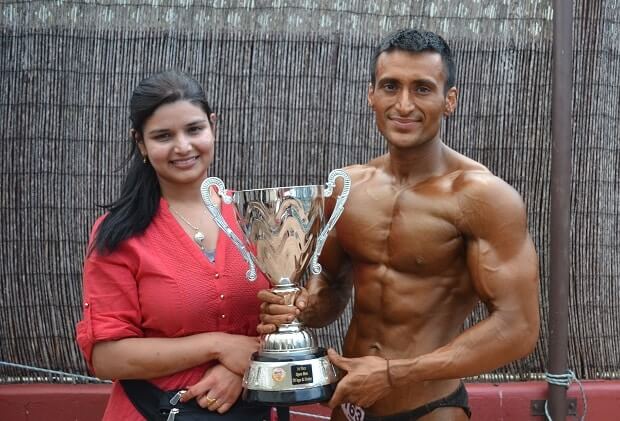
After winning the Mr Australia title, Amandeep Singh is aspiring to become Mr World
It was a moment of pure joy and relief for 30-year-old bodybuilder Amandeep Singh as he was finally crowned with the title of Mr Australia 2013 in the under-70kg category. The victory came after competing twice for the coveted title at the Australasian Natural Bodybuilding (ANB) competition in Sydney in 2008 and again in 2010, where he secured the runners up position. 2013 has been a special year for Amandeep as he won three different bodybuilding titles including the coveted national ANB award, and state awards from Victoria and New South Wales in the under-70kg category.
Speaking to Indian Link about his long journey from a small town in Punjab to competing on a national level in Australia, Amandeep says he has a lot more to accomplish in the field of bodybuilding, and this is just the start.
His mantra to success is consistency, patience and discipline when it comes to diet and training. “Bodybuilding is all about your state of mind and mental strength. The most crucial period are the weeks before a competition that can either make or break you. Only exercise is not sufficient to become a bodybuilder. To see changes in your body, you have to eat the right food and nutrients,” revealed Amandeep.
His interest in bodybuilding began at just 21. Ironically, the first time Amandeep went to a gym in his hometown of Banga in Punjab, he was insulted and ridiculed by a local bodybuilder. “I remember being taunted for my lean body when I was lifting weights and asked to go home by a bodybuilder in our local gym. That’s when I made up my mind that I will indeed become a body builder,” he recounted.
The turning point in Amandeep’s life was meeting his mentor and coach Ramakant Sharma who holds the title of Mr World (Middleweight) 2007. Under Sharma’s guidance and training, Amandeep won Junior North India championships twice in 2003 and 2005.
“My guru Ramakant bhaji is my role model. I moved to Chandigarh from Banga and started training with him. I competed in fifteen other competitions at state and national levels,” explained Amandeep. “I was going to go into partnership with Ramakant bhaji (brother), I had already earned the financial backing and the goodwill I needed, but my plans to go to Canada or America to compete in bodybuilding competitions came to a tragic halt because of a family tragedy,” he said.
Amandeep’s mother and his greatest motivator, suddenly passed away from a heart condition in October 2006. Amandeep found himself in Australia six months later, in support of his elder sister. He studied hard to finish a hospitality and management course during the day, and worked at a petrol station at night to support himself financially.
Despite no financial backing in Australia, Amandeep continued his training and met Rupi Hothi, another aspiring bodybuilder who became his training partner and a close friend. Together they trained for hours at the gym. And their dedication finally paid off. In 2008, Amandeep battled his inner demons to become the first Indian to win the Sydney bodybuilding runners up title at the prestigious Australasian Natural Bodybuilding (ANB) competition.
Amandeep received a lot of adulation for his unique routine by the judges and audience when he performed on Punjabi songs on the day of the competition. “I love playing to the gallery and showcasing Indian culture. I have performed live on dhol beats, Bollywood songs like Singh is king and Shera the komb Punjabi which the audience loved,” he recalled.
Amandeep took a break from bodybuilding in 2011, when he married Manpreet Kaur. However he soon hit the gym again with encouragement from his wife and friends. Manpreet is his pillar of strength and single-handedly looks after his entire diet
Singh keeps a watch on everything he eats. His knowledge on food and its nutrients is remarkable. “Apart from intense training five to six days a week, I eat five to six meals daily. Every meal contains micro and macro nutrients, essential fatty acids, and essential amino acids and proteins which are a vital part of my diet,” revealed Amandeep.
His diet and training routine is not easy, but Amandeep has already made quite a few sacrifices along the way. He loves cricket but can’t play the sport as that can affect his weight and muscle symmetry. He rarely eats out and can never binge-eats. “On my birthday I treated myself to cashewnuts which landed me in hospital. Unfortunately this incident occurred just a month before a competition in 2011, and I wasn’t fit enough to participate,” he recalled.
Based in Musswell Brook in NSW, Amandeep enjoys the simple, laidback life of the countryside with his family. He is employed at a machinery welding company during the day and works flexible hours so that he can dedicate enough time to his training. His boss and workmates also support his passion.
Amandeep Singh lives by the motto that one should dream big. Apart from bodybuilding, he is also interested in horses, thanks to friends who are jockeys and horse trainers. “I love watching the races and one day hope to own a thoroughbred winning horse,” he admits with a cheeky smile.
Now that he has won the title of Mr Australia on a national level, Amandeep’s next big goal is to represent Australia internationally. “I have given myself two years to bulk up and then take part in the under-80 kg category. It is my dream to win Mr World someday. God willing that too shall happen one day,” he said in conclusion.
2013 – the year that was

We take a quick look at the major events that defined the year of weather woes, political movement, arrivals and departures, and the creation of the selfie

2013 is on its way out, and what a year it has been! We’ve experienced high political drama, devastating natural disasters, random acts of terrorism, births, deaths – all the ingredients that make an interesting and varied year, but one that we will be glad to confine to the annals of history. So here are some of the most significant events of the year gone by, and let’s hope that 2014 brings the world peace, prosperity and contentment.
Happy New Year!
What’s with the world?
Some things haven’t changed. Like the civil unrest in the Middle East, with Syria giving the world at large a scare relating to its use of chemical weapons. But progress has been made with the US removing some sanctions on Iran, a sign of good things to come.
Barack Obama is now in his second Presidential term, but the US shutdown has been a challenging situation, as has the spying scandal for which America is still sheepishly apologizing. Unlike our very own PM Tony Abbott who’s tough stance and refusal to apologise to the Indonesian government came as a surprise to political pundits. An unpublished letter from him to Susilo Bambang Yudhoyono seems to have resulted in a status quo.
The Global Financial Crisis continues, but it seems like everyone’s simply tired of talking about it. Let’s move on, seems to be the common sentiment, and about time too!
Weather woes
Natural disasters seem to have abounded in 2013, with a devastating typhoon in the Philippines which resulted in a massive loss of life. The floods in Uttarakand in India also caused mayhem. Closer home, widespread bushfires in New South Wales devastated land, flora and fauna, and homes. Sydney was enveloped in a haze of smoke and dust, that took days to clear.
Manmade mayhem
The year did not start on a good note with the Brazilian nightclub fire disaster in which many lives were lost, followed by the Boston Marathon bombing, sending the USA into a spiral of fear once again. Later, the Kenya mall attack by extremists brought to light the ugly strength and reach of terrorism. Asia was in the news with a tragic factory collapse in Bangladesh, and we cannot even list the numerous bomb blasts across Iraq, Afghanistan, Pakistan and Syria, among other countries, where such incidents have, tragically, become commonplace.
Australian antics
For Australia, 2013 heralded political change with the federal elections being won by a clear majority by the Liberal party. Labor lost with Kevin Rudd back in the hotseat, having ousted Julia Gillard in a non-spectacular coup. Prime Minister Abbott is already mired in the spying scandal, there seems to be dithering in relation to asylum seekers and the polls are being unkind. It wouldn’t be surprising to find Mr Abbott giving 2013 a rousing farewell!
Oddly, the media have been wasting space covering the antics of Lara Bingle, Tom Waterhouse, James Packer and any sporting celebrity you could possibly think of.
But the Australian cricket team is on a high, having resoundingly thrashed the Poms to win the first two Ashes Test matches. We’ve already forgiven and forgotten their defeat to India earlier this year!
Same sex couples celebrated the legalization of same sex marriages in Australia, with 46 couples exchanging vows recently in Canberra.
Rest in peace
Nelson Mandela died at 95, social activist and past President of the Republic of South Africa, whose memorial service was attended by a huge contingent of world leaders and celebrities. The world joined South Africa in celebrating his life, lived with dignity and his incredible journey to end apartheid in his country.
The death of Margaret Thatcher, past Prime Minister of the UK, aka the ‘Iron Lady’ was celebrated too by vocal and disgruntled people, in what was to be viewed as one of Britain’s more embarrassing moments.
Arrival and departure
The much anticipated royal baby was born and christened, and Prince George now becomes the fourth heir to the throne of England, also presenting the media with stories and speculation for the rest of his life, bless him!
Sachin Tendulkar has finally retired from Test cricket, to a tumultuous farewell. Now all that remains is to make him a minister or build a temple to honour his name!
Pope Benedict XIV resigned in February 2013, becoming the first Pope to resign his position in 600 years. But the newly elected Pope Francis, head of the Catholic Church, has been creating historic inroads within the Vatican. Numerous signs of his humility, empathy and kindness have created a renewed interest in the Church by Catholics around the world. And surprisingly, he tops the list of the world’s most talked about topics on Facebook!
Diaspora’s doings
The Indian diaspora has been in the news with a record number of Indian-origin candidates standing for elections to the House of Representatives and the Senate.
An award for local event of the year could unanimously be awarded to the Hindu Council’s Diwali Mela, which was well-presented and offered a glimpse of the festival to Sydneysiders.
Shahrukh Khan’s performance with Bollywood belles Madhuri Dixit, Rani Mukherji and Jaqueline Fernandes lent a fitting touch of glamour to Parramasala 2013.
But the most important event of 2013 turned out to be a non-event, as the Bharatiya Pravasi Diwas held in Sydney resulted in a poor turnout and non-participation by the diaspora.
But hopes are high with Tony Abbott’s visit to India on his agenda for 2014, which could result in the Indian diaspora taking on new and exciting challenges in the mainstream of industry and politics.
Award winning streak!
It has been an incredibly busy year for Indian Link, as we carried away numerous awards at the NSW Parliament’s Multicultural Media Awards and Parliament of NSW Multicultural Media Awards.
Selfie central
In a move guaranteed to annoy purists of the English language, the Oxford University Press, publisher of the Oxford English Dictionary, pronounced ‘selfie’ its word of the year for 2013. Everyone from Obama to Pope Francis, to Miley Cyrus has posed and posted selfies, so why not you?
Indian Link announces the Special Selfie contest, where your photograph of yourself could win an exciting prize. Just visit and you could win tickets to Sydney Festival’s Band of Magicians.