Home Blog Page 6

Brushstrokes of belonging: Harris Park mural

0
Harris Park Mural
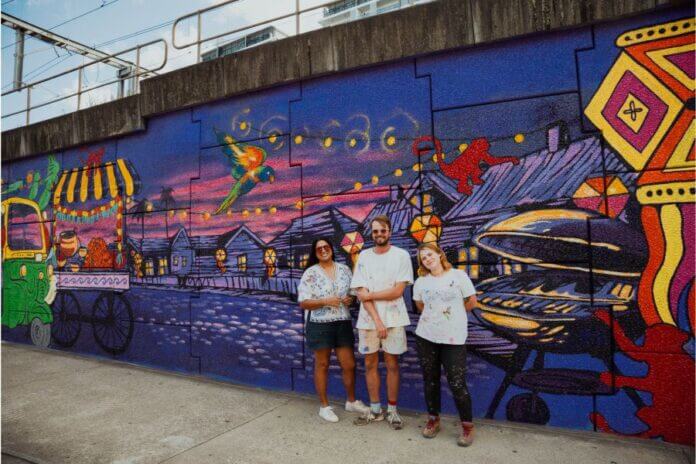
Artists Gauri Torgalkar, Patrick Hunter and Em Hatton (Source: Connor Neil)
Reading Time: 4 minutes


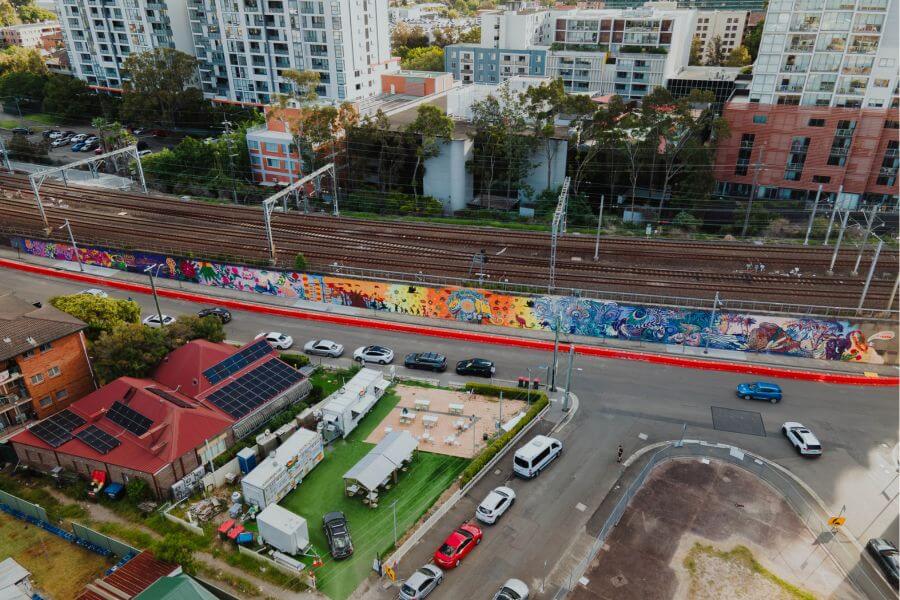
At Sydney’s Harris Park, affectionately called ‘Little India’, a 120-metre mural transforms Station Street East into a living, breathing canvas. There is no single story, no single narrative — and that refusal to simplify sits at the heart of this project.

The artwork, as artist Gauri Torgalkar describes it, is a layered visual journey through “memory, adaptation, and assimilation”, capturing not just what the South Asian diaspora looks like, but what it feels like to live between worlds.

Titled ‘A Tapestry of Harris Park’, the mural marks the first stage of a broader cultural precinct project led by the City of Parramatta with support from the Australian government. Beyond its scale, the collaborative work, inaugurated on April 2, stands out for its insistence on complexity – resisting the easy, often flattened narratives that diaspora communities are reduced to in public art.
Harris Park Mural
Aerial view of 120-meter long Harris Park Mural (Source: Connor Neil)

Harris Park itself embodies that complexity. Once home to early European settlers, later a thriving Lebanese community in the 1960s, it is now widely frequented by the South Asian diaspora. Yet, as Torgalkar points out, even in its current identity, the suburb carries “markers of its previous iterations and journeys, alongside the newer more nuanced and layered hybridity it experiences on a regular basis”.

For Torgalkar – who has lived in India, the US and now Australia – that hybridity is deeply personal. Her practice, she says, has long explored “the immigrant experience, particularly the need to forge cultural connections within new communities”. In this mural, that translates into a refusal to offer a singular version of South Asian identity. Instead, the work embraces multiplicity, allowing different stories to coexist.

The birth of a unique concept

Extensive community consultation was a huge part of creating the mural. Torgalkar, along with collaborators Em Hatton and Patrick Hunter, gathered stories ranging from first-generation migrants’ early struggles to younger voices navigating dual identities. The team merged these voices – so they are “nostalgic for those from the diaspora, while exciting for visitors unfamiliar with the culture”.

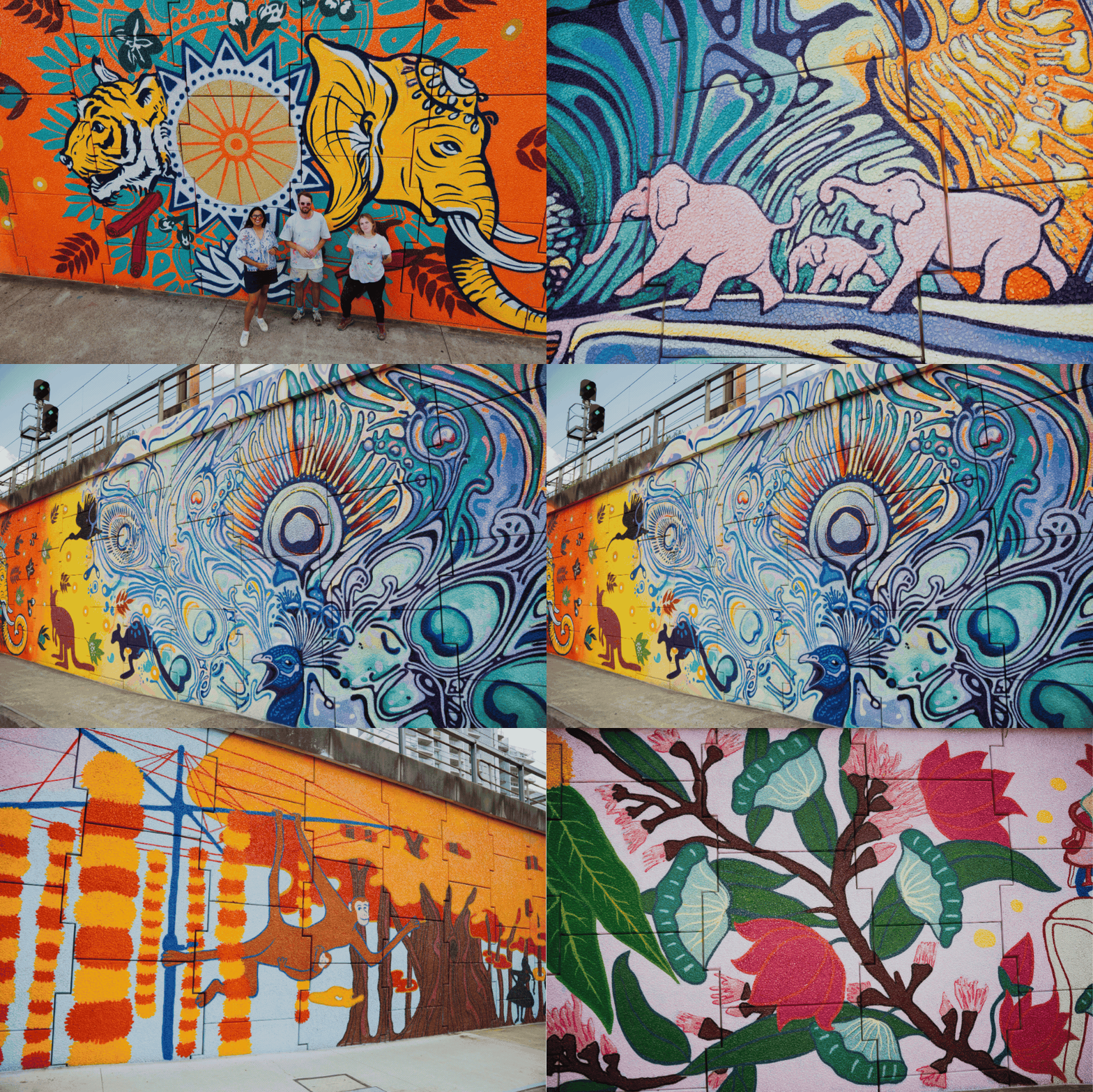
At the centre of the mural sits a powerful metaphor: food. Not as cliché, but as connection. Drawing from the Dharug meaning of Parramatta – “the meeting place of eels” – the three artists created a gathering scene around a radiant golden sun, sending spices and herbs outward. Indian elements such as chillies, cinnamon, cloves and anise sit alongside Lebanese olives and wheat, and native Australian ingredients like lemon myrtle. An elephant welcomes visitors with a garland, embodying ‘Atithi Devo Bhava’, the Indian ethos of hospitality.
(Source: Connor Neil)

Food, Torgalkar explains, is often the first entry point into culture – “No celebration is without food”. But here, it becomes something more: a shared language across communities.

That idea of coexistence runs throughout the mural. The duality of janmabhoomi (land of origin) and karmabhoomi (land of action) – a concept echoed by community members – is visually embedded across the work. Indian motifs are never isolated; they are always grounded in Australian contexts. Marigold garlands hang from a Hills Hoist. A monkey swings through a suburban backyard. Diwali lanterns illuminate heritage buildings. A peacock dances alongside a lyrebird.

Art attack

But not all stories are loud. Embedded within the mural are quieter, more intimate narratives: two girls practising Bharatanatyam, perhaps alongside ballet or jiu-jitsu, reflecting parents’ efforts to preserve culture through the next generation; children playing cricket under a banyan tree – a symbol both deeply Indian and universally communal.

If one looks closely, the mural’s structure carries meaning – it moves from sunrise to nightfall, becoming a metaphor for migration itself — “beginning with arrival… moving towards assimilation and adaptation… and then toward belonging,” Torgalkar tells Indian Link. The shifting colour palette mirrors this journey, evolving from cool morning tones to vibrant midday hues and softer evening shades.

For contemporary artist Em Hatton, navigating this complexity required restraint. “The highest priority for us has been in not coming in and making assumptions,” she says, particularly as someone outside the South Asian diaspora. Instead, her role became one of facilitation, centering community voices and ensuring that “all elements in the mural are directly related to stories from the community.”

Hatton’s own connection to the diaspora – through her South Indian Tamil partner’s family, who migrated to Western Sydney in the 1980s – also shaped her understanding. She speaks of the “third culture” experience, where second-generation individuals exist not within one identity, but a hybrid of both.
(Source: Connor Neil)

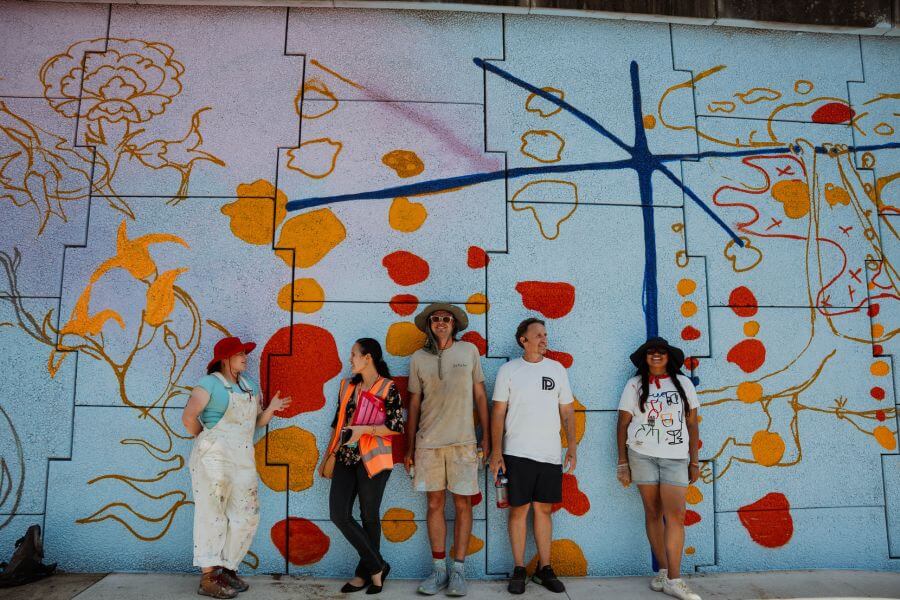
For Patrick Hunter, the scale of the mural offered a different kind of challenge. “At that size the mural becomes an environment rather than an image – you move through it, you don’t just look at it,” he shares.

Rather than pre-defining the entire composition, Hunter worked from sketches, allowing the piece to evolve organically. The key, he explains, was rhythm: “tension and release… areas of complexity that reward close looking, and then moments of breath”.

The left-most section of the mural, featuring the cockatoo surrounded by paisleys and floral motifs, was brought to life by community members, residents and shopkeepers.

“When people feel connected to a work, they care for it,” Torgalkar adds. “In that sense, this mural is not just for the community and of the community, but it is also, in part, created by the community, for all to experience.”

Read more: Gauri Torgalkar: An Australian floral tribute to Diwali

Solo travel: Unexpected life lessons in Botswana

0
Reading Time: 4 minutes


Part of the beauty of solo travel is the spontaneity that comes with the absence of meaningful guardrails. At its best, the abandonment of inhibitions means true escapism; money becomes monopoly money, strangers become friends, the next stop is wherever you want it to be. Even at its worst – when logic gives way to travel-induced insanity – you pick up life lessons and stories worth telling (even if sheepishly), as I was reminded on a recent trip to Botswana.

Botswana is a vast, dry, and startlingly beautiful country. Although synonymous with the Okavango Delta – the world’s largest inland delta – up to 90% of Botswana is covered by the Kalahari Desert. 

I arrived in Maun, the dusty safari gateway town, with no great ambition beyond seeing wildlife in Botswana’s ‘high cost, low impact’ model – fewer tourists, fewer jeeps. 

Any visitor to Africa needs to be comfortable with things not going to plan – TIA (This is Africa) is the refrain – but my first day was going particularly smoothly. I’d been upgraded on the way in, my driver was waiting at the airport, and at the pub, made fast friends with a South African mining entrepreneur, and a British expat from Singapore. 

But Africa has a way of cutting you down to size.

At some point in the night – lubricated by exceedingly cheap lagers – our South African friend offered us a lift. In Sydney, the response would be ‘No thanks mate, I’ll get an Uber’. Instead, here: ‘TIA, let’s go.’

Botswana solo travel
Sitting under the shade of a Moremi Baobab tree (Source: Supplied)

My hotel was just across the Thamalakane River, but the nearest bridge was 15 minutes away. ‘No matter, we’ll take the shortcut’ said our driver, seated in a Great Wall ute bearing very little structural similarity to a Landcruiser. It wouldn’t be my first time in a car driving through flowing waters in Africa, so I didn’t protest.

In hindsight, I should have.

Halfway across the river, the ute got stuck. Water was rising rapidly. My passenger side door would not open because of the pressure. As the driver forced his door open, the river rushed in with enough force to clarify the situation very quickly. We scrambled out and waded to shore in chest-deep water in darkness, shoes filling with mud, dignity dissolving. 

And this is where Botswana began handing out life lessons against my will.

Lesson one: You don’t need all the data

The corporate world loves complete datasets and 100-page slide decks before making decisions. But standing in a river in Botswana in the dead of the night, I was operating in what some might call a “limited data environment”.

Had I known, while still in the river, that it was home to hippos, crocodiles, and a history of recent fatal encounters, I may have made an even worse decision – such as climbing onto the vehicle and waiting there like a marinated entrée. 

Lesson two: Credentials matter

We all know someone who speaks with the confidence of a subject matter expert but has the qualifications of a Facebook comments section. Most of the time, they’re harmless. Occasionally, they drive you into a river at night in a vehicle that has no business being there.

If someone suggests a “shortcut” through moving water, a little due diligence helps. Questions like ‘Have you done this before?’ and ‘Could we die if you get it wrong?’ 

Solo travel Botswana
Spotting hippos during the Mokoro safari (Source: Supplied)

Lesson three: Be goal-oriented

Wading through the black river, I made the deeply unhelpful mistake of turning on my phone flashlight. Suddenly, every ripple became a potential apex predator. I quickly realised that with the light off, the situation downgraded from “blockbuster National Geographic documentary about natural selection” to “spontaneous night swim with consequences.”

With only my end goal – the shore – in mind, things were much less frightening.

Lesson four: nature reigns supreme

The absurdity of that first night could have easily set the tone for my time in Botswana, but it didn’t – over the next week, I saw the best of what Botswana had to offer.

At Moremi, we watched a pride of lions draped in the shadow of a tree in lazy intimacy, elephants appeared from all corners, zebra blocked paths with complete indifference, and towering baobabs stood watch in the distance. Across the Delta, the Mokoro safari was the true prize, my fingers trailing through glassy water as my poler steered us through reeds, keeping a respectful distance from nearby hippos. 

Across the Makgadikgadi Pans – amongst the largest salt pans on earth – the scene was like something out of a fairytale, replete with hundreds of elephants, hippos, zebras, wildebeest, and giraffes, but few predators. In the four hours we spent there, we saw no other vehicles; our only company for lunch was a series of elephants playfully passing by our jeep. 

Solo travel Botswana
Hippos in the river, zebras blocking the road, and vultures swooping on carcasses (Source: Supplied)

At the nearby and otherwise barren Nxai Pan, the watering holes absolutely teemed with life and death alike, as wildebeest, springbok and elephants sought an escape from the drought, while vultures feasted nearby on the carcasses of those who could not.

For all that Botswana taught me, the biggest lesson was that nature is both remarkably beautiful, and completely uninterested in your plans.

TRAVEL NOTEBOOK

Best time: July – September for peak water levels and wildlife.

Getting there: Fly Australia → Johannesburg → Maun (gateway to the Delta).

Stay: Base yourself outside Maun (except for Magkadikadi and a helicopter ride over the Delta). Aim for Moremi, Chobe or Chief’s Island.

Cost: ~$3,500–$4,500 per person for a 5‑day shared safari (more for premium lodges, less for camping).

READ ALSO: Along the Silk Road’s living cities


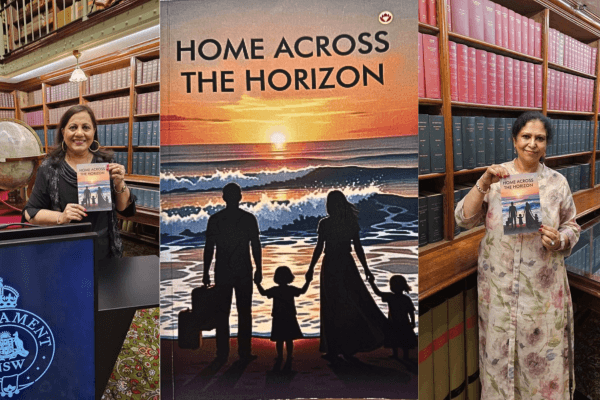
ILASA’s Home Across the Horizons: A review

0
home across the horizon
Reading Time: 5 minutes


The book Home Across the Horizons, produced by the Indian Literary and Art Society of Australia (ILASA), lands in interesting times. As migrants – especially those of Indian origin – continue to hear variations of “You don’t belong here” and “We’re full”, this anthology of short stories gently shifts the focus, exploring what the idea of “home” might mean to diasporic writers.

Across thirty-two stories, South Asian writers trace journeys of home, homecoming, home-building, and being unhomed. Together these stories explain (Hamsa Venkat), inform (Indranil Halder), chill (Gwen Bitti), disturb (Hasitha Adhikariarachchi), befuddle (Sydney Srinivas), intrigue (Vibhavari Das Singh), delight (Sumathi Krishnan), and inspire awe (Uma and the many ways we leave, arrive, and return to ourselves. Even if we’ve never crossed borders.

Building home, brick by brick

In Hriday Nayyar’s story, an international student toils away, balancing work and study, financial pressures and loneliness. It’s the very same grind in Pankaj Upadhyay’s piece, where a small-town youth arrives in Mumbai chasing the promise of a better life. In Pooja Anantha’s work, a young couple move through heartbreak and hope on their IVF journey – each step marked by quiet endurance. There’s struggle, but also the discipline of persevering. Home, here, is not inherited – it is built, painstakingly, through uncertainty, sacrifice, and small, stubborn acts of belief. And yet, years later, the toil finds its answer: in a quiet moment by Sydney Harbour; in a mentoring session that comes full circle in Mumbai; in a young family realising they were given a garden when they had only asked for a single flower.

home across the horizons
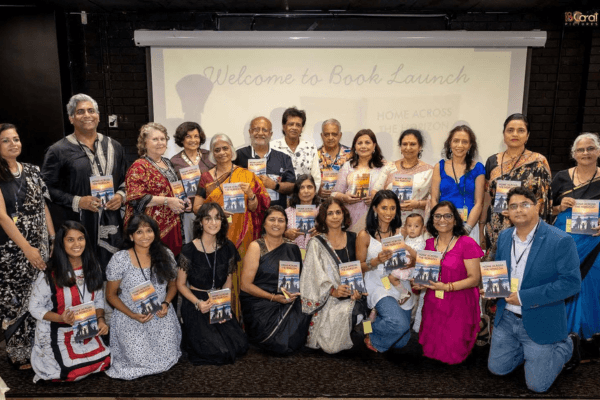
Authors with a copy of the book at the launch event (Source: Supplied)

The ache of elsewhere

The pull of “where I come from” meanders through many stories in the anthology. For writer Devaki, a chance sip of chai comforts and rejuvenates; for Rajeshwari Jayadev, the scent of jasmine becomes a bridge home. For Rekha Rajvanshi, a passing resemblance sparks memories of familial warmth, while for Hasitha Adhikariarachchi and Samantha Sirimanne Hyde, the civil war in Sri Lanka endures as a story that insists on being told. For many migrant writers, memory becomes a creative archive. Distance gives clarity: things once commonplace – smells, gestures, idioms – gain texture and meaning. Writing becomes a way to hold on to what risks fading, to preserve a self that might be diluted in new environs. “Back home” helps locate identity when much else is in flux.

home across the horizons
Anu Shivaram and Rekha Rajvanshi at the launch event (Source: Supplied)

Outsiderhood

Alienation is another oft-visited theme. The Madman of Barahdwari (Meena Mahanty Kumar), and the Witch of Karla (Preeti D’silva) are both shunned by their own for most of their lives, but find recognition in kindred spirits. Alienation is not always about distance from a place, but distance from belonging itself – of being made to feel like an outsider even within what should have been home. In migration, this dissonance sharpens: home is less a given, and more a shifting space one must constantly negotiate. 

Making peace with place

And then begins the psychological work of migration – of acceptance, reconciliation, and, eventually, allegiance. Acceptance arrives first, often quietly: a recognition of where one stands, and a willingness to inhabit it. (In Shipra Tewani’s story, the protagonist finally arrives at a sense of home after eleven years of troubled marriage marked by indifference, distance, and disease. Similarly, Sonu Sarda’s protagonist comes into her own when she decides she has had enough of her philandering partner.) 

home across the horizons
Rekha Rajvanshi with other diaspora authors (Source: Supplied)

Reconciliation follows, more layered, as migrants make peace with what has been left behind and what has been gained, holding both without letting one diminish the other. (For writer Usha Salagame’s character, despondent after a trip back “home” to India, a warm welcome from an immigration officer at Sydney airport is enough to settle where “home” truly lies. And in Sharon Rundle’s story, a father finally comes to terms with how his dying daughter wishes to be farewelled). 

And over time, something deeper takes root – an allegiance not born of origin, but of experience, of living and investing in a place until it begins, slowly, to feel like one’s own. Author Savitha Narayan brings this to life through a protagonist who makes a horrific decision in defence of her adopted country. In Alok Roy’s well-told story, an early Indian migrant’s English language test is revisited two generations later – with a surprising reversal of roles. In Jyotsna Jyoti’s tale, an Indian family forms an unlikely bond with resentful neighbours, over a game of cricket. In Hamsa Venkat’s piece, a diehard Bharatanatyam devotee, exposed to a variety of new genres, understands that all forms of dance are but a “language of the soul.” In Mekhala Ramprakash’s work, an Indian character gains an uplifting new perspective on death – and life – from her elderly Aussie neighbours. And in Vibhavari Das Singh’s story, the quiet pull of ancestors is felt wherever home is made, even if only temporarily. And saving the best for last, for 16-year-old writer Sanjana Vishal, home is where you are happiest, such as in the world of books and stories, even if it is your last day on earth.

In the dim light, her gaze fixed on a sterile, rectangular table, and carefully placed on it, a hardbound book with intricate detailing. She smiled, letting her final thoughts drift into a sanctuary of imagination.

home across the horizons
Rekha Rajvanshi at the NSW Parliament launch (Source: Supplied)

Home as belonging

Together, these stories edited by Anu Shivaram map the emotional geography of being human – the pull of roots, the courage of departure, and the fragile, hopeful work of making a life anew. They remind us that home is less about where we come from, and more about where we are allowed to belong. In the end, they challenge how we speak about migration. They make it harder to say, “We’re full”, because home is not a fixed place to be protected, but a living idea, shaped by those who arrive and those who receive. 

Set against today’s migration debate, Home Across the Horizons is the insight matters. Learn more about ILASA here.

READ ALSO: Book Review: Mother Mary Comes to Me

When heavy periods are treated as ‘woman’s fate’

0
Heavy periods
Reading Time: 4 minutes

Heavy periods

In many families, heavy periods are not seen as a health issue, but accepted as part of being a woman. Girls are told to be brave, young women that it will settle, and mothers that it is normal after childbirth. So life goes on – work, study, school runs, social events – while managing pain, exhaustion, and constant anxiety. Yet this quiet burden is widespread. In Australia, around one in four females experience heavy periods, with recognised impacts on physical, emotional, social, and economic wellbeing.

When “just a period” begins to run your life Heavy periods

Heavy menstrual bleeding is not just about volume – it is defined by its impact on quality of life. It may involve frequent changes of protection, prolonged bleeding, large clots, or structuring daily life around fear of leaks. It can also lead to iron deficiency and anaemia, causing fatigue, dizziness, and reduced functioning. The national consumer guide notes that nearly two-thirds of women with heavy menstrual bleeding are iron deficient.

This is not a minor inconvenience. It is the student afraid to stand in class, the woman in a meeting worrying about stains, the mother planning her day around her body. When bleeding dictates what a woman wears, where she goes, how she sleeps, and whether she can leave home comfortably, it is no longer “just a period.” It is a health issue.

The silence is costing women dearly

The burden is significant, yet many women still do not seek help. A national survey by Jean Hailes (a not-for-profit dedicated to women’s health) found that 78% of Australian women aged 18–44 had experienced painful, irregular or heavy periods in the past five years. Of those affected, 75% said symptoms disrupted daily life, 44% had to pause work or study, and 58% reported impacts on mental wellbeing. Yet only 56% had spoken to a doctor.

That gap matters. It means women are normalising suffering that is often treatable, losing years to fatigue, pain, and delayed diagnosis. Many who do not seek help believe nothing can be done, or feel too embarrassed to ask.

When culture teaches women to endure

For women from culturally and linguistically diverse communities, the silence can run deeper. Not because culture is the problem, but because stigma, modesty, misinformation, and practical barriers can keep treatable conditions hidden. Research shows CALD women may face taboos around discussing such issues, along with language, financial, and access barriers. In practice, this can mean reluctance to seek care, fear of examinations, or uncertainty about the health system. Many are managing not just symptoms, but silence, stigma, and confusion – allowing heavy bleeding to be quietly normalised.

The price of bleeding quietly

Heavy periods also come with a cost that is rarely discussed openly. There is missed work, reduced productivity and poorer concentration. There is also the monthly household cost of pads, tampons, period underwear, pain relief, iron tablets, extra washing and spare clothing. Jean Hailes notes survey findings that 55% of respondents had missed work because of their period, and reporting on the same issue has estimated the economic burden of problematic periods in Australia at around A$14 billion a year. 

Heavy periods
Planning what you wear, where you go and what you do around your period suggests you might be facing a health issue (Source: Canva)

For many women, especially in a cost-of-living crisis, this is not a minor expense. It is another pressure added to an already exhausting experience.

Heavy bleeding can be a warning sign Heavy periods

Heavy bleeding can happen for many reasons. Healthdirect (a government-funded virtual health service) lists causes including hormone imbalance, fibroids, polyps, adenomyosis, endometriosis, thyroid problems, bleeding disorders and some medicines such as blood thinners. Australian longitudinal research has also shown that heavy menstrual bleeding becomes more common with age, rising from 17.6% at age 22 to 39.3% at age 48 among menstruating women, and is associated with poorer quality of life. 

Common does not mean harmless. Sometimes heavy bleeding is the first clue that something more is going on. Heavy periods

The conversation that can change everything

The good news is that women do not have to simply endure it. Australia’s Heavy Menstrual Bleeding Clinical Care Standard says women should be offered the least invasive and most effective treatment appropriate to their needs and preferences and supported to make informed choices. Treatment can include iron replacement, anti-inflammatory medicines, tranexamic acid, hormonal treatment, a hormone-releasing IUD, and in some cases procedures or surgery. 

If your periods are affecting your work, study, sleep, exercise, relationships or peace of mind, that is reason enough to seek help. Keep a simple record of how long you bleed, how often you change products, whether you pass clots, and whether you feel dizzy or exhausted. Take it to your GP. And if you are not heard, seek a second opinion. Women deserve better than being told to “put up with it.” They deserve answers, options and care.  Heavy periods

READ MORE: When periods begin, autism changes everything

Come on Angus Taylor, you can do better

0
Angus Taylor
Reading Time: 2 minutes

Angus Taylor’s immigration policy


View this post on Instagram


A post shared by Indian Link (@indianlink)

With the newly announced migration policy by the Liberal Party, it is a race to the bottom – and Angus Taylor and Pauline Hanson are both sprinting.

Taylors newly unveiled migration policy – is being sold as “strong” and “practical,” but it seems less like mainstream economic management and more like an audition tape for One Nation.

And if there’s one thing history shows, it’s that voters rarely reward the back-up band over the original act.

Because here’s the thing: when the Liberal Party starts sounding like One Nation, voters don’t think, “Wow, bold reinvention.” They think, “Why not just go for the original?”

Migration does strain systems, sure, but casting it as the root of all economic problems is both simplistic and misplaced.

And if this all feels familiar, that’s because we’ve seen the movie overseas – and it’s not exactly a box office hit.

In the US, Donald Trump built an entire political brand on going hard against migration. It fired up crowds, sure – but governing? That turned into chaos, division, and policies that proved unsustainable.

Then there’s Brexit – sold as “taking back control.” Fast forward, and Britain’s still trying to figure out who’s going to drive the trucks, staff the hospitals, and keep the economy from quietly wheezing in the corner. Turns out slogans don’t come with a workforce.

And this is the trap regarding Angus Taylor’s immigration policy, once you go down the fear-and-blame route, you can’t really climb back out.

If the Liberal Party wants to lead, it needs to sound like itself again: serious, solutions-focused, and not auditioning for someone else’s base.

A smarter approach would be to lean into what the Liberals have traditionally done well: acknowledge the pressures, invest in solutions, and keep the focus on economic results, not culture wars.

Because if there’s one consistent lesson from overseas, it’s this: negative leadership might win a headline, but it rarely wins the debate.

READ MORE: Middle East war: Uncertainty today, strength tomorrow

South Asian links at MWF and SWF 2026

0
Nikita Gill and guests at Melbourne Writers Festival Sydney Writers Festival 2026
Reading Time: 3 minutes

Turn the page on this year’s Melbourne and Sydney Writers Festivals, with headline international guest, Irish-Indian poet Nikita Gill, set to share her bestseller ‘Hekate’ with audiences in both cities, and lots of interesting stories from local writers across fiction and non-fiction writing.

The Melbourne Writers Festival runs from May 7th-10th, and the Sydney Writers Festival is on from May 17th-24th. Melbourne and Sydney Writers Festival 2026

NIKITA GILL

Melbourne  | Sydney

Nikita Gill Melbourne Writers Fest

The Sunday Times-bestselling author of eight poetry anthologies, Irish-Indian poet Nikita Gill is making a highly anticipated stopover at both Melbourne and Sydney writers festivals to share insights on myth and feminist reimagining.

AHONA GUHA

Melbourne | Sydney

Dr Ahona Guha Writers Fest

Clinical and forensic psychologist Ahona Guha will talk about her book, ‘How We Relate’ and navigating loss and resilience.

AVANI DIAS

Sydney

Avani Dias

The former ABC South Asia correspondent joins acclaimed journalists to talk about the stories that changed their life.

AMITAV GHOSH

Sydney

Amitav Ghosh

Don’t miss Jnanpith Award winner Amitav Ghosh as he reflects on his career in both fiction and non-fiction.

DINUKA MCKENZIE

Sydney 

Dinuka Mckenzie

Festival regular and author of the Detective Kate Miles series returns to lead a conversation about writing crime from a First Nations perspective.

MICHELLE DE KRETSER

Sydney

Michelle De Kretser

University of Sydney honorary associate Michelle De Kretser will be in conversation with the 2025 Booker prize winner on identity.

NIRAJ LAL

Melbourne 

Niraj Lal

Host of the ABC Kids podcast Imagine This brings some primary school imagination and insights about current affairs.

OSMAN FARUQI

Melbourne 

Osman Faruqi

Journalist and editor of Lamestream Media chats with fellow indie journalists about our media landscape. Melbourne and Sydney Writers Festival 2026

PRANATI NARAYAN VISWESWARAN

Melbourne 

PRANATI NARAYAN VISWESWARAN

The self-described culture junkie is here to celebrate cutting-edge new works and talent.

S. SHAKTHIDHARAN

Sydney 

S Shakthidharan headshot source supplied

Fresh off the back of his Windham-Campbell prize win, the playwright reflects on his debut memoir and family secrets.

SHANKARI CHANDRAN

Sydney

Shankari Chandran
Shankari Chandran (Source: Instagram)

Miles Franklin winner from Canberra shares her words of courage for the closing address of the festival.

SOOLAGNA MAJUMDAR

Melbourne

SOOLAGNA MAJUMDAR

The Kolkata-born, Perth raised comic artist shares pieces from forthcoming work Food Bird.

TASNEEM CHOPRA OAM

Melbourne

Tasneem Chopra OAM

The acclaimed cultural consultant will lead a conversation with two fierce women who refuse to back down. Melbourne and Sydney Writers Festival 2026

India significantly rolls back transgender people’s rights

0
(Source: Canva)
Reading Time: 3 minutes


Little did I know, when I wrote a glowing article in February on the slow but steady legal wins for LGBTQIA+ people in India, that the Indian Parliament would soon pass sweeping rollbacks to the Transgender Persons (Protection of Rights) Act 2019 (Original Act). 

The new Transgender Persons (Protection of Rights) Amendment Act 2026 (Amending Act), attracted widespread condemnation from opposition politicians, media outlets, human rights organisations, and LGBTQIA+ activists, commentators and allies globally. It has drawn the ire of well-known personalities from Sushant Divgikr and Trinetra, to Rajya Sabha (Upper House) member and actress, Jaya Bachchan, whose speech in Parliament lambasting the bill has gone viral. 

The original Act was prompted by a landmark Supreme Court of India decision in 2014, which found that transgender people were entitled to fundamental rights under the Indian Constitution. They had the rights to self-identification, equality and non-discrimination, and as socially and economically backward classes, should be given reservations for educational and employment opportunities.

In 2019, the original Act was passed, introducing protections from discrimination when accessing goods and services, finding a place to live, and in relation to employment and education.

The Act also introduced protections from forced and bonded labour, and established a National Council for Transgender Persons to advise and review policies, laws and programmes relating to transgender people. These measures were designed to address the widespread marginalisation, threats to safety and significant socio-economic disadvantage many trans Indians faced across the country.

The original Act defined a transgender person as “a person whose gender does not match with the gender assigned at birth and includes trans-man or trans-woman (whether or not such person has undergone Sex Reassignment Surgery or hormone therapy or laser therapy or such other therapy), person with intersex variations, genderqueer and person having such socio-cultural identities as kinner, hijra, aravani and jogta.”

This approach was broadly consistent with the definition in the widely recognised Yogyakarta Principles of 2006, which sets out how to apply international human rights law to sexual orientation and gender identity.

The original Act formalised the right to self-perceived gender identity for trans Indians seeking a certificate to recognise their identity. By comparison, New South Wales has only recognised self-identification (without the need for surgery) for change in gender marker and names on birth certificates last year – meaning India was ahead of some Australian governments!


View this post on Instagram


A post shared by Pride in Protest (@pride.in.protest)

Transgender rights india

The amending Act removes the right to self-identification, instead requiring medical experts to determine the gender identity of those seeking a certificate of identity from a District Magistrate. Further, the amended definition of transgender person is significantly narrower than the original, with just kinner, hijra, aravani and jogta groups and intersex people included. It also includes eunuchs (which technically means people who have been castrated) and people who have been forced into changing their gender identity.

Many transgender people do not fall into any of these categories and yet still face social barriers, family rejection and exploitation. Whole swathes of trans Indians have now lost hard-won legal protections and welfare entitlements.

Medical practitioners may now be deterred from delivering gender affirming care, with hospitals now required to report private medical information to officials. 

Equally, issues around force or inducement, and the mental capacity of those undertaking surgery should be assessed on a case-by-case basis with professional judgment, rather than being addressed through a blanket, paternalistic approach.

Further, conflating intersex people with transgender people is also inaccurate, given intersex people are those with a variation of biological sex characteristics, unlike the widely accepted definition of transgender people explained earlier.  

The trap India may be falling into, as it seeks to become a top three economy and lift living standards for hundreds of millions, is being caught up in manufactured culture wars imported from the West. Indian civilisations have long recognised diversity, including around gender identity. With the Government delayed in its $5 trillion GDP target, sky-high rates of pollution and an Indian rupee in free-fall, we instead have yet another minority whose rights are being toyed with.

Pax Silica: What India actually signed

0
Pax Silica
Reading Time: 3 minutes


For most of India’s Independent life, non-alignment wasn’t just a foreign policy, it was a point of pride and built into the country’s bones. For generations of Indians who grew up with that policy, it became a part of how they understood India – principled, sovereign, and no singular country’s ally. In February 2026, India signed onto Pax Silica, a US-led technology and supply chain initiative anchored around AI, semiconductors, critical minerals, and energy. For a community watching a world that feels increasingly like it is sorting itself into sides, and watching the news wondering what comes next, it is worth understanding what India actually walked into and what it is betting on getting out of it. 

The reaction was swift. Popular media and social platforms framed it as a semiconductor alliance, a powerful new bloc tightening its grip on global chip supply chains. However, it wasn’t the narrative Washington and New Delhi were telling. In the Declaration, the word “Artificial Intelligence” appears five times, whereas the word “Semiconductors” only appears once. AI runs on silicon, critical minerals, semiconductors, and resilient supply chains. Pax Silica isn’t only about semiconductors, or chips, or minerals, but about the end-to-end process of mining and processing critical minerals to manufacture chips for AI systems. 

Pax Silica
India signed the Pax Silica declaration on the final day of the AI Impact Summit in February 2026 (Source: Press Information Bureau)

Pax Silica

Established in December 2025, Pax Silica aims to secure critical technology supply chains and counter China’s dominance in AI and hardware. Australia is a founding member alongside the United States, Japan, South Korea, Singapore, the United Kingdom, and Israel, among other signatories. India’s entry is a significant addition, as a large non-Western democracy with no mutual-defence treaty with the US, bringing reserves and a massive talent pool. It raises questions about India’s multi-alignment strategy and how far New Delhi is willing to collaborate with Washington on trade and security. 

India’s entry ticket is its rare earth reserves, critical minerals processing ambition, and a vast talent pool for research and development. India holds the third-largest rare earth reserves by most estimates, yet accounts for less than 1% of global mining output. Australia, by contrast, has an established mining and processing foundation. The two countries have had a formal Critical Minerals Investment Partnership since 2022 with the goal of strengthening the supply chains and investment in critical minerals projects. The $250 million Pax Silica Fund, the US State Department’s flagship effort on AI and supply chain security aims to address the risks of diversifying supply chains by creating a trusted network for trade. However, whether the fund supports India’s ambitions of becoming a processing partner depends on whether India is able to leverage the Fund’s goal of securing supply chains to build its processing capacity. That said, the fund still requires Congressional approval, and has no guarantee in the current US fiscal environment. 

This gap between India’s reserves and its processing reality is where Pax Silica’s founding members hold the most leverage over India’s ambitions. But the minerals discussion is part of a larger question – one that matters directly to Indians and Australians working in technology, research and innovation. Who gets to have a say in how AI is developed and deployed? If the US, UK, and Japan amongst other key players in AI continue to set the rules for how AI is developed and deployed, Indian and Australian professionals may find themselves compromising within a framework that doesn’t fully support their ambitions. Through this partnership, India has a chance to establish itself as a credible partner in the AI ecosystem, not just a provider of raw materials and human resources. 

The Pax Silica Declaration is almost four months old. The Pax Silica Fund is relatively newer – announced in late March 2026, only weeks after India signed the Declaration. India’s joining of Pax Silica is perhaps better viewed as an audition. Joining an initiative where the norms, rules, and goals are all pre-determined, India will have to convert its mineral reserves and talent pool into genuine influence over how the initiative evolves. How the Fund’s contracts are structured and whether they align with India’s processing ambitions will be the first real answer. What India actually signed is clearer than what India will get out of it. 

Tanisha Shah is a Masters of International Relations student at The University of Sydney. 

READ ALSO: Rare earths and realpolitik

When AI starts shopping for you, fashion may be entering a new era of pricing

0
Reading Time: 3 minutes


Fashion has always been a bit different to other industries. Consumers do not just buy because they need something. They buy because they are bored, influenced or simply browsing.

That makes it a perfect space for technologies designed to shape how we shop. Fashion sales are driven by cyclical trends and volume.

Much of the industry depends on overproduction, followed by constant cycles of discounting to clear stock. Sales are not just occasional events. They are built into how the system operates.

And now, a new layer of AI technology is starting to turbocharge that system.

Pricing is already starting to change

Dynamic pricing has been around for years. We see it most clearly with flights and ride sharing, where prices often increase the more you search, especially when there is a clear intention to pay for the service.

But in fashion, demand is not always tied to necessity. Because of this, pricing does not just reward urgency. It can also reward patience.

AI in fashion pricing
Digital e-commerce platforms are increasingly using AI technology to influence consumers (Source: Canva)

This suggests that dynamic pricing in fashion is not simply about pushing prices up. It is about constantly adjusting them to keep products moving.

A recent report from Business Insider in the United States shows how dynamic pricing is already taking hold in fashion retail. Prices of items sitting in an online cart at a major clothing retailer changed multiple times over a few days. Sometimes they went up, sometimes they dropped. In some instances, waiting resulted in a discount of up to 17%.

As this becomes more common, shopping will feel less like a simple decision and more like timing a system.

In Australia, the consumer watchdog does not consider dynamic pricing inherently unlawful. Broader data-use guidelines around pricing are not yet comprehensive.

When the bot does the shopping

At first glance, new AI tools for online shopping seem focused on convenience.

Virtual try-ons are becoming more realistic, allowing people to see how garments fit and drape on their own bodies. This could help reduce returns, which are a costly burden to retailers.

But companies like Google are taking this a step further. You can try items on, set the price you are willing to pay, and the system will track it, notify you when it hits that price, and even complete the purchase if you give permission.

What starts as a tool for convenience quickly becomes something more. You’re not even actively shopping anymore, your bot is purchasing on your behalf.

This is part of a broader shift towards what is called “agentic commerce”, where an AI agent acts on your behalf based on pre-set preferences.


View this post on Instagram


A post shared by McKinsey & Company (@mckinseyco)

Is the consumer setting the price?

Using a shopping agent changes how dynamic pricing works.

Traditionally, brands set prices and adjust them based on demand, inventory and consumer behaviour. But in this emerging model, consumers are also feeding into that system directly by stating what they are willing to pay.

At first, this feels empowering. It sounds like consumers are gaining more control. But it also creates a new dynamic.

Who’s really in control of pricing if both sides are driven by AI?

If someone sets a price they are comfortable with, the system can complete the purchase as soon as that price is reached. But the price might have dropped even lower if that data was not available.

In effect, consumers may be setting their own limits without realising it.

AI in fashion pricing
Your carts, and your clicks are being monitored by AI agents (Source: Canva)

This creates a feedback loop. Retailers optimise prices using data, while consumers provide their own price thresholds. Both sides are guided by algorithms and the final outcome sits somewhere in between.

The question is no longer just how prices are set, but who is really influencing them.

Convenience meets over-consumption

There are clear benefits to this shift. Automating purchases could make everyday shopping easier.

But in fashion, where consumption is already high, tech tools that make pricing feel more personalised or within reach are unlikely to reduce consumption. They may even encourage overconsumption.

Consumers should be mindful not to let the apparent convenience of shopping bots and personalised pricing alerts lead to a rise in impulse purchases.

This article first appeared on The Conversation, written by Aayushi Badhwar, Lecturer in Enterprise and technology, RMIT University. Read original article here.

READ ALSO: Ads are coming to AI, but is it really such a bad thing?

Hovering too close: the problem with helicopter parenting

0
helicopter parenting
Reading Time: 4 minutes


In many Indian families, parenting is not just a responsibility; it becomes a life mission. We want our children to have what we didn’t, we plan every step, and we worry about every risk. We tell ourselves we are being caring, involved, and protective. But sometimes, without realising it, love turns into constant control. That is when parenting begins to hover.

Helicopter parenting means staying so closely involved in a child’s life that the child has little room to think, choose, fail, recover, and grow. It is not about one moment of helping; it is about a pattern of stepping in too quickly, too often, and too strongly. In our work as medical practitioners in Melbourne, we see this frequently in South Asian families, including Indian households, especially as children reach their teenage years and academic pressure rises.

Parents often don’t recognise it because it looks like responsibility. It sounds like devotion. But the impact on children can be the opposite of what parents intend.

What helicopter parenting looks like at home

Many parents will say, “That’s not me.” Yet the signs are often everyday habits. If you decide your child’s friends, constantly monitor where they are, direct how they should play, and control every hour of their study routine, you may be hovering. If your child faces a conflict and your first instinct is to call the teacher, message the coach, or fix the situation before your child speaks for themselves, you may be hovering. If you routinely step in so your child never feels discomfort, embarrassment, or failure, you may be hovering.

There is also a stronger version of helicopter parenting that is quietly growing: parents who don’t just hover but remove every obstacle before the child reaches it. The intention is to smooth the path. The result is that the child never learns how to walk the path.


View this post on Instagram


A post shared by Dr. Ririi Trivedi (@ririitrivedi)

Why Indian parents hover more than they think

Indian parenting is rich in warmth, closeness, and sacrifice. But it is also shaped by pressure. “Log kya kahenge (What will people say?”) is not just a phrase; it becomes a silent scorecard. Marks are not merely indicators of current academic ability – they are status, security, and sometimes indicators of self-worth. Many parents who struggled early in life or built stability through education naturally fear that one wrong step will ruin a child’s future. Add social media comparisons and constant talk of “success,” and hovering can feel like love.

But constant parental oversight – watching, correcting, and intervening – can lead a child to internalise a limiting belief: “I can’t do life without you.”

The real cost: Confidence, calm and coping

Children build confidence by doing. By trying. By failing in small ways. By learning how to fix mistakes. When parents take over decisions and problems, children lose those chances.

Over time, helicopter parenting can make a child anxious, because the world begins to feel unsafe. If parents behave as if every problem is a crisis, the child’s mind learns to treat problems as threats. Some children become perfectionistic and afraid to make mistakes. Some become indecisive, always needing reassurance. Some appear high achieving, but inside they feel fragile.

In older students, we have seen academic stress become so intense that it shows up physically: racing heartbeat, breathlessness, panic-like episodes. The pressure around Years 11 and 12 can become especially heavy in homes where VCE/HSC is treated as a make-or-break moment. It is important to remember that Year 12 results matter, but they are not the only test of life. A child who learns resilience and self-management will face life’s bigger tests with far more strength than a child who simply learns how to fear failure.

over protective parenting
Give your child the space to fail, and then learn from that failure. (Source: Canva)

A simple mirror: The Sleepover Test

Here is a gentle question for many Indian families: would you allow your child to stay at a friend’s house for a sleepover? For some parents, the idea feels uncomfortable. But a safe sleepover is not just fun. It teaches independence, manners, social confidence, and responsibility away from the comfort of parents. It is a small rehearsal for adulthood.

Independence does not begin suddenly at 18. It is built slowly, through everyday freedom.

Let them fall – but be the net

The message here is not to “leave the children alone.” Instead, it is: stop holding the steering wheel of their life. Think of your child like a tightrope walker. If you hold their hand every step, they may reach the end, but they won’t develop balance. If you become the safety net instead, they will fall at times, but they will learn. They will get back up. They will grow steadier. And one day they will walk with confidence because they know, deep inside, “I can do it.”

Good parenting is not about removing all hardship. It is about building capability.

Our job as parents is to put ourselves out of a job – not by withdrawing love, but by raising children who can stand strong with our support, not our control.

READ ALSO: When periods begin, autism changes everything