


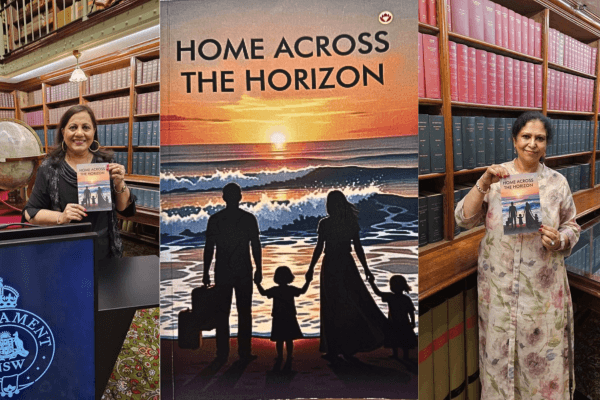

The book Home Across the Horizons, produced by the Indian Literary and Art Society of Australia (ILASA), lands in interesting times. As migrants – especially those of Indian origin – continue to hear variations of “You don’t belong here” and “We’re full”, this anthology of short stories gently shifts the focus, exploring what the idea of “home” might mean to diasporic writers.
Across thirty-two stories, South Asian writers trace journeys of home, homecoming, home-building, and being unhomed. Together these stories explain (Hamsa Venkat), inform (Indranil Halder), chill (Gwen Bitti), disturb (Hasitha Adhikariarachchi), befuddle (Sydney Srinivas), intrigue (Vibhavari Das Singh), delight (Sumathi Krishnan), and inspire awe (Uma and the many ways we leave, arrive, and return to ourselves. Even if we’ve never crossed borders.
Building home, brick by brick
In Hriday Nayyar’s story, an international student toils away, balancing work and study, financial pressures and loneliness. It’s the very same grind in Pankaj Upadhyay’s piece, where a small-town youth arrives in Mumbai chasing the promise of a better life. In Pooja Anantha’s work, a young couple move through heartbreak and hope on their IVF journey – each step marked by quiet endurance. There’s struggle, but also the discipline of persevering. Home, here, is not inherited – it is built, painstakingly, through uncertainty, sacrifice, and small, stubborn acts of belief. And yet, years later, the toil finds its answer: in a quiet moment by Sydney Harbour; in a mentoring session that comes full circle in Mumbai; in a young family realising they were given a garden when they had only asked for a single flower.
The ache of elsewhere
The pull of “where I come from” meanders through many stories in the anthology. For writer Devaki, a chance sip of chai comforts and rejuvenates; for Rajeshwari Jayadev, the scent of jasmine becomes a bridge home. For Rekha Rajvanshi, a passing resemblance sparks memories of familial warmth, while for Hasitha Adhikariarachchi and Samantha Sirimanne Hyde, the civil war in Sri Lanka endures as a story that insists on being told. For many migrant writers, memory becomes a creative archive. Distance gives clarity: things once commonplace – smells, gestures, idioms – gain texture and meaning. Writing becomes a way to hold on to what risks fading, to preserve a self that might be diluted in new environs. “Back home” helps locate identity when much else is in flux.
Outsiderhood
Alienation is another oft-visited theme. The Madman of Barahdwari (Meena Mahanty Kumar), and the Witch of Karla (Preeti D’silva) are both shunned by their own for most of their lives, but find recognition in kindred spirits. Alienation is not always about distance from a place, but distance from belonging itself – of being made to feel like an outsider even within what should have been home. In migration, this dissonance sharpens: home is less a given, and more a shifting space one must constantly negotiate.
Making peace with place
And then begins the psychological work of migration – of acceptance, reconciliation, and, eventually, allegiance. Acceptance arrives first, often quietly: a recognition of where one stands, and a willingness to inhabit it. (In Shipra Tewani’s story, the protagonist finally arrives at a sense of home after eleven years of troubled marriage marked by indifference, distance, and disease. Similarly, Sonu Sarda’s protagonist comes into her own when she decides she has had enough of her philandering partner.)
Reconciliation follows, more layered, as migrants make peace with what has been left behind and what has been gained, holding both without letting one diminish the other. (For writer Usha Salagame’s character, despondent after a trip back “home” to India, a warm welcome from an immigration officer at Sydney airport is enough to settle where “home” truly lies. And in Sharon Rundle’s story, a father finally comes to terms with how his dying daughter wishes to be farewelled).
And over time, something deeper takes root – an allegiance not born of origin, but of experience, of living and investing in a place until it begins, slowly, to feel like one’s own. Author Savitha Narayan brings this to life through a protagonist who makes a horrific decision in defence of her adopted country. In Alok Roy’s well-told story, an early Indian migrant’s English language test is revisited two generations later – with a surprising reversal of roles. In Jyotsna Jyoti’s tale, an Indian family forms an unlikely bond with resentful neighbours, over a game of cricket. In Hamsa Venkat’s piece, a diehard Bharatanatyam devotee, exposed to a variety of new genres, understands that all forms of dance are but a “language of the soul.” In Mekhala Ramprakash’s work, an Indian character gains an uplifting new perspective on death – and life – from her elderly Aussie neighbours. And in Vibhavari Das Singh’s story, the quiet pull of ancestors is felt wherever home is made, even if only temporarily. And saving the best for last, for 16-year-old writer Sanjana Vishal, home is where you are happiest, such as in the world of books and stories, even if it is your last day on earth.
In the dim light, her gaze fixed on a sterile, rectangular table, and carefully placed on it, a hardbound book with intricate detailing. She smiled, letting her final thoughts drift into a sanctuary of imagination.

Home as belonging
Together, these stories edited by Anu Shivaram map the emotional geography of being human – the pull of roots, the courage of departure, and the fragile, hopeful work of making a life anew. They remind us that home is less about where we come from, and more about where we are allowed to belong. In the end, they challenge how we speak about migration. They make it harder to say, “We’re full”, because home is not a fixed place to be protected, but a living idea, shaped by those who arrive and those who receive.
Set against today’s migration debate, Home Across the Horizons is the insight matters. Learn more about ILASA here.
READ ALSO: Book Review: Mother Mary Comes to Me