


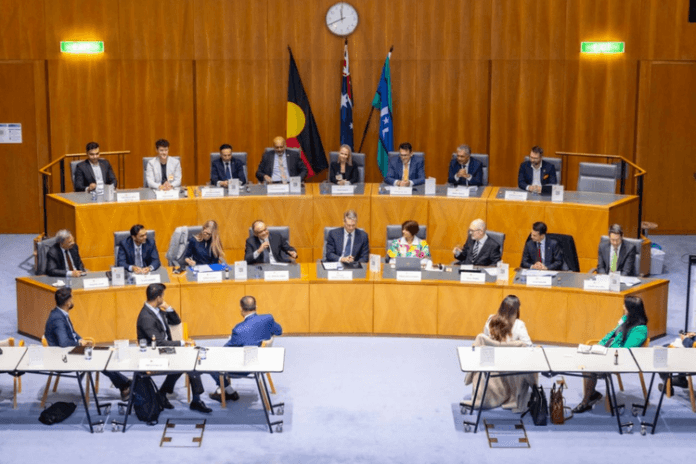

IABCA Canberra Roundtable
How prepared is Australia to engage with India?
According to more than 100 senior government, business and policy leaders gathered in Canberra, the answer is just 3 out of 5.
The striking finding emerged from the inaugural India-Australia Business and Community Alliance (IABCA) Leadership Pulse Survey, launched at a high-level Australia-India roundtable on 2 July. It captured the central tension running through the conference: widespread optimism about the bilateral relationship, but more needs to be done for Australia to capitalise on it.
The survey also pointed to where delegates see the greatest opportunity. More than 70 per cent identified digital infrastructure, artificial intelligence and advanced technology collaboration as the strongest drivers of future growth, suggesting that while confidence in Australia’s preparedness may be low, belief in the partnership’s potential remains high. The sample size of 100 was low and IABCA noted that future surveys will require a broader respondent base to become a representative benchmark.
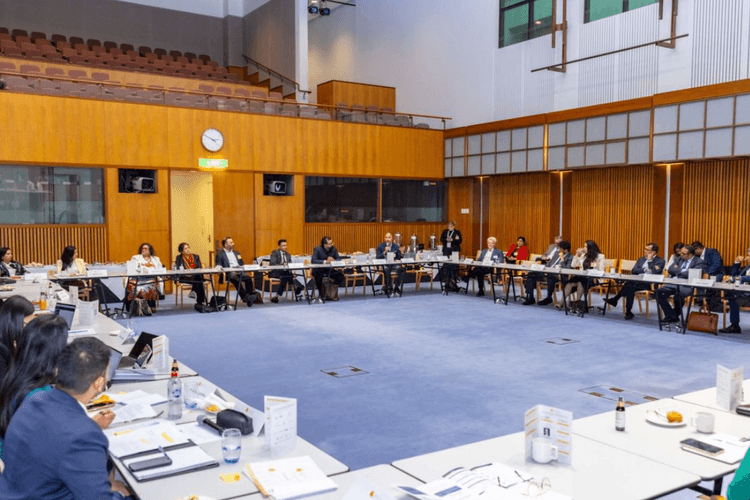
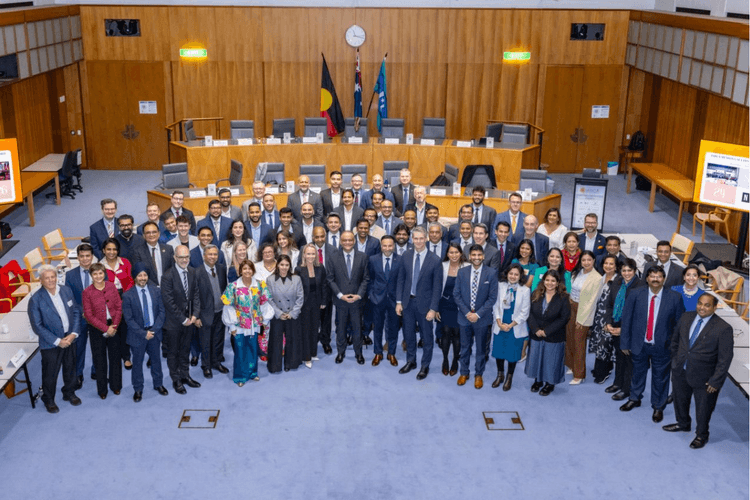
Held at Parliament House, the roundtable sought to move the Australia-India relationship beyond familiar narratives of shared values and expanding trade to a more practical question: how can governments, businesses and institutions turn opportunity into action?
One of the event’s defining features, according to the convenor of the conference and IABCA founder Sonia Gandhi, was the candour of the discussion.
“It is not often that government speaks so candidly in a public forum – and that honesty helped ground the discussion in reality rather than aspiration,” she told Indian Link later.
That realism was reflected across the day’s keynote addresses.
Assistant Minister for Science, Technology and the Digital Economy Andrew Charlton described Australia and India as one of the defining partnerships of the 21st century, arguing that both nations face the shared challenge of building prosperity in a technology-driven world. “AI, quantum technologies, digital infrastructure and clean energy are priority sectors,” he stressed, “but lasting outcomes would depend on people, partnerships and shared innovation rather than policy alone.”
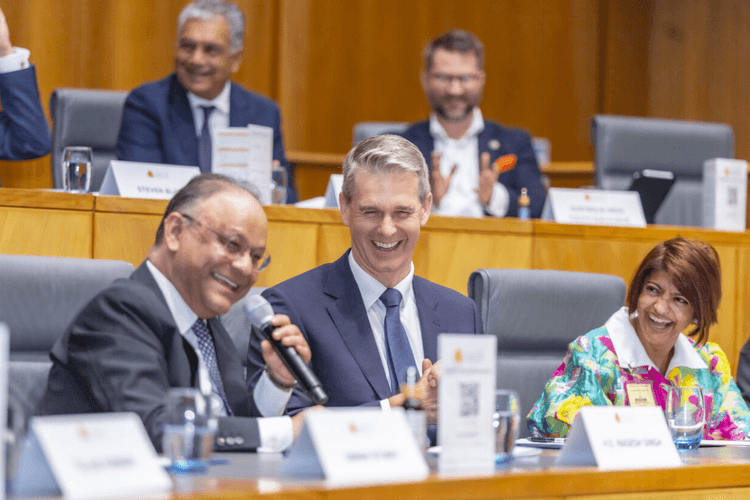
Indian High Commissioner Nagesh Singh described the two countries as natural partners, united by democratic values, multicultural societies and converging strategic interests. He highlighted the nearly one million Australians of Indian origin as a living bridge between the countries. “However,” he pointed out, “public perceptions of India here have yet to catch up with the country’s rapid transformation.”
Austrade CEO Dr Paul Grimes described India as a major engine of global growth and called for deeper trade, investment and commercial partnerships.
Sarah Storey, First Assistant Secretary of DFAT’s South and Central Asia Division, said the conversation had shifted from “Why India?” to “How India?”, describing India as “mission critical” to Australia’s economic diversification strategy, and pointing to existing trade agreements and engagement frameworks as strong foundations.
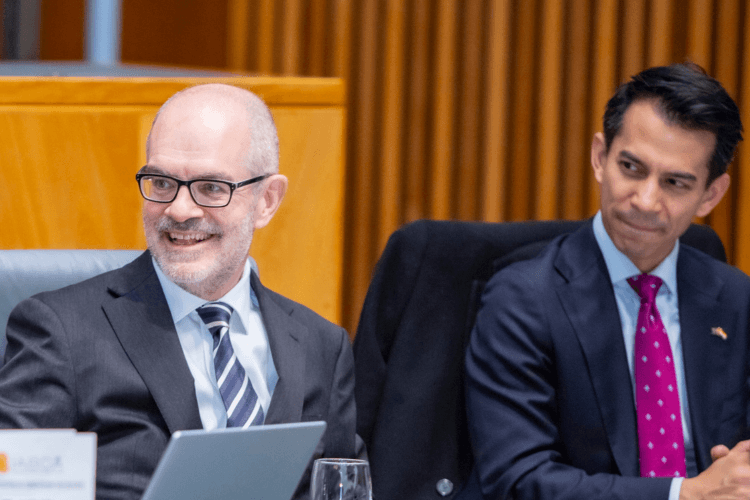
Ryan Neelam, CEO of the Centre for Australia-India Relations, echoed that message, arguing that “India is no longer a future opportunity but a present strategic priority.” He described the two nations as “co-architects of a changing global order” and urged Australian businesses and institutions to engage more actively beyond government and diaspora networks.
Yet the discussion also exposed a disconnect, while senior government officials expressed strong confidence in Australia’s state of engagement with India, the industry pulse suggested that business readiness needs to be accelerated and that far more practical support is needed.
That theme carried through the broader discussions.
Participants identified talent mobility as a significant obstacle, with universities and industry leaders citing visa costs and administrative complexity as barriers to attracting international students, researchers and skilled professionals.
While delegates saw enormous collaboration potential in AI, quantum technologies, cybersecurity and clean energy, many argued that existing partnerships remain fragmented and lack the scale needed to match the ambitions expressed by both governments.
Cultural intelligence also emerged as a recurring theme. Participants argued that understanding India’s business environment, investing in long-term relationships and building trust should be viewed not as soft skills, but as commercial capabilities essential to succeeding in the India market.
Gandhi also pointed out that the Pulse identified that one of the clearest structural gaps remains the limited support available to small and medium-sized enterprises.
While strategic dialogue between the two countries is strong, she argued, practical pathways for SMEs remain underdeveloped, with many businesses lacking the market intelligence, networks and support needed to engage confidently with India.
“Reducing barriers for SMEs must become a central priority, particularly by improving access to practical India-focused market intelligence and entry pathways,” she said. “Both Australian and Indian SMEs need to be encouraged to think more deliberately about cross-border opportunities, rather than leaving engagement to large corporates alone.”
The Leadership survey may have scored Australia’s India readiness at just three out of five. But if the discussion in Canberra was any indication, there is growing recognition that closing the gap will depend less on new rhetoric than on better execution.
Read more: Lowy Institute’s Shruti Pandalai: Closing the India-Australia gap