


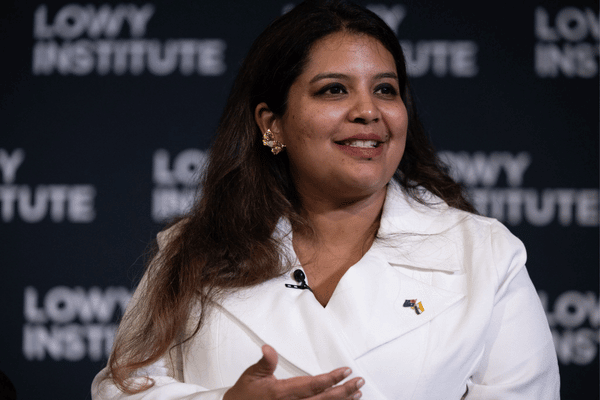

Shruti Pandalai
How do you see your new role – not just in terms of its geopolitical significance, but also as the challenge of creating something entirely new, with no predecessors or established blueprint to follow?
What attracted me most to the role was precisely that combination. The geopolitical significance is obvious, we are living through a moment when India is becoming a far more consequential actor in regional and global affairs. But the more exciting challenge is institution-building. For much of my career, whether as a researcher, speaker at international forums, or even as a journalist I’ve found myself analysing and presenting India’s strategic choices to international audiences. The opportunity now is to build a platform that does that systematically and at scale.
The fact that there is no predecessor is actually exciting. It gives us the opportunity to create something that is responsive to this moment, rooted in rigorous research, connected to policy debates, and capable of building enduring links between Australian and Indian strategic communities. If we do this well, the programme will become an institutional bridge in its own right.
What can we expect from the India Program, both short and long term? Shruti Pandalai
In the short term, I think the priority is straightforward: improving India literacy. There is tremendous interest in India across government, business, academia and the media, but often less familiarity with the strategic logic that informs Indian decision-making. The India Programme will want to help explain not just what India does, but why it does it. That means accessible research, policy briefs, participation in dialogues, expert exchanges and public engagement that demystifies India’s foreign policy, security outlook and economic ambitions.
Over the longer term, I would like the programme to become a trusted platform for ideas, talent and partnerships, a place where Australian, Indian and international experts can engage seriously on the issues that will shape the Indo-Pacific over the next decade.
Absolute privilege to be appointed the Inaugural India Chair @LowyInstitute . Many thanks to @mfullilove @MihaiSora @RyanNeelam @AusIndiaCentre @dfat for this fantastic opportunity. Looking forward to hitting the ground running. 🙏🏼 https://t.co/4R0IEH7FsC
— Shruti Pandalai (@shrutipandalai) May 15, 2026
You’ve said there is ‘more shared strategic logic between Canberra and New Delhi than people often realise.’ Yet the 2025 Lowy Institute Poll placed India relatively low in public trust among Australians. What do you think ordinary Indians and Australians most misunderstand about this partnership, and is bridging that gap something the India Program is positioned to address? Shruti Pandalai
I think both sides sometimes underestimate how much the relationship has changed. Australians often encounter India through headlines that don’t always capture the complexity of its strategic thinking. Indians, meanwhile, sometimes still view Australia through an older lens and don’t fully appreciate how central the Indo-Pacific has become to Australian strategic policy. What I have consistently found in conversations across both countries is that there is actually considerable convergence beneath the surface. Both countries are navigating questions about economic resilience, technological competition, maritime security and managing strategic uncertainty. The challenge is translating elite-level cooperation and leadership momentum into broader public understanding. Think tanks have a role to play here. Habits of cooperation are difficult to sustain without familiarity, and familiarity begins with understanding.
Where do India and Australia diverge in their approach to China, and does that create friction?
There are differences, but there are also real convergences. India’s China challenge is immediate and continental as well as maritime. Australia’s experience is shaped by different geography, economics and alliance considerations. So it is natural that the two countries don’t always frame the problem in exactly the same way. What is striking, however, is how much convergence has emerged over the past decade. Both countries are thinking seriously about resilience, strategic autonomy, economic security and preserving a stable balance in the Indo-Pacific. The objective isn’t identical policies; it’s developing enough strategic understanding to cooperate where interests align. In that respect, the trajectory remains very positive.
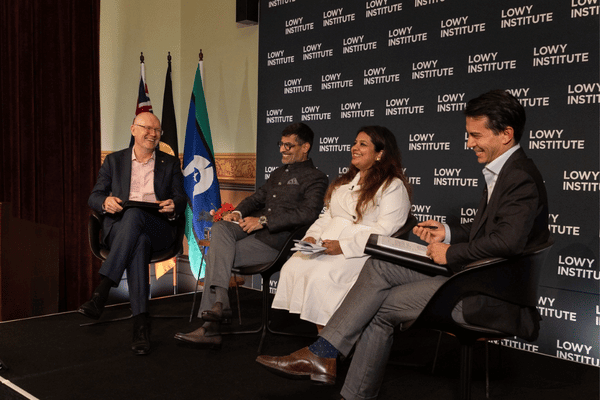
What are the key priorities for Australia-India collaboration in the Indo-Pacific? Shruti Pandalai
The first priority is maritime security in the wider Indian Ocean region, where both countries have a strong interest in maintaining an open, stable and rules-based environment. The second is technology. Whether we’re talking about critical technologies, digital infrastructure, cyber resilience or supply chains, this is increasingly where strategic competition and cooperation intersect. The Pacific Islands are also becoming an important area of convergence. What stands out to me is that both India and Australia increasingly recognise the importance of being responsive to local priorities. Development partnerships, climate adaptation, healthcare, capacity building and digital connectivity are all areas where the two countries can work together constructively. The focus should be on delivering practical outcomes rather than viewing the Pacific solely through a geopolitical lens.
We’re navigating a volatile world order and an unpredictable United States. How does this affect minilaterals like Quad, and how can Australia and India ensure that it doesn’t lose momentum?
The real test for any minilateral is whether it can survive changes in political circumstances. The Quad’s core strength was for it to be a versatile flexible format, and in that regard, it has evolved beyond being a diplomatic concept. It increasingly reflects genuine strategic demand from its members. The challenges that brought the Quad together – maritime security, technology governance, resilient supply chains and regional stability – have not disappeared. For Australia and India, the answer is to keep the focus on delivery. The more practical cooperation the Quad produces, the less vulnerable it becomes to shifts in political leadership or changes elsewhere in the international system.
I’m delighted to welcome @shrutipandalai as the @LowyInstitute’s inaugural India Chair, supported by the @AusIndiaCentre @RyanNeelam.
Shruti joins us from the Manohar Parrikar Institute for Defence Studies and Analyses, and is a former broadcast journalist.
Welcome Shruti! pic.twitter.com/Byye8TUHyu
— Michael Fullilove (@mfullilove) May 25, 2026
As the first person to hold this role, what does success look like for the India Program in the years ahead?
The Lowy Institute has set benchmarks on global excellence in research – the India Programme should be contributing to that effort. I would like to see a programme that has helped deepen understanding of India’s strategic choices among Australian audiences, strengthened institutional connections between our two countries, and created opportunities for the next generation of scholars and policy practitioners. Ultimately, if policymakers, researchers, journalists and business leaders increasingly turn to the programme as a trusted source of insight on India and the Indo-Pacific, and if we’ve built networks that continue to thrive long, then I think we will have succeeded.
READ ALSO: An Indian migration pulse check from the Scanlon Foundation