

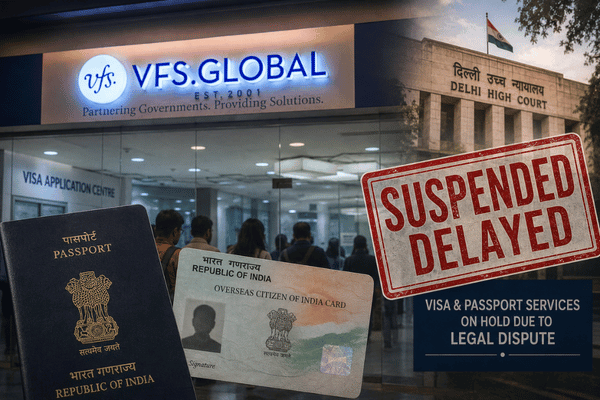

In a significant setback for India’s Ministry of External Affairs (MEA), the Delhi High Court has quashed the tender process for outsourcing Consular, Passport and Visa (CPV) services at Indian missions in Abu Dhabi, Kuwait, Singapore and Canberra, ruling that the technical evaluation process lacked transparency, consistency and adequate reasoning.
The judgment, delivered on 15 July 2026 by a Division Bench comprising Justice Anil Kshetrapal and Justice Shail Jain, arose from challenges mounted by two unsuccessful bidders, E Trav Tech Limited and Verasys Limited. Both companies argued that they had been unfairly eliminated during the technical evaluation stage despite meeting the requirements specified in the Requests for Proposal (RFPs) issued by the MEA.
At the heart of the dispute was the outsourcing of visa, passport and consular support services at Indian missions abroad. These services are critical for the Indian diaspora, including thousands of Australians who rely on outsourced service providers for passport renewals, visa applications and other consular requirements.
Court finds evaluation process flawed
The Court made it clear that it was not examining whether the technical experts reached the “right” conclusion. Instead, it focused on whether the decision-making process itself met the standards of fairness, transparency and non-arbitrariness expected in public procurement.
According to the judgment, the MEA and the respective Indian missions failed to explain why marks were deducted from bidders under various technical criteria. While bidders were eventually provided with a break-up of their scores, they were not given the reasons that justified those scores.
The Court found that several criteria required comparative evaluation, with the best bidder receiving full marks and others receiving proportionately lower scores. However, the benchmarks used to determine the “best offer” were never disclosed. As a result, bidders had no way of understanding how their submissions compared with competing bids.

Inconsistencies raised concerns
One of the most striking findings related to inconsistent scoring across different missions.
The Court noted that E Trav submitted substantially identical credentials and client references across multiple tenders but received different scores for the same category. In one mission, it was awarded four out of seven marks; in another, three out of seven; and in Kuwait, zero. Similar inconsistencies were identified in the evaluation of Verasys.
The judges concluded that in the absence of any recorded reasons, such inconsistencies appeared arbitrary and could not be objectively verified.
The judgment also highlighted examples where bidders appeared to have met specified benchmarks relating to office space, parking facilities, appointment availability and turnaround times, yet did not receive the corresponding marks prescribed under the RFP scoring matrix.
Implications for Canberra and the diaspora
The ruling has particular relevance for Australia because Canberra was one of the missions covered by the affected tenders. The Court acknowledged submissions that one successful bidder had already invested heavily in establishing facilities in Australia after being declared the winning bidder. Nevertheless, it held that transparency and fairness in public procurement could not be compromised.
For the Indian community in Australia, the immediate impact on day-to-day services is expected to be limited. The Court has allowed existing service providers to continue operating on an interim basis to ensure there is no disruption to public services while a fresh tender process is conducted. But this is difficult to execute as VFS Global is out of contract and cannot provide arbitrary services.
Fresh tenders ordered Indian visa services
In its final order, the Delhi High Court set aside the technical evaluation process and nullified the resulting contract awards for all four missions. It directed the MEA to issue fresh tenders within one month and complete a new procurement exercise as expeditiously as possible.
The judgment is likely to have ramifications beyond the four affected missions. By emphasising the need for documented reasoning, transparent evaluation standards and meaningful bidder debriefings, the Court has sent a strong message to government agencies engaged in large-scale procurement exercises.
For the MEA, the decision represents both a legal and administrative challenge. The ministry must now restart a major international tender process while ensuring full compliance with procurement rules and the principles of fairness laid down by the Court.
More broadly, the case underscores an increasingly important principle in modern public administration: expertise may guide procurement decisions, but transparency remains essential for public trust. It is to be seen if MEA will appeal this ruling
Read more: Indian diaspora awaits High Court ruling as VFS services remain paused across Australia.