


Australia returns Indian antiquities
Three ancient temple idols, stolen from Tamil Nadu shrines and trafficked abroad decades ago, are set to make their way home after Australia agreed to their repatriation during the third India-Australia Annual Summit on Thursday.
Prime Minister Narendra Modi, on the Melbourne leg of his three-nation tour, held extensive talks with Australian Prime Minister Anthony Albanese, where the return was formally welcomed as part of the broader India-Australia Joint Summit statement. Foreign Secretary Vikram Misri confirmed at a press briefing that Modi had conveyed his gratitude to Albanese for the voluntary return of the artefacts from Australian collecting institutions.
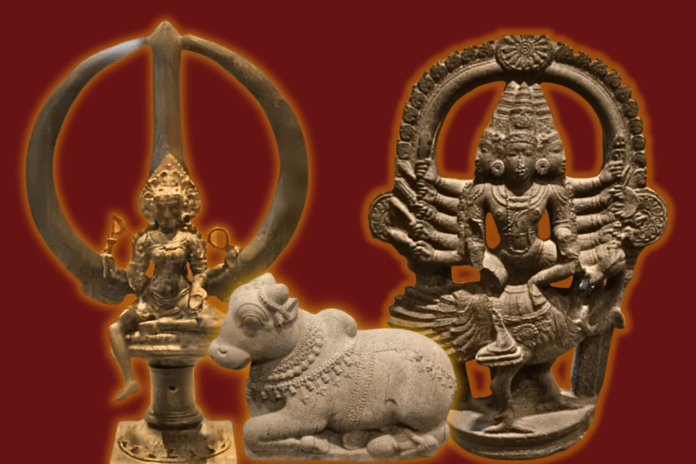
The three pieces had been housed at the National Gallery of Australia and the Art Gallery of New South Wales. A ceremonial bronze trident bearing the image of Goddess Bhadrakali and a granite idol of Nandi, both dating between the 11th and 16th centuries, originally stood in the Sri Kasiviswanathaswamy Temple in Kollumangudi, Tiruvarur district. The third piece, a basalt sculpture of the six-headed deity Karttikeya, comes from the Naganathaswamy Temple in Manambadi, Thanjavur district, built under the Chola emperor Rajendra Chola I in the early 11th century.
Their return marks the end of a long investigative trail. The Tamil Nadu Idol Wing Criminal Investigation Department launched investigations into the missing artefacts after First Information Reports were registered in 2016, after establishing that the idols had been illegally removed from their temples and smuggled out of the country. Investigators eventually traced the pieces to the Australian institutions and invoked the Mutual Legal Assistance Treaty, a formal government-to-government legal cooperation mechanism, to secure their return.
Albanese, addressing the media alongside Modi, described the handover as a gesture made in the spirit of friendship, framing it as part of Australia’s commitment to ethical collection practices going forward. The exchange was reciprocal in nature. India has agreed to voluntarily and unconditionally repatriate the remains of an Australian First Nations ancestor, currently held at the Government Museum in Chennai, to their Traditional Custodians. Australia’s Minister for the Arts, Tony Burke, said the return of ancestors and the voluntary handover of cultural artefacts both reflect values shared between the two nations.
For India, the case adds to a growing list of recovered antiquities and underlines how provenance research, once a peripheral concern for Western museums, has become central to how institutions now examine the objects in their collections. Where evidence establishes theft or illegal export, more museums are choosing cooperation over prolonged legal disputes.
The Ministry of External Affairs confirmed the idols will be transported back to India in due course, with the formal handover process to be worked out through diplomatic channels in the coming months. Australia returns Indian antiquities
Read more: ‘A flat white with you, Melbourne’: PM Modi in Australia