

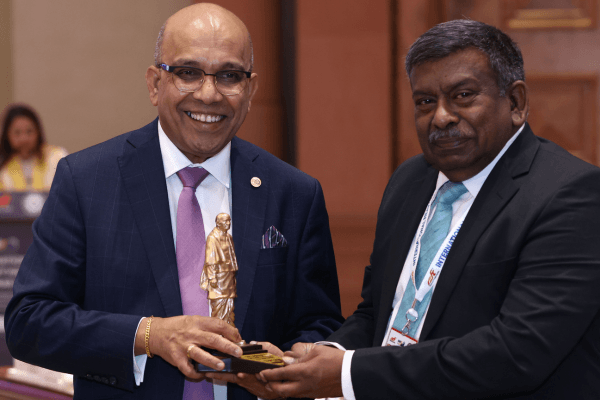

When we last wrote about Professor Ravi Ravitharan following his 2014 Railway Technical Society of Australasia (RTSA) Award win, we called him ‘the railway man’, a fitting title for someone who grew up loving locomotion.
“We had railway lines close to our house – the sound you hear when it goes through the joints, the bouncing around – ‘dig dig, dig dig, dig dig’ – that’s what I remember,” Professor Ravitharan reminisces on his childhood in Sri Lanka.
“At that time, I didn’t think I’m going to work in railway. I was interested in engineering, and eventually I was fortunate to work in railway – I love the industry.”
Speaking to him twelve years later, you get the sense his passion has only gotten stronger; so too, his collaboration with the Dedicated Freight Corridor Corporation of India (DFCCIL).
As Director of Monash University’s Institute of Railway Technology (IRT), Professor Ravitharan’s team are helping the DFCCIL run efficient services across dedicated freight lines, taking the strain off high-demand passenger lines.
“Previously, India used normal railway to carry passengers and freight. This isn’t the most efficient way because passenger transport requires lower axle loads, meaning less weight carried, as [normal rails are meant] to move people fast,” he explains.
“Freights are heavier [trains] and therefore a different environment is required – the road track should be stronger than passenger transport requirements.”
India’s first freight line, the Eastern Dedicated Freight Corridor, stretches from Ludhiana to Sonnagar, and has been operational since June 2024. A second Western Dedicated Freight Corridor from Dadri to Mumbai was completed in April 2026, with both lines steadily growing in speed, number of trains and load sizes.
Over the last financial year, the DFCCIL operated an average of 403 trains a day, moving almost 4.4 million tonnes of coal, iron ore, cement and container traffic. Professor Ravitharan says the aim is to eventually have 45 percent of India’s freight travelling through dedicated lines, up from the 20 percent they currently carry.
With India boasting the biggest freight network in the world, maintaining something this big and expensive becomes challenging.
That, Professor Ravitharan says, is where Australia and the IRT comes in. With the help of the Monash IRT, Australia has become a world-class heavy haul technology operator – the AutoHaul system, which Monash IRT tested during commissioning for Rio Tinto’s use in the Pilbara, is the best in the world.
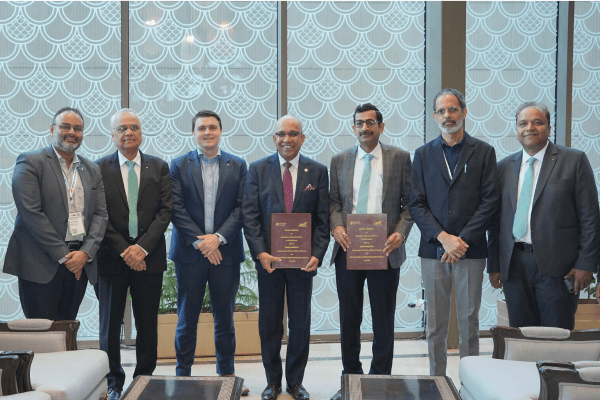
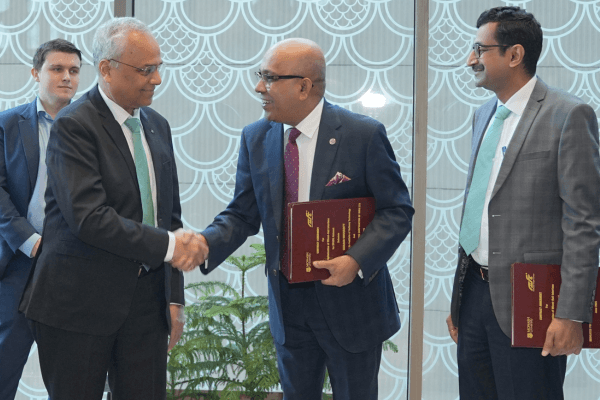
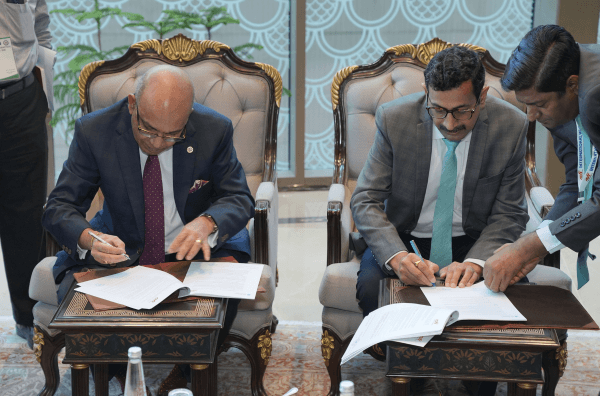
Monash IRT have signed a commercial agreement with DFCCIL to help them ‘optimise the wheel and rail interface, to improve their efficiency, safety, and cost reduction’.
“When I say maintenance, it’s about shaping the rail; using heavy machinery to get the correct shape so the trains can run smoothly and not have to do maintenance frequently,” Professor Ravitharan explains.
“It might take two years…we will focus initially on the eastern dedicated freight corridor and then the western freight corridor.”
The project also involves building the capacity of Indian engineers, so they are self-sufficient at maintaining their freight rails.
“In 1972 when Australia started heavy haul operations, we could have gone to another country and asked their help all the time, but instead we built our own capability, and now we are the expert in heavy haul railway maintenance,” says Professor Ravitharan.
“We’re trying to help India do the same thing.”
Though bilateral relations focus on education, trade and cricket, Professor Ravitharan argues rail is an overlooked area of engagement, India and Australia looking to building bigger, more connected cities.
Professor Ravi Ravitharan
To that extent, building India’s heavy haul capability may pay dividends in the future.
“If India has strong heavy haul railway capability, they might help us one day when we need assistance – we’re always short of engineers and India produces a significant number of capable intellectuals,” he says.
The Monash IRT, home to 70 researchers working with 170 industry partners, has an international reputation, with clients including Hong Kong’s MTR, Singapore’s MRT and of course, the DFCCIL.
But despite being chosen to optimise freight and passenger railways worldwide, Professor Ravitharan says Australia has only just started to properly leverage the IRT’s capabilities.
World leaders in freight rail we may be, but many improvements remain for Australia’s passenger rail networks, he says, pointing to the stagnating progress on the Melbourne to Brisbane Inland Rail and Melbourne Airport Rail.
“In Australia, we are reactive. We don’t think aloud, look at our vision and say these are the issues that we need to resolve. We need to use strengths we have,” Professor Ravitharan says.
“We have been working in the rail space at Monash for 26 years, and we are regarded as the experts, but I think we have been used [domestically] when there’s a problem.”
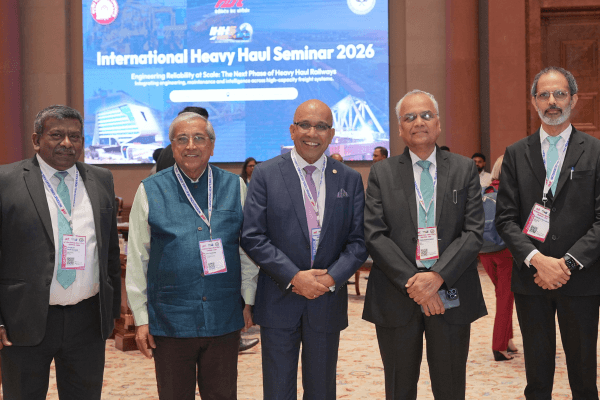
As Australia pledge net zero emissions by 2050, Ravitharan says the deepening India-Australia rail partnership lets us learn from India’s extensive and affordable passenger railway network.
“For a while [in Australia], we forgot about railway, but now we are revamping it…it’s a cheaper mode of transport, and if you look at the carbon emission by high-speed rail versus plane, it’s significantly smaller, less than 10%. If we’re serious about carbon neutral, this is the best way to do it,” Professor Ravitharan says.
“In India, [most] people are transported through railways…if you’re looking for economical ways of moving people, this is what we can learn from India. I think if we put in the effort, railway can be a significant form [in Australia].”
READ ALSO: The Railway Man