


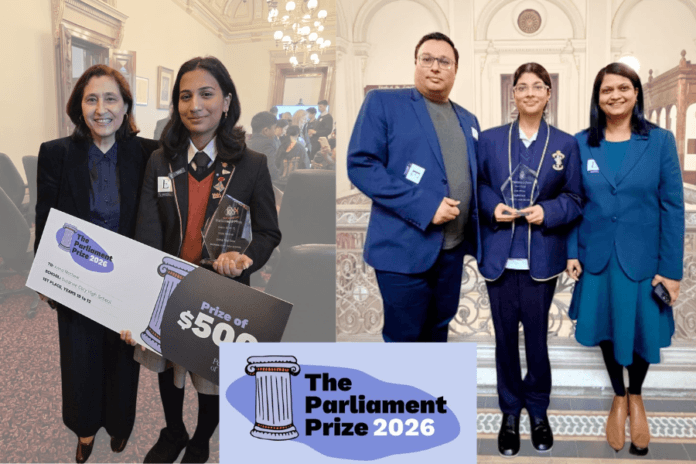
In a rare hat trick, South Asian students have dazzled the competition at the Victorian Parliament Prize 2026, taking out first place in all three age categories.
Noah Farid, Anna Mathew and Kashvi Soni were the three first prize winners selected out of 1180 entries from across the state, and have received a commemorative trophy and $500 prize, as well as classroom resources for their schools to promote civics and citizenship.
Stella Maris Catholic Primary School, Point Cook student Noah Farid won in the Years 5-6 category for his video ‘Victoria should introduce a minimum age of 16 to ride an e-bike’.
Citing cases of e-bike fatalities and injuries and even compiling his own survey of 20 kids in his area, Farid argued ‘excitement is racing ahead of safety’.
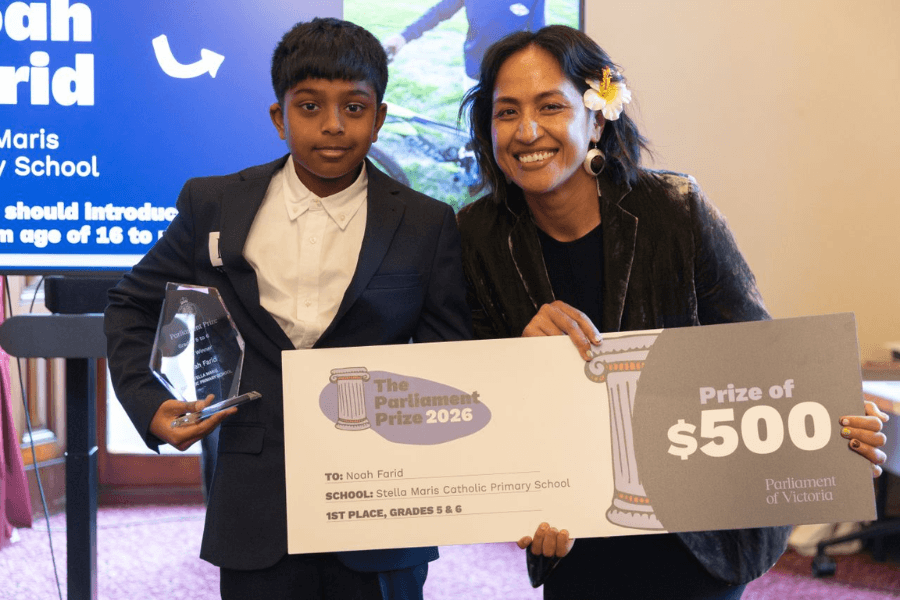
“We’ve seen the statistics, we’ve seen the losses, we’ve seen the tragedies…how many injuries are too many? How many losses must be had?” he concludes in his video. “When it comes to protecting children, one loss is already too many.”
Anna Mathew, Year 11 student at Suzanne Cory High School took out the first prize in the Years 10-12 competition, speaking on the benefits of Auslan (Australian Sign Language) inclusion in schools for all students.
“It feels great to have won such a huge honour,” Mathew told Indian Link. “I feel as though my hard work and passion towards civics have truly paid off.” Parliament Prize 2026
Mathew’s video, ‘Sign of the Times: Why Auslan Belongs in Every Classroom’, was a natural extension of her advocacy for Auslan at Susanne Cory, which sees her run a student club dedicated to teaching the language and fundraise for Deaf Children Australia.
“By mandating Auslan, we choose to raise a generation of Australians who see capability, where others see disability,” Mathew asserts in her video.
Crucially, Mathew explains that teaching Auslan is not only an inclusive practice for the deaf community but also has the potential to strengthen the academic performance of hearing students.
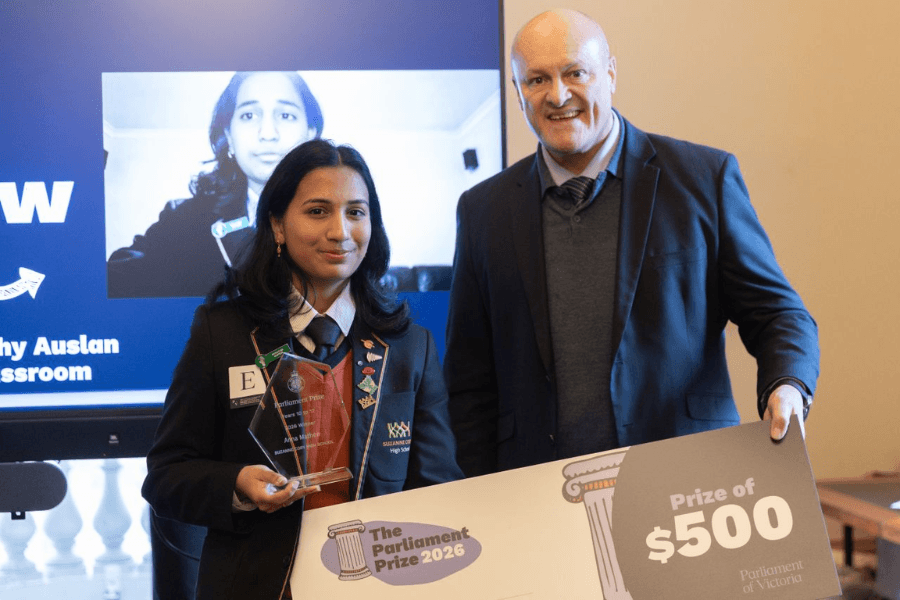
“The hard part for me was the time limit of 90 seconds because I just truly had a lot to say and wanted to address all of the perspectives involved,” Mathew reflects.
Meanwhile, in the Years 7 to 9 category, Kashvi Soni, Year 8 student at Catholic Ladies College, raised the alarm on a youth loneliness epidemic as social media becomes ever more pervasive.
“It feels absolutely wonderful winning the prize, knowing that the crucial issue of youth loneliness was heard out by the Parliament of Victoria and action will hopefully be taken to make today’s youth feel supported and cared for,” Soni told Indian Link. Parliament Prize 2026
“Seeing all the other intriguing competition in the Parliament Prize, I feel extremely grateful to have received this award out of the hundreds of veritable issues in our community.”
Inspired to take up the topic after seeing her friends lost in their phones at parties, she says despite the under-16s social media ban, young people still aren’t going outside and socialising.
Parliament Prize 2026
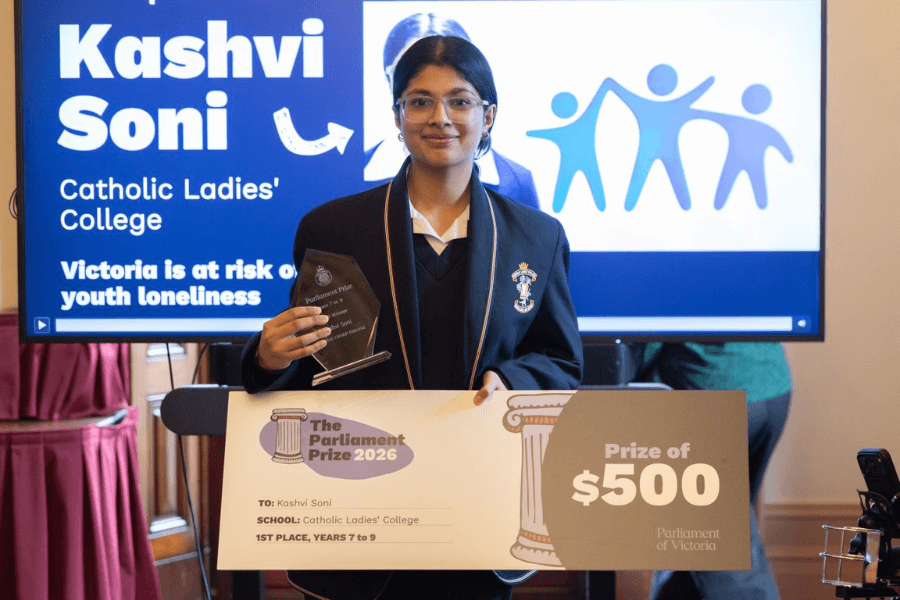
“The constant scrolling, the absence of normal communication; I just found it absolutely mind blowing that social platforms such as TikTok or Snapchat were only founded less than 15 years ago and how much impact it has caused on youth’s social awareness,” she commented.
Passionate about civic involvement, Soni looks forward to running campaigns or petitions for Parliament on other similar youth issues.
“I feel the Parliament Prize has prospected a future for me in spreading awareness about issues and actually implementing them,” she said.
“Of course I will continue to advocate, with a label or not, about critical issues and the Parliament Prize has given me complete confidence that my calls will be heard.”
The Parliament Prize is an annual student competition asking students to record a 90-second Members Statement as though they were speaking to parliament. Parliament Prize 2026
The videos are then judged by a panel including real Members of Parliament, with the top three receiving a cash prize and an invitation to Parliament House in Melbourne for an award ceremony.
READ ALSO: Eight Indian languages gain ground in Australian schools with new government grants