



Jacob John
When Jacob John stepped down last week after 11 years as chair of a 3GPP working group – the longest tenure in the standards body’s history – he did so as the recipient of its Lifetime Achievement Award, a recognition that caps a career spanning nearly three decades and four generations of mobile technology.
“It’s a pinnacle to my career,” John tells Indian Link, days after returning from the meeting where he formally handed over leadership. “I couldn’t be happier, personally, for myself and for the group, and broadly, for what I could achieve as a technology professional. Nothing more I could ask for.”
For the uninitiated, 3GPP, the 3rd Generation Partnership Project, is the global body that writes the technical rulebook that every mobile phone, tower, and carrier network must follow. It is unglamorous, largely invisible work, but it is also the reason a phone bought in Sydney works seamlessly in Seoul or São Paulo. John has spent much of his career inside that machinery. In 2013, John’s contributions were first formally recognised with the Technical Excellence Award, a milestone that would pave the way to his election as working group chair just two years later, and the first Indian-Australian to hold the position.
Born and raised in and around Cochin, Kerala, Jacob John trained as an engineer, working first at Indian Telephone Industries in Bangalore and then in the machine tools division of HMT, before migrating to Sydney in 1991 to join his sister’s family. He completed a Masters in Computing at the University of Technology Sydney and, in 1997, joined Motorola as a senior software engineer, a role that would define the rest of his working life. Next June marks 30 years with the company.
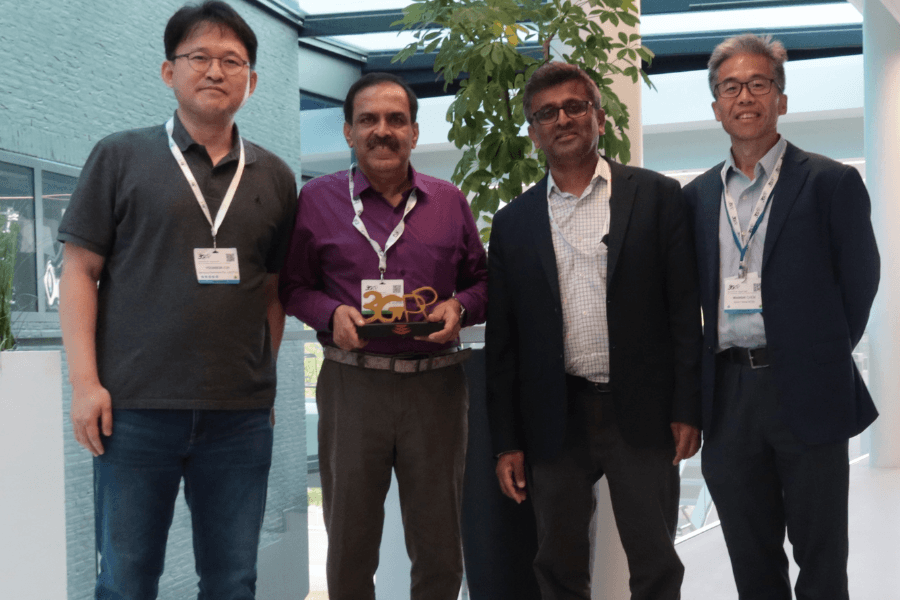
It was Motorola that gave John the rare opportunity, as an Australia-based engineer, to contribute to international standards work, a field where distance and travel costs have historically kept participation from the region low. “Very few people can participate and contribute because of the distance, the meetings happening across the world, the travel takes a toll,” he says.
The technology John has helped shape is not abstract to most people’s lives; it is the difference between a handset and a “mini computer,” as he puts it. He points to the arrival of 4G, or Long-Term Evolution, as the true turning point, the moment packet-based mobile data allowed phones to become, in his words, “a life partner device.” As chair, he led his group through the delivery of 5G, launched globally in 2020, and has spent the past six years on 5G Advanced. Behind the scenes, his working group’s task has been to protect the licensed spectrum that carriers pay heavily for, and to ensure every device on the network conforms to a common standard.
Asked about the road ahead, John is candid that 5G’s legacy is mixed, strong on spectral efficiency and data speed, but light on the kind of breakthrough applications that defined the 4G era. He is markedly more optimistic about 6G, due to be standardised by 2029, which he expects to be shaped heavily by artificial intelligence and to finally deliver seamless handover between terrestrial and satellite networks, meaning phones that stay connected in the most remote corners of the world. He is equally frank that outages, like the Optus and Telstra incidents Australians have grown used to, will not disappear entirely. Wireless spectrum, unlike a fixed telephone line, is shared and finite, and network reliability ultimately depends on how carriers deploy and maintain their equipment.
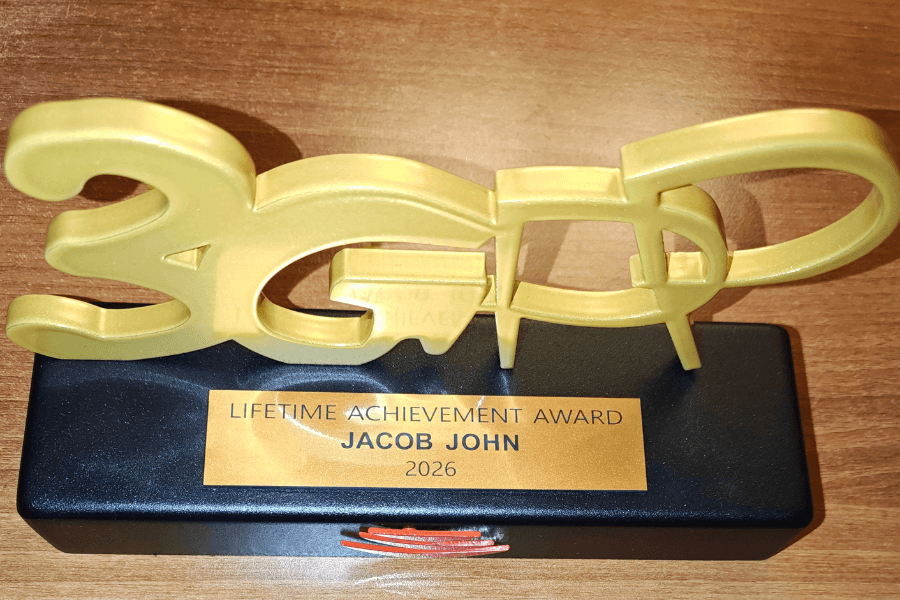
One of the reasons Jacob John chose this moment to step down, he explains, is precisely because 6G standardisation is only beginning. “Ideally it is better to be there at the start of the technology to the end,” he says, but committing to stay until 2029 wasn’t realistic. Instead, he has handed the chair to his long-serving vice chair, elected from Qualcomm, and has committed to mentoring the incoming leadership through their first few meetings. Within Motorola, John continues to consult across the company’s globally distributed development teams, with plans to fully retire sometime next year.
The role came at a personal cost that John doesn’t gloss over. Three to four months a year on the road, quarterly meetings rotating across continents, and years of missed family functions and events. He credits his wife’s support through what he calls “God’s grace” for making the journey possible, particularly in the years since their son left home. That son, Matthew Jacob, has his own story making waves in the community: a Tuckwell Scholar who studied Politics, Philosophy and Economics at ANU before working as a policy officer in Federal Parliament, he is now completing a PhD in Economics at Harvard, expected to graduate next May.
Now easing into semi-retirement, John says he is looking forward to reconnecting with friends and family, taking up badminton again, a sport he once played competitively for Kerala state, and making more trips home to Cochin. What he’ll miss most, he admits, is the technical camaraderie and even the geopolitics of standards negotiations themselves. “Everything has to end at some point,” he says. “But that part, I’ll miss.”