Three days after marking Pink Sari Inc’s tenth anniversary with a mega event, its president Shantha Viswanathan isn’t exactly basking in the moment; her sights are set firmly on the future.
“We have so much more to do,” she tells Indian Link.
At the helm of a volunteer team working to raise cancer awareness in the South Asian community here, Shantha Viswanathan has overseen a string of programs that have delivered measurable outcomes, and earned the organisation a state health award.
Yet she knows there is considerable ground still to cover.
“The Indian community is one of the fastest growing communities today. Now this is good, but the incidence of cancer is also increasing. We are seeing a lot of it in young people. In the last two days alone, I’ve had three people referred to me with cancer. The need for support has increased manifold.”
It was fitting then, that Karen Jameson Sutton of Cancer NSW used the tenth anniversary event to look not only at what has been achieved but at what comes next.
“I understand that in the Indian tradition, the number ten is deeply auspicious. It represents completeness, fulfillment of a chapter, and the beginning of the next.” She added however, “Today is also a celebration of ten remarkable years, of the compassion, courage, and generosity that has shaped Pink Sari’s journey so far.”
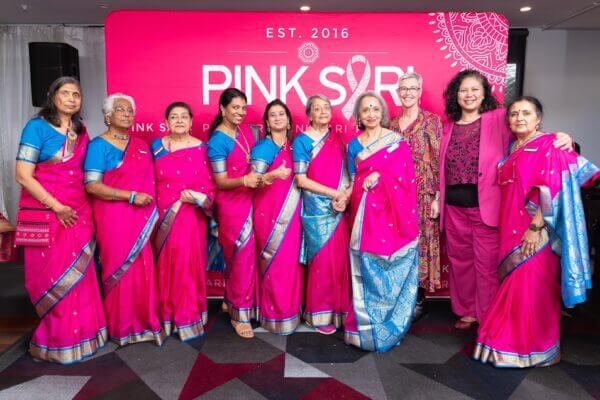
For Shantha, success is measured less in the number of programs Pink Sari Inc has delivered, or even the number of people it has helped, than in something less easily quantified: trust.
“What we really value most is the trust that we’ve built with our communities.”
That trust, she believes, has translated into tangible change: greater awareness, earlier screening and, importantly, a greater willingness to talk openly about cancer.
But she is also keen to dispel a perception that has lingered from Pink Sari Inc’s beginnings.
“We started with breast cancer awareness, but we’ve gone far beyond that,” Shantha stresses. “People still think we only work with women and breast cancer. We don’t. Today we connect with people of all genders and with people affected by all types of cancer.”
For Shantha, that evolution – from a breast cancer awareness initiative to a broader cancer advocacy and support organisation – is itself a measure of how far Pink Sari Inc has come.
A Trusted Presence
Pink Sari Inc began as Pink Sari Project, when the Multicultural Health Communication Services reached out to community organisation Seva. Shantha, then leading Seva’s women’s wing Saheli, and long drawn to the health field, rose to the occasion. The initiative successfully increased breast cancer screening rates, and when it ended, Pink Sari Inc was formed to sustain the momentum.

Its volunteers – in their bright pink saris – stamped their vibrant presence at community events, as they went about turning conversations about cancer into a normal part of community life.
The programs they developed and delivered offer something of a blueprint for effective community participation in health.
These include Beyond Pink (support for carers), Your Bowel Matters (for bowel cancer), Cervical Cancer Screening, and Can Info and Care (culturally sensitive support for those newly diagnosed, to help them navigate the health journey).
“We’ve executed these programs via information sessions that our volunteers are trained to deliver,” Shantha says. “But we’ve also incorporated fun ways to get the message out – we are aware that traditional methods that service providers use like brochures etc don’t always work in our community context. Some of our own innovative programs have used photography, music, dance therapy, song writing, yarning, creative writing, a flash mob, even cricket.”
(Pink Sari is now a staple at Sydney’s annual Pink Test at SCG in collaboration with the McGrath Foundation).
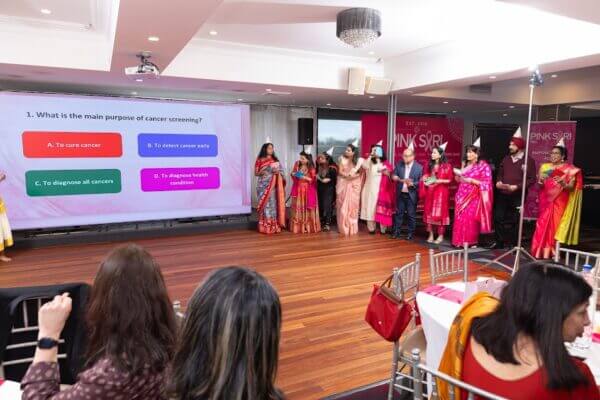
While these creative activities may give Pink Sari Inc greater visibility and provide an engaging way into the conversation, Shantha is aware that the real education happens through targeted information sessions, where people access reliable information, ask questions and engage directly with health professionals.
“A recent webinar for stem cell donation, coinciding with donations for a patient, went down particularly well – South Asians are severely underrepresented in this form of donation,” Shantha describes.
At the tenth anniversary gala, oncologist Shalini Vinod spoke about four forms of cancer screening. Alongside the more established breast, bowel and cervical screenings, is a new addition – lung cancer screening, which started only last July and which she herself was involved in.
“This is information people need to know,” Shantha stresses. “People come to us when things go wrong for them, but early detection, as we keep saying, is what helps. We urge people to come to our sessions – this is one of the ongoing challenges we are facing.”

Challenges
For all its growth, Pink Sari Inc remains an entirely volunteer-run organisation, and Shantha sees sustainable funding as one of its greatest challenges. Support from Cancer Institute NSW has enabled much of its work, but competitive, short-term grants make it difficult to commit to ongoing programs.
“What we’re seeking is recurrent, long-term funding,” she says, arguing that grassroots organisations can struggle to compete with larger organisations for funding, despite their reach and established relationships within communities.
Pink Sari is now applying for Deductible Gift Recipient (DGR) status, which would open the door to corporate and philanthropic funding previously beyond its reach.
Looking ahead
Next on Shantha’s to-do list in broadening the conversation around cancer prevention, is exploring the relationship between diabetes, lifestyle and cancer risk – particularly relevant to South Asian communities – and bringing appropriate health professionals into its education programs.

However, at the top of her larger wish list is a permanent Pink Sari Hub – a welcoming physical space where people can seek information, attend workshops and information sessions, meet health and allied-health professionals, and, importantly, find support during and after cancer.
“We want somewhere people can come and feel comfortable asking questions and talking about cancer,” she says.
The hub would also allow Pink Sari to formalise an area that has increasingly become part of its work: cancer survivorship. The organisation already connects people undergoing cancer treatment with others who have lived experience, but Shantha envisages more structured support groups and programs addressing exercise, nutrition and life beyond treatment.
“A cancer journey never ends,” she says.
Ten years on, then, the ambition is not simply to run more programs. It is to build the infrastructure – funding, premises, partnerships and trained volunteers – that will allow Pink Sari to be there for the community for the long haul.
Read Also: Pink Sari Inc launches Cancer Info and Care program