Home Blog Page 996

Michelle Obama celebrates Diwali

0
Reading Time: 3 minutes

 michelle obama bollywood

 
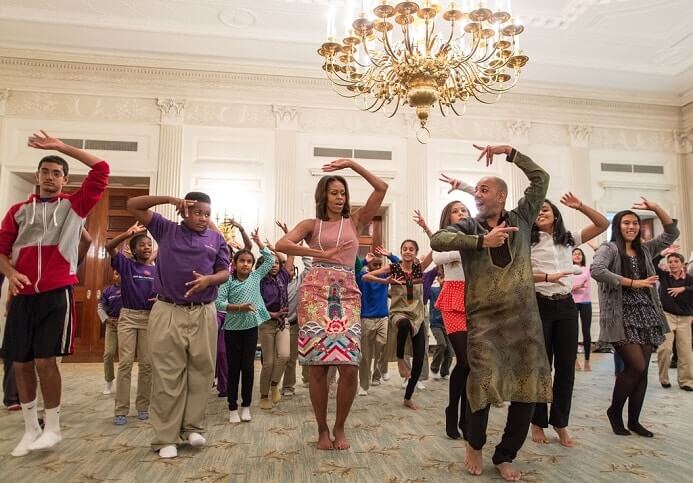
US First Lady Michelle Obama lit a diya (lamp) in the East room to start White House Diwali celebrations after trying out some Bollywood dance moves with some local students in the State Dining Room.
“We’ve celebrated this holiday here at the White House every year since (President) Barack (Obama) took office. And there’s a reason why we’ve done that,” she said, welcoming guests including members of the Indian community and Indian-American officials on Nov 5.
“We got to practice a little Bollywood this afternoon,” Michelle Obama said.
“And, of course, as you all know, I think I can dance” she proudly informing her guests amid laughter. “But not as good as they can dance. But we had a wonderful time.”
“It was the first time that we did Bollywood in the State Room here at the White House,” said the First Lady who had joined a dance number during Diwali celebrations in Mumbai during Obamas’ India visit in November 2010.
Joining the celebrations was her dance teacher Nakul (Dev Mahajan ) in “his jeans and t-shirt now” “from one of my favourite shows on the planet – So You Think You Can Dance”.
Also present was India-born fashion designer Naeem Khan who had designed her dress her for the occasion.
“When we say that we want to make the White House the ‘people’s house,’ we mean all people. We mean that we want to honour and embrace all of the many cultures and faith traditions that make us who we are as Americans. And Diwali is very much one of those traditions,” she said.
“It’s a time to come together with friends and family, often with dancing and good food,” said Michelle Obama noting Diwali is celebrated by members of some of the world’s oldest religions not just here in America but across the globe.
“But Diwali is also a time for contemplation and reflection. It’s a time for us to think about our obligations to our fellow human beings, particularly those who are less fortunate than we are,” she said.
“And as we light the diya we recommit ourselves to the triumph of light over darkness, of good over evil,” she said recalling the shooting tragedy at a Sikh Gurdwara in Oak Creek, Wisconsin last year “when an act of unthinkable violence shook a community to its core.”
“But I am also thinking of how in the face of such evil, we also witnessed the power of goodness and forgiveness,” Obama said.
“The families and community leaders I met when I visited Oak Creek just weeks after the tragedy, they showed us such courage and grace,” she said. “Instead of giving in to bitterness or despair, they honoured those they lost through service.”
“I’m also thinking of all the people across America and around the world who held prayer vigils during that time and sent messages of love and support, and held the people of Oak Creek in their hearts.”
“I am so proud and so honoured to be celebrating this beautiful holiday at the White House with all of you,” the First Lady told guests. “And I wish you all and all your loved ones a Happy Diwali and Saal Mubarak.”
US lawmakers also joined the Indian-American community for the first ever Diwali celebrations on Capitol Hill after the US Congress passed resolutions honouring the Indian festival of lights and celebrating the strong relationship between the US and India.
 
IANS
 

Peace on the Phi Phi islands

0
Reading Time: 4 minutes

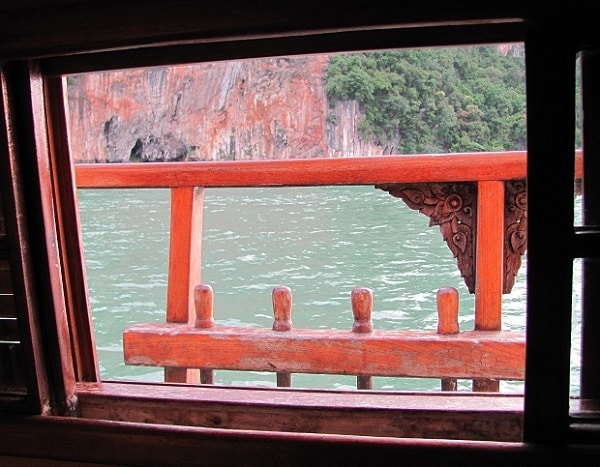
View from Cabin
When novels or films dramatically evoke the landscape in which they are set, we can be inspired to go there. To retrace the steps of Leonardo diCaprio in The Beach, filmed on the island of Phi Phi Leh, was what I wished to do. I could travel with hundreds of tourists who arrive by ferry, or take an eminently more pleasant scenic route, exploring the islands of southern Thailand onboard the Suwan Macha, a beautiful wooden schooner rigged with the sails of a traditional junk.
My eight fellow passengers were French from the Reunion islands. A mix of sophistication and exotic elegance, surely. Shown to my cabin, several pairs of tiny legs dangled over my window and then the faces of two inquisitive girls peered at me. Five young children, all under 10! Elliot, Basil, Louis and the two impish girls, carefree, barefoot and agile as monkeys. What delightful company they made, so curious about all that we saw.
We departed with the course set for the spectacular karst topography of Phang Nga Bay, a bizarre landscape in which limestone is weathered and moulded into unimaginably odd shapes. Massive sheer cliffs coloured white, grey and black, rose vertically from the intense turquoise water.  Warrens of caves and patches of jungle clung suspended in crevices on the sides of cliffs. On a long-tail boat we explored coves with stalactite formations and passed cliffs where men climb twined bamboo poles hundreds of metres high to collect the nests of swiftlets prized by the local Chinese, a culinary delicacy for bird’s nest soup.  As the sun set bringing the oranges and pinks of a tropical night and gentle waves slapped rhythmically against the boat, all worrisome thoughts were pushed far away.
Next morning we visited a Sea Gypsy Village, passing women selling trinkets and children at play. At James Bond Island, depicted in the movie The Man with the Golden Gun, we were outnumbered by boatloads of Chinese tourists. We left for a small deserted island bordered by white sand beaches and went snorkelling in clear water, the coral sadly showing signs of stress.
As we approached the mainland near Krabi, the darkness of nightfall was punctuated by bright lights pointing down into the water belonging to the local fishing fleet making its way out into the night.  The trip had taken several hours with the skipper appearing to hit the engine throttle hard. We had encountered large waves, it was the great wide open water and the children squealed with joy.
We put the anchor down near a small island for shelter and after a windy night, headed for Phi Phi Don, the larger of the two Phi Phi islands with cross currents causing the boat to rock from side to side, up and down. Relieved, we arrived at a beautiful white sandy bay with Chinese tourists splashing about in the shallow water. Long-tail boats passed by conveying tourists, narrow wooden vessels with an eggbeater propeller welded onto a long swinging shaft. I walked over the hill to reach Long beach, a beautiful deserted stretch of beach with several resort hotels tucked in amongst groves of palms and pandanas. Further along at Ton Sai Bay, the narrow maze of alleyways struggles to cope. With bars displaying fairy lights suggestive of noisy evenings, restaurants, t-shirt and sarong vendors, hair braiders and tattoo artists all squeezed in with crowds of skimpily clothed backpackers, all conspired to turn me back to the relative solitude of the boat.
One of our crew was missing, but found soon afterwards with a swollen foot, a casualty of having trodden on a sea urchin. We set off for Phi Phi Leh, a small uninhabited island of white sandy beaches that juts out from the horizon, its craggy peaks and black cliffs rising dramatically. But choosing to travel during monsoon season has its risks. Raindrops as big as hens’ eggs began to fall, drenching us all. “Isn’t that Phi Phi Leh that we’re passing, the reason why we’ve come here?” I asked. “Come on now all together, let’s wish we can go there!” But before the skipper could answer, a loud putt, putt, fizz noise from the engine was a sign of foreboding. As the waves grew in size, crashing and lapping at the base of the cliffs, the sky turned black and the skipper sped off to get a mechanic.
The engine still would not start. The skipper announced that we would go in the rubber dinghy to Phi Phi Leh. And so it was that we landed rather excitedly on the very same beach made famous by the movie The Beach. Led to a thatched hut, we were given rice and curry by the resident ranger and his family, though as I was so seasick, I lay on the sand without moving. The storm intensified, we ran for shelter, ending up at the ranger’s hut. Exhausted, we fell asleep.  Next morning the skipper returned, and by rubber dinghy we were taken to a diving boat and back to Phi Phi Don for our ferry ride back to Phuket.
After the ferry departed, I turned to take one last look at Phi Phi Leh. The rain had cleared and a spectacular rainbow appeared above it. The islands of Thailand are the stuff of castaway fantasies. Wishes do come true, after all!
 
Travel notebook
Getting there
Jetstar (direct), Thai Airways International, Singapore Airlines, Malaysia Airlines and Air Asia fly to Phuket.
Getting around
It’s a drive across the island to the marina and a ferry boat ride. Given the ferry takes 2 hours, it is too gruelling to attempt in one day. To explore the islands of Phi Phi, an overnight stay or more is required.
One of the benefits of cruising onboard the Suwan Macha is that transfers from your Phuket hotel are included as well as all meals, kayaks, snorkelling gear and excursions.  The boat visits islands seen by few tourists. Guest cabins for single and double occupancy are compact with shared bathroom facilities. An adventure rather than luxury experience. E: info@asian-oasis.com W: www.asian-oasis.com
Where to stay
For exploring the islands including Phi Phi, you’ll need pre and post accommodation stays on Phuket. I stayed at the newly opened Pullman Phuket Arcadia, overlooking the Andaman Sea and convenient to the airport. E: H7488-RE@Accor.com  W: www.pullmanphuketarcadia.com
The Beach Resort on Long beach at Phi Phi Don has helpful staff and nice rooms. E: resvn@phiphithebeach.com W: www.phiphithebeach.com
Insider’s tip
Contact the Tourism Authority of Thailand at Level 20, 56 Pitt Street, Sydney T: (02) 9247-7549 for brochures and maps. I’d recommend avoiding the monsoon season, November – April is high season, but the best months to go.

Forum confronts gender and racism issues

0
Reading Time: 4 minutes

The circumstances surrounding gender discrimination and racism were openly discussed in a wide-reaching forum, reports ASTHA SINGH
Beauty-of-the-Races-Four-Women-Models
The Symposium on Racism and Women held on October 17 at the NSW Parliament theaterette, proved an excellent forum for members of the community and organisations to express concerns about gender and racial discrimination against women. Government representatives, politicians and academicians addressed these issues, and positive outcomes in advocating improvement in government policies and programs to condemn racism against women were achieved. The forum was co-sponsored by the Immigrant Women’s Speakout Association of NSW (IWSA) and the Australian Human Rights Commission (AHRC). The full house marked an important milestone in women empowerment strategies of NSW and Australia.
Gender equality in Australia implies a society in which women and men enjoy the same opportunities, outcomes, rights and obligations in all spheres of life. Equality between the two genders exists when both have equal opportunities for financial independence through work or through setting up businesses, enjoy equal access to education and the opportunity to develop personal ambitions. The forum addressed a critical aspect of gender discrimination as the empowerment of women, with a focus on identifying and redressing racism issues and discussing ideas about how women would achieve autonomy to manage their own lives.
The forum was well-attended and included Federal and State Government politicians such as Pru Goward, Minister for Women; Sophie Cotsis, Shadow Minister for Women, and various heads of ethnic organisations such as the Federation of Ethnic Communities Council, the Ethnic Communities Council and the Community Relations Commission. Speeches were given by Senator Concetta Fierravanti-Wells, representing Prime Minister Tony Abbott, also Parliamentary Secretary to the Minister for Social Services, with a special responsibility for Multicultural Affairs and Settlement Services; and Victor Dominello, NSW Minister for Citizen and Communities and Minister for Aboriginal Affairs, also member for Ryde, who also represented the Premier of NSW. Mr Dominello hosted the symposium on behalf of the NSW Government. NSW Deputy Leader of the Opposition and Member for Canterbury Linda Burney represented the NSW Opposition Leader, and also spoke at the forum. Speeches were also delivered by Gillian Triggs, President Australian Human Rights Commission; Stepan Kerkyasharian, President Anti-Discrimination Board; and Pallavi Sinha, Chairperson of the Immigrant Women’s Speakout Association (IWSA).
Participants of the symposium reflected on the current measures in making better strategies in responding and assisting victims of racial vilification and attacks.
In her introductory speech Ms Sinha said, “In relation to women, 80% of women who approach IWSA as clients have reported that they experienced racism. When a woman experiences racism, it doubles discrimination because of the fact that she is from a different race, cultural background and age-group. Sometimes women are more vulnerable because they don’t know their rights or they don’t have the confidence to stand up for themselves. Racism against women affects individuals and Australian society adversely”. As Chairperson of IWSA, Ms Sinha admitted that she has seen women who have suffered a loss of self-esteem, have felt stigmatised and isolated which had a negative effect on their physical, emotional and mental health and their participation in a household or at their workplace, which can have a negative effect on productivity and the economy.
“I think it’s very important that more research is done in this area and that the government adopt a gender perspective in the design, delivery and evaluation of all policies and programs,” she stated.
“Unfortunately, immigrant and refugee women suffer a ‘triple whammy’ effect when racially vilified. It’s a combination of factors. It’s both gender (because) they’re women. It’s race because of their particular racial background, but it’s also more nuanced in that we have to think of the cultural and linguistic backgrounds which add to those disadvantages,” stated Guillian Triggs.
Addressing women’s issues also requires recognising that women are a diverse group, in the roles they play as well as in characteristics such as age, social status, urban or rural orientation and educational attainment.
“Racism in any form should be condemned as it is damaging and systemic. Migrant women face many problems around employment and engagement in society, they don’t have job search networks and they also need gender education along with awareness about facilitation of work placements,” she added.
Summing up, Ms Triggs said, “migration discrimination cuts across various other types of discriminations like asylum seekers discrimination, race, sex, age and ethnicity discrimination”.
Concetta Fierravanti-Wells summed up the racial discrimination act of 1975 and mentioned some initiatives taken by the Government in advocating gender and race equality like Harmony day on March 21 and endorsement of intercultural and international events in Australia by the government.
Victor Dominello emphasised that intensity of discrimination and racial activities is usually precipitated by fear and ignorance by the victims in most cases, minorities. He succinctly stated that inter-religion, inter-racial and inter-community marriages are an antidote to racism.
Stepan Kerkyasharian’s speech was the most informative and factual one. He spoke about the root causes of discrimination and about his own experiences about resolving issues around racism and discrimination. He once again boldly explained the definitions of the two, and explained the laws around the prevalence of racism and discrimination. He recommended that different boards across institutions and government should perform their roles in facilitating prevention of such acts from occurring through print media, online communication, magazines, newsletters and also set up an effective enquiry and complaint service.
Linda Burney, the first Aboriginal Australian elected to the NSW Parliament emphatically stated that sexual violence is regularly linked to racism for indigenous women, often within very small towns.
“It makes you feel sick, racism,” Ms Burney said. “For anyone who says racism isn’t an issue in this country and that people should just got on with it, we are a great multicultural society, there is no two ways about it, but let’s not pretend”.
Ms Sinha also added that legislation needs to be toughened to give women more access to help, and that it is a problem that has a disproportionately negative effect on immigrant women.
The serious mood lightened within the forum with a vibrant and colourful display by Asian women playing the drums, and a flash mob by migrant women.
Following this, two women participants shared stories of racism they experienced and the Q&A session saw active participation between attendees and guest speakers.
As an outcome of the Symposium, IWSA will be working with the AHRC and ADB to prepare recommendations about migrant women facing racism that will be presented to the State and Federal Governments.

Sculpture by the Sea photos

0
Reading Time: < 1 minute

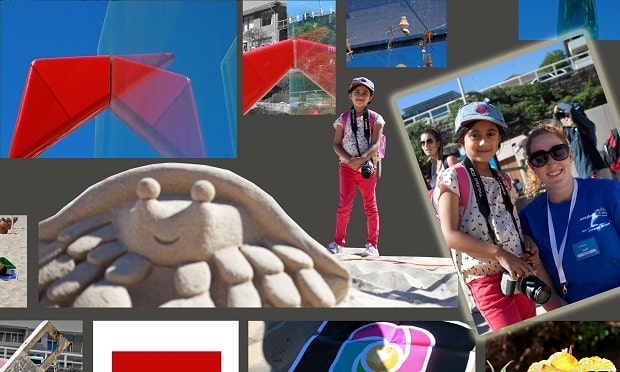
8-year-old Ananya Wakhare’s photos of Sculpture by the Sea
Sculpture by Sea 2013 by Ananya
Have you taken any? Post them to our Facebook page!

Funny Side Up! Diwali!

0
Reading Time: < 1 minute

Ind link Nov13i

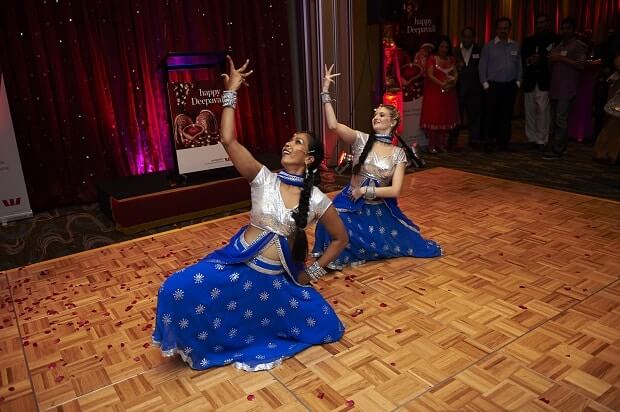
Happy Diwali from Westpac!

0
Reading Time: 3 minutes

Wishing wealth and prosperity to all
Indian entertainment v2
To help customers celebrate Diwali with their loved ones overseas, Westpac is providing customers a special Indian Rupee FX rate at participating branches* along with a special fixed Telegraphic Transfer (TT) rate of only $5 for new and existing customers until November 8.
As part of Westpac’s value offering for its customers, Westpac also offers bonus interest on its eSaver online savings account and a discounted home loan offer which they hope will brighten customers’ celebrations this year.
 
Customers wanting to save will receive bonus interest for the first three months when opening a new Westpac eSaver account. Customers can enjoy ongoing access to their money via their linked account and earn up to 4.11% p.a. variable rate on their new account for 3 months (includes 1.61% p.a. introductory fixed bonus rate for 3 months plus 2.50% p.a. standard variable rate).
 
To help those buying property save more now and in the long term Westpac is offering a discount of 0.90% off our standard variable rate until 29 November 2013 for new home loans of $250,000 or more under Westpac’s Premier Advantage Package. In addition, customers can also receive savings from a range of Westpac and BT Financial products and services covered under this package.
Swami Venktaya, Ashil Sharma, Supreet kaur, Neenu Mediratta, Suraj Kapila, Vicki Singh, Sian Lewis, Ross Watts, Prashanth Paramanathan v2
Damien MacRae, General Manager of Westpac Premium said: “Westpac has always had strong ties with the Indian community; we have a diverse workforce who actively work to serve and provide our customers with a great experience when they deal with Westpac.”
 
“I’m delighted that we are able to continue to support the Indian community giving our customers the opportunity to save more or use the money to celebrate their new home with family and friends,” he said.
 
Saving on the variable rate is only one way that Westpac helps customers own their own home sooner. Mr MacRae points out a number of ways new and existing property owners could look at to pay off their home loan earlier as highlighted by the findings from the recent Westpac Home Ownership Report.
 

  1. Use an offset account – Have your salary paid directly into your offset account so that it starts offsetting against the balance of the mortgage straight away.
  2. Plan ahead – Use an offset calculator to visualise how you can save money and reduce the life of your loan.  You can access this calculator at westpac.com.au/homeowns.
  3. Increase frequency of repayments – While simple this is a great way to make savings on your home loan. For example, paying half your monthly repayment every fortnight means you would make the equivalent of an extra month’s repayment every year.
  4. Spend money to save money – If you can afford to increase your repayments, this can mean significant savings over the life of a loan.
  5. Make lump sum payments – Consider putting any lump sums of money you receive into your offset, such as a tax refund or any bonus.
  6. Take advantage of rate cuts by keeping your repayments the same. You would be surprised at how much of a difference making even small decreases will make over time.

 
Offshore, Westpac is building its capability in the Mumbai branch which it opened 12 months ago. The Mumbai branch is equipped to offer retail banking products and services to Westpac customers, providing a convenient and safe banking experience to the Indian community.
 
To find out more about Westpac’s product offerings visit www.westpac.com.au today.
 
*NOTE: Participating branches for special Diwali FX and TT offer include Sydney, Ashfield, Burwood, Strathfield, Auburn, Blacktown, Liverpool, Merrylands, Parramatta, Seven Hills, Brookvale, Wentworthville, West Ryde, North Ryde, Westmead, Mouth Druitt, Blacktown, Castle Hill and Bankstown.

The best and worst of us

0
Reading Time: 3 minutes

2012's best and worst
“It was the best of times, it was the worst of times,” Charles Dickens wrote famously, in the opening lines of his novel A Tale of Two Cities (1859). “It was the age of wisdom, it was the age of foolishness, it was the epoch of belief, it was the epoch of incredulity, it was the season of Light, it was the season of Darkness, it was the spring of hope, it was the winter of despair, we had everything before us, we had nothing before us, we were all going direct to Heaven, we were all going direct the other way”.
An appropriate description of what we’ve experienced in the last few weeks!
The ‘best’ before us was the wonderful spirit of selflessness amongst the local Australian community as they came together to back our firefighters. The Rural Fire Service (RFS) battled bushfires, at times there were over 56 raging simultaneously, in temperatures ranging from mid to high 30o, strong winds of over 30 km/hour and low humidity. While over 200 homes were destroyed across the Blue Mountains, people living in Sydney were not immune to the conditions, as the city was enveloped in a haze of smoke. Media was at the forefront of reporting on the emergency situation confronting NSW, and not only detailed progress of the fires, but also spoke of the work done by the firefighters. The RFS is largely a voluntary organisation and its various members come from all walks of life. Stories emerged of Albert Newton (78), a volunteer veteran of over 60 years with the RFS, playing his part in warding off a fire at Bilpin.
A prominent face of the NSW fires has been Shane Fitzsimmons, Commissioner of the NSW RFS, who has been personally affected by fire tragedy. In 2000, his father George Fitzsimmons was back-burning in the Ku-ring-gai Chase National Park when the fire got out of hand, killing him and three colleagues. Shane was 31 and since then, he has dedicated his life to firefighting. These stories are a reminder of the passion felt across communities at times of crises, and new migrants can learn much about their new home from these accounts.
Also commendable is the maturity in which the State Government handled the crises. Barry O’Farrell and his team of ministers should be congratulated for backing RFS Commissioner Fitzsimmons and allowed him to take charge of the situation. Politics took a backseat as experts dealt with the emergency at hand.
Among the ‘worsts’ however, is the total lack of connection with local issues that Indian government officials have shown as they make the rounds of the community during our festive season. Although much mention was made of the tragedy at the recent Diwali Mela at Sydney Olympic Park by guest speakers as well as MCs, Indian government officials made no connection with this issue that is intrinsically involved with the lives of the Indian diaspora here. It is hoped that the connect with current local issues increases over time.
The ‘worst’ also came courtesy of Immigration Minister Scott Morrison who has increased his rhetoric against asylum seekers. While heavy-handed media restrictions on access and reporting on the issue is prevalent, calling them ‘illegals’ is harsh and confronting. This attitude defies the ‘fair-go’ ethos of Australia. There may be some rorting of the system, but others are genuine refugees. Upon assessment, call one group illegal if you have to, but treat the other with dignity and compassion. They will live in Australia and contribute, perhaps even join the RFS and give their best for their adopted community.

Diwali memories

0
Reading Time: 6 minutes


Most of us have many happy memories of Diwali. Carefree, joyful times spent in the company of family and friends, made more exciting with new clothes, an abundance of festive food and fireworks. We have enjoyed the Lakshmi puja, Bhai Dooj and visiting homes gaily decorated with diyas, lights and rangoli.

In this yaadon ki baraat, some recount happy times, others tell of scary incidents, but all are wonderfully nostalgic and we hope, bring a touch of light and laughter to your own celebrations this year.

My first Diwali
Uzma Beg
My very first Diwali was in the year 2003.
Coming from Pakistan, I had had no previous exposure to this festival.
But the very first day at work as a broadcaster on Indian Link Radio, also coincided with the Festival of Lights. My first ever radio show therefore, was on Diwali. No wonder it is my most memorable Diwali!
It is memorable for another reason, though. My co-host that morning, was my colleague Khalid Malik. Two Muslims, and both from Pakistan, fronting a show on Diwali. Now how’s that for Australian multiculturalism?!
As we got down to work with our carefully prepared playlist of upbeat songs, the phone lines lit up. It was a barrage of listeners calling in to wish their friends and family Happy Diwali. There was much fun and laughter, and the positive energy was infectious. We got completely caught up in the joy of it all… I enjoyed myself thoroughly. We ended with, you guessed it, plenty of puppies and jhappies!
What a happy first show it was for me. I felt lucky to have got acquainted with the listeners in an atmosphere of joie de vivre, and that pretty much set the mood for my shows ever since. To all my favourite listeners who have stuck with me since then, and to the hundreds more who have joined in through ten more Diwalis, I say, thank you, and Diwali Mubarak!
Khalid Malik has since moved back to Pakistan and made a name for himself in the entertainment industry there. How I would love to have him back on my show on Diwali this year to mark the tenth anniversary of our first appearance together. Are you listening, Khalid miya?
Diwali 2013 will be a special one for Uzma as she clocks up ten years behind the microphone at Indian Link Radio, a full decade of non-stop diva-style dimaag-chaat-buk-buk. Congrats, Uzma!
 
True communal harmony 
Amitabh Mattoo  
My most memorable Diwali experience was in 1975, at my home in Srinagar in the beautiful Kashmir valley. We lived in a neighbourhood that had Muslim, Sikh, Buddhist and Hindu homes right next to each other. Unlike today when Kashmir has become synonymous with violence and conflict, in the 1970s the valley was synonymous with religious and cultural harmony and togetherness.  On the morning of Diwali in 1975 (I was 13 years old then), all the children in the mohalla first collected money from the elders and then went to buy the choicest fireworks from nearby Maharajah bazaar, which was converted into huge fireworks supermarket. And in the evening, instead of celebrating Diwali just in our own houses, everyone, Sikhs, Muslims, Buddhist and Hindu families, assembled in the grounds of nearby Amar Singh College, first ate together and then watched the spectacular display of fireworks. It didn’t matter which faith we belonged to or our political loyalties, we all came together in celebrating the victory of good over evil. Those were the days, unimaginable in Kashmir today!
It’s a special Diwali for Dr Mattoo as the Australia India Institute, of which he is director, has just concluded its fifth successful year of operations.

Warm and fuzzy 
Manpreet Singh
There have been so many happy Diwalis, I couldn’t possibly pick one! Ok, let me see – turning all the lights on in the house on Diwali night, but first checking to see there were no fused bulbs and changing them if there were any; helping to line up the façade of the house with electric light strings, which would stay on from just before Diwali to just after Guru Purb, equally significant, if not more so for us Sikhs; that much awaited afternoon when we would be taken to the shops to purchase our choice of patakas; the endless parties night after night in the week of Diwali as we made the rounds to homes of close friends and family;  the special little things I would have for all my cousins, especially as the oldest cousin in the clan; the special moments with each of my brothers on Bhai Dooj (Brothers’ Day)… Oh, there definitely were some not-so-happy moments which we all laugh at today, such as when my hair went up in flames from a stray phooljhadi (sparkler) or when my brother burnt his hand! But overall, the outstanding memories are those magic moments of sharing and happiness and non-stop partying… A very Happy Diwali to you. May the diyas enlighten you, may the crackers add sparkle to you; may the candles fill you with hope, and may your fears go up in smoke!
Congrats to SBS Punjabi broadcaster Manpreet as she celebrates her Walkley Award nomination and UNAA’s media award for increasing awareness of women’s rights and issues. It’s certainly going to be a happy Diwali for her.
 
Crying for (an authentic) Diwali
Mandeep Rana
One of our most memorable Diwalis is when my wife Simran and I took our ten-month-old daughter Ashna to India during Diwali. The poor babe got such a fright with the patakas on Diwali night that she caused quite a panic amongst the family members. She squealed non-stop as the firecrackers went off outside. Of course we thought she would get used to it shortly, but no! The louder they got, the harder she cried. Everyone ran helter-skelter to close the doors and windows and cover her ears and block air spaces with towels and sheets. But all the poor darling did was turn redder and redder with the constant crying. As for her mum, she turned redder and redder as she tried hard not to cry! And me, I just stood there wondering whether to cuddle my two girls in protection, or storm outside and give the pesky teenage revellers a piece of my mind, or drag a quilt out from somewhere to further soundproof the doors… or just eat another piece on burfi in resignation. It was one heck of a long Diwali night before the noise subsided and the fruit of my loins fell into exhausted sleep. And if you have had a ten-month-old, you will know the kind of exhausted sleep Simran and I fell into as well!
Many friends tell us that one of their fervent Diwali wishes is to be able to take their kids to India to see an authentic Diwali. Diwalis in Australia are so sanitised, they complain; no patakas, bad mithai, no extended family… our kids must see the real thing. But then I remember Ashna’s first Diwali and wonder, will your kids really enjoy it?
This Diwali will be a special one for Mandeep Rana and partner Dimpy Singh, as their Terrey Hills Restaurant Urban Tadka wins two awards in as many months (state level and national level Savour Australia 2013 Award for best Indian restaurant ), in its second year of operation.

Diwali with primary school kids
Mala Mehta
Every Diwali is special for me, but the most special is always the current one! This year’s Diwali has been like a dream come true for me, as I celebrated it with a few hundred primary school kids.
Students from seven mainstream schools got together at Cronulla Public School to mark Diwali. And what a Diwali party we had!
There were Indian outfits galore for teachers as well as students; a traditional Indian welcome ceremony; Indian music and dance, and some sumptuous Indian food for all. The mostly non-Indian kids learned about Diwali as they enacted scenes from the Ramayana (including a Ravana figure complete with ten heads), crafted colourful diyas as candle holders, and drew rangoli and henna designs during art lessons. And the Bhangra and the Bollywood dancing, what a hit!
My only regret is that alas, we did not have sparklers…
Having worked towards making something like this happen for the last 24 years, it was truly exhilarating to see it all come to fruition. I cannot express in words how I felt but hopefully my photos will say it all!
The event was initiated by the Principal Mr Peter Banks and the India Calling teacher and Assistant Principal Mrs Joanne Williamson. A huge thank you to art teacher Ms Jacqui Hachfath, Indian teacher Ms Kulwinder Kaur, music experts Mr Vinod Rajput and Mr Bulla Singh.
India Calling is a multistage teaching resource currently complemented by a Hindi language program, trialled and developed in the Sydney Region of the NSW Department of Education and Communities’ Expanding Horizons with Asia initiative. It involves both face-to-face lessons presented by our specialist Hindi teacher, augmented by videoconference technology to connect a total of 520 students in Year 3 and 4 across all the participating schools in the state. This innovative educational program shares resources to develop an understanding of India and provides insight into the Hindi language. This program builds vital ‘people-to-people’ links among school children of both countries and sows the seeds for opening up of opportunities for considerable growth through education, including exchange of language and educational programmes and deepening ties between Indians and Australians. 
This Diwali will be a special one for Mala, as the Indian Calling program of which she is coordinator, marks five years since inception.


Diwali comes to Sydney’s CBD

0
Reading Time: 3 minutes

To the delight of the workforce, Martin Place was transformed into a riot of music, festivity, colour and celebration, writes ASTHA SINGH
Pic11
It was that time of the year between Dusshehra and Diwali, that the pre-Diwali celebrations were held for the second consecutive year at Martin Place in Sydney’s CBD. The October 17 celebrations included the India Calling initiative, loads of stage performances, flash mob dances, attractive and colourful traditional costume stalls, henna, rangoli and other art stalls, and naturally, Indian food stalls. The day-long event was organised by the Hindi Council of Australia (HCA), and included more than 300 performers, participants and volunteers. Over 6,000 people visited through the course of the day.
The event kicked off at mid-day with a warm welcome and the Australian and Indian national anthems. Students from Cronulla, Mascot and Ashbury Public Schools participated in the India Calling feature, and were joined by Double Bay, Canterbury, Annandale, Carlton South and Janali Public Schools.
It was amazing to see the young Cronulla Public School kids depicting the story of the Ramayana dressed as Rama, Sita, Lakshman and Hanuman. Mascot Public School students walked on the stage representing people from different Indian states, wearing Punjabi, Rajasthani, Tamil, Bengali and Kashmiri costumes. This was followed by dance performances to Jai ho and Twist by the Ashbury Public School students.
(The India Calling program encourages school children to learn respect for each other’s cultures, customs, language and religions, and provides them an opportunity to meet on significant days in the Indian calendar and participate in cultural activities).
The colours and energy of Martin Place during a busy working Thursday was phenomenal as people from different backgrounds walked around, curious to check out the action behind the music they must have heard through their office windows. By 12:30pm and during lunchtime, the area was jam-packed.
Of course the portly God of Good Beginnings, Ganesha, was invoked in the traditional Ganesh Arti, and the Deva shree ganesha dance set off the dance mood.
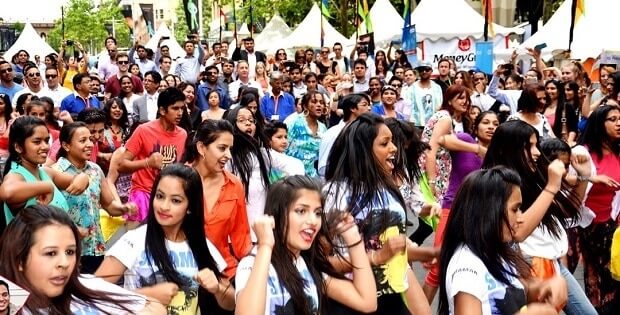
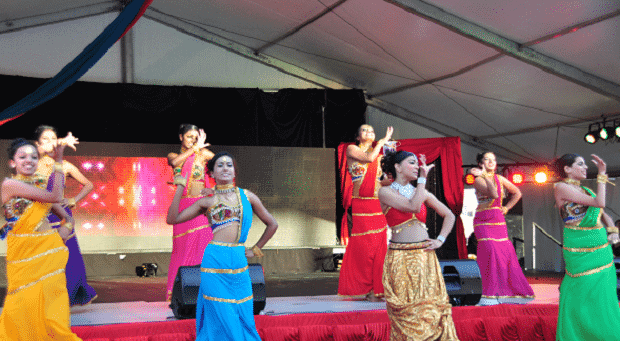
There was Bollywood dancing, a flash mob dance and even a dance class with Balam pichkari steps taught to an interested audience. Garba, laavni, bhangra and the inevitable popular Bollywood dance numbers followed. The dances were energising and greatly applauded by the audience, including the ‘whistlers’ amongst the crowd who had increased in number.
Meanwhile, the henna stall saw a lot of traffic with ladies and even men wanting beautiful designs applied on their hands and arms. The expertise of the henna artists won them over in no time! The costume photo booths offering the opportunity to be photographed in traditional Indian dresses also saw a lot of visitors.
The most exciting and spirited session however, was towards the end of the day when the workforce had finished their day and all sorts of city-goers were interested to join the Diwali celebration buzz! This segment was versatile, starting with classical and instrumental performances, before moving onto Bollywood and traditional fusion performances.
The garba performance by ISSO Blacktown, Tagore dance by Arpita, the presentation by the Lotus Dance School and an innovative and colourful performance by Abhinav School of Arts were also a part of the session. The ‘100 years of Bollywood’ performance entailed dance numbers from golden oldies to contemporary numbers.
The other notable performances of the evening were Rhythmic Squad, a Bollywood mash up; Shiamak Group; Pallavi from CK Performing Arts; Raas garba fusion by ISSO Blacktown; dhol giddha group paniri led by Reema Randhawa; and dhol beats dance floor with DJ Dimple. The competent MCs for this session were Australian and Bollywood actor Nick Brown, and Hindu Council members Emie Roy and Leah Briars.
The cultural programs were managed by Anita Sharma and Sanjay Khanna, and the event was well organised by Sanjeev Bhakri, Raman Bhalla, Bhupinder Chhabra under the sincere guidance of the Chairman of the Council, Prof Nihal Agar. Distinguished guests included the Indian High Commissioner Biren Nanda; Consul General Arun Goel; MP Phillip Ruddock; MP Craig Kelly; MLC David Clarke; MP John Robertson; MP Matt Kean; MP Geoff Lee; Councillor Gurdip Singh; and ex-Councillor Dilip Chopra.
The event was well received as indicated by the number of visitors who attended the event, and it has been hailed as a great success. Many visitors left all eager to attend the Hindi Council Diwali fair, to be held on a much grander scale, only a few days later.

Diwali Mela in Sydney is a winner

0
Reading Time: 4 minutes

Fundraising efforts stepped up at Deepavali mela in support of the bushfire victims
DSC_3372
“The message of light dispelling darkness can be found in many religions,” Victor Dominello, NSW Minister for Citizenship and Communities and Minister for Aboriginal Affairs said recently, “but no other culture celebrates this with as much energy as the Hindus!”
He was speaking at the 15th Deepavali Mela organised by the Hindu Council of Australia at the Sydney Olympic Park in late October.
Minister Dominello couldn’t have said it better. This year’s Deepavali had it all – entertainment, fun and food, catching up with friends, Raavan dehan, and to round off, some superb pyrotechnics.
The atmosphere began with cheerful anticipation of a busy day, with a riot of colours assaulting the senses through many brightly dressed attendees in traditional attire, coloured stalls sporting various wares and services, and the gaiety and camaraderie that is so symbolic of Diwali. The mela drew in some 15,000 people, much more than the UIA sponsored fair only months ago, and delivered in every respect. By the end of the day, the crowd was happy and content, having enjoyed a taste of home away from home.
Both Victor Dominello and Labor leader Chris Bowen impressed with their speeches on the occasion, also with their knowledge of the festival and the community they were addressing. Chris Bowen recalled his first Festival of Lights seventeen years ago, when he attended a Diwali celebration at Fairfield as mayor.
Both splattered their speeches with ‘namastes’, ‘shukriyas’ and ‘dhanyavaads’, in what can only be viewed as sharing the spirit of the season.
Hindu Council head Nihal Agar’s address clearly brought out his appreciation for the volunteers, whose efforts were indeed obvious for all to see.
Prof Agar’s dedication to the cause has been so exemplary, that he could possibly be called ‘Mr Deepawali’. Putting in perhaps just as many hours into this voluntary activity as in his day job, he has gained the respect of the Indian community at large. To the members of the Council, he is a great leader and motivator and has instilled the same spirit of dedication within his team. Not only did he pick his core team of organisers well, Prof Agar also ensured that they worked cohesively and efficiently. In the end, perhaps it was the clear vision espoused by the Diwali Mela committee that saw the event meet with the success that it did.
High Commissioner Biren Nanda’s speech on the other hand, sadly contained no message of hope or congratulations for the Indian community, or indeed the wider mainstream as they tackled an extreme natural disaster.
Even as bushfires raged in the nearby Blue Mountains, the Olympic Park event saw the launch of the Hindu Climate Action Kit. The Kit has been developed jointly by the Hindu Council of Australia and ARRCC (Australian Religious Response to Climate Change), a multi-faith organisation promoting actions to reduce eco-footprint amongst the faith communities of all major religions.
The HCA’s Vijay Singhal who helped develop the kit, said, “The current extreme weather conditions are a very timely reminder to all of us to take action to reduce our eco-footprint. From Hindu teachings and prayers to easy-to-understand science and improving energy efficiency, from ideas for nurturing a sense of connection with Mother Nature to advocacy, this kit will empower us in Greening our temple worship.”
ARRCC President Thea Ormerod helped launch the kit at the event.
There were some murmurings that perhaps the fireworks should be cancelled as a mark of respect for those affected by the bushfire, following the Chinese community that cancelled its own fireworks the same week. Raman Bhalla from the organising team revealed to Indian Link that indeed the idea was considered, but the decision was finally taken after some deliberation to keep them on. “I’ve had some 250 calls asking if the fireworks will be on,” he said. “The burning of Raavan is an essential element of the Diwali tradition. However our thoughts are definitely with those affected, as well as with those fighting the tragedy, and so we have decided to push our fundraising appeal very, very strongly.”
Indeed MC Manbeer Kohli passionately urged everyone on a regular basis, to do their bit.
On stage, the events ranged from cultural acts such as songs and dances both traditional and contemporary, to missives from various charities such as Transplant Australia. The standout numbers were crooners Jaspreet Grover and Priyanka Bhanushali, the Shiamak Davar dancers, and out on the grass, the Bollywood flash mob.
And by the way, how cool were the MCs Manbeer Kohli and Leah Briars: we hope to see lots more of them in the future.
Meanwhile, stalls in the outer field did brisk business. The food stalls probably saw half hour long waits at any given time, with stall holders such as the sugarcane juice rushing to refill supplies at regular intervals. (Hey, was that a fight that broke out at one of the foodie stalls? We couldn’t tell from the distance!) The ‘dharmic’ stall selling religious samagri was also busy, as expected, and everyone dropped by at the makeshift mandir to say quiet prayer to Lakshmi and Ganesh, the gods of the season.
The Western Union-sponsored Bollywood dance competition was an absolute hit, with some pretty good entrants strutting their stuff. The Ministry of Bhangra (MOB) were as forceful as ever as they stunned the audience with their energy, and while usually they are clear winners wherever they go, this time round they saw some stiff competition from the innovative Rhythms of India. MOB ended up placing first, with Rhythms of India a close second. Thank you MOB and Rhythms dancers, for raising the level of entertainment at Indian community functions! And keep up that spirit of competition because it makes it all the more enjoyable for the audience (who are sick by now of the amateur fare to which they are regularly treated).
The Telstra-sponsored Rangoli competition was a nice touch too: it added that ‘back home’ feel commendably, and no doubt inspired many to make plans for participation next year.
Overlooking it all, the big baddy Raavan stood witness to the celebrations, taking it all in with his ten heads, and weathering the hot sun in anticipation of his own fiery end. He may have looked pretty docile, but to the Hindus gathered there, he was evil personified! Come dusk, he was set alight, as revellers cheered. All the evil in the world had been symbolically brought to an end; the world was rid of all negative energies. As if to rejoice, the fireworks display came on, and as the sky glimmered and shimmered with a million lights, to the Hindus it marked the beginning of a shiny and hope-filled New Year.