
Home Blog Page 963

Dancin’ in the rain

2
Photo: Ravinder Singh Jabbal
Reading Time: 2 minutes

Malaika Arora Khan is a huge drawcard at IFFM’s Telstra Bollywood Dance Competition

Photo: Ravinder Singh Jabbal

There was no sunshine or blue skies, but it was the perfect day for dancing in the rain at the Telstra Bollywood Dance competition; for many reasons. The participants had come from different parts of the country, there was substantial prize money to be won including a free trip to India and the dancers had been gearing up for this event for weeks.

It helped of course to have Bollywood’s original yummy mummy Malaika Arora Khan to turn up the heat.

Malaika is currently a judge on the 2014 season of India’s Got Talent. The svelte Indian actress, dancer and model who is famous for her sizzling dance numbers Munni and Chaiyya Chaiyya was in Melbourne as one of the judges of the Telstra Bollywood Dance Competition. The event was held at the iconic Federation Square as part of the Indian Film Festival of Melbourne 2014. Writer-director Vijay Krishna Acharya of Dhoom 3 fame and Avtar Panesar from Yash Raj Films accompanied Malaika on the judging panel. The spectators could also take part in the event by voting for their favourite contestants via their phones.

It was one Bollywood dazzler after the other as teams and individuals showcased some amazing talent. Any discomfort from the inclement weather was soon forgotten amidst the riot of colours, foot-tapping music and some sensational performances. The jury was out along with the umbrellas and it was a tough call to decide the winner.

The judges were looking for expression, form, technique and creativity and they found it all in the performances of the Shiamak Dawar Dance group and The Sapphires. The two groups went on to share the best dancing group title. Sanjana Jaiswal won the Pre Teens solo for her innovative fusion of Indian classical dance performed on Bollywood pop songs. The beautiful Elise Watson-Ford deservedly took the adult solo prize for her creative combination of Indian music and western ballet. Elise won a trip to India courtesy of Gaura Travels. The rest of the winners received cash prizes from Telstra’s General Manager Alister Park.

During the course of the evening the crowd swelled to thousands despite the cold and wet weather. Their persistence was rewarded when towards the end Malaika bust a few moves of her own on stage. Clad in a simple pink short shift dress, a faux fur coat, opaque stockings and some killer black heels, Malaika Arora Khan was quite clearly the crowd’s favourite.


More from IFFM here:

A Tete-A-Tete with Amitabh Bachchan

Couldn’t get enough of Big B

And now, an Amitabh scholarship!

And the award goes too

Check out the photos of Big B at IFFM on our Facebook page here

Couldn’t get enough of Big B

3
Photo: IFFM
Reading Time: 3 minutes

Amitabh Bachchan thrills his Melbourne fans at IFFM event

Photo: IFFM

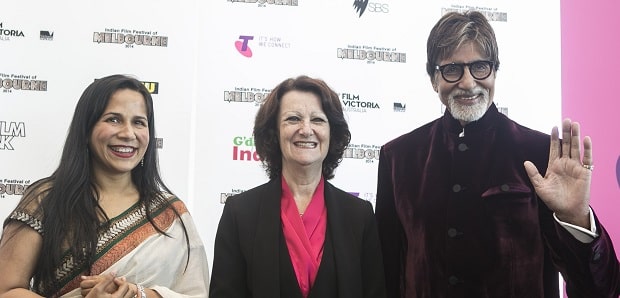
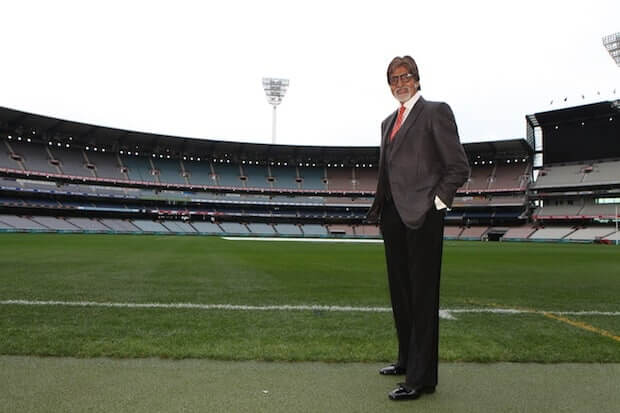
In an atmosphere of heightened interest and tightened security, Indian cinema’s luminary actor Amitabh Bachchan was in Melbourne recently to open the Indian Film Festival of Melbourne 2014 (IFFM). Big B’s presence in Melbourne created a buzz in the community like never before.

Within seconds of his arrival at Melbourne airport the adoration for this living legend of Indian cinema was mapped on social network through innumerable selfies, tweets, digital camera photos and Facebook posts.

The IFFM Opening Night event and the screening of Sholay 3D sold out within 48 hours of going on sale. The media, including mainstream, were present in substantial force to report on the celebrity.

Taking all this adulation gracefully into his stride, the 72-year-old actor spent a couple of hectic days in Melbourne addressing press conferences, giving media interviews and attending events related to the Indian Film Festival. He also visited the La Trobe University in Bundoora to present a scholarship named after him.

“This is my first trip to Australia and I hope to have many opportunities to visit this beautiful country again,” said Mr. Bachchan at a press conference held at the Investment Centre in Collins Street prior to the opening of the Festival. At the conference Mr. Bachchan expressed his delight at receiving the honour of Opening the Indian Film Festival and receiving the International Screen Icon Award from the Australian Government.

Mr. Bachchan said that cinema has been a great binder that goes beyond colour, caste or religion.

“We enjoy the same product, laugh at the same jokes and sing the same songs,” Mr. Bachchan said. “We enjoy the same emotions”.

He added that in a world that is fast disintegrating, there are very few institutions left that brings such integration. “It is wonderful to see that Australian government has decided to use this medium in bringing the two communities together and building strong bonds of friendship”.

He echoed similar sentiments at his Opening Night address prior to the screening of his biggest hit Sholay redone in a 3D version.

“I hope that through this medium of culture, film and entertainment, we come closer and become even greater friends than we already are,” said Mr. Bachchan.

During the Opening Night event held at Hoyts Melbourne Central Mr. Bachchan connected with his fans and answered questions presented to him, on behalf of the audience, by Festival Director Mitu Bhowmick Lange. Amidst screams of rapture and declarations of undying love from his fans, he recited in that famously rich baritone, an extract from Madhushala, a popular poem penned by his father Harivanshrai Bachchan. He then took the time to recite and translate a dialogue from Agneepath, a hugely successful film of his,for the benefit of Minister Louise Asher and other non-Hindi speaking guests.

The excitement reached fever pitch, when on popular demand, he also recited famous dialogues from his blockbuster movie Kabhi Kabhi.

Throughout the event Mr. Bachchan maintained a remarkable air of composure. On his way out there was a frenzied but thwarted attempt from his fans to get closer to him. People who had travelled from all parts of Victoria just for this moment jostled with each other to get an unobstructed view. There was an onslaught of cameras and digital phones as everybody took pictures before Mr. Bachchan was whisked away amidst tight security. The audience obviously couldn’t get enough of their favourite star, but everyone went home with a story to tell.

More from IFFM here:

Dancin’ in the rain

A Tete-A-Tete with Amitabh Bachchan

And now, an Amitabh scholarship!

And the award goes too

Check out the photos of Big B at IFFM on our Facebook page here

A Tete-A-Tete with Amitabh Bachchan

3
Photo: IFFM
Reading Time: 4 minutes

It was a few minutes with the Big B, but it was worth it

Photo: IFFM

A school friend of mine has celebrated every birthday of superstar Amitabh Bachchan in the last 25 years. She has a photograph of her idol next to other deities in her place of worship; she is a walking encyclopedia of information on Big B, and a couple of years ago she spent an enormous amount to celebrate his 70th birthday with over 200 people. Unfortunately she is yet to meet the multiple award-winning actor. She called me recently for the first time in 20 years, just to ask, “Did you really interview Big B?”

The adoration for India’s most popular screen idol is universal in nature. The phenomenon that is Amitabh Bachchan has been perfectly captured in Anurag Kashyap’s Murabba as part of the Indian anthology film Bombay Talkies. The protagonist of this film travels to Mumbai to fulfill his ailing father’s desire to feed the star a homemade murabba (fruit preserve) and to bring the remaining half back to save his father’s life. The desire to catch a glimpse of the God of Indian cinema has brought thousands of people to his doors in Mumbai, every Sunday, for the past 30 years. If Mr. Bachchan is in town, he comes out to wave to his crazed fans.

The patriarch of Indian cinema was in Melbourne recently to officially open the Indian Film Festival of Melbourne 2014. I had the pleasure of speaking briefly to him. For someone who has dealt with the onslaught of cameras, requests for sound bites, public and media scrutiny though four decades of his life, I found that Mr. Bachchan was unfailingly courteous albeit economical with effusiveness.

To begin with, I asked him how the ‘angry young man of 1970’s’ would like to be addressed in 2014.

“I guess ‘angry old man’,” came the reply with no hesitation and a slight smile.

I would personally settle with calling him ‘seriously sensational old man’, however Big B claimed that he did not believe in these epithets.

Such is the power of this superstar that his social media network has a combined following of over 25 million people and counting. A simple comment by him, on his blog, generates a tsunami of likes and responses. He is known to communicate to his extended family (‘EF’ as he likes to call them) on a regular basis and his loyal followers have now started reaching out to each other and participating in each other’s lives as one does in a community.

Before his arrival in Australia he wrote on his blog: ‘There is within a day, travel again. To distant and unknown territory, to receive recognition, to inaugurate fond relationships and to acknowledge the presence of our cinema at foreign destinations…’ 

I requested Big B to elaborate on the bit about ‘inaugurating fond relationships’. Mr. Bachchan paused for a few seconds to think and replied, “I was talking about the relationship between the Australian and Indian communities. A large population of Indians lives here and they will watch films that I am associated with at the Festival. This Film Festival has been designed to bring our two communities closer and to expose Australians to our creativity and our culture. I am hoping this will help to further that relationship,” he added.

The recent election season in India had it all: drama, comedy politics and satire; so did Big B’s latest release Bhoothnath Returns. I asked him if the message conveyed in the movie resonated with his own opinion of politics to which he replied, “I went into politics on an emotional level and because I was unqualified for it I have accepted my failure there. I do not know politics and therefore I have stepped down. I have since not made any political statement and I do not intend to return into politics,” he declared.

“My latest film Bhoothnath Returns is a sequel,” he continued, “and it begins from where the last film ended. It is a story of a kid who is leading a very oppressed life because of certain politicians who are not doing their job properly. There are many related issues that have been put across in a light satirical manner and there is an emphasis on the importance of casting your vote. Every vote matters and if you are not voting, then you are not expressing your voice. These are some of the messages that are very pertinent to this film,” said Mr. Bachchan.

At 72 years of age there is no dearth of work for this influential actor. His upcoming releases include Sujoy Ghosh’s Badla with Vidya Balan and Shoojit Sirkar’s Piku. He is currently working ona new film with R Balki with whom he made Paa and Cheeni Kum. He is also doing a TV series with Endemol, Anurag Kashyap and his team for Sony Entertainment Television. Another season of Kaun Banega Crorepati is expected later this year and then there’s a few more projects slated for 2015. “I just feel very fortunate that there are people who still want to work with me and give me the opportunity to express myself,” said Mr. Bachchan as we wrapped up our conversation.

Even as I write this, Big B is back in India already working, tweeting, blogging and making gracious comments on the hospitality that he enjoyed during his first ever trip to Australia.

‘Heady and humbling’ is how he describes his experience in Melbourne. Hopefully he will be back soon for more of the same.

More from IFFM here:

Couldn’t get enough of Big B

And now, an Amitabh scholarship!

And the award goes to

Dancin’ in the rain

Check out the photos of Big B at IFFM on our Facebook page here
A contented life

0
Photo: Purvi Joshi
Reading Time: 4 minutes

Letting go of regret, resentment and anger can lead to contentment, happiness and peace

Photo: Purvi Joshi

Everyone would like to lead a contented, happy and peaceful life. Whatever our economic situation may be, we value the experience of a happy contented life that gives us peace, more than anything else. Sometimes achieving this wish could be hindered by the intrusion of some debilitating negative emotions, of which we may not even be aware. Surprisingly, once we become aware of these negative emotions, we can work towards getting rid of them. This is the most important first step and the quickest way to enjoy the peace we seek. We need not look for something outside of our self, but getting rid of something negative that already exists in our thinking can make us truly happy.

Unresolved issues have a habit of resurfacing and upsetting our balance unexpectedly. It is vital that we learn to deal with them. The two most common that unsettle us are regrets and resentments.

There are many times in our lives when we look back and think, ‘if only…’; ‘perhaps I should have….’. There may be many regrets. The thought that something could have been done differently, something that was under your control and was not done, surfaces from time to time. Sometimes it may be even something one said that need not have been said. Sadly, we cannot remedy that action. It happened in the past. This means we cannot turn the clock back. The time has gone by when the right thing to do would have been to apologise or make amends. A quick apology or some form of redeeming action could have righted the wrong.

Years later, if this thought re-occurs, it would seem that it still has some importance in your thinking, subtly influencing your life, and it warrants attention.

While regrets are always about disappointment with oneself, resentment is almost always directed towards another. It is a feeling that is a mixture of annoyance, anger, envy and even hatred. Quite often it follows an actual incident when one may have been belittled, or perhaps even perceived as such. Almost always the resented person is initially someone who was held in high esteem or is of a higher status. It can surface when this person is praised or seen as exceptional. Sometimes it can occur within a family or in a work situation when one’s achievements may be overlooked, while others are given preferential treatment. In emotional relationships, rejection or perceived rejection by another can also cause resentments. In social situations, resentment is often experienced when there is perceived inequality and unfairness, and can trigger conflicts that are hard to appease. Quite often this is the trigger for resistance and hostility within communities, as can be often seen in international conflicts and even local communities.

The disappointment of a real or perceived incident triggers a sequence of negative emotions that fester and lead to an unpleasant state of mind, sometimes with even more dire consequent actions.

Effects of harbouring regrets and resentments

Regrets are often one of the main reasons for dissatisfaction about one’s life. An opportunity lost always has a habit of surfacing when one feels in a particularly low mood. When things don’t go the way one wants, we start regretting a lost chance when something could have been done differently. The habitual delving into the past brings up many ‘if only….’ statements. Very quickly this results in a sense of frustration and anger towards oneself. Occasionally it is directed outwards at the person or persons who may have triggered this frustration. This can result in a sense of hopelessness and sadness. There is a ‘lost look’ about a person who is unable to focus on the present. Lack of motivation, difficulty in enjoying achievements and a general apathy can be experienced when regrets are not dealt with and resolved.

Resentments, on the other hand, tend to be felt more when it is towards a loved one. To be hurt by a friend or someone you have been close to creates a sense of betrayal and sadness that one is unable to express. Turning all this inwards leads to several unproductive feelings such as becoming cynical, being sarcastic and even a loss of trust in general. Sometimes this can result in a loss of self-confidence and lead to communication difficulties. Particularly when it is perceived as caused by a loved one or family member, future communication with that person is lost. Resentments are obstacles that can cause major damage psychologically.

What can be done?

Firstly, we need to be honest with ourselves. A bit of soul-searching could unearth resentments we may hold against persons that may have contributed to our sense of anger or annoyance from time to time, when in their company. It is possible that something was misread or misunderstood. Looking at them objectively, one needs to realise how debilitating these resentments have been in one’s life. Perhaps the time has come for forgiveness and the need to let go of the incident. Realising the powerful negative effects that resentments have been influencing all areas of life, one has to realise that it is of utmost importance to face them and get rid of them by letting go. This is by no means easy. However, one has a lot to gain by getting rid of resentments so life may go on more happily.

Regrets can perhaps be best handled by accepting that certain decisions were made that seemed best at the time. Acceptance and learning to move on is the most constructive thing one can do.

Regrets and resentments are very destructive. To become aware of their presence and learn to tackle them and get rid of them is the best thing one can do to gain a content, happy and peaceful life.

Big B hits Melb for IFFM!

0
Photo: Ravinder Singh Jabbal
Reading Time: < 1 minute

Check out our photos of Big B in Melbourne on our Facebook page!

Photo: Ravinder Singh Jabbal

See more photos here!


A separate ballot box for each candidate!

0
Reading Time: 2 minutes

A look back at India’s first general elections in 1951

Did you know that in the first general election in India, held over a four-month period in 1951-52, voters were given differently coloured ballot boxes for each candidate in which to cast their vote?
India’s first Election Commission had very thoughtfully kept in mind the large population of illiterate voters – literacy level was just 16 percent then as compared to 73 percent now – while deciding on the balloting system.
At polling booths, each candidate was allotted a separate ballot box, differently coloured, on which each candidate’s name and election symbol was labelled.
“A voter had to simply insert the ballot paper given to him in the ballot box of the candidate of his choice in the voting compartment,” writes former chief election commissioner S.Y. Quraishi in his book An Undocumented Wonder: The Making of the Great Indian Election (Rainlight, Rupa).
Even as the country is in the midst of its 16th general election spread over 36 days and 10 phases, what is not known are the challenges the fledgling democracy faced in conducting the country’s first general election in 1952, that was spread over four months and 68 polling days, or phases, says Quraishi.
The elections were held from Oct 15, 1951, to Feb 21, 1952, for an electorate of over 173 million (173,212,343). The first phase was held in the assembly constituencies of Chini and Pangi in Himachal Pradesh, before the onset of winter, while the final 68th phase was held in Uttar Pradesh.
The ballot papers were printed by the Election Commission at the Government of India Security Press at Nashik, where the Indian currency notes were also printed.
The first general election had a total number of 1,874 candidates, including 533 independents, compared to 8,070 candidates in the 2009 election. The number of political parties participating were 53, including 14 national parties. The 2009 election saw 363 political parties participating, which included seven national parties and 34 state parties, with the rest comprising unrecognised parties.
“As many as 196,084 polling stations were set up throughout the length and breadth of the country, of which 27,527 were exclusively reserved for women,” he says in the book. Of the 173 million electorate, 105,950,083 voted.
After the votes were counted and results declared, the first House of the People was constituted by the Election Commission on April 2, 1952.
More than 60 years later, India’s electorate now stands at over 814 million. The country is holding 10-phased elections, from April 7-May 12, 2014, for the 16th Lok Sabha. India’s literacy level stands at over 73 percent.
To help out in the election process, a provision was made under Section 159 of the Representation of the People Act, 1951, to allow the employees of local authorities and government servants to be deployed on election duty.
Employees from the private sector were deliberately kept out, writes Quraishi.
But as the size of the electorate and elections grew, the poll panel found the number of government servants inadequate. In 1997, Section 159 was amended to include the services of employees of state-run universities and other government institutions as well as public sector companies to add to the human force needed.

IANS

Indian Link’s Top 5 Picks for Sydney Writers’ Festival

0
Sydney Writer's Festival
Reading Time: 3 minutes
Sydney Writers’ Festival

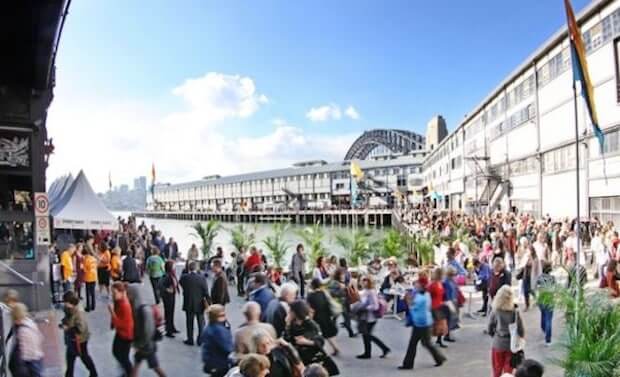
Harbourside food and fun with a week of insightful and entertaining readings, workshops, panels and performances on the side – what could be better than the 2014 Sydney Writers’ Festival?

Here are Indian Link’s top five must-see events for the festival:

Festival Club

The Chaser’s Empty Vessel

Snuggle up and enjoy some late night laughs with bedtime stories by top comedic writers. Then make sure to stay awake for some riveting discussions at the Chaser’s Empty Vessel with some of the festival’s biggest names including Reza Aslan and Jeremy Scahill.

Thursday, May 22 2014, 7:00 PM – 11:30 PM at Pier 2/3 Club Stage, Pier 2/3, Hickson Road, Walsh Bay. Tickets $15 at the door, no pre-bookings

Family Day: Comedy Storytelling Hour

Tristan Bancks

If you’re getting tired of the heavy stuff and are looking for some lunchtime entertainment make sure to attend the Comedy Storytelling Hour. Come witness the hilarity of Tristan Bancks, Oliver Phommavanh and James O’Loghlin as they re-create and make fun of the extent people will go (including themselves) to make others laugh!

Sunday, May 25 2014, 1:45 PM – 2:45 PM at Pier 2/3 The Big Top For Little People, Pier 2/3, Walsh Bay. Free, no bookings.

Curiosity Lecture Series: On What Gandhi Would Do

Mahatma Gandhi

Former High Court Justice Michael Kirby gives an insightful talk on how we can apply the inspiring views of Mahatma Gandhi to contemporary world issues including women’s rights, climate change and sexuality. Kirby will discuss how useful Gandhi’s frameworks of wisdom and compassion are in confronting global problems, emphasizing how one man became the Father of a Nation.

Saturday, May 24 2014, 3:30 PM – 4:10 PM at Pier 2/3 Bloomberg Stage, Pier 2/3, Hickson Road, Walsh Bay. Free, no bookings.

Zoe Daniel: Storyteller

Zoe Daniel

Zoe Daniel, ABC South East Asia Correspondent, is one of only a handful of women to combine one of the most dangerous jobs in the world with one of the most demanding – motherhood. She discusses, Storyteller, her memoir that covers political unrest in Bangkok and the bittersweet story of conjoined twins in India, to a tragic plane crash in Laos and the destruction of Typhoon Haiyan in the Philippines to her personal story of the universal juggle of work, ambition and family amid the unpredictability of life and the predictability of the 24/7 media cycle.

Saturday, May 24 2014, 2:00 PM – 3:00 PM at Casula Powerhouse Arts Centre, 1 Casula Road, Casula, Free, bookings essential 9824 1121.

Real Worlds / Imagined Worlds

Ivor Indyk

Giramondo publisher Ivor Indyk shares the stage with four of Australia’s most versatile and wide-ranging poets: Judith Beveridge, Ali Alizadeh, Kate Middleton and John Mateer. They read and discuss poems that travel across the world and through time, to India, medieval Spain, the Middle East and the US, and over thousands of years, to probe the limits of human ambition, emotion and language.

Sunday, May 25 2014, 10:00 AM – 11:00 AM at Philharmonia Studio, Pier 4/5, Hickson Road, Walsh Bay. Free, no bookings.

Indian Link's Top 5 Picks for Sydney Writers' Festival

0
Sydney Writer's Festival
Reading Time: 3 minutes

Sydney Writers’ Festival

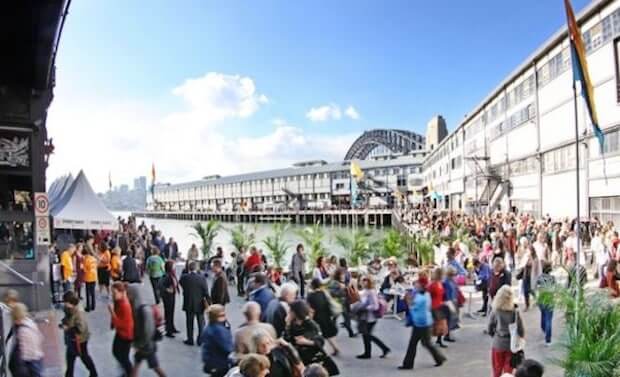
Harbourside food and fun with a week of insightful and entertaining readings, workshops, panels and performances on the side – what could be better than the 2014 Sydney Writers’ Festival?
Here are Indian Link’s top five must-see events for the festival:
Festival Club
The Chaser’s Empty Vessel

Snuggle up and enjoy some late night laughs with bedtime stories by top comedic writers. Then make sure to stay awake for some riveting discussions at the Chaser’s Empty Vessel with some of the festival’s biggest names including Reza Aslan and Jeremy Scahill.
Thursday, May 22 2014, 7:00 PM – 11:30 PM at Pier 2/3 Club Stage, Pier 2/3, Hickson Road, Walsh Bay. Tickets $15 at the door, no pre-bookings
Family Day: Comedy Storytelling Hour
Tristan Bancks

If you’re getting tired of the heavy stuff and are looking for some lunchtime entertainment make sure to attend the Comedy Storytelling Hour. Come witness the hilarity of Tristan Bancks, Oliver Phommavanh and James O’Loghlin as they re-create and make fun of the extent people will go (including themselves) to make others laugh!
Sunday, May 25 2014, 1:45 PM – 2:45 PM at Pier 2/3 The Big Top For Little People, Pier 2/3, Walsh Bay. Free, no bookings.
Curiosity Lecture Series: On What Gandhi Would Do
Mahatma Gandhi

Former High Court Justice Michael Kirby gives an insightful talk on how we can apply the inspiring views of Mahatma Gandhi to contemporary world issues including women’s rights, climate change and sexuality. Kirby will discuss how useful Gandhi’s frameworks of wisdom and compassion are in confronting global problems, emphasizing how one man became the Father of a Nation.
Saturday, May 24 2014, 3:30 PM – 4:10 PM at Pier 2/3 Bloomberg Stage, Pier 2/3, Hickson Road, Walsh Bay. Free, no bookings.
Zoe Daniel: Storyteller
Zoe Daniel

Zoe Daniel, ABC South East Asia Correspondent, is one of only a handful of women to combine one of the most dangerous jobs in the world with one of the most demanding – motherhood. She discusses, Storyteller, her memoir that covers political unrest in Bangkok and the bittersweet story of conjoined twins in India, to a tragic plane crash in Laos and the destruction of Typhoon Haiyan in the Philippines to her personal story of the universal juggle of work, ambition and family amid the unpredictability of life and the predictability of the 24/7 media cycle.
Saturday, May 24 2014, 2:00 PM – 3:00 PM at Casula Powerhouse Arts Centre, 1 Casula Road, Casula, Free, bookings essential 9824 1121.
Real Worlds / Imagined Worlds
Ivor Indyk

Giramondo publisher Ivor Indyk shares the stage with four of Australia’s most versatile and wide-ranging poets: Judith Beveridge, Ali Alizadeh, Kate Middleton and John Mateer. They read and discuss poems that travel across the world and through time, to India, medieval Spain, the Middle East and the US, and over thousands of years, to probe the limits of human ambition, emotion and language.
Sunday, May 25 2014, 10:00 AM – 11:00 AM at Philharmonia Studio, Pier 4/5, Hickson Road, Walsh Bay. Free, no bookings.

Moghul meals

0
Reading Time: 4 minutes

This British mem could teach you a thing or two about Indian cooking

“I like to think of myself as a daughter of India”.

The unmistakable Indian lilt in Joyce Westrip’s speech gives away her deep passion for India. As does the fact that she can talk uninterrupted, for hours if allowed, about the land where she was born.

84-year-old Joyce is the quintessential Indophile. She may have left India in 1947 like the others of the British Raj, but continues to carry her love for the country in her heart to this day.

Now a Perth resident, this British mem has become a veritable storehouse of information on India and Indian society. An avid collector of artifacts from India, her private library of books on India is so large that she is currently preparing a bibliography.

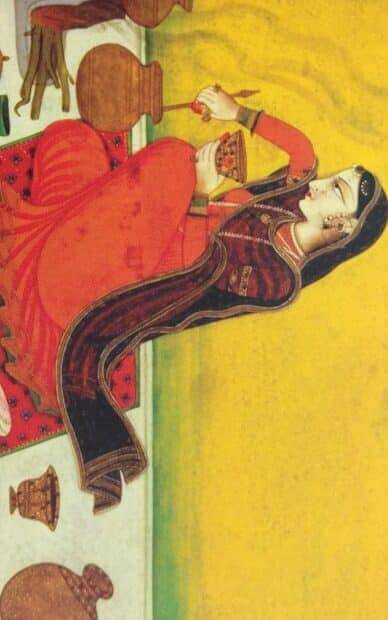
Joyce’s particular passion however is reserved for Indian cooking, especially Mughal cuisine. The author of a book entitled Moghul Cooking: India’s Courtly Cuisine, Joyce has been touring extensively in recent years, doing lectures and demonstrations. She was even awarded the Medal of the Order of Australia in 2000 for her work promoting cultural links between India and Australia.

The luscious foods of central Asia and Persia, married with the richness of Indian spices, in a technique that fearlessly uses butter, ghee, milk, yogurt and cream, and other exotic ingredients such as saffron and rosewater, have a strange hold on this amazing woman of the British Raj.

Joyce was seventeen when her family left India in 1947 for England. She remembers being unimpressed by her homeland.

“When I first saw Buckingham Palace, it was so gray and drab I was shocked. I thought, poor old England, the Royal Family seems to have fallen on hard times! You see, I was used to palaces that were opulent and jewel-encrusted and rich with colour! I missed the colours and aromas of India, the flowers, the saris, the hustle and bustle, the tamasha”.

Walking past an apothecary one day, the young Joyce saw some spice jars through the window that brought a flush of nostalgia. The cinnamon and the cloves and the cardamom beckoned, and she bought some, determined to cook her first curry.

“It turned out awful! It was then my mother introduced me to curry powder, and I learnt to cook vegetables, fish and meat in it. My curries then became a great event”.

But the use of curry powder made all her curries taste the same, and that was not the way she remembered Indian food!

Moving to Australia with her husband, Joyce found plenty of other ingredients she could incorporate into her curries, like herbs and garlic and ginger, thanks to the Italian and Greek influence in this country. She began experimenting more regularly with recipes her mother’s friends had sent her, and became adept enough to host what she calls “curry parties”.

Joyce went to university to do her BA, and opted for Indian history as one of her subjects. Reading of the Mughal times, she found herself intrigued by the opulent lifestyle of the times, fascinated by the clothes, jewelry and food of the royals.

“Reading Abul Fazl, the biographer of Emperor Akbar, I was captivated by his meticulous records of the kitchen department in Akbar’s palaces. He provides details of not only how the food was cooked and served, but also of how it was stored and how the kitchen was run. I was hooked! Then began my extensive research into the evolution of Mughal cuisine”.

Besides reading every book she could lay her hands on, Joyce actually travelled the Khyber Pass from Istanbul through Iran, Afghanistan, Pakistan and north-western India to New Delhi, following the path of the Mughals and talking to people on the way about their cuisine. She gathered recipes and techniques, not only from commoners but also descendants of royalty that she could meet up with.

“In Rajasthan for instance I stayed at the palace hotels, where the cooks/retainers who worked for the erstwhile royal families had stayed on. I learnt from them, straight from the horse’s mouth, as it were. When Maharani Gayatri Devi heard of my research, she arranged for maharanis from around the area to talk to me”.

She picked up invaluable information, not to mention plenty of anecdotes, from these sources. The result was her book Moghul Cooking. The book contains some truly exotic recipes such as akhni, yakhni, badami shorba, pomegranate soup, apricot-flavoured meat, chicken stuffed with minced lamb, khargosh korma, gobi kaju, dahi makkai and many more.

The rest is history. Soon she was on every major cooking show on Australian TV, and was busy organising gourmet tours to India.

Today Joyce claims to have less energy for her to do as many things as she would like to, but she certainly shows no signs of slowing down! Moghul Cooking is now in its second edition, and Joyce has also released Fire and Spice: Parsi Cookery and An ABC of Indian Food. And of course her love for India is as strong as ever.

“India keeps drawing me back. When I said once to Indira Gandhi that I am a daughter of India, she looked at me said, ‘But you ran away!’ I replied that I had no choice at the time, but I keep coming back!”