

A long bus trip in South America results in a ground-breaking new app that will simplify external meeting requests, reports RITAM MITRA

It’s the typical office problem: you need to schedule a meeting between your team, yourself and several external stakeholders. You know when your colleagues are free, you’ve just checked your shared calendar on Outlook. But it takes 20 emails or a dozen phone calls to try and find a bit of common free time with others, and soon enough, you’ve spent hours trying to organise just one short meeting! A new app, Foogi, aims to free up time for more important things by making scheduling meetings a cinch, and the idea was the result of a very long bus trip.
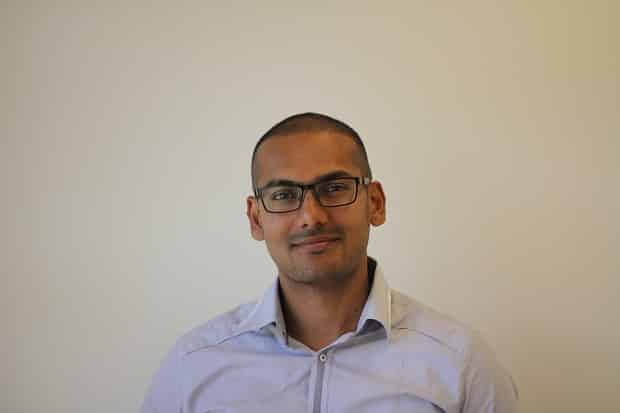
Foogi takes advantage of the smartphone age, allowing for the sharing of all types of calendars, including Outlook, Google and iCal, across all mobile operating systems, such as BlackBerry, Android, iOS and Windows Mobile. But its main strength is that it only shows others free spaces in your calendar, so they can’t see who else you’ll be have meetings with. Although Foogi has not been formally launched yet, 60 users have already downloaded the free app from Google’s Play Store, with an iOS launch imminent. Foogi founder and CEO, Amit Jaiswal, wants to use this early period in the app’s cycle to learn exactly what users want and make the product as good as it can be.
“Once we’ve figured out exactly what is the easiest way for Foogi to work for users, we’ll start marketing it,” he says. “By next month it should be available on all platforms, and that’s when we’ll have a proper launch”.
As recently as this year, Amit was working as a business analyst, a job involving regular meetings with clients and other stakeholders. Having been in the corporate/profit environment from a young age, Amit was more than familiar with the pain of trying to schedule meetings. Although most organisations allow for calendars to be shared between colleagues, for confidentiality reasons, sharing your calendar externally is usually not permitted, you obviously don’t want anyone else to see the meetings you have lined up for that week. “Outside the company, it was a nightmare,” says Amit. “If you try to meet with five people, you call the first person up and then call the second person, and then you might have to go back to the first person again. You put in 4-5 hours’ work for just an hour’s meeting”.

It was in this backdrop of mundane to-ing and fro-ing that Amit went travelling for six months in South America, and had an epiphany. “The only way to get around was by bus, so there were 15-hour bus trips. On such long trips, your brain comes up with new ideas. I realised that the (scheduling) problem was solvable now because of mobile technology. I realised that there’s an easy way to do this!” Everyone’s syncing their calendars onto their phone, and if I create an app, it will have an easy way to get access to any calendar. I basically built the tool to solve my own problem,” he reveals.
Although he has a background in computer engineering, having built several Windows and web applications in the past, Foogi is Amit’s first attempt at a mobile app. He’s enjoyed the experience so much that he’s given up his regular job as a business analyst, and he refuses to look back. “I have no regrets at all,” he says. “But it’s not easy. Part of the reason why I gave up my job was that while I was working in corporate, you have parts of the job that are really fun, but parts that are very boring, like organising meetings and so on. And even more than that, it’s the Gen Y dilemma where we feel like we can do more with our lives, and we’re all kind of dissatisfied with our jobs, even though we are really well paid and we should be grateful”.
Amit’s theory behind the job dissatisfaction that he says is typical of Gen Y, is two-fold, that jobs offer no opportunities to grow, and that Gen Y have nothing to fight for. “In all the jobs I’ve had you don’t really grow, you don’t really learn, you take the skills you have and you just do it. It kind of felt like stagnation, it felt like death,” he says. Meanwhile, in generations before us, says Amit, events such as war and Indian independence gave our ancestors something to strive towards.
“They had a sense of accomplishment and achievement,” he avers. “Even our parents’ generation, they came from nothing and they worked really hard to give us this awesome lifestyle. They came to Australia, leaving their families behind, and sacrificed a lot to give us everything”.
Amit continues, “But for us, we graduated and straight away we started earning as much as our parents. We lack that feeling of accomplishment and achievement, because it came so easily. If we’ve got none of those obstacles (that previous generations faced), we should be achieving a lot of things but why aren’t we?”
There are a number of perks that come with starting your own company. To Amit, the most rewarding aspects of starting Foogi have been the constant learning curve, the intimate start-up community that has supported him throughout the whole process, and the opportunity to build his own team. Groups such as Alive Mobile have provided advice and mentoring to Amit, as well as introductions to industry leaders and potential clients. In light of receiving no form of support from the Australian government (“it’s all talk,” says Amit), he recognises that the close-knit start-up community was crucial to getting Foogi on the road.
Meanwhile, Amit’s Foogi team has now grown to eight members, including three partners and four interns. “Unfortunately I’m not paying any of them. But the people are like-minded and they didn’t really like the profit lifestyle. It’s great, but there’s also a sense of responsibility, I need to start making money with Foogi as soon as possible so that I can pay these great people,” he says.
“It was really exciting being offered a position with Foogi,” says Shikha Jaipuriar, a 20-year old PR and Media Intern at Foogi. “It’s a really unique opportunity, especially being able to take charge and handle projects on my own which I’d never get to do in any other work setting. I think it’s definitely taught me a lot more about the business and shown me how to be more hands-on”.
Foogi is just one of a few ideas in Amit’s pipeline. Along with a connection at Alive Mobile, he’s also working on a disaster recovery app that will help those affected by events like the 2004 Boxing Day Tsunami locate their loved ones in the immediate aftermath of the disaster. Amit’s entrepreneurship is certainly an inspiration to others seeking a more exciting and innovative existence.
Frustration-free Foogi
Psyche: Pride and reconciliation

Life is too short to hold grudges, particularly within the family, writes SAROJA SRINIVASAN

Have you ever wondered why or how best friends and family members stop talking to each other for years? What is it that each find so difficult to extend the olive branch and make amends? They find it so hard to say ‘let bygones be bygones’ and start again. Is it pride? Is it an overvalued sense of their own self-righteousness and self-importance that stops them from crossing the bridge to shake the other’s hand? Is it stubbornness or a lack of willingness to improve the situation? Many people confuse the courage that is required to make an effort to say sorry, as weakness. In fact, the opposite is true, it takes a courageous person to have the modesty to take the first steps to clear the air.
Far too often people forget that life is too precious and too short to carry grudges. If good friends and close family members do not have the humility to make amends and bring back the closeness they once shared, how will they ever be considerate to others? One may wonder how they would react if someone crossed their path, even accidentally. Their stubbornness to see another’s point of view could cost them heavily.
During teenage years, it is common to come across rivalry between friends, petty arguments leading to stand-offs. Sometimes many such situations never resolve and a precious chance to start a life-long close friendship is lost. Occasionally, strong friendship ties that existed in the past help to resolve it. When such quarrels exist in adult relationships, it is indeed a sad state of affairs.
Not so long ago, I came across a family who were scattered all over the world with no contact between them. We hear of such break-ups and wonder how it could have started. Perhaps an unresolved argument about a trivial matter, a disagreement about a family decision, or just a simple misunderstanding. Who knows? Was it an unresolved resentment simmering below the surface that was vented in an argument that led to the standoff?
Sadly, whatever the reason, pride and ego seem to come in the way of an amicable resolution. Repeatedly we find that a sense of empathy and understanding is sadly lacking when such resentments remain unresolved over several years. The longer it remains unresolved, the harder it becomes. It is very important to sort out differences quickly and aim to come to a resolution even if it means agreeing to disagree, so that the doors of communication remain open. An old saying comes to mind: ‘Never go to bed angry and upset after an argument,’ which really means resolve conflicts quickly, preferably on the same day.
If we stop for a moment and realise how many people do not have a family to call their own, either from birth, or due to a totally unforseen accident, the luxury and privilege of being part of a family unit or enjoying close friendships becomes very precious. One has to have maturity and humility to value it and preserve it at all costs. This effort has to come from both parties. When each refuses to start the process of making-up, waiting for the other to make the move could mean the moment of reconciliation is lost forever. The bonds of family and close friendships are surely worth preserving, whatever it takes.
Green energy solutions for urban poor
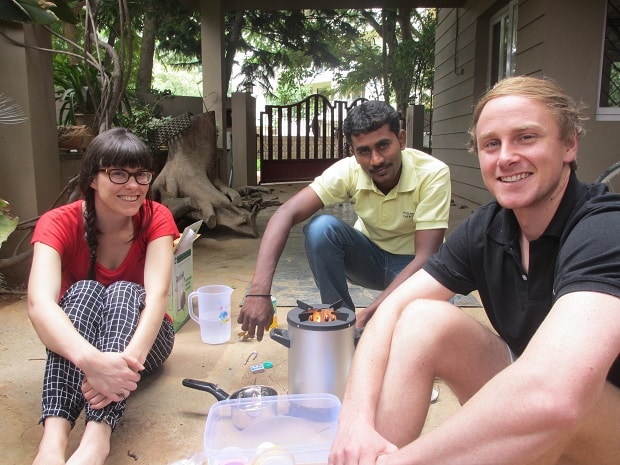
Eradicating energy poverty is the challenging task of a group of young eco warriors

As global economies lobby to contain spiralling energy consumption, fringe communities in developing countries have quite literally been left in the dark. In today’s world of tablets, touch screens and texting, ironically, many still face acute energy poverty. According to estimates, 1.3 billion people worldwide have no direct access to electricity, of which 400 million live in India alone. As the sun sets, their lives come to a grinding halt.
There is a widening gulf between the haves and the have-nots. Lack of proper infrastructure and poor awareness has forced those living below the poverty line in rural and semi-urban areas to rely heavily on age-old practices like kerosene lamps and coal-fired stoves that are not only harmful to environment, but also pose a serious health hazard.
In a bid to improve the living conditions of such Indian families, a group of young eco warriors have been striving to create safer and more affordable lighting solutions. Known as Pollinate Energy, for this dedicated team, social impact outweighs profit.
Embracing sustainable production and consumption concepts, Pollinate’s Young Professionals Program, has been regularly sending experienced volunteers to educate and train local communities in India and thereby empower them.
Pollinate Energy co-founder and director Emma Colenbrander said the program, which has a far-reaching social vision, brings together Australian professionals with Indian micro-entrepreneurs to help promote the distribution of safer, more affordable clean energy solutions to urban poor communities. Besides removing the burden on unsustainable fuels, the programme also aims to increase overall productivity and foster economic independence.
Global technical management services provider AECOM is one of the Pollinate’s first corporate partners. AECOM employees, Sydney-based landscape architect Belinda Dods, environmental engineer Rosanna Sanderson (Brisbane) and engineering geologist Johannes Wilson (Christchurch), recently volunteered in Bangalore as part of Pollinate Energy’s Young Professionals Program. During their India stint, the trio worked closely with local entrepreneurs, or ‘Pollinators’, mentoring them as they introduced solar lanterns and smokeless cookstoves in the local community.
“AECOM sees ‘social businesses’ like those championed by Pollinate Energy as a solution to environmental, energy and economic challenges,” AECOM Chief Executive, Australia New Zealand, Michael Batchelor stated.
“Our people are extremely passionate about improving liveability, sustainability and connectivity – in their own communities and around the world – and we are glad to support innovations and programs that do so,” he added.
What drew Dods to the project is Pollinate’s strong focus on innovation. The former international trade and business finance professional left behind a thriving career in corporate sector to follow a passion in landscape design and architecture. Her interest in sustainable technologies also led her to compete in the International Solar Decathlon, where her team finished third. More importantly, the experience certainly triggered a passion for innovative and sustainable design as well as desire to use this to drive social change.
Indian Link caught up with Belinda Dods to find out more about her involvement with Pollinate Energy’s Young Professional Programme
Indian Link (IL): What prompted you to volunteer for Pollinate programme? What was the experience like?
Belinda Dods (BD): I’ve always been interested in social businesses and was eager to find out more about how Pollinate Energy is achieving its goal to ‘eradicate energy poverty’. So when my manager approached me to apply, I was really excited.
The program totally exceeded my expectations. We had incredible speakers join us to discuss the finer points of social business, and this helped us gain a greater appreciation for the problem and the solutions out there.
As well as the work we completed in the communities, another facet of the program was to develop a part of Pollinate Energy’s business. Another Sydneysider, Lorenn Ruster and myself were tasked with promoting advocacy for Pollinate Energy’s cause in Australia. Pollinate Energy has teamed up with some very clever local talent; design firm Amigo & Amigo and public engagement firm Wildwon, to create the very first solar powered VIVID Festival lighting installation. We will be liaising as Pollinate Energy Ambassadors to see this exciting project come to fruition. Our roles as Ambassadors will also see us more broadly assisting with their operations in Australia.
Having travelled through India previously, I had an idea of what it would be like, but faced with such grinding poverty, the importance of organisations like Pollinate Energy really hits home. The low would definitely have to be the realisation that many of the people in the communities have no legal rights and their fate and homes are under constant strain and uncertainty. The high was most certainly the people: the Pollinate Energy founders and their vast energy for this cause, the young professionals from India, Australia and New Zealand with their fresh ideas and enthusiasm, the Pollinators who welcomed us in and guided us through our community experiences, and the communities themselves with their warmth and kindness.
IL: Tell us more about your specific role with this project? What did it involve?
BD: We were partnered with a ‘Pollinator’, and accompanied them to communities, helping develop sales strategies to improve and grow their respective businesses. The current program sees us introducing fuel-efficient cook stoves into the community. The cookstoves burn at least 50% less wood and emit at least 50% less smoke, so are better for peoples’ health (people mostly cook inside within the midst of clouds of smoke) and economically better, saving them money on fuel. Having discussed our approach for the day, we head out as a team to a slum community to do demonstrations – making chai and explaining the benefits of the product. As a group we assess our strategy and propose changes for the next day. The second part of our role sees us involved in working bees. The three groups look to bring in a source of income that can subsidise the social part of the business by creating pictorial guides for the products to be used by the predominately illiterate users and advocating Pollinate Energy’s work.
IL: How did the team work to educate people on urban fringes about cost effective renewable energy resources? What was the reception to this novel idea?
BD: It is difficult with any new product to convince the community that it does all it is said to do, but it only takes one person to give it a go to gain the trust of a community. One woman cooking chapati tested the cooking time on both their traditional fires and the new fuel-efficient cookstoves; the benefits where obvious with the cookstove taking far less time and using far less wood. So it’s just a matter of time before they infiltrate the communities on a large scale. The initial solar light products are at the point now where they almost sell themselves. People can see the benefits for their own eyes and have come to trust the Pollinators and their products.
IL: Who were some of the other participants and what did they bring on board to the project?
BD: From India, Neelima Jain, Keshav Lakshman and Sneha Kariyappa were part of our team; and from Australia there was Holly Hyder, Lorenn Ruster and Rosie Sanderson. Johannes Wilson, one of my AECOM colleagues alongside Rosie, is from New Zealand. I can honestly say that everyone had a unique talent that came to light during the program, from Sneha’s ability to befriend everyone in the communities and make them feel comfortable, to Rosie’s unique insight into the area having previously worked for Engineers without Borders in Chennai. We had strategic consultants, engineers, and landscape architect. It was refreshing to hear all the different points of view and to learn from each another. We were all there for the right reasons and had so much to learn from each other.
IL: What images of India did you come away with, what were your personal experiences?
BD: Colour, noise and spices! Everywhere you go, India surrounds you with activity, be it the noise of the horns on the street, the brightly coloured saris everywhere, or the smells of so many different spices mingling in the air, which themselves act as a welcome respite from the pollution, rubbish and dust. At first it all hits you and feels overwhelming, but as you adjust you see more of what is the same and less of what is different.
For example, we made tea one evening, and as the ladies in the community laid out a mat for us to sit on, I cuddled one of their babies. Asking the few questions of Kannada I have picked up along the way, we drank tea and laughed with them, recognising a common joke made about wanting us to adopt their children. They have come to Bangalore to make a better life for their families, and it’s a wonderfully humbling experience to sit and share tea and try to begin to understand the daily pressures they face.
To volunteer or find out more about social change programmes in environmental sustainability sector, visit www.pollinateenergy.org
A spiritual odyssey in the footsteps of our seers
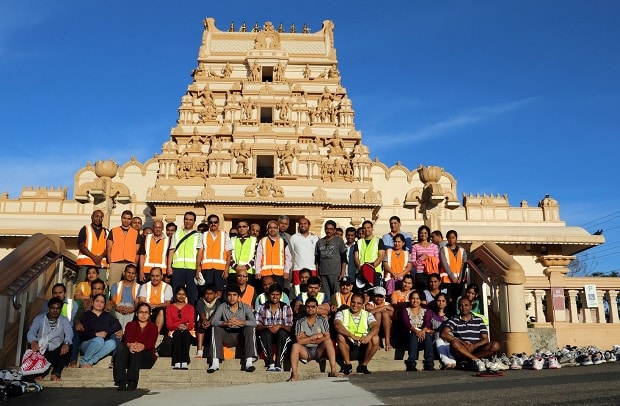
Participants in the paadayatra embark on a successful journey of personal and spiritual achievement

At the crack of dawn when most Sydneysiders were probably snuggled under their cosy doona or recovering from the Friday night hangover, a young lad stood patiently on the footsteps of Murugan Temple at Westmead. The only other soul in sight was the temple priest, getting ready for the morning abhishekam.
Twenty minutes later, organisers appeared on the scene, bustling about in preparation for a big day ahead. Participants slowly started trickling in and by 6am, a sizeable crowd had gathered, a motley bunch of young and old, all sporting fluorescent vests, with anticipation in their eyes.
If there was any trepidation, they certainly didn’t show it. But then, they were in good hands and they knew it. Invoking Ganesha, the God of good beginnings and Tirupati Balaji, the group started out on the paadayatra.
The Westmead to Helensburgh paadayatra has now officially become part of Sydney Hindu calendar and an integral feature of October long weekend. Personally rewarding, paadayaatra is a spiritual journey on foot undertaken by the devout, as they seek to understand the special bond between man and his maker.
Commissioned in 2012 by the Hindu Council of Australia and organised by Let’s Give Hope, a Sydney based youth group, this unique event follows in the tradition of our ancient seers, who travelled from Kashi to Kanyakumari on foot, long before motorised transport and roadside motels were taken for granted. Centuries later, it was revitalised by the peace-loving Mahatma Gandhi as he single-handedly took on the British Raj.
Carefully planned and organised by Sai Paravasthu of Let’s Give Hope, the SVT paadayatra has the official support of several leading organisations including the Premier’s Office, Events NSW, RTA, police and ambulance services, as well as all the local councils along the walking trail.
Yet again, a determined group of Sydney Hindus took part in and successfully completed the gruelling journey of over 75kms from the Murugan Temple at Westmead to Sri Venkateshwara Temple at Helensburgh, visiting Shirdi Sai Mandir along the way. A number of eager devotees undertook the shorter stretch between Westmead and Sai Mandir. Building on the experiences of 2012, the team was even better prepared for eventualities. A core group of volunteers escorted the walkers, offering revival strategies.
Prior to the walk, an induction night was held for participants at Murugan Temple, briefing them extensively on the procedures. Arrangements were also in place regarding health and safety issues. All participants were previously screened and registered, with an insurance cover being provided by the Hindu Council of Australia.
While the paadayatra may seem like something of a novelty to many Indian Australians, interestingly, a close-knit group led by Wentworthville veteran Murali has been walking the same stretch for several years now. In fact, it was Murali’s 25th paadayatra last year. Sporting his trademark thongs and infectious enthusiasm, he was yet again motivating newcomers as always, giving them tips on how to cope.
Embracing sustainable values for the individual, the paadayatra is a not just a test of stamina and endurance, but also of faith. While it may be a personal milestone, it is no less a great team-building opportunity. It was therefore heartening to see a number of teens and young adults in the group, willing to give up their weekend for a wonderful cause. After all, not every lesson is learnt in the classroom.
On a larger scale, this novel initiative also sought to bring Hindu temples, missions and organisations in Sydney together as one happy family.
Singing and chanting along the way, the group walked down Parramatta Road, reaching Sai Mandir in time for aarthi. Volunteers had prepared a nourishing breakfast at the temple. Rehydrated, the yaatris now embarked on the most strenuous stretch, Strathfield to Sutherland, reaching the venue by 5pm. Overnight accommodation had been arranged for all of the walkers.
Well rested, the participants were all ready for the homestretch, departing at the crack of dawn. Enthusiastic walkers showed no tiredness from the day before, and outclassed expectations by walking briskly to the temple, reaching Lawrence Hargrave Drive before 10am.
Once the entire group had slowly gathered, the devotees walked en masse to the temple. A large welcome party awaited them, and aarti and annadhaanam followed.
Talking to Indian Link after the event, Sai Paravasthu, the event leader stated that he was very happy with the successful outcome of the 2013 paadayatra.
“I would like to congratulate all the walkers for their dedication, perseverance and patience in participating and completing the paadayatra this year,” Paravasthu stated. “We had no issues, casualties or problems (by God’s grace) and everyone enjoyed the event and hopefully rested well”.
He is particularly grateful to the volunteer teams who were at the service of walkers at all times, preparing delicious food for breakfast, lunch and dinner. “A lot of volunteer hours and effort has gone in making this event seamless and successful, and we hope to build on this for next year,” he added.
Having successfully managed two paadayatras, Paravasthu and his dedicated team would like to invite more members of the community to join this event, reinforcing age-old customs and values and making it a bigger success.
When one house creates distress for Governments

Major countries of the world face turmoil as their governments cannot agree on legislative programs

Several countries have bi-cameral systems. That is, they have two houses in their parliaments. Currently, there are three countries which have entered into crisis mode because one house is trying to undo the will of the other house: America, Italy and Australia.
The United States has shut down its Government, except for essential services. This is because the House of Representatives insisted in adding clauses concerning Obamacare to what is essentially a financial bill. After protracted negotiations, President Obama threw the down the gauntlet and shut down almost the entire Government of around 800,000 public servants. This has now been reduced because a law was found concerning financing for the military.
In Italy, former Prime Minister Berlusconi had withdrawn his members of Parliament from the current Prime Minister Letta’s coalition government. Berlusconi, troubled by court judgements against him, has called for fresh elections but President Napolitano insists that that would be the last resort. As we go to press, Berlusconi, troubled by an internal party revolt, has softened his stand.
In Australia, the existing Senate which will be in office till the middle of next year, and the newly elected Senate, both threaten to be antagonistic to the new Abbott government and its legislative programs.
The more we look at democracies, the more we could be perplexed by their differences. When Australia opted to copy the Senate system from America, it still left a legacy of the British system almost intact and that was the Public Service. India is similar.
Incoming governments like in India and Australia inherit a system of public service hierarchies which would supposedly help it to run the country and more importantly, to draw up legislation to implement its programs. There is assuredly a fund of knowledge and expertise in such a system, but there could also be animosity as the appointees might be inclined to an outgoing government that had appointed them.
Then there is the possibility that there is corruption in some quarters; in some areas there might be a system for getting approval for projects such as for planning a new suburb or for exploring a new mine. Some examples of this have been identified by the anti-corruption court or ICAC in New South Wales.
In the United States, the first task of an incoming President is to literally appoint thousands of public servants. It is a new government from scratch. Such appointments can take some time and important cabinet positions need vetting from the legislative chambers (the Senate and the House of Representatives). This is especially true in the first term of a Presidency.
President Obama decided very quickly after he took office to appoint some Republicans in his Government. It was a question of acquiring some well experienced staff who had a deep knowledge of the problems that the nation faced, such as of the wars in Afghanistan and Iraq.
Currently, the Obama administration is facing a crisis as the House of Representatives is stubbornly refusing to permit the Government to borrow money to pay salaries to its employees.
Similar situations have existed in Australia, such as during the Whitlam era. At that time the Governor-General sacked the Whitlam Government because it could not get supply through the Senate.
The Abbott Government is currently in the phase of addressing the problem of manning the public service. The Liberal-National Coalition had made no secret that it would reduce the number of public servants. Soon after taking office, the Climate Commission, headed by the outspoken Tim Flannery, was dismissed. The members of that Commission have decided to form a sort of think-tank and use an internet site to inform the public about the growing concerns regarding climate change.
The next exodus of high profile members from the public service has been the resignation of the entire board of the National Broadband Network. The Minister concerned, Malcolm Turnbull, has not accepted their resignations.
The world is currently watching with anxiety as the impasse between the Senate and the House of Representatives in the USA does not show any signs of being resolved. That battle is over a bill to enable the public service to be adequately funded. President Obama says that the Republicans are holding a gun to the head of the government, to get whatever they want.
The unacceptable bill has not been put to the vote presumably because a number of Republicans have revolted, and wish to end the impasse. If the USA cannot get the bill passed, the entire country could get downgraded and it will find difficulty in borrowing money. This could set off a global financial crisis, the effects of which could threaten the economics of many nations in Europe and Asia.
Manvi’s masterpiece
A painting by a talented young artist has been chosen for display at a prestigious public location

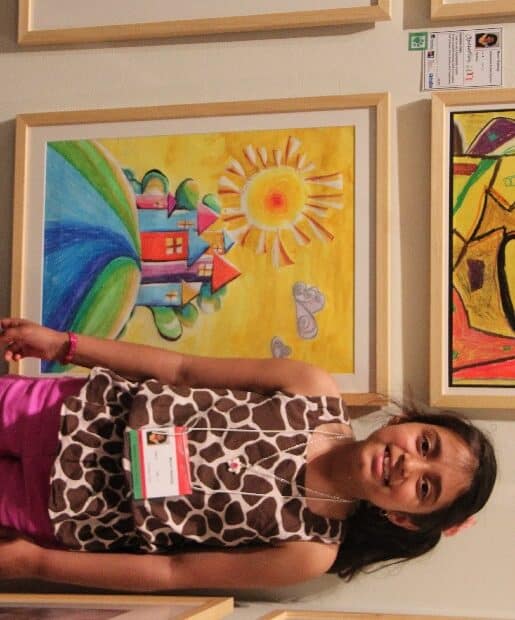
It is every young artist’s dream to have their painting hung in a public place where it can be admired by throngs of people everyday. Manvi Rastogi is just 8, and has already achieved this distinction. Her painting Sunshine Town, is one of the handful chosen from the Operation Art Exhibition to be displayed for a year, at the head office of NSW Commission for Children and Young People, before being hung permanently at one of the state’s regional hospitals.
Manvi is a veteran of Operation Art, an initiative of the Westmead Children’s Hospital, in association with the New South Wales Department of Education and Communities. The Premier’s state-wide exhibition provides a platform for schools and students from kindergarten to year 10 to demonstrate their visual arts achievements through exhibitions at the Armory Gallery, Sydney Olympic Park and the Art Gallery of New South Wales.
All schools from the state are invited to enter four paintings for the exhibition. The contestants are encouraged to create cheerful and uplifting artworks suitable for display in hospitals. All entries find a place in the exhibitions, and 50 are chosen to become part of the permanent collection at the Westmead Children’s Hospital.
Manvi’s paintings have been making the cut for the past three years from Haberfield Public School, but this is the first time her work has been chosen for the permanent collection. Her winning entry this year is a bright watercolour and oil pastel landscape created on A2 size poster paper.
Speaking to Indian Link, mum Megha Rastogi was rightly proud of her daughter’s achievement admitting that “It is very encouraging to have Manvi reach this level. Her success has reinstated in us that we need to support her talent even more”. Manvi receives no formal training in art, but her artistic flair is inherent from her mum and maternal grandmother.
Sunshine Town is a brightly coloured piece featuring a large sun overlooking houses nestled on a hill. “It represents love, hope, peace and happiness,” explained Manvi.
Megha observed that her daughter’s paintings often included a big, bright sun, which to her, signifies the positivity, hope and happiness that the child is trying to convey through her art. “For the last two years I had been painting animals for Operation Art, so this time I wanted to do something different,” Manvi said talking about Sunshine Town. “I wanted to draw mountains and houses”. She took to the internet and sifted through picture books for inspiration to come up with the unique piece.
Manvi loves to paint animals and buildings. She experiments with varied mediums like watercolour, acrylics and oil pastels, but admits her favourite is watercolours. She is a quick painter, revealing her winning entry Sunshine Town took only 45 minutes to complete.
Manvi is not sure whether she wants to be an artist when she grows up, because there is so much to explore yet. In addition to indulging in her painting pursuits, Manvi sticks to a wholesome schedule with swimming, cricket, photography and learning to play the violin featuring prominently in her life. But she innocently admits, “what I enjoy most is cooking with my mum”.
Apart from Operation Art, Manvi has participated in the Harmony Day competition every year and has entered and won the K-Mart Art Competition in the past. She is always on the hunt for more competitions and is planning on continuing to participate in Operation Art.
The exhibition at Armory Gallery is on until October 27 and with a record 897 entries, the 2013 Operation Art offers a unique opportunity to witness the creativity of Manvi and other young masters in the making, for free.
Kaalachakra celebrates not just art, but life
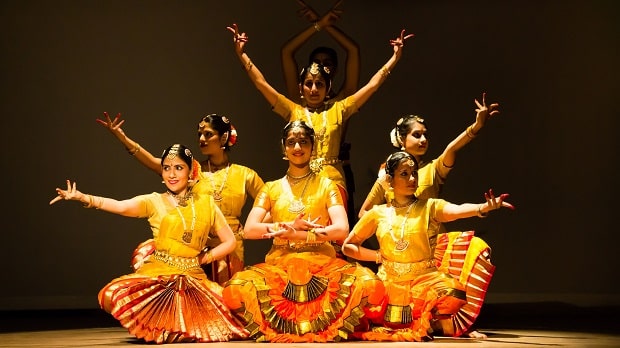

A mesmerising and profound journey through various stages of life is enacted through Bharatnatyam
Man’s tenuous relationships within the turning wheel of time formed the basis of Kaalachakra, Hamsa Venkat’s latest Bharatanatyam ballet.
The enchanting production by her Samskriti School of Dance was staged at Marana Auditorium in Hurstville for the Resourceful Australian Indian Network’s (RAIN) annual fundraiser.
The esoteric concept throws up many existential challenges which are not just difficult to answer, but also to understand. Who is an individual, what is their identity, how important are they and where do they fit in the Great Chain of Being? These were some of the philosophical issues that Kaalachakra explored. The three hour long performance, harmoniously balanced the ephemeral with timeless, and mundane with profound, to create an artistic extravaganza that appealed to people of all ages and backgrounds. Kaalachakra was not just a celebration of art, but life itself.
Hamsa’s ability to reach out to her audience and keep them engaged while exploring a subject of this depth and magnitude is especially commendable. The stories (particularly those about sibling rivalry, lifelong friendships and young romance), were aptly chosen and clearly resonated with the audience.
Not only did her selection of texts for the thematic presentations provide variety, the segments themselves were beautifully choreographed and executed. The elaborate preambles and narrative interpolations helped create the mood as the dancers embarked on a creative journey.
“Basically, I feel any art should reach to the core of the human being and explore the creative spirit of those involved while giving to the community we live in,” Hamsa told Indian Link after the show. This is exactly what Kaalachakra achieved, in the process raising over $20,000 for the seniors’ cause.
The music for the performance, both the choice of lyrics and the rendition, was clearly outstanding. High calibre live orchestra has become one of the hallmarks of Samskriti School of Dance. The soulful vocals by Sangeetha Ayyar and Krishna Ramarathinam, supported by Mohan Ayyar on the synthesiser, Pallavarajan Nagendran on mrudangam, Balaji Jaganathan on violin, Chidambaram R Suresh on morsing and Hamsa on nattuvangam, came together seamlessly, setting the mode and tone for the performance. The chemistry between the orchestra on the sidelines and dancers on the main stage was palpable.
Conforming to traditional framework of Bharatanatyam ballet, Kaalachakra was presented in seven segments, each exploring a new facet in the wheel of relationships as one journeys through time, Santhaanam (sacred umbilical ties), Sahodaryam (bonding among siblings), Sishyam (teacher-disciple relationship), Srishti (dependence on nature), Sakhyam (lasting friendships), Shringaaram (innocent romance and sanctity of marriage) and finally, Smaranam (human kind’s communion with their maker).
Each relationship was explored in great detail, offering ample opportunity for the senior disciples to display their mastery over this ancient and difficult art form. Samskriti’s junior students showed no less promise; rising up to the challenges that such a large-scale production demands. Clearly there is no dearth of talent or dedication.
The highpoint of the evening of course was the dramatic centrepiece, Srishti, which probed humankind’s links with the environment. Fittingly, the sun, which is revered in many cultures as the life force, held pride of place in this sumptuous piece. Through the stories of Pandavas, Hanuman, Kunti and Surya himself, the Varnam paid homage to Sun God in all his dazzling glory as he journeys across the horizon. Not only was it a feast for the senses, Srishti tested the stamina and endurance of the performers. Elaborate formations, sculpturesque poses, brilliant lighting, thoughtfully chosen costumes, as well as high-energy vocals ensured that the varnam would be etched in the audience’s mind long after the curtains came down.
In fact each segment had its own unique charm. The opening kauthuvam from Mahabharatha, on Abhimanyu and Chakravyuh, explored how life’s learning curve begins in the womb. Sibling love (Draupadi/Krishna) and rivalry (Krishna/Balarama), lifelong friendships (Tamil padam Pandadithanale Unnai Thoodhanupinen about Valli and her sakhis) as well as devotion and respect of student for his guru (Padmapada/Adi Shankara) are all influential relationships that shape our perceptions, and eventually our destiny. The odyssey of love (the staple of every relationship) was sumptuously told through the immortal tale of Nala and Damayanthi (once again verses from Mahabharatha, which were translated into Tamil by US based scholar Dr Ravi Shankar).
The concluding segment from Thyagaraja’s Naukacharitham poignantly explored ego and man’s relationship with God himself. Quite like a boat that traverses through storm and calm, taking it all in its stride, life is filled with surprises that test the individual’s ability to embrace the good and bad, the beautiful and terrifying, with grace and dignity. Such trials not only shape his character and personality, but also make him realise that he is after all only a small aspect in the larger scheme of being, a drop in the ocean. The lesson that Kaalachakra teaches us is interdependence. The props and special effects (Adrian Van Raay, Muthu Sharma, Rama Vishwanathan, Deepa Gopinath and Devika Krishnamurthy) of this scene provided the perfect backdrop for a breathtaking audio-visual presentation.
In fact, the whole production was thoughtfully conceived and brilliantly executed. A thing of beauty is a joy forever. Hamsa Venkat’s Kaalachakra is a lasting contribution to the Indian Australian cultural scene.

It’s time to move on

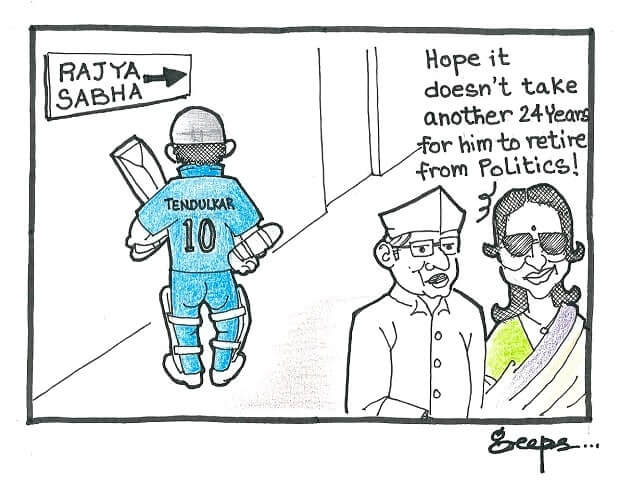
Senior sportsmen present a myopic view on cricketer Fawad Ahmed’s religious beliefs, despite unstinted support for him from Cricket Australia

It’s a mark of modern times that foreign-born athletes can represent their adopted countries with pride on the sporting field. Indeed, in the 2011 census, it was revealed that over a quarter of the population was born overseas. It’s no surprise that foreign-born athletes have become ubiquitous in all Australian sports, think tennis player Jelena Dokic (Yugoslavia), former Wallaby Clyde Rathbone (South Africa), and boxer Kostya Tszyu (Russia). Australia also recently welcomed its first ever Muslim test cricketer in Usman Khawaja.
But recent comments regarding Fawad Ahmed, who was in 2012 granted asylum as a refugee from Pakistan, serve to remind us that Australian cricket, at all its senior representative levels, has rarely been representative of the varying demographics of its adoring population.
Fawad Ahmed played ten first class matches in Pakistan before fleeing to Australia in 2010 as an asylum seeker. In Pakistan, Ahmed had been involved with a non-government organisation that sought to provide education to women, and this allegedly led to threats being made against him by extremists. After fleeing to Australia, he began playing cricket with Melbourne University and working in a warehouse, but his claim for asylum was initially rejected. It must be noted, however, that heavy support shown by Cricket Australia (CA) led to ministerial intervention through which Ahmed eventually become a permanent resident in late 2012. Ahmed later had his citizenship fast-tracked through the enactment of Commonwealth legislation, lobbied for again, by CA.
CA’s expanded role in promoting an inclusive and more representative culture at the elite level was made even clearer when they first approached Ahmed to ask whether he would be comfortable wearing clothing with the Victoria Bitter logo, given he was a practising Muslim and did not drink alcohol. After Ahmed suggested that he would be uncomfortable wearing the logos, CA produced special uniforms for Ahmed.
And that would have been the end of the matter – but, as happens with those who find themselves in the public spotlight, someone will always have another word to say.
First came the inevitable racist comments on Twitter, which CA Chief Executive James Sutherland appropriately condemned. Indeed, Sutherland expressed that “CA is fully supportive of Fawad’s personal beliefs and he is a valued and popular member of the Australian cricket team and the wider cricket community.” But it was not good enough for some.
Last month, former Australian batsman, Doug Walters, took offence to Ahmed’s choice saying, “I think if he doesn’t want to wear the team gear, he should not be part of the team. Maybe if he doesn’t want to be paid that’s okay”. This formed part of a revealing Daily Telegraph piece that only highlighted the myopic view of some of the country’s other ageing statesmen.
Geoff Lawson, the former fast bowler and Pakistan team coach, thought there were contractual issues that arose, announcing that, “If you don’t agree with the terms you have a choice as to whether you work somewhere else. Players should be able to object on a number of moral grounds… as long as they don’t accept the payments the sponsor provides”.
To begin with, Walters and Lawson both missed the memo from Victoria Bitter themselves. A Carlton & United Breweries (CUB) spokeswoman said, “We support the approach taken in the case of Fawad’s shirt,” and there is no doubting the fact that Ahmed’s declination to wear the sponsor’s logo would have been an absolute blessing for CUB. Ahmed, a quiet, humble, respectful, and as of yet a relatively unknown cricketer, would certainly not have been a marketer’s dream, but VB instead enjoyed a tremendous boost in publicity, ironically as a result of the logo Ahmed wasn’t wearing.
Secondly, Lawson’s comments suggest that by refusing to wear the VB logo, Ahmed was in breach of his contract. It beggars belief that a former coach of the predominantly Muslim Pakistani cricket team could trivialise the issue so readily.
Ahmed reached an agreement with CA not to wear the logo, and it is almost certain that this agreement was honoured in writing within his contract, which lends Lawson’s argument no weight whatsoever. In any case, it does not matter that the agreement may not have been explicitly set out in Ahmed’s initial player’s contract, as the subsequent negotiation and consensus between all parties, including CUB CA and Ahmed, would still have legal effect, whether oral or written. Even great cricketers such as Lawson and Walters would not seek to challenge centuries of common law contract principles.
The best (or worst, depending on how amusing you find his bigotry) comments were made by the former rugby international, David Campese. If you’re struggling to make the connection between Fawad Ahmed, CA and David Campese, don’t worry, others did too. On his Twitter account, Campese applauds Walters, writing, “Well said Doug, Tell him to go home.” When reminded that the South African batsman Hashim Amla also refuses to wear a South African sponsor’s logos for the same reasons, Campese’s retort was certainly worth a read, if for pure entertainment value: “It is SA. Who knows what the deal is. And I don’t care. At least Doug Walter (sic) cares. Which is a start. Great player”. Sutherland denounced Campese’s tweets unequivocally, although the tweets themselves probably discredited the man adequately.
Australia got its cricket from England, but as much as we berate the ‘Whinging Poms’, they’re a generation ahead of us in their attitude towards and acceptance and inclusion of players with foreign backgrounds. Players such as Ravi Bopara, Owais Shah, Monty Panesar, Sajid Mahmood and Adil Rashid are standouts with sub-continental roots. Then there are players with South African backgrounds, including Andrew Strauss, Kevin Pietersen, Jonathan Trott and Matt Prior. There may be a quiet murmur here or there regarding the presence of so many players of South African origin on the team sheet, but if anyone knows how to take pride in their national team, it’s the English.
It is refreshing and exciting to see CA initiatives aimed at increasing cross-cultural awareness and take-up of the game from a grassroots level. CA recently announced that two community rookie contracts would be offered by each BBL team in an effort to “provide opportunities to players who might not otherwise be identified as one of Australian cricket’s pathway programs; players from rural communities, indigenous backgrounds, low socio-economic areas and those from non-English speaking backgrounds.” The CA drive makes sense, many junior representative sides will feature young talents from a variety of backgrounds, but at the higher levels the numbers dwindle. Now, with the likes of Ashton Agar, Gurinder Sandhu and Fawad Ahmed at the highest level, it’s time to cast off the shackles of times gone by.
Because at the end of the day, the best 11 players should represent Australia on the cricket field. It should be enough that a player chooses to represent Australia. After all, since when did wearing a sponsor’s logo make you an Australian? It’s time to move on from the past.
Diwali recipe ideas (using a microwave!)

ABHILASHA SENGUPTA will be making some home-made mithai this Diwali, but will not be sweating over that stove

We know you’ve been watching what you eat lately, but Diwali is round the corner and you know there will be the odd box of mithai coming by. Each Diwali you’ve proclaimed to all and sundry that there will be no mithai, but that mithai, it knows the way to your house… So this year, why not make your own, and that way, the store-bought Diwali might stay right there, in the store! And of course, because it will be home-made, your mithai will be tastier, and healthier. Yes, we know you’re time-poor and couldn’t be bothered to make khoya or boil milk down to 1/4th of its volume, or make that one-string consistency sugar syrup, so we’ve collected some microwave recipes for you.
Post Diwali, tell us which ones worked out best for you.
Happy Diwali!
Microwave Doodh Peda
1 can condensed milk
1 cup whole milk powder
1 tbsp kewra essence or rose essence
1/4 cup finely chopped pistachio
2 tbsp unsalted butter
Mix together the condensed milk, milk powder, melted butter and the essence in a microwave-safe bowl. Microwave on high for 4 minutes. Remove and mix thoroughly. Put back in the microwave for another 2 minutes. Stir again and put back in the microwave further if needed – it should all come together in one mass. Remove and let cool briefly. Divide into balls of desired size. Sprinkle each with finely chopped pistachio.
Instant Kalakand
1 tin condensed milk
6 tbsp milk powder
2 tbsp yogurt
2 tbsp ghee
Mix all the ingredients in a glass bowl. Let stand for a minute or so. Microwave on high for 3 minutes. Take the bowl out and stir the contents once. Microwave again for 3 minutes on high. Keep watching as it could bubble over. If it does, stir and continue. The kalakand is cooked when the mixture all comes together as a mass and browns slightly and unevenly as a result of caramelisation.
Pour into a flat dish and smooth out. When cool, cut into squares.
Another variation is to use 1 measure of ricotta cheese and 1 ½ measure of condensed milk. Follow the same procedure.
Besan Laddoo
1 cup besan (Chickpea flour)
6 tbsp ghee
1 cup fine sugar
½ tsp cardamom powder
Mix besan and 2 tbsp of the ghee, melted, in a microwave-safe bowl. Microwave for about 2 minutes. Take out and stir; then add 2 more tablespoons of the melted ghee. Mix and microwave again for another 2 minutes. Continue the process until the besan turns brown and gives off its aroma. Add more ghee if you think it’s turning dry. Cool slightly and then introduce the cardamom powder. Mix well.
Add the sugar and mix well to combine. Knead gently till the sugar is all mixed in. This could take up to 5 minutes. Then start shaping into balls. If you find that it doesn’t come together, you might have to add more ghee and give it another whirl in the microwave.
Mango-flavoured Pedhas
1 ½ cups ricotta cheese
2 cups thick, good quality mango pulp
4 tbsp evaporated milk
½ cup shredded fresh coconut
½ tsp cardamom powder
Grease a deep microwave-safe bowl. Put in the shredded coconut and microwave until lightly browned. Then add the cheese, evaporated milk and mango pulp and microwave for maybe 5 minutes. Keep watching it. Take out, mix well and return to microwave for another 5 minutes. Make sure it doesn’t spill over. Take out and allow to cool, but keep stirring intermittently. Return to microwave and heat again till it all comes together and doesn’t stick to the hands. It might take up to 30 minutes all up. Cool slightly and then add cardamom powder. Shape into balls and then flatten.
Taste mango pulp beforehand to see if sugar is needed. If it is, then add it in the second round of heating.
For a healthier product use half portion low fat ricotta cheese.
Carrot Halwa
2 cups grated carrots
1 tbsp butter
6 tbsps milk powder
¾ cup skim milk
6 tbsp sugar
½ tsp cardamom powder
1 tbsp slivered almonds
Put butter into a deep microwave-safe bowl and heat for 15 seconds. Add grated carrots and microwave a few times two minutes each, till the raw smell disappears.
Mix together in another bowl the milk, milk powder and sugar. Add to carrots and mix well; cook for another 6 minutes. You’ll have to stop at 2 minute intervals to stir.
It should all come together in one mass. If you feel it is getting a bit too dry, add a little milk and heat again. Take out and cool slightly, then add cardamom powder and mix well.
Garnish with slivered almonds.