


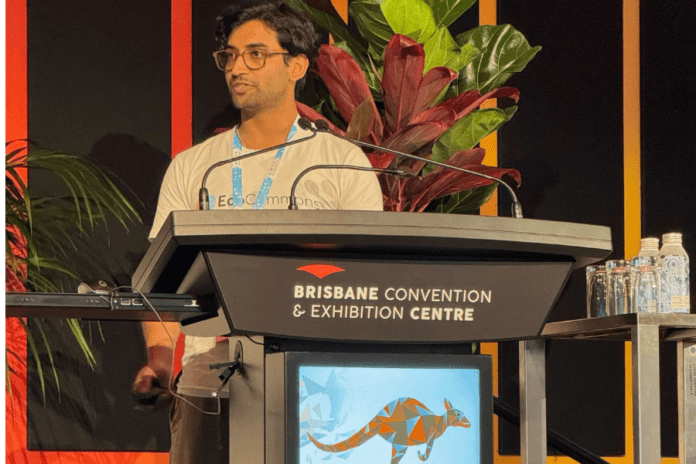

EcoCommons Australia, a national digital platform turning environmental data into conservation insight, has won the 2026 Australian Museum Eureka Prize for Excellence in Data Platforms.
The Australian ecological modelling platform brings together thousands of environmental datasets with modelling tools and computing infrastructure, letting researchers and conservation practitioners ask questions about species and their habitats without piecing together data and technology from multiple sources. It now has more than 1,200 users.
Its value becomes clear in cases like the Eastern Bristlebird — endangered, secretive, and often easier to hear than see. Somewhere in Australia’s forests, there could be a bird that nobody knows is still there, and for conservationists trying to find remaining populations, searching a vast landscape can feel like looking for a needle in a haystack. EcoCommons can at least help them decide which haystack to search.
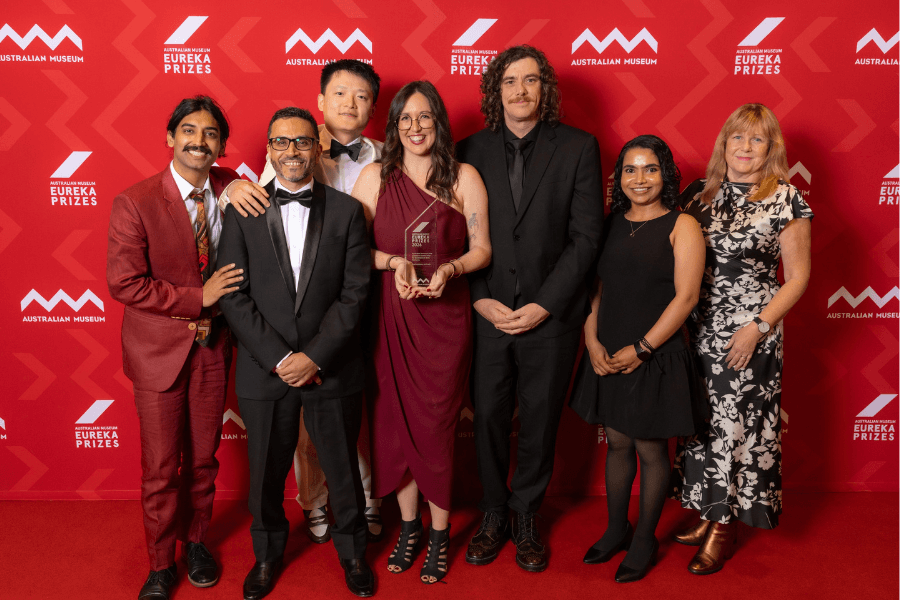
For Abhimanyu Raj Singh, a Data Ecologist at QCIF and a member of the EcoCommons team, the recognition is significant precisely because there was no single discovery behind it.
“Infrastructure work is mostly invisible,” he tells Indian Link. “Nobody writes a headline about a dataset being cleaned properly or a model finally running without falling over.”
Yet that quiet work can determine what other researchers are able to discover.
Bridging the gap
EcoCommons is a collaboration involving QCIF Digital Research, the Australian Research Data Commons, the University of Melbourne’s Centre of Excellence for Biosecurity Risk Analysis, the Atlas of Living Australia, TERN, CSIRO, Macquarie University, UNSW and Griffith University.
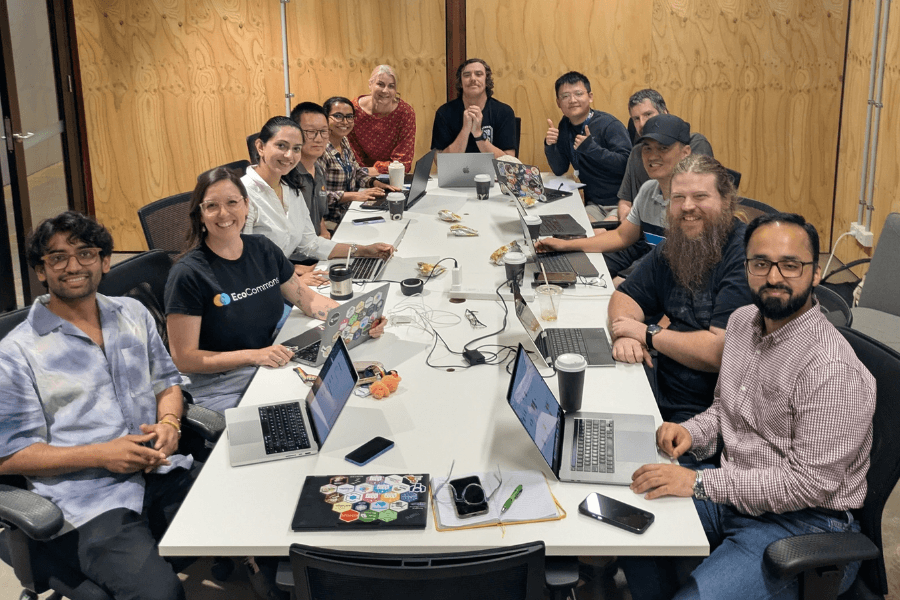
Its purpose is fairly simple — bring data and the tools needed to make sense of it together.
“The problem we were solving wasn’t a shortage of data or a shortage of methods,” Singh adds. “It was the distance between them.”
Closing that distance can change the scale of conservation research.
Once datasets can work together, a question that may once have required months of work can be explored much more quickly and applied across multiple species and larger landscapes.
But Singh is equally interested in making sure the technology is accessible to the people who know those landscapes best.
“Because the people who know the most about a landscape are usually not the people who write code,” he explains.
That could be a ranger with decades of experience, a traditional owner group managing the country, a small conservation organisation, a policymaker or a citizen scientist.
Their knowledge may not exist in a database, but it can be crucial to understanding what the data are saying.
Field knowledge meets tech
Singh’s own journey has shaped this philosophy. He began in zoology before moving into environmental science, field ecology and eventually spatial data. Having worked on threatened-species surveys, invasive species and habitat management, he has experienced both sides of the equation.
A species record, he points out, may look like nothing more than a point on a map. But behind it could be someone standing in the field at dawn, listening, observing and making a judgement.
“A model only knows what you give it,” he shares.
The Eastern Bristlebird project demonstrates why that matters.
BirdLife Australia and the NSW Saving our Species program wanted to know where the endangered bird might still exist in areas that had not been adequately surveyed.
Through EcoCommons, researchers combined species records with environmental information, including vegetation condition, disturbance history, fire regimes and topography, to model habitat suitability across the species’ range.
The result was not simply another map for a scientific paper.
The predictions helped field teams identify locations where acoustic recorders could be deployed to listen for the birds.
For Singh, that is precisely why technology becomes most powerful in conservation: not when it replaces the ecologist, but when it helps the ecologist see further, search smarter and act faster.

The next challenge
For Singh, one of the biggest challenges EcoCommons can help tackle is the cascading impact of climate change.
Habitats are shifting. Fire regimes are changing. Marine heatwaves are intensifying. Rivers and wetlands are changing. Species are moving, disappearing or interacting differently.
And the effects do not stop with one species or one ecosystem.
“Ecology is fundamentally about connections,” Singh says. He sees EcoCommons playing a role in understanding those connections — from identifying where species may be disappearing and how habitats are changing to improving threatened-species monitoring, understanding the ecological impact of fire and marine heatwaves, and bringing citizen science and local knowledge into conservation planning.
Ultimately, he hopes the platform can help answer a question that is becoming increasingly urgent as Australia’s climate changes: where are those connections beginning to break, and where do we still have an opportunity to strengthen them?
Read more: Burning Questions: Vijay of UWS studies forest fires across two worlds