


What happens when a great book meets the big screen? In Indian cinema, quite a lot. For decades, filmmakers have dipped into literature for stories worth retelling – sometimes sticking close to the source, sometimes boldly reshaping it.
It’s not an easy transition. Pages packed with detail have to become a tight, visual narrative. But when it clicks, the magic is undeniable – stories that live twice, once in print and once on screen.
Here are eight sensational Indian movies that reiterate their book origins with nuance and richness.
Devdas (2002)
(Based on Devdas by Sarat Chandra Chattopadhya)
Starring: Shah Rukh Khan, Aishwarya Rai, Madhuri Dixit
A much-loved cult classic in Indian cinema, Sanjay Leela Bhansali’s adaptation reimagines Sarat Chandra Chattopadhya’s Bengali romance novel of the same name with intensity and passion. The film narrates the story of wealthy law graduate Devdas (Khan) who returns to Bengal to wed his childhood friend and lover, Parvati “Paro” (Rai). Much to his dismay, Devdas’s family rejects the union, sparking his spiral into alcoholism and eventual undoing as he struggles to come to terms with the loss of his love.
Ponniyin Selvan: I (2022) & Ponniyin Selvan: II (2023)
(Based on Ponniyin Selvan by Kalki Krishnamurthy)
Starring: Vikram, Karthi, Ravi Mohan, Aishwarya Rai, Trisha Krishnan
This two-part chef d’oeuvre by Mani Ratnam paints on the screen Kalki’s five-volume historical fiction tale set in the 10th century Chola Empire. A spectacle of loyalty, dynastic pressures, conspiracies and the ever-immense tension between duty and love, the films follow events during the reign of Rajaraja Chola I (Mohan). Condensing the first two volumes, Ponniyin Selvan: I recounts the journey of warrior Vandiyathevan (Karthi) who embarks across the Chola land to deliver messages from crown prince Aditya Karikalan (Vikram) to Aditya’s sister and father, but soon stumbles upon secret plans to overthrow the Chola throne. The sequel covers the remaining three volumes, continuing to revolve around the rule of Rajaraja Chola I as his kingdom fights to resist perilous threats to the empire. A regal and visually brilliant saga infused with high-octane drama, the films are faithful portrayals of their textual sources.
Pather Panchali (1955), Aparajito (1956) & Apur Sansar (1959)
(Based on Pather Panchali and Aparajito by Bibhutibhushan Bandyopadhyay)
Starring: Subir Banerjee, Kanu Banerjee, Karuna Banerjee, Uma Dasgupta, Pinaki Sengupta, Smaran Ghosal, Soumitra Chatterjee
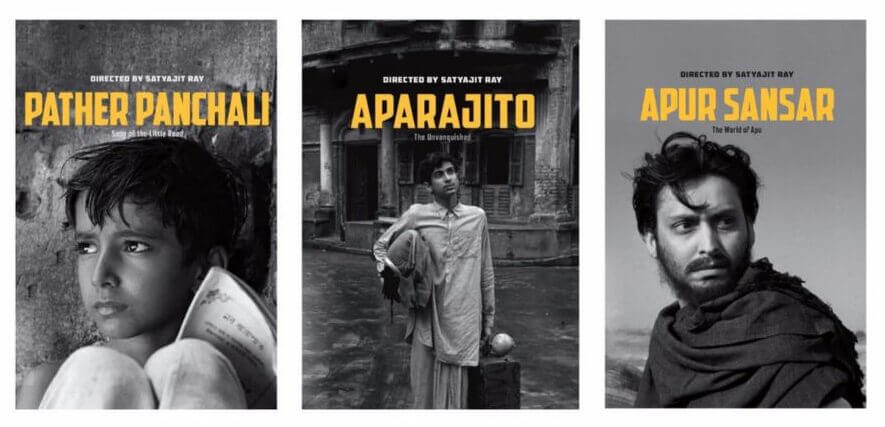
Satyajit Ray’s Apu Trilogy flawlessly recreates Bibhutibhushan Bandyopadhyay’s heartfelt bildungsroman* novels through a cinematic lens. In the vein of its title that translates as ‘Song of the Little Road’, the first movie Pather Panchali narrates the hardships of its child protagonist Apu (Subir Banerjee) and his elder sister as their family navigates austere rural poverty. Through a raw and unwavering gaze, Ray rendered a soul-stirring take on daily existence, pains and joys.
The sequel Aparajito spans from the last part of the first novel to the early sections of the second novel depicting Apu’s life after his family relocates to Varanasi, as he grows from a young boy (Sengupta) to a college adolescent (Ghosal). In this film, Ray explores the strained relationship between Apu and his mother, as the former slowly detaches himself from his rural background. The unconventional portrayal of the mother-son relationship was one of the very first in Indian cinema, cementing the film as bold, sublime and emotionally rich.
Concluding the celebrated trilogy with a flourish, Apur Sansar chronicles Apu’s (Chatterjee) romantic relationship with his wife, Aparna, who unfortunately dies during childbirth. Struggling to grapple with his grief and the responsibility of raising his son, Apu eschews his duties and becomes a vagabond.
A cornerstone of both Indian and world cinema, the Apu trilogy is hailed by critic Roger Ebert as “a promise of what film can be”.
* ‘Bildungsroman’ is a literary genre that follows the protagonist’s growth from childhood to adulthood.
The Goat Life (2024)
(Based on Aadujeevitham by Benyamin)
Starring: Prithviraj Sukumaran, Jimmy-Jean Louis, K.R. Gokul Amala Paul
This Malayalam survival drama makes for an accurate rendition of Aadujeevitham by Benyamin, with both works shedding light on the unjust, yet rampant exploitation of migrant workers in the Gulf states. Two Malayali immigrants Najeeb (Prithviraj) and Hakim (Gokul) seek better livelihoods in Saudi Arabia, only to be picked up by a deceitful local and later separated from each other. Trapped in dire circumstances, Najeeb is forced into slave labour at a remote, isolated desert farm as a goatherd – his dangerous journey and tribulations following his escape forms the remaining of the plot. Blessy’s direction cleverly delves into themes of profound loneliness, faith and sheer human will amid adversities.
Visaranai (2016)
(Based on Lock Up by M. Chandrakumar)
Starring: Dinesh, Anandhi, Samuthirakani, Murugadoss
Reworking true incidents of custodial torture and abuse of authority by the law enforcement agency, this Tamil socio-political thriller revolves around four labourers in Andhra Pradesh who are brutally persecuted in detainment and pressured to confess to a crime they did not commit. Soon, they experience a short-lived relief after being saved by a presumed honest policeman when they realise greater challenges loom over them. The savage events in the film were based on M. Chandrakumar’s memoir which recounted his personal experience of being arrested with his three friends and enduring two agonising weeks in prison. Directed by Vetrimaaran, the critically acclaimed film foregrounds the horrors of corruption and police violence.
Read more: The Bard goes masala