
Home Blog Page 985

The Year 12 balancing act

0
Reading Time: 14 minutes

Students from Adelaide dissect the final year of school and how they achieved success in 2013

Happy-Android-2013

After an intense year of hard work and preparation, the results of the SACE examinations are finally out, and a whole raft of new graduates are ready to embark on the next stage of their lives after school.

Indian Link spoke to students in Adelaide about their Year 12 experience, how they maintained a healthy balance between work and play, and their plans for the future.


What was your overall experience of Year 12?

Cutie Kannampuzha: Year 12 was mostly stressful, as expected. In the beginning of the year especially, it was really difficult because there was so much to do and I wasn’t very organised. But after I’d devised a routine, the year was easier to handle, even enjoyable.

Adit Chakranarayan: Year 12 as a whole was an enjoyable experience that was both challenging and rewarding. It is a time where organisation is a must, to ensure success.

Azaara Perakath:  It was one of the most rewarding experiences of my entire high school journey. Trying to keep up with the pressures of Year 12 while carrying out my duties as head prefect was certainly a juggling act, but it also taught me some invaluable skills that will influence the person I will be in the future.

Chaitra Barot: Year 12 is a difficult, stressful and a hectic year in comparison to any other year in school. Starting of the year is always uncomplicated and effortless, but by the end of term 3, it becomes unbelievably intricate. If you put in all the effort of studying the whole year through, you will definitely achieve what you have aimed for.

Jesrin Joseph: It was the most stressful year of my life. You have so much to do in such a short amount of time. It’s a rewarding experience and once finished, you understand what you are capable of and discover more things about yourself along the way.

Surekha Krishnan: It was all right, I mainly found it tough during term 4. All I wanted to do was study dance, and since I was dancing or learning to dance in various forms including ballet, jazz, tap, Bharathanatyam, Odissi, among others for over 9 hours a week, I found it very exciting!

Paurav Joshi: It was a pretty cool year. Like any student I did feel stressed. However, because I had completed two Year 12 subjects in Year 11, I had more free periods during my day which (when used wisely), allowed me to stay on top of my work.

Anjitha Sreekumar – It was a busy year with a lot of work. It was stressful, but yet the best year!

Darren Rebello: It was a very challenging, stressful and difficult year, but by prioritising my work, I was able to manage the stress well. I also used time management skills to get enough sleep to cope up with schoolwork for the next day, and to remain fresh throughout the day. Taking control of my studies right from day one helped in keeping everything under control, which was a big boost during the hectic year.


What subjects did you choose and why?

Cutie: I chose to do the IB (International Baccalureate) where I was required to take 6 subjects, some extra-curriculars and learn a subject called Theory of Knowledge. The subjects I did were English, Maths, Chemistry, Biology, French and Economics.

Adit: I chose Maths Studies, Maths Specialist, Physics, Chemistry and English studies because I enjoyed them the most and was good at them.

Azaara: I did the IB and chose English, French, History, Biology, Maths and Economics. I selected a combination of arts, humanities and science-based subjects. Since I have always wanted to pursue a career in the direction of law, I opted to take both History and Economics, subjects of a humanities/social sciences nature that would be a useful sounding board for my University plans.  However, I realized that combining a law degree with science would give me an inestimable advantage, as well as be the amalgamation of my two primary interests.

Chaitra: The subjects that I chose were Maths Studies, Biology, Chemistry, ESL Studies, Hindi and IPP (Information Publishing Programming). With six subjects instead of four, I had to work hard but I wanted to do something challenging and different. I also had to give an entrance exam UMAT (Undergraduate Medicine and Health Sciences Admission Test) to get into Medicine and also, I am a part-time worker at Coles. It was all very stressful but I think it is advantageous to have the knowledge of more subjects and careers.

Anjitha: I did Biology, Chemistry, Maths Studies and Maths Specialist. I chose those subjects because I wanted to get into Pharmaceutical Engineering or Medicine, and it requires some of these subjects as prerequisites.

Jesrin: I choose the subjects Maths Studies, Physics, Biology, ESL Studies, and I had to do a Research Project and Religion. I choose those main four subjects because I was not too sure of what career I wanted. Choosing these four subjects made me eligible to apply for almost 90% of the courses and kept my options open. Physics was the key subject which was a prerequisite for a majority of the courses, including the engineering and science courses.

Surekha: Dance, English communication, Tourism and Photography. I chose dance because I want to be a dancer, and the others because they were interesting and not too difficult.

Paurav: I chose Maths Studies, Physics, Biology and Legal Studies. I completed stage 2 level English and Art in Year 11. I wanted to keep my options open in University as (at the time) I wasn’t sure what pathway I would choose after high school.

Darren: Right from primary school, I preferred Mathematic and Science subjects and opted to choose Specialised Mathematics, Mathematical Studies, Chemistry and Physics from year 11. I thoroughly enjoyed the theory and applications of each of these subjects in Year 12.


What was your study routine and how did you cope with the stress?

Cutie: I studied in a lot of different ways, depending on the subject material. Often when I was learning new concepts, I would try to do it in a group. If I had additional difficulties, I would get help from my teachers, family or tutors. With assignments, I would always plan my work before beginning to write it up and refine it with help from the teacher. With practice and revision for tests or exams, I found it best to go over my notes, textbooks and instructional videos by myself, because that way I was more focused and used my time more effectively. I tried to revise really frequently so that it wouldn’t be too difficult to cram right before the exam.

I tried to de-stress a bit by watching a movie, but once I set a routine and tried to follow it, the stress just petered out. The exam period was the least stressful part of the year for me because I had learned how to organise myself a lot better by then. It’s also important to have a life outside of academics: sports, or volunteering or music or something that’ll give you contentment and social interaction.

Adit: Year 12 for me was not that stressful, except for a few weeks in the third term during which it felt like we were under pressure. Other than that, the year was a great one!

Azaara: As soon as I began senior school, I was aware of the challenges ahead of me. The single most important coping strategy was becoming (and staying) organized. Creating a study schedule was the best move I made. I used lists to prioritize tasks and consequently managed to avoid excessive sleep deprivation! I also scheduled frequent revision sessions rather than ‘cramming’ close to tests or exams. To do this however, I had to have long-term plans to ensure a balance between my academic work, my responsibilities as a student leader and my extracurricular pursuits such as sports and music.

Chaitra: It was not easy at all for me to do six subjects as I wanted to achieve the highest marks in all the subjects. I did not take any support from a tutor to improve my knowledge or understanding. I use to study by myself and took help from my subject teachers when required. Year 12 is a difficult, stressful and a hectic year in compare to any other year level in school and near the end of term 3, it becomes unbelievably intricate.  If you put in all the effort studying whole year then you will definitely achieve what you aim for.

Anjitha: To cope with the stress, I talked to teachers, got lots of help from them and my family, but especially my parents. I studied every school day and tried to memorize what I learned on that day itself. I went through class notes and workbooks. I started my exam revision from the middle of term three. I also did lot of previous exams and questions from the study guides. It was very stressful, especially with Maths Specialist. We also got lot of assignments at the same time and therefore it was important to be really organized. Unlike the previous years, we didn’t get lot of time to finish assignments.

Jesrin: I just decided to give it a go and see what I could achieve if I put my mind to it. Although at times I almost gave up. I did not do much work at school. Some of my peers would do their homework and similar work at school and they were just always working. But during this time, my mates and I goofed around and had some fun, and kept the work for home where you are alone and probably always bored.

Surekha: Most of my work was assignment based, so there was not much studying to do. But I constantly took breaks or would go out for a bit to avoid stress. However, since I loved what I was doing, it didn’t feel too hard. I also had a part-time job, and this took my mind off studies too. I also knew that I only needed an ATAR score of 60 to get into dance, so didn’t feel the pressure as much.

Paurav: I would like to say I kept a steady study routine but unfortunately that wasn’t possible – laziness, friends and lack of motivation played a primary role in hindering my studies. Also, my perfectionist attitude caused me to spend too much time on my work when I eventually did get around to completing it. However I always prioritized and made sure that for every break I took, I put in an equal amount of hard work until I was satisfied with what I had done for that day. This ensured that I would not regret any decisions I made the next day. Putting in the hard yards in the previous year allowed me to make Year 12 much easier to cope with. My parents gave me endless freedom and support, never pressurizing me and having faith in my ability. Truth be told, I had no time management skills besides completing my work as soon as I received it and prioritizing my tasks, ensuring that they were completed to the best of my ability.

Darren: My study pattern was quite challenging, persistent and committed. I studied for a couple of hours, took a break and carried on this cycle until 11pm. I had a well-organised study pattern and prioritized the important workload on a daily basis, which attributed to my success.

I did not have any added support from a private tutor or at home, except for the guidance of teachers at St. Paul’s, where help was always and readily available all the time. My parents’ constant following up and frequent discussions helped me monitor my progress and guided me towards this achievement.


What extra-curricular activities or hobbies helped you maintain a balance between work and play?

Cutie: I was in the school band playing the flute, a part of Club Red which encourages members to donate blood, in the French conversation club, and in the international club. Hobby-wise, I watched a lot of movies and TV shows, sometimes with friends, sometimes by myself. At one stage, I played chess with my dad every day for a few weeks.

Adit: Maintaining a constant exercise regime helped me focus on things other than study and really helped to keep the balance. Also focusing on my goal to become a doctor really motivated me.

Azaara: I have always loved being involved in activities which prompted me to take on various leadership roles within the school, entering writing competitions, joining language clubs and representing Glenunga on the girl’s tennis team, as well as the hockey team. I was also a weekly volunteer at the local animal shelter, which served as both a feel-good activity and a way to take my mind off study. At home, strumming my guitar was a sure-fire way to get me back on track whenever I felt even slightly overwhelmed by the daunting study hurdles ahead.

Chaitra: I did not get much time to play sports as I was occupied and engaged with my learning. I was also a Prefect in my school, I had to host assemblies, attend meetings, help organise events, help teachers whenever needed… the list is endless. I still somehow managed to balance my workload in a productive way.

Anjitha: I enjoy dancing. This year, I performed in a couple of shows in term 1, and therefore I was able to manage. After that, I stayed away from dance and concentrated more on studies until the end of exams.

Jesrin: Just hung out with friends and had a good time while making sure I stayed on schedule and did all my work. I read somewhere that a clean room gives off a positive vibe, which could help you study and could motivate you. From personal experience I think this is a good tactic that could be used, as long you don’t waste all your energy cleaning the room! Also, eating little snacks while you study and taking breaks at least every 50 minutes helps you stay focussed.

Surekha: Dancing! Outside of school, I teach Bharatanatyam, train in Odissi, ballet, jazz and tap, among others. But since I love dancing, I really enjoyed learning all the new dance styles, and some were necessary for Year 12.

Paurav: I did not have any extra-curricular activities, really. Just ate and slept well and made sure I had a normal social life. In reflection, the year was not as stressful and difficult as it is often made out to be as long as you maintain a social life in moderation and enjoy the entire experience.

Darren: When I needed to take a break, I loved playing the guitar as a stress-buster, and being a fan of soccer helped take my mind off studies. I also believe firmly in charity and giving back to the community, and have dedicated holidays during which I volunteer for the Salvation Army charity stores, an activity I thoroughly enjoy. I also played cricket and read to keep my mind focused on activities that do not involve studying.


What advice do you have for current students?

Cutie:  I feel a bit pretentious giving tips, as I don’t think I’m such an authority on Year 12 myself. But talk to your teachers and they’ll probably tell you what they told me: organisation, motivation and practice are key. You need to be organised so you’ll be in the best state of mind to study effectively. Motivation is important because you will really give your all to whatever you’re studying. Practice is, of course, important because nearly all the subjects I learnt were examined at the end of Year 12 and required us to do work we learnt back in the beginning of Year 11.

Adit: Study hard, exercise, get organised, choose subjects that you enjoy and are good at, and enjoy the year!

Azaara: Year 12 is your final year of schooling. It is about acquiring the skills to be an independent learner and to find out what works best for you, because ultimately, that’s what living life is like. Find a study regime that works best for you and remember to keep a balance between studying and socializing. Also, it’s definitely important to carefully consider your subject selection, because it impacts your ability to make decisions about your tertiary education and the relevant courses you will be eligible to apply for.

Start out with a realistic goal, and don’t forget to have fun while setting out to achieve it!

Chaitra: Plan how you will work for the week and be aware of due dates. Most importantly, work hard from the start of the year and be up to date with your work in all subjects. Work smart, not hard.

Anjitha: Don’t leave your assignments and revision for test/exam for the day before. And don’t choose Maths Specialist unless you really need it!

Jesrin: Do anything you can to stay motivated. Never give up despite the temptation to do so, because you will definitely regret it when the results come out. Eat, pray and study – trust me, it works! Stay organised and the number one rule is to never procrastinate. From my experience, procrastinating is the worst thing you could do to yourself.

Surekha: Do the subjects you enjoy and require, and don’t leave everything to the last minute.

Paurav: Ensure that everything is in moderation – breaks, social time as well as study, and use every resource available to you, especially your parents and teachers. They are your greatest assets in Year 12. The year is not stressful if you do the subjects and activities you enjoy, and ensure that only your best is given to every task you undertake. At least then, it can be said that you tried your best and nothing more can be asked of you. Remember, the ATAR required for a particular university course is only representative of its popularity, not its difficulty. Popular courses have greater competition and therefore require a higher ATAR to enter the course. At the end of the year, the ATAR you receive is the one you deserve, and obtaining the score you want is very, very rewarding.

Darren: Take control of your studies right from beginning of the year and work hard to obtain the results you seek. Keep your goals in mind and work towards them. While there may be periods where you are tired of studying and feel like giving up, remember and look forward for the end of year holidays. If you remain persistent and work hard, you will reap the rewards of what you sow.


What is your most memorable Year 12 experience?

Cutie: I can’t pick one. Year 12 is a series of experiences which can’t be reduced to just one particular moment. It’s getting closer to your friends, realising how important what you’re doing will be to your future, learning how to cope with difficulties, and being proud of yourself when something you work so hard towards becomes a reality.

Adit: Getting a merit for Chemistry and Research project.

Azaara: That’s difficult, there are so many! Perhaps travelling to Sydney with the school prefects to be on the nationally televised show Q&A where former Australian Prime Minister, Julia Gillard, was the sole panellist. Being at a forum where the youth of Australia were able to ask questions of the PM was incredibly inspiring, and I returned home with a new sense of resolve and motivation.

Chaitra: Achieving the Academic Excellence Award at school and achieving the Medal for Academic Excellence in Hindi.

Anjitha: The fun I had with my friends is my most memorable experience from my last year in school.

Jesrin: My most memorable experience would be dropping my mate into the school fountain on muck up day while the whole school watched. This might be a weird memorable experience, but during one week I had four tests in four days and just getting past that and being alive and awake on the fifth day of the school was rewarding. Last but not least, when I finished my last exam of Year 12, it was the best moment of my life. My friends and I decided to scream at traffic intersections and go for a car ride straight after.

Surekha: The school formal and graduation night. Even though some were not part of school, the dance performances I gave at various events like OzAsia Festival and others.

Paurav: The most memorable experience for me in was most likely the school formal, because it was such a successful night (along with the after party) and provided the perfect lapse from strenuous study. Even if you do not have a date, I highly recommend attending it.

Darren: Being awarded the College Dux for my Year 12 achievement was the most memorable moment, because it had been a difficult year and my hard work had paid off.


What does your future hold?

Cutie: I’m aiming to do medicine at Adelaide University.

Adit: Medicine at Flinders University. If not, I’ll do a pharmacy degree and then apply for graduate entry into medicine.

Azaara:  I hope to study a law-science double degree at the University of Adelaide. Given that I have been studying French as a second language for much of my childhood, I am also keen to undertake an academic exchange in France during the course of my degree to enhance my proficiency in the language as well as to broaden my horizons.

Chaitra: My future plan is to attend a Medical School, which will successfully lead me into acquiring a Medicine degree

Anjitha: I am planning to do Medical Imaging this year. I might attempt the UMAT and try for Medicine again, but that’s not for sure.

Jesrin: I’ve decided to do something with Science. So I’ve applied for physiotherapy and hopeful I’ll get in. If I like it I’ll stay, or maybe change.

Surekha: Train in dance and join a dance company. The real challenge was getting into University, because the course I wanted to do at Flinders University is combined with a TAFE Diploma. This proved to be a difficult entry point, so I have decided complete my diploma at a private college and then go to Uni later on.

Darren: I am focused on community giving, I believe in helping the community and have opted to follow Bachelor of Pharmacy through the University of SA. I am unsure about what the future may hold for me but I now look forward to starting Uni, and hope to progress through it attaining the best marks I can.

Paurav Joshi: As I await my offers from prospective universities, I plan on choosing either a law or architecture course at Adelaide University and then just seeing where life takes me. From what I’ve heard, Uni life can be very exciting and fulfilling and I look forward to it.


FOR THE VISUAL BOXES

Cutie Kannampuzha

Glenunga Intl High School

IB score 42/45; ATAR 99.80


Adit Chakranarayan

Christian Brothers College

ATAR 99.6


Azaara Anna Perakath

Glenunga International High School

IB score: 41/45; ATAR: 99.1


Chaitra Barot

Roma Mitchell Secondary College

ATAR 97.80


Anjitha Sreekumar

Charles Campbell College

ATAR 95


Jesrin Joseph

Christian Brothers College

ATAR 87.5


Surekha Krishnan

Aberfoyle Park High School

ATAR 76.05


Paurav Joshi

Adelaide High School

ATAR 95.2


Darren Rebello

St. Paul’s College

ATAR 99.75

Beauty rich and rare: Amoghavarsha’s One Australia

0
Reading Time: 4 minutes


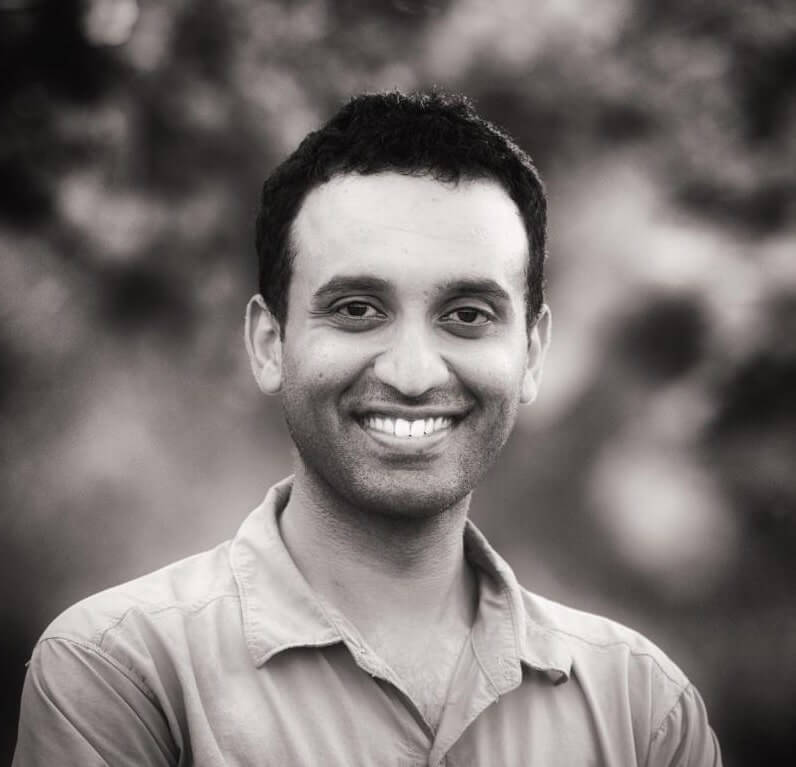
Bannerghatta National Park, Karnataka, India. A crimson sun sets over a herd of Samba deer, and a young, aspiring wildlife photographer captures an artful shot of the setting sun between the antlers of a deer. Amoghavarsha’s One Australia

It’s a turning point of sorts for Amoghavarsha, software engineer turned photographer, storyteller and filmmaker. “There were 20 other photographers there, and I was the only one to get that shot. Even today, people identify me by that particular shot”, he says enthusiastically.

nature photographer amoghavarsha
Amoghavarsha (Source: IMDb)

Today Amoghavarsha is a successful, full-time wildlife photographer and filmmaker. He was part of the Indian delegation at the Australia-India Youth Dialogue in 2013, which gave him an opportunity to visit Australia for the first time.

“When I knew someone was picking up the tab, I decided to make the most of it”, he says cheekily.

And he did. He travelled for 5 weeks, from the Tarkine rainforest to the Great Barrier Reef, filming remote wilderness and urban landscapes.

Amoghavarsha's One Australia
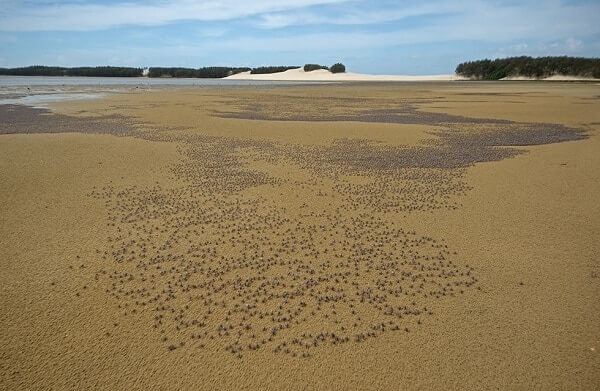
Amoghavarsha’s Australian soldier crabs

The result is a 4-minute independently funded video called One Australia that he released, to perfect timing, on January 26, 2014: Australia Day and India’s Republic Day.

It’s not been an easy journey for Amoghavarsha. He quit the comfort and stability of a job in software programming in Bengaluru, and plunged headfirst into wildlife photography.

“The first six months were really, really, REALLY difficult, even to just make ends meet”, he says. “The biggest issue was not money. One copes by making lifestyle changes. What was harder was finding and building a market for my work. Then the financial crisis hit in 2008. I questioned myself, wondering if I was good enough. That was the hardest bit”.

One Australia
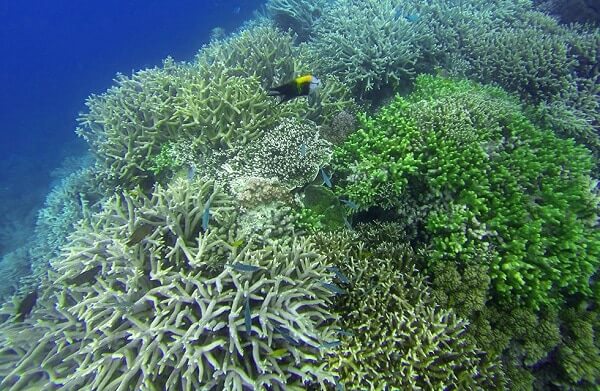
Great Barrier Reef by Amoghavarsha

Commercial opportunities like wedding photography came along where Amoghavarsha had the opportunity to make quick money. Tempting though it was, he didn’t give in. And it paid off. In six months, things started falling into place. He started teaching short-term courses in photography, and got opportunities to work with Karnataka Tourism and the Centre for Environment and Education. amoghavarsha’s one australia

“With photography, I realised that there was a lot of focus on the tiger,” he explains. “So I started photographing snakes and frogs, some of which are so rare, only 4 or 5 photos of them in the wild exist!”

He landed an assignment with Natural Geographic, where he worked on a film called Secrets of the King Cobra.

This was another turning point of sorts. “I realised that I love telling stories,” he reveals. “Film as a medium seemed very natural to me”.

Ancient palms (Image: Amoghavarsha)

And so a film of his Australian travels was the obvious choice for Amoghavarsha. A riveting montage of his travels, the films plays more like a fast-paced thriller than a travel film. The music – contemporary, fresh, and laced with a sense of mystery – was composed for and inspired by the film. Covering 7000 kilometres, the film features Philip Island, Apollo Bay, the Great Barrier Reef, the Tarkine rainforest, Bruny Island, Airlie Beach, South Stradbroke Island and much, much more. Amongst the urban landscape is a time-lapse feature of the Sydney Opera House. Amoghavarsha laughs and recalls shooting it from the 18th floor of the Shanghai Hotel in Sydney with friends. Yes, there was beer involved. And yes, he does mix business with pleasure.

Talking of beer brings us to Melbourne, and a beer shop he visited in St Kilda that stocked 600 types of beer from all over world.

“I love beer”, he chuckles, “and the sheer variety at this place was amazing. I guess I work hard and I party hard!”

The Apostles (Image: Amoghavarsha)

Amoghavarsha adds, “Melbourne’s a bit like Bengaluru. Very arty and cultural”.

When asked about Australia in general, he says he was captivated by the beach culture.

“We don’t have this sort of a coastline in India”, he explains, “I loved the beach, and the sea-focussed culture. I loved the Great Barrier Reef, it was something I had always dreamt of. Plus I did diving for the first time. Now I’m hooked!”

Talking about achievements, Amoghavarsha says taking his work across India across different mediums and reaching a mix of people, is very satisfying. His work was exhibited on a mobile train exhibition organised by the Indian government which aimed to reflect India’s biodiversity and spread awareness about conservation.

Australia has 390 species of ferns (Image: Amoghavarsha)

“Two million people saw my photos and were able to connect with the Western Ghats. To think people in remote parts of the world know me through my work…it’s humbling”, he states.


Amoghavarsha’s One Australia can be viewed here

READ MORE: 2.1 people per minute

Cricket for a cause

0
Reading Time: 3 minutes

Better understanding underlines the annual Victoria Police versus Indian Community friendly cricket match

cricket web

The annual Victoria Police versus Indian Community (Indigos) friendly cricket match was held on a very warm day on January 27 at the Sunshine Heights Cricket Club at Ainsworth Reserve Sunshine. The Victorian Police team took out the trophy for the first time in the event’s history, proving to be too good for the Indigos.

Both teams were buoyed this year with the addition of new elements: the Indigos, captained by Kartheek Garepally, benefitted from the support of players from the Shakti Lions Sports Club, while the Victoria Police club rode to a friendly victory with the backing of the Victorian Police Cricket Club and its 30-year-history. Senior Constable Fitzroy Police and team captain Rob Bartlett has been involved with the team for seven years, and confessed that the team had “been given a bit of a hiding” at the hands of the Indigos in recent years.

The match was conceived four years ago as a way to promote understanding between the Victorian Indian community and the police force.

Senior constable Greg Hinton has been part of the project since its inception, and said he understands the demographics and cultural misunderstandings between the community and the police because of his own Indian heritage.

“Both countries have a love of cricket, so this was a logical place to start”, said Sr Constable Hinton, adding that the timing is especially significant because of Australia Day coinciding with India’s Republic Day.

Community Liaison Officer at Footscray Ash Dixit was one of the first Indians to join Victoria Police ten years ago, and said that one of the aims of the event is to bring about understanding between the community and the police.

“There’s a lot of under-reporting in the Indian community with things like domestic violence”, he said. “We want to encourage (the community) to understand that the police in Australia are different from the police in India”.

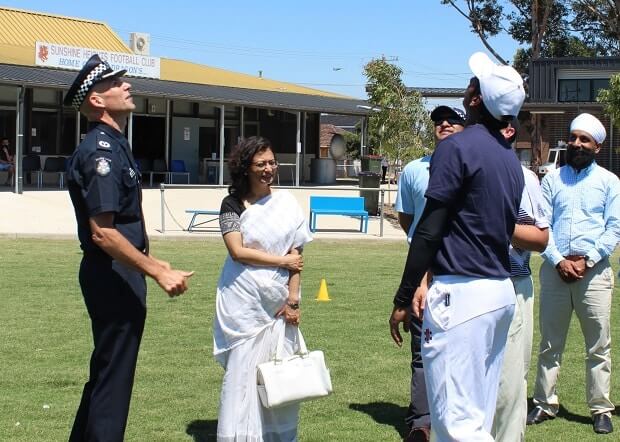
Indian Consul General for Melbourne Manika Jain was in attendance, and together with Victoria Police Assistant Commissioner Andrew Crisp, greeted the players and spectators. Asst. Commissioner Crisp said that although previous matches had been held at Fawkner Park near the city, it was good to be “in amongst the community” at Sunshine.

That sentiment was echoed by Nick Hatzoglu, Club Manager Cricket Australia, who said that the match was a way the police could show “their human face”.

Nick’s brother and Sunshine Heights Cricket Club president Chris Hatzoglu called the match just another element of integration at his progressive club.

The match went off smoothly, with Local Police Superintendent Colin Weir and Retired Sergeant Colin Newport serving as umpires.

At one point, amid the baking conditions, a small whirlwind lifted a couple of cones into the air, but nothing was as memorable as Manny from the Indigos smashing a huge 70 runs off 16 balls before retiring. Batting first, the Indigos set a target of 179 runs to chase. Brad Miles posted an impressive 78 on the board before retiring, and soon after the wickets began to fall, but not too soon to hit a score of 181 in the nineteenth over.

At the awards ceremony, Indigos Vice-President Ramesh Parasuram and the Victoria Police team’s Vice-President thanked sponsors JJL I.T. and Caltex Albert Park, as well as the Sunshine Heights Cricket Club for their hospitality. Umpires were also recognised before the trophy was handed over to the triumphant winners.

As spectators began to drift away, Leading Senior Constable and Multicultural Liaison Officer Dinesh Nettur told Indian Link that plans are afoot for the Cricket World Cup, currently in Australia ahead of next year’s tournament, to make an appearance at the 2015 Victorian Police vs Indian Community match – something that would bring people together indeed!


Republic Day ceremony

0
Reading Time: 2 minutes

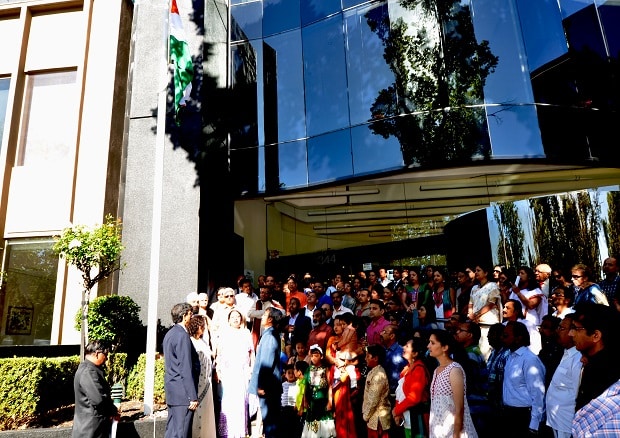
CARL BUHARIWALA attends the flag-hoisting event at the Indian Consulate

CGI 11 - Guru AP Guruswamy

The Indian flag swayed in the wind as members of the Indian community sang the Indian national anthem. They were gathered for the short and simple Flag Hoisting Ceremony conducted by the Consulate General of India on India’s Republic Day (26/01). The new Consul General Manika Jain conducted the flag hoist and read out the 65th 2014 Presidential address to the nation on the eve of their Republic Day.

India’s Republic Day, 26 January 1950, is special as it marks the moment when the fully-fledged and permanent Constitution of India came into effect. It is the day when this special document assured its citizens justice, equality and liberty, and endeavours to promote fraternity among them. In addition, that day, sixty-four years ago, marked the end of British rule.

In his customary message to the people of India on Republic Day, the Indian President noted optimistically that 2014 will be the year of healing after fractured and contentious politics. The focus will be on the people. This is to ensure economic growth across all sectors, advancements in the education system and a continuing development of a harmonious society that is free from fear.

The short documentary played towards the end of the ceremony was indeed interesting. It showcased the handloom (khadi) weavers of India who, to this day, continue to practice the trade to sustain a living. As a part of everyday life for most Indian citizens during the freedom movement, hand-weaving was a route to emancipation and financial independence. The industry flourished after Independence, due to a lesser degree of foreign market competition, as they were able to provide good quality and low cost clothing to the locals.

The Kabir song Jheeni re jheeni chadariya played in the background; firstly in the beautiful Rajasthani dialect, and progressing to the modern version with a great electric effect. The transition, portrayed in musical composition and lyric, compares well with India’s progress in all walks of life. The respect shown towards India’s traditional ways is commendable.

The video emphasised how, despite differences developed over time in culture and politics, hand-weaving continues to flourish across all parts of India. It plays a pivotal role in ensuring economic growth of the less advantaged members. It is a trade that has not been disowned despite the hard work involved in doing manual labour. It is a daily practice that displays the fortitude of the Indian labourer and, largely, the strength of the Indian community to stand united over time. The weaving of the colourful threads into a finished cloth product clearly signifies that there is ‘Unity in Diversity’.

It can be seen that India has excelled after independence and she will continue to do so into the future. Historic practices are proving to be invaluable rituals. Although mastered over time, the hand-weavers still work with original mechanical design. Such dedication and mastery are fundamental in ongoing success. The Indian community does have the confidence, courage and commitment to achieve great things in 2014. As the Indian President concluded, “2014 will be a year of resurgence”.


Swinburne Uni honour for Ravi Bhatia

0
Reading Time: 3 minutes

An honorary degree acknowledges Indian-born entrepreneur’s contribution to the ICT industry


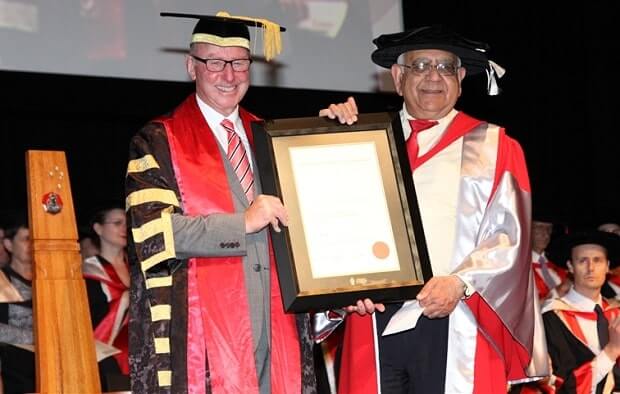
RB DOCTORATE web

An honorary degree of Doctor of Technology was awarded to Indian businessman Ravi Bhatia recently, by the Swinburne University of Technology, Melbourne. The degree was ‘In recognition of achievement of National and International Eminence in Industry, Management and Leadership and substantial contributions to Swinburne University of Technology’.

According to the Citation for the Graduation Ceremony Program, Mr Bhatia has contributed significantly to the use of high technology in Australia through founding of Primus Australia, and served as its CEO till July 2011. He developed the organisation from its inception into a highly successful and profitable facilities-based telecommunications carrier, generating over A$500m in annual revenue through organic growth and acquisitions. Primus became the fourth largest telecommunications carrier and the third largest ISP in an environment of dominance by Telstra.

The citation stated that Mr Bhatia led the development and commercial deployment of Australia’s first copper-based DSL broadband services. More recently, he was responsible for the roll-out of first release NBN sites in Tasmania and NSW. He also pioneered the development of bypass and override codes to introduce competition in Australia’s international telecommunications. He was responsible for development and deployment of indexable and searchable voice order recording systems that contributed a significant increase in productivity in the industry. Earlier, Mr Bhatia pioneered the use of inverse multiplexing to improve utilisation efficiency of international cable bandwidth for the internet.

Accepting the honorary degree Mr Bhatia said, “I am a student and not a day passes when I do not learn something new, be it in the fields of technology, science or management. I am truly humbled by the great honour bestowed on me by an august and a highly respected institution – Swinburne University of Technology, an institution with over 106 years of distinguished history and an institution that belongs to top 3% of universities of the world. I am tremendously excited about the future and we have many opportunities that lie ahead of us at Swinburne University”.

Mr Bhatia who completed his B.Tech in Electrical Engineering from Indian Institute of Technology, Delhi has more than 25 years of international experience in the telecommunications industry. He has worked in senior management positions with major global telecommunications organisations in the United States of America, Europe and Asia, including Siemens and OTC. He is a former member of Board of Directors of TIO and the Alfred Foundation, current President and former National Vice Chairman of Australia-India Business Council, and Convener of COSRA, a non-profit organization that is assisting international students in Melbourne. He is also a senior advisor to HCL.

Mr Bhatia strongly believes that advanced manufacturing, enterprise IT, higher education and advanced healthcare are areas of strength in which Australia has long experience and tremendous knowledge. According to him, “Some of these classical industries may no longer be viable in Australia for various reasons. However, I believe that we have the capability to create centres of excellence, elsewhere in the world, for such industries using our people, technology and management skills”.

Mr Bhatia also took the opportunity to congratulate all the international students who received their undergraduate and graduate degrees from Swinburne University. He thanked them for bringing their cultures to Australia, thereby enriching Australian society.

“Some of the international students may choose not to stay on in Australia, and I hope their education at Swinburne has endowed them with new skills and knowledge. I am certain they will take back with them Australian values of mateship, justice and a fair go,” he said.

In conclusion, Mr Bhatia thanked Chancellor Bill Scales, Vice Chancellor and President Prof Kristjanson and Members of the University Council for the honour, claiming that he will always cherish it and will try his best to meet the expectations of his alma mater.


Life at Uni

0
Reading Time: 5 minutes

Students can do much more than just assignments at University

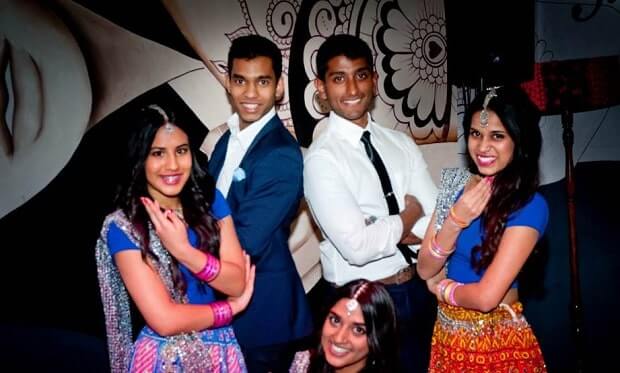
Saylee Gaonkar (extreme right) with performers at Nashaa
Photo: Priyank Menezes Photography


After graduating from High School, young people today opt for different pathways to progress their lives, and one of these going to University to further their education.

So how do students find the experience of studying at Uni – is it daunting, exciting or just an extension of school, a lot of work and no play. Two Uni students share their experiences with Indian Link.


Cultural cooperation

Starting University can be both an exciting and nervous experience, and from a current third year student’s perspective it’s important to find a good study-work-friends balance during your time here. Finding a hobby or interest that you can pursue through the University you attend is a good way of finding new friends, settling into Uni life and finding an escape from all the assignments.  All three Universities in South Australia have cultural groups for students looking to expand their involvement and interest in their culture. I began my tertiary studies in 2012 at the University of South Australia, and will begin the third year of the Bachelor of Physiotherapy degree, which I look forward to successfully completing in the next two years. When I began university, though there were a number of groups affiliated with UniSA’s student-run organisation ‘UniLife’ which strived to improve student life. But there was no cultural society for people of South Asian descent or for those who were simply interested in South Asian culture. This led to the creation of the South Asian Arts Society (SAAS) in January 2012, whose vision was to create a society to celebrate and foster the development of South Asian cultural arts and youth artists in Adelaide, of which I am a Founding Member and current President. The organisation offered a number of opportunities for its members to participate in cultural nights, network, get involved in dance teams and created a link to the wider South Asian cultural arts-loving student community. Since its inception, the SAAS has gone from strength to strength, with the girls dance troupe ‘Adelaide Jazba’ performing at a number of events such as the Indian Mela, UniSA’s Masked Ball, several Diwali functions, to being placed within the top 15 contestants at the 2012 Indian Australian Dancing Star Competition. The group won first place in the group performance category at the Adelaide auditions for this event. The SAAS held its very first cultural night for the student community of all three universities in Adelaide, called ‘Nashaa’. Over 150 students arrived dressed in their Bollywood best to enjoy a night of Bollywood dances, music, prizes, yummy food and drink, and most importantly, fun before the stressful exam period began! The event was as intoxicating as its name, and ended a very successful year for SAAS. 2013 saw another great performance by SAAS’s co-ed dance performance team ‘Adelaide Agni’, at different events including the Mela and the Adelaide Tamil Association’s Diwali Night. The return of ‘Nashaa’ in September was welcomed by an increased number of students interested in the fantastic evening that followed.

As I complete the next two years and finish my leadership within the society along with my degree, I look forward to all the other dance performances and events in which we will be involved. I also welcome all current and new university students interested in our vision to join us in participating and enjoying our beautiful and colourful culture. Visit the SAAS fanpage on Facebook for more details.

Saylee Gaonkar


Volunteering works

Being a new migrant from India, my life at University has been exciting, as well as challenging. I finished my year 12 in India and came to Australia with my parents for my further studies. I was very excited and curious to experience and learn about this new world and culture. With some time before starting Uni, I got to know this new lifestyle through my job at a local retail store, which gave me good insights. I learnt that people here are very hospitable and accepting by nature. They are outgoing too, which inspired me to come out of my shell and has helped me make more friends at University. I am currently in my third year of Electronics at University of South Australia.

Life at University here is very independent, which came as a real shock. In the beginning I found it hard to adjust to the new ways of learning and organising my workload, but good friends helped and we got through difficult tasks together. Regular communication with my lecturers has been a great advantage as well, and after the first year I realised that, if you want to know and learn more, the University will always provide you with lots of resources.

I started participating in various extracurricular activities, it was hard not to, as they are so much fun! I have joined the student association at UniSA, and am in the loop with all the events that happen on campus.

Organising the South Australian Multicultural Debate  (SAMD) has been a very rewarding experience. Its vision is to improve student life by bringing international and domestic students together at Uni, as well as providing an opportunity for students to improve their networks across other universities in Adelaide. This event stages debates about prominent issues that have been both, a hindrance and a symbol of success to Australia’s multicultural society. I participated in this debating competition in my first year, and the following year, I was invited to be a part of the executive committee. Students have to plan and organise activities for the day of the event and work together throughout the year to make the event possible. My role over the two years was that of deputy convenor and a topic director, and I learned many valuable lessons while organising this event.

I also worked with Elabtronics, as a part of my work experience which was great; but more importantly, I got a chance to contribute to the community. I took part in establishing a society called ‘Robo Angels’ to encourage women to take up engineering. It is our goal to bring the simple technology of elabtronics to schools which allows students to gain an insight on how engineering enables them to be creative with technology. Our motive is to eradicate the influence of the stereotype that girls are good at reading, writing and comprehension, while boys excel in science and maths. We want to prove that, with hard work and an interest, anyone can be successful.

Through volunteering in various activities, I have met and worked with new people, and improved my interpersonal skills. It was a bit of a challenge to plan activities around Uni assignments, but it was worth it. After all, University is not about studies alone, but about bringing out and improving your life-skills. It is a precious opportunity to mould your personality and get ready for the real world out there.

Surya Kumar Gamini

Big Bang-ed out?

0
Reading Time: 5 minutes

The Rainbow Theory attempts to squash existing belief about how the universe began, writes SYDNEY SRINIVAS

solar system

Recent reports in scientific journals announced the banishment of the hitherto held Big Bang Theory about the origin of our universe, making way for the Rainbow Theory. The age of our universe is not 13.7 billion years as we were previously informed; apparently it has been in existence from times immemorial.

How old is the universe? How did it begin? Scientists have pondered over such questions for a long time. The term ‘universe’ here includes not just our solar system, but all possible solar systems, planets and stars – in short, everything that exists.


Einstein and his Theory of Relativity

The impetus to discover answers to such questions came as a consequence of Albert Einstein’s theories of relativity. Presenting the Special Theory of Relativity in 1905, he showed that time and space are both relative. This was against the belief scientists held especially after Isaac Newton’s  (1642 – 1727) theory that both these are absolute. What is ten metres for me, is ten metres for everyone; and what are ten seconds for me, are the same for everyone. Einstein showed that this is not so, and everything depends upon the speed of the observer. In 1915, Einstein announced his General Theory of Relativity with a new interpretation of gravity. Newton had held that gravity is a force between two objects. But Einstein said something that startled the world. He claimed that there is a four dimensional Space-Time continuum. We can easily imagine a three-dimensional space consisting of x, y and z coordinates, say east-west, south – north and up and down. To these when time is added it becomes the four dimensional continuum, difficult to imagine but easily expressed in mathematics.  This is like a four dimensional mattress. Einstein said all planets and stars stay on this mattress. The consequence is that the mattress gets wrapped due to their mass. The resulting curvature is gravity. When any foreign body enters this curved space-time, it has no option but to follow a predetermined path.  Einstein said further that the path followed does not depend upon the mass or the energy content of the foreign body. The scientists were awed on hearing this theory, which was a landmark in the history of science. Einstein rose to a level on par with Newton.

The consequences of the theory of relativity have been many, Black Holes and Gravitational Waves to mention a few, but an important consequence is that of the age of the universe. Einstein applied his theory to explain the universe. Unlike his predecessors, Copernicus, Galileo and Newton, he did not limit himself to our solar system. Instead he considered the entire universe. He developed a solution to his equation, but a surprise was in store for him. Einstein’s equation indicated that the universe was contracting day by day. He consulted a few astronomers whose knowledge of Cosmology was as limited as his. They, including Einstein, were of the opinion that our universe was stable.  Einstein concluded that there must have been a mistake in his calculation and invented a Cosmological Constant (no better than a Fudge Factor). When this was inserted into his equation, the universe became stable. That pleased Einstein.  By then he had acquired the stature of a great scientist.  Others simply accepted his view.


Big Bang Theory

A voice was dissent was heard in 1922, from Russian scientist, Alexander Friedmann. He had done independent calculations starting from the theory of relativity.  It was clear that the universe was expanding, and not stable. On hearing this, Einstein remarked that there was a flaw in Friedmann’s work which was accepted by the other scientist. The curtain fell on this debate when Friedmann died prematurely at 37.

Science is a flowing river, never stagnant. Georges Lamaitre, a good Cosmologist and a Belgian priest and scientist came onto the scene. His calculations showed that Einstein was really wrong, the universe is expanding. Now, Einstein too was convinced. Further evidence came in 1931 when he visited the Mount Wilson observatory in California which housed the well-known Hubble Telescope.  He was shown some of the results of viewing of the distant stars. It was clear – the universe was expanding.

It is easy to work out the rest. If one considers the four dimensional space-time continuum, the implication is, that mattress is expanding always like a balloon. The distance between stars and planets is increasing day by day. Just work backwards. Yesterday the distances were smaller, last year they were smaller still. What about a hundred years ago? A million years ago? The universe becomes smaller and smaller as we go back in time. Ultimately a situation is reached when the universe is just a point, a singularity in the language of scientists. Then the density and the temperature of the universe would be infinite. It should have happened 13.7 billion years ago. It is believed that back then, there was an explosion called the Big Bang. As a result, the universe is expanding since that day. Density and temperature have decreased. Planets and stars developed, solar systems came into being, life started. That explosion continues even today.


Rainbow Theory

There have been many reversals in science. A strange fact came out about ten years ago. Scientists were trying to unite theory of relativity and quantum mechanics. Einstein gave an explanation for the photoelectric effect in 1905, for which he was awarded the Nobel Prize. As an outcome of his explanation came the new branch of physics namely, quantum mechanics. This has been very successful in describing the behaviour of subatomic and small particles. Curiously enough, Einstein never believed in quantum mechanics. He held it only as a hypothesis throughout his life.

Uniting relativity with quantum mechanics, scientists discovered that when a foreign particle enters the space-time continuum of any object, the path taken by the particle depends upon its energy content. All particles do not behave identically, as found by Einstein. For example, when white light when enters the continuum its constituent colours may assume different paths thus exhibiting a rainbow, thus it is called the Rainbow Theory.

And its consequences? Adel Awad of the Centre for Theoretical Physics at Zewail City of Science and Technology in Egypt published in October, that there are two possible consequences. Firstly, as we go back in time the universe becomes smaller and smaller, but never shrinks to a point. Secondly, the universe assumes a smaller size as we trace back in time, but after a while retains its size. It plateaus afterwards. In any case, there was no big bang or an explosion. The universe has been in existence for a much longer time than 13.7 billion years. It is eternal and had no beginning.

No theory is sacred or everlasting in science. As new evidence comes in old theories are shelved. We have to wait and see when the Rainbow Theory will be experimentally confirmed.


MGR: A legend lives on

0
Reading Time: 3 minutes

M R NARAYAN SWAMY reviews debut writer Shrikanth Veeravalli’s take on India’s most well-known actor-turned-politician

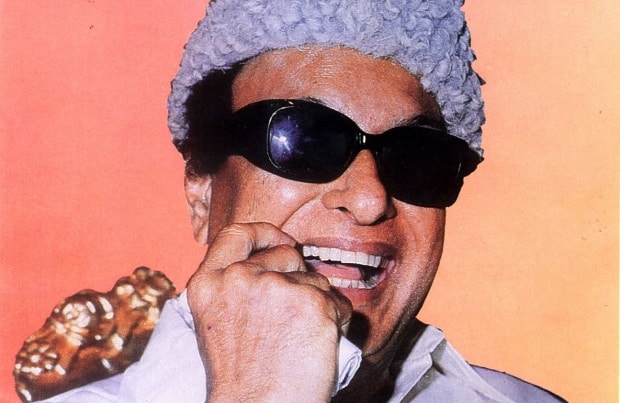
MGR (7)

He was born in Sri Lanka but gave no second thought to try to split that country. He crushed the Maoists ruthlessly at home but promoted the LTTE. He was a Malayalee who became a darling of the Tamils. His governance was marked by corruption but that didn’t affect his image. Millions worshipped him like a god but he had no real friend in life. Marudhur Gopalan Ramachandran, or MGR in short, was an enigma all his life and beyond, as is depicted in MGR: A Biography.

“MGR was a difficult man to understand,” says author Shrikanth Veeravalli, in his first book. His dual personality may have been due to the tough years he underwent when he was young. MGR lost his father when he was only two and a half years old in Sri Lanka. His mother moved back to India. Life was tough; MGR and his brother at times went hungry. That was before the Madurai Original Boys Company drama troupe tapped MGR’s acting talent – for Rs.5 a month!

Economic conditions forced MGR to try to join the Indian Army at a promised salary of Rs.125 a month. That was when Murugan Talkie Films turned his dream into reality by offering him a role in cinema – paying him Rs.350 in monthly retainer plus Rs.35 on shooting days. The Indian Army lost a soldier and Tamil cinema gained a legendary hero who went on to act in over 130 movies – and also rule Tamil Nadu for 10 long years.

It was Muthuvel Karunanidhi who gave him the title ‘Puratchi Nadigar‘ (Revolutionary Actor) as MGR played the role of a Dravidian hero beating the bad guys in movie after movie, becoming the DMK’s greatest vote catcher. But when Karunanidhi tried to clip his wings, MGR revolted and formed his AIADMK – and kept his rival out of office until he died.

What made MGR tick? What gave him the god like stature that no actor in India – not even NTR in neighbouring Andhra – could match?

MGR’s 1977-87 reign was not a rosy one. Corruption was rampant. Tamil Nadu slipped badly on the industry map. But for millions, he was above it all. In real life, as in movies, MGR silently helped those in distress in large numbers. It could be giving away 5,000 raincoats to rickshaw pullers across the state one rainy day. The number of houses he recovered from attachment and gave back to the distraught families is just too many. Every single day he helped someone or the other – without bothering about publicity. His path-breaking scheme of providing meals to children in schools – later embraced by the country – helped innumerable boys and girls from poor families to educate themselves.

“MGR effectively used populism to convert cinema scenes into reality in the mind of people (creating) an illusion that MGR’s government was performance-oriented whereas in reality it was one of the worst periods in state governance.”

And so, when the ‘god’ died on the eve of Christmas in 1987, Tamil Nadu came to a halt. A total of 31 people committed suicide, not wanting to live when their hero was no more. His last journey attracted 1.2 million mourners. MGR may be dead but the legend lives on.
This is an insightful work on a Tamil icon but it could have done with better editing.


Beyond a billion ballots

0
Reading Time: 3 minutes

M R NARAYAN SWAMY on Vinay Sahasrabuddhe’s take on what’s wrong with Indian democracy

beyond a billion ballots


It is the world’s largest democracy but India’s political system suffers from serious flaws. This much is known to – and admitted by – almost all Indians.  In Beyond A Billion Ballots, what activist-researcher-freelance journalist Vinay Sahasrabuddhe does is to plunge into the depths of all that has gone wrong with Indian democracy, as only a scholar can. “Democracy in India is more impressive in form than substance.” Unlike most others, he comes up with possible solutions to stem the rot.

India, he says, can ill afford the growing scepticism about democracy. Widespread corruption, sycophancy, populism and money-and-muscle power are the major diseases. This is one reason why Indian democracy has failed to secure better governance.

“People no longer believe that politicians pursue politics for some great cause,” Sahasrabuddhe says. The moral authority of party leaderships has eroded. Of the 49 recognized parties, barring the BJP, CPI and CPI-M, almost all others are one leader-centric and/or family controlled. Dynastic rule is an accepted trend in several regional parties. And with party forums losing relevance, middle rung leaders have lost their importance. With television reaching almost every home, party leaders can communicate with voters directly without local organisers. Regional, caste and religious identity dominate the political scene.

Ideology has been pushed to the periphery; personal ambition is the sole motivating factor for most party workers in most parties. So singularly absent is ideology that any party could fit into the Congress-led UPA except the BJP and any party barring the Congress and Communists could join the BJP-led NDA. “The image of a politician has never been so bad in India.” The absence of genuine internal democracy in most parties has contributed to their decline.

Is there a way out? Sahasrabuddhe is a strong advocate of the Proportional Representation (PR) system, as opposed to the present First Past The Post electoral outcome. “PR is likely to help improve the quality of democratic governance… PR is more capable of challenging moneyed and patronage politics.” Sahasrabuddhe feels that PR could perhaps tackle the systemic solutions to India’s democratic deficit. “PR will provide greater political stability and more certainty (to) the schedule of elections.”

But political and democratic reforms are easier said than done. The book warns that Indians are hungry for a better quality of life and this unrest can be ignored only at our peril. Delays in fixing the system will add to social unrest. “Sooner than later, India needs to unlock its democracy – now chained to the archaic, outdated aspects of the system.”

The book – a scholarly study but repetitive in parts – moans that the Lokpal movement lost its way and failed to unveil a larger agenda for political and institutional reforms. This comment was made before the AAP’s amazing success in Delhi though the party did not take recourse to money and muscle power. The Delhi election – like polling in some states – also disproved the contention of diminishing popular participation in the democratic process. The book asks political parties to include voters at all levels of activities and deliberations “if they are to transform into vital institutions”. In some ways, this is what the AAP has done, causing widespread envy.

Finally, the book says that “today, parties are in newspapers, not in localities, they conduct public meetings, although they are otherwise absent in the mohalla“. Is this true for all Indian parties?


Here comes the RAIN again!

0
Reading Time: 4 minutes

RAIN welcomes a promising 2014 after the past year was filled with successful events and operations. SUDHA NATARAJAN reports

 Multicultural health week St George 009 (2)

2013 was an event-packed year for Resourceful Australian Indian Network (RAIN).  Our management committee earned so much respect for the projects undertaken and carried out successfully, that the whole committee was re-elected without a second thought.


Financial stability

Financially the year saw progress, and this was reflected through the enhanced facilities at our community premises at 501 Forest Road, Penshurst and our repayment of 30% of the loans taken from caring community members.

The unique strength of RAIN lies in its members, our seniors.  Their past experiences in life have taught them frugal spending, but it is their generosity in times of need, the capacity to save wherever possible, and strategic planning of finances that has helped us to a great extent, to be where we are.  They contribute whatever they possibly can towards the progress of an organisation which works hard to move towards its aim of having a facility that would cater for the ethno-specific needs of our community elders, whether it is a nursing home or an adult care facility, where their needs are cared for while their family is at work.


Planning projects

RAIN has had an effective community consultation and has come up with plans for 2014 including what makes the seniors socially inclusive and active and happy. There are projects which will progressively assist with their involvement in healthy pursuits and creative learning, as well as a continued assessment of their needs.

Our Mahila project has successfully carried out a health survey and assessment of Indian subcontinent women over 50, and the analysis of this survey is currently being done by Prof Ritin Fernandez, Professor of Nursing at St. George Hospital and Cathy O’Callaghan of NSW Health South Eastern Sydney Local District. We also produced a DVD titled A triumph of Light over Darkness on the story of ageing, which was screened at the Civic Theatre in Hurstville during the Diwali Discovery festival.


Mastering multiculturalism

RAIN seniors were also partners in the Hurstville Multicultural Community Choir Fiestaville, at its debut performance. Together with 40 Chinese participants led by Danny Dong and Christina Mimmocchi, our own Gitanjali choir singers Nisha, Shantaben, Manjuben and Jayaben, led by Usha Chaula and Veda Srinivasan in dazzling sarees performed Indian traditional songs and also a special Diwali song, which included an extract of a poem specially written by Dr Ramah Juta to music by Christina Mimmocchi. Fantastic Bollywood dancing was performed by Gita Pandit, Usha Naker, Veena Girdhar, Hina Wadhwana, Smita Bhoola and Anita Patel, at the event. Thanks to Hurstville Council officers David Linden, Anne-Marie Wiles, Brenda Eggleton and Jamal Bassam, the program was successfully planned and presented to an appreciative multicultural audience.

Our highlight of the year was the stunning Kalachakra concert performance by Mrs Hamsa Venkat and the Sanskriti School of Dancing at Marana Auditorium. The 800+ audience was spellbound by the performance, and the committee is truly grateful to Hamsa for such staunch support in fundraising for a noble cause.


Recording legacies

We had two projects in the past two years, the Heritage Circle with Hurstville and Kogarah Council funding support, and Leave a Legacy project in partnership with Gymea Community Aid and Information Centre, with funding support from Sutherland Council.  These projects encouraged seniors to come up with memories in their lives and also historical events in which their families were involved. The material collected was exhibited during Seniors Week and those involved were also invited to talk on their experiences during Diwali celebrations. Armed with this treasury of information through these projects, we decided to continue collecting information and published a book which will help us know our seniors and highlight their interesting, yet untold experiences. We are thankful to the Kogarah City Council for funding this project. Questionnaires have been distributed to seniors covering details of their lives, past and present. Our seniors, though of Indian origin, are from Africa (east and south), Fiji, Malaysia, Singapore, Sri Lanka and other countries. Many have experienced World War II, and despite being born in other countries, their parents who migrated there ensured that they were deeply rooted in traditions sacredly and respectfully carried from the motherland India. The book titled Travel Through Times, will also reflect the traditional norms of our seniors and will offer insights into how they kept their culture intact through several journeys and decades. It will also provide awareness of time-told traditions and norms for the benefit of service providers in the region.  An exhibition will be held at the Kogarah Library during Seniors Week, supported by the Kogarah City Council and its officer Arabella, and a special celebration will be held to mark Harmony Day.


Stimulating seniors

RAIN remains strong and silent, enhancing and empowering its seniors through several awareness sessions and stimulating projects.  Our fun-loving seniors not only focus on games, arts and crafts, recipe sharing, yoga and meditation, singing and Bingo, they also take intellectual journeys that help jog their memories and encourage creativity. With support from Illawara Catholic Club as part of Hurstville Council’s Clubs NSW program, we have a community development project that invites different language speaking seniors on each Wednesday to get together and explore scripture and slokas in that language.  Mr Sambamurthi leads the Tamil group with his expert rendering of Tamil literature, and RAIN Chairperson RS Loga delights the Tamil group with her poetry reading sessions. The Sanskrit group learns the meanings of slokas, learning alongside the ancient language, dhanyavadha (thanks) to our tutor Dr Meenakshi Karthikeyan. We also have regular meditation sessions conducted by Dr Gunu Naker on Friday mornings, and yoga by Vedavalli Srinivasan. Our Vice Chairpersons Adarsh Sachdev and Hardika Hirani, along with secretaries Subhash Rughani and Rita Devmurari, keep the Hindi and Gujarathi sessions active and alive with bhajans and antakshari.  We have active Fiji Indian representation with Nisha Hunt, Satya Sharma, Gayatri Sharma and others.

An organisation guided by the wisdom of seniors with their varied talents and a practical education that only experience can provide, will definitely achieve success in its endeavours.