



Some of the most renowned global literary, musical and dramatic talent have Indian links

‘Made in India’ is a label that makes all Indians swell up with pride. Whether it is Tata, Mahindra, Godrej, Bajaj, Vivien Leigh, Rudyard Kipling… whoa! Have we lost it? Well, no. It is a fact that some of the world’s greatest celebrities really are Indian-born. If you don’t believe it, you’ll be pleasantly surprised to meet these people.
10. Milton Reid
Perhaps best known for playing the bad guy in James Bond movies Dr No and The Spy Who Loved Me, Milton Rutherford Reid was also an accomplished wrestler who went by the name of ‘The Mighty Chang’. Milton was born in Mumbai on April 29, 1917. His Scottish father Edgar William Reid worked as a customs and excise inspector at the time, and his mother was of Indian origin. He starred in 53 movies and television shows. Milton returned to India to be with his mother and sister, where he passed away in 1987.
9. Vivien Leigh
She stamped her place in history with Oscar winning performances as Scarlett O’Hara in Gone with the Wind and as Blanche DuBois in A Streetcar named Desire. Vivien Leigh, the actress who went on to become the darling of tinsel town, was born in Darjeeling in West Bengal on November 5, 1913 at the campus of St. Paul’s School. Vivian Mary Hartley was the only child of Ernest Hartley, an English officer in the Indian Cavalry, and Gertrude Mary Frances who was probably of Irish and Parsi Indian ancestry.
8. Julie Christie
Staying Far From the Madding Crowd these days, Julie Christie has enjoyed decades in the limelight as a movie legend from the 60s, with the Academy, Golden Globe, BAFTA and Screen Guild Awards under her belt. Born in Chabua, Assam on April 14, 1941, she is the daughter of Rosemary and Francis St. John Christie. Her father managed the Singlijan Tea Estate where Julie was raised along with her brother and an older half-sister.
7. Engelbert Humperdinck
To sum up Engelbert Humperdinck’s artistic achievements, it is suffice to say that he boasts a star on the Hollywood Walk of Fame and received a Golden Globe Award as ‘Entertainer of the Year’ in 1989. The highlights of his career have been his number one hits ‘Release Me’ and ‘The Last Waltz’. He was born Arnold George Dorsey in Madras, India on May 2, 1936, one of ten children to British Army NCO Mervyn Dorsey and Olive Dorsey.
6. William Makepeace Thackeray
William Makepeace Thackeray was a noted novelist of the 19th century, famous for satirical works like Vanity Fair and Pendennis. During the Victorian era he was ranked second only to Charles Dickens. Thackeray was born on July 18, 1811 in Calcutta, which was the capital of British India at that time. The old Freeschool Street where he was born is now called Mirza Ghalib Street. He was the only child of Richmond Thackeray, secretary to the board of revenue in the British East India Company, and Anne Becher.
5. Erick Avari
A well-known face on the silver screen with performances in hit movies like Home Alone 4, Mr Deeds and Planet of the Apes,Erick Avari’s love for cinema is inherited. His father ran two movie theatres and his grandfather was one of the pioneers of Indian cinema. He was born Nariman Eruch Avari in a Parsi household on April 13, 1952 in Darjeeling, West Bengal, and hails from the Avari-Madan family.
4. Rudyard Kipling
Almost eighty years after his death, children are still growing up reading his novels Rikki-Tikki-Tavi, The Jungle Book and Just So Stories. Rudyard Kipling was a short-story writer, poet and novelist remembered for his writings about British soldiers in India. He was born in Mumbai (then Bombay) on December 30, 1865. His father, John Lockwood Kipling was the Principal and Professor of Architectural Sculpture at Sir Jamsetjee Jeejebhoy School of Art in Bombay. The house where Kipling was born still exists in the school’s campus.
3. Joanna Lumley
Remember Sapphire of the late 70’s hit Sapphire and Steel, that’s our girl Joanna Lumley. Actress, model, author and human rights activist are some of the hats worn by this 70s pin up girl who recently appeared in The Wolf of Wall Street with Leonardo DiCaprio. Joanna Lamond Lumley was born in India on May 1, 1946 in Srinagar, Kashmir. Her father James Rutherford-Lumley served as a Major in the 6th Gurkha Rifles. Because of her support for the Gurkha Justice Campaign, Joanna is now considered a ‘national treasure’ of Nepal. The family moved to England in 1947.
2. Cliff Richard
One of the greatest musicians of our times, Cliff Richard is Britain’s Elvis Presley, the Peter Pan of Pop, an OBE (Officer of the British Empire), knighted for his charity work and holder of numerous titles and records. He was born Harry Rodger Webb in India on October 14, 1940 at King George’s Hospital on Victoria Street in Lucknow. His father Rodger Oscar Webb was a manager for a catering contractor for the Indian Railways. The Webb family lived in Maqbara, near the main shopping centre of Hazratganj.
1. George Orwell
We owe the terms ‘cold war’, ‘Big Brother’, ‘thought police’ and others to this literary genius. George Orwell was one of the most influential English writers of the 20th century and best known for his novel Nineteen Eighty-Four. Born Eric Arthur Blair on June 25, 1903 in Mothihari, Bihar in British India, he adopted the pen-name George Orwell in 1935. His father Richard Walmesley Blair was an Opium Agent for the Indian Civil Service in Bengal, while his mother Ida Mabel Blair was raised in Burma.
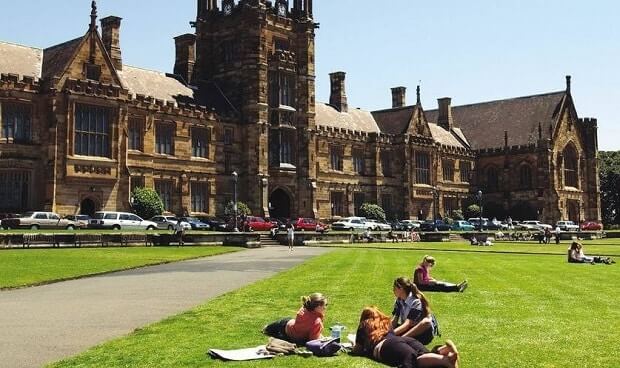
Sydney wins global acclaim for its multiculturalism and first class education options

In what is heartening news for the city, Sydney has been acclaimed as the most popular city in the world for international university students, striding ahead of popular destinations like London, Paris and New York.
Sydney’s new global ranking was revealed following results by global consultancy firm A.T. Kearney that studied the size of international student populations for its 2014 Global Cities Index.
Sydney beat more than 83 cities, and figures from the federal government show that the city is home to an estimated 50,000 international students studying at the city’s universities, with another 50,000 studying vocational and English courses. That’s a whopping figure, by any standards. Across Australia, more than 300,000 international students are studying here, with students from the top five countries hailing from China, India, South Korea, Malaysia and Vietnam. Enrolment data also reveals an increase in the number of students from Pakistan, Colombia and the Philippines.
Recent data published by the Department of Immigration and Citizenship indicated that July – December 2012 saw 27% growth in higher education student visas granted to offshore applicants. The council’s figures showed that about 35,000 international students studied on campuses in the City of Sydney and more than 10,000 lived in the local government area. In total, the international student community has contributed more than $1.6 billion to the city’s economy and generated demand for 10,000 full-time jobs.
In addition, Sydney’s cultural diversity and regional and global connections are strengthened through the influx of students living here. The city’s friendly multicultural environment, opportunities for first-class education, professional experiences, cutting-edge research opportunities, a strong economy and unmatched lifestyle are all incentives that are highly attractive to international students.
The City of Sydney council has several programs to support international students, including a dedicated international student resource guide and an international student leadership and ambassador program designed to provide work experience, skill development, mentoring and leadership training. The program has participants from 18 countries.
In fact, graduates from universities in Sydney include some of Australia and the world’s most successful academics, specialists and business figures, not counting five Nobel laureates, six prime ministers and two governors-general.
The City of Sydney has certainly moved up since last year, where it won the 4th spot for most popular city for international students in the QS Best Student Cities ranking, compiled by the higher education specialist that publishes the annual QS World University Rankings. Paris won the top spot for its world leading universities and low tuition fees.
The city is enthusiastic about continuing to retain its position as most popular city for international students across the world.
MIRA SAMRA’s summary of her grandparents’ 50th wedding anniversary

A crowd of about 120 people gathered at the Northbridge Golf Club in Sydney on the evening of Saturday February 22 to celebrate the golden wedding anniversary of my grandparents Harjeet and Mandhir Randhawa. It was as if the God’s were also showering their blessings from the Heavens above as it turned out to be a beautiful evening with a soft breeze blowing creating the perfect atmosphere for a great celebration.
A more befitting venue could not have been chosen to mark 50 years of married bliss for the couple. Days leading to this celebration, relatives and friends had been flying in from as far as New York, Canada, Singapore and Malaysia.
The evening began with pre-dinner drinks in the beautiful garden overlooking the Middle Harbour and the city beyond. It all looked so tranquil in the setting sun and as the guests walked over the red carpet that has been specially laid out for the evening, they were in awe of the beautiful surroundings that had been chosen for this celebration.
The theme for the evening was ‘The romantic 60’s’, and the couple had gone to great lengths to select special music from that era to be played during the evening. As the songs from that by-gone era, sifted through the air, the guests reminisced and some hummed along. After about an hour all the guests began to slowly make their way inside where a fairy tale atmosphere awaited them. Everything from the table settings, the golden chair backs to the candles had been carefully selected to make for a magical setting. The couple walked in to a special rendering of an old Hindi number, Janam Janam Ka Saath Hai.
The couple’s 17-year-old grandson Ajai who had accepted their request to be the MC for the night did a great job. Then there was a video presentation of some family photos which had been painstakingly put together by my grandparents. They had sifted through many old albums for this presentation and there were many ‘oohs’ and ‘ahs’ and laughter rang out as those present recognised some in the photographs and commented on the hairdo’s and clothing of the past decades. There were some short speeches by members of the family which recalled what they could remember of the couple’s wedding 50 years earlier. The couple then took turns to speak and thank everyone present for attending and making it a memorable evening for them. They especially thanked their three children Hareen, Brijinder and Param and their spouses who were present, for the time they had input in planning of the celebration. This was followed by the couple cutting the cake cutting and another performance. Speeches over, everyone took to the floor and danced the night away.
It was truly a night to remember and one that was a celebration of 50 golden years of a very special couple’s marriage, my grandparents, the mood for which was created by their many friends and relatives.
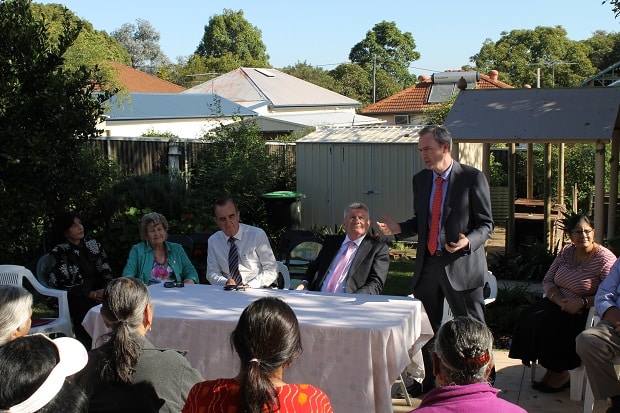
HACC funds will help provide home care for subcontinent origin seniors

In what is a piece of incredibly good news, the Resourceful Australian Indian Network (RAIN) has been advised that the organisation will receive $77,000 under the Australian Government’s Home and Community Care (HACC) programme, to support older people in the St George and Sutherland areas.
Assistant Minister for Social Services Mitch Fifield visited RAIN at its Penshurst Centre on April 24, after being invited by Federal Member for Banks, David Coleman. “RAIN is an outstanding local community organisation”, Mr Coleman said. “It is an innovative group that is delivering much-needed and high-quality services to the local Australian-Indian community”, he added.
The HACC funding will allow RAIN to expand its services and provide support to older Australians, enabling them to live at home for longer. “With this funding, RAIN will deliver important activities to build social interactions and enable older members of the Indian community to remain active and connected with their peers and community”.
Senator Fifield said the funding provided to RAIN was part of an additional $240 million provided to 331 organisations across Australia as part of a competitive tender.
The news has been welcomed with delight by RAIN members and the Indian community, who take pleasure in participating in the organisation’s many events and in keeping busy, active and happy.

Migrant stories come alive through chance encounters with enterprising Sikhs in the heart of Myanmar

One sunny afternoon a few weeks ago as we were travelling through the Shan state in eastern Burma (Myanmar), through the town of Taunggyi meaning ‘huge mountain’ to be precise, we were startled to come across a gurdwara! We stopped to have a look. Here we met Tara Singh, the caretaker, who identified himself as a Burmese Sikh. In all respects he looked a Sikh except that he wore the Burmese traditional attire, a longyi that is similar to the Indian lungi. Just a couple of hours before in a small village on the road to Kakku, we were intrigued when we spotted a turbaned Sikh, Avatar Singh, in his wayside convenience store. He too, like Tara Singh, had dual names – Sikh and Burmese, but he had lost all knowledge of the Punjabi language.
I was pleasantly surprised to see the presence of my Sikh brothers in this quiet part of the world. Tara Singh, ordained as ‘gyani’ by the other Punjabi locals, wasfluent in Punjabi and Hindi, and narrated to us his story of migration and survival. Tara Singh came to Burma in the 1930s but when the Japanese occupied Burma in the early 1940s, he fled and took refuge in Calcutta. As a consequence of the Japanese invasion, a large percentage of Indians fled Burma overland into Assam, largely on foot. Others returned after the war, but many never did.
Hearing his story, I recalled the vivid descriptions of this exodus in Amitav Ghosh’s novel The Glass Palace, of how the refugees suffered terribly and thousands died. Tara Singh stayed in Kolkata till the infamous riots broke out in Kolkata after India’s Independence in 1948, when he once again escaped to Burma and has been a resident of the Shan state since.
The Sikh migration to Burma started in the 19th century with the British Indian Army. Sikh soldiers took part in sizeable and growing numbers in the wars that the British waged against the Burmese kings. After the last (the Third War in 1885-86) war, Burma became a province of British India. Many Indians migrated to Burma at this time. Tara Singh mentioned that in the 1930s there were more than 10,000 Sikhs in Burma, and Taunggyi was home to a few thousand of them. Now there are only about 40 Sikh families.
Most of the Sikh families congregate on Sundays at the Taunggyi gurdwara for prayers and langar, the free communal meals. The British supported and encouraged Sikhs to build gurdwaras for which land was generously allotted. But all this ended in the era of the so called ‘Burmese way to Socialism’. The Taunggyi gurdwara received a Government notice that it was to be pulled down to widen the road. Tara Singh proudly states that with the support of patrons and many relatives overseas, it was not only re-built but done so on a much larger scale. Vahe guru ji ka Khalsa, Vahe guru ji ki Fateh – the victory belongs to God, reiterated.
It was just not the Sikh Army personnel who migrated to Burma. Many infrastructure projects were started by the British colonial government and it contributed to an unprecedented economic boom in Burma that drew many other Indians. Many migrated – as civil servants, engineers, river pilots, soldiers, indentured labourers and traders.
As we left the Shan state a few days later, at the Heho airport waiting for a delayed flight, we met yet another Sardar brother, jovial sexagenarian, Surinder Singh. He was a retired tailor. Unlike many of his relatives who returned to India after the socialists took over, he stayed in Burma through all the good and bad times, philosophising that life’s pleasures and turmoils are everywhere. Surinder Singh was indeed a philosopher and he quoted with ease from the works of Khalil Gibran, Bahadur Shah Zafar and Friedrich Nietzsche! He recounted the call of freedom fighter Netaji Subhas Bose at Taunggyi, to join his Indian National Army. Although Surinder Singh did not actively respond to the call, he remembered its intensity as if it was an event of yesterday. He was fighting his own battle of survival. Life wasn’t easy under the British or the Japanese; nor was it under the military Burmese governments since the 1960s. In fact, after Burma got its independence, the law treated most Indians as ‘resident aliens’. But Surinder Singh has survived to tell the tale.
Such has been many a story of migration – a story of struggles, hardships, and challenges. But as Surinder Singh summed it up in his philosophical way, ‘home is where the heart is’! This sentiment is also echoed in the words written by the Mughal King Bahadur Shah Zafar, who was exiled by the British to Burma and died there in 1862, pining for his motherland India. His poignant words “Kitna hai badnaseeb Zafar, dafan ke liye do gaz zamin bhi na mil saki kuye yaar mein!” (How unlucky is Zafar! For burial, even two yards of land were not to be had in the land of his beloved!) are inscribed on his tomb in quiet corner of Yangon.


Although fats are generally considered as bad, small amounts are necessary for our overall wellbeing

Fats are considered to be a culprit in most of our diets as these may lead to obesity, heart disease and stroke. But fats do have their benefits and are necessary in our diet, playing a very important role in ensuring balanced, healthy eating.
All fats are not culprits, depending on the type and amount of fat you use. They are mainly grouped as follows:
Saturated fats
These are considered to be bad fats, linked to heart disease and increased cholesterol in the body. Saturated fats are those that are solid at room temperature. The main sources are:
Tran fats
Trans fatty acids are rare in nature. They are only created in the rumen of cows and sheep, and are naturally found in small amounts in milk, cheese, beef and lamb. Trans fats raise LDL (bad cholesterol) levels and increase the risk of heart disease. These also tend to lower HDL (good) cholesterol, so are potentially even more damaging. We should be more careful of trans fats produced during manufacturing rather than the ones naturally present. Trans fatty acids are also created during the manufacture of some foods such as some table margarines, pies, pastries, cakes and biscuits.
Fortunately, Australian manufacturers are able to remove most of these trans fats during the manufacturing process.
Unsaturated fats
Unsaturated fats are an important part of a healthy diet. These fats help reduce the risk of heart disease and lower cholesterol levels when they replace saturated fats in the diet. These can be further divided as:
Replacing saturated fats with monounsaturated fats has a cholesterol lowering effect. These can be found in foods like avocados, almonds, cashews, macadamias, hazelnuts and cooking oils or margarine spreads made from oils such as canola and olive oils.
Polyunsaturated fats can be divided into two groups known as omega-3 fats and omega-6 fats. These two types of fats have slightly different health benefits.
Omega-3 fats have been shown to be protective against heart disease and they help decrease LDL (bad) cholesterol levels. Omega-3 fats are found in oily fish such as salmon, herring, mackerel, sardines and trout. Also eggs and meats such as lean beef and chicken and finally, plant sources including linseed/flaxseed, walnuts and soybeans. Fish and other animal sources contain different types of omega-3 fats than plant sources. The omega-3 fats that come from animal sources are more bioavailable, which means to get the same effect from plant-based sources, you would need to eat a lot more. Animal sources have also been shown to have more benefits for cardiovascular health than plant sources of omega-3.
The Heart Foundation recommends that adults should have 500mg of omega-3 (marine source) every day to reduce their risk of heart disease. This can be achieved by consuming 2-3 serves of 150g of oily fish a week.
Omega-6 fats have been shown to decrease the risk of heart disease when they are consumed in place of saturated and trans fats. Omega-6 fats sources include margarine spreads, sunflower, soybean, sesame oils, corn, nuts such as walnuts, pecans, Brazil and pine nuts, and sunflower seeds.
Health benefits of fats
Reduce unhealthy fats; add healthy fats
Always remember that all fats give you the same amount of calories, i.e. 9 calories per gram, even the good ones, so you do need fats, but in moderation.Consume less than 10 percent of your daily calories from saturated fats, and replace them with unsaturated fats whenever possible. Ensure that you eliminate trans fats from your diet for a healthy, happy, fat-moderated lifestyle.
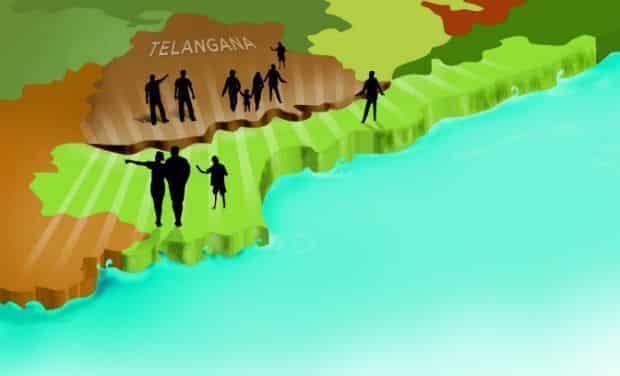
An increasing number of states are looking at linguistic division, writes NOEL G DESOUZA
In 1952, a horrendous event took place in what is now Andhra Pradesh. Several people were undertaking a fast-unto-death campaign to force the government of India to create a state of Andhra from the Telegu-speaking parts of what was then the Madras province. The prevailing grudge amongst the Telegu people was that they were getting a raw deal from the majority Tamil population.
One of the agitators, Poti Sreeramulu actually died, and this provoked a large-scale agitation; people lay across railway lines and paralysed rail transport. The state and central governments had miscalculated the fury of the people. The state of Andhra came into being the following year. At the time there was no talk of creating a larger Andhra, with the addition of the Telegu parts of the erstwhile Hyderabad state and neighbouring Telegu-speaking areas in other states.
However, there was a flow-on effect from the government, caving in to the Andhra cause. Poti Sreeramulu has currently become the symbol for a United Andhra, for which he had never agitated.
Ever since the subcontinent was partitioned between India and Pakistan, both countries have been in the process of being internally redesigned. The concept of linguistic states was originally objected to by the then Prime Minister Pandit Nehru. He had dismissed the idea by calling it the ‘Plan Balkan’ because it resembled the break-up of the Balkans in Europe, into linguistic nations. But Nehru was a democrat and gave in when he saw that there was strong support for the concept at the grassroots level.
The States Reorganisation Commission (SRC) was set up in 1953 with Fazal Ali, Sardar KM Panikkar and HN Kunzru as members. The original redesigning in 1956 mostly followed the proposals of this SRC. Its three members had impeccable credentials; they had scholarly as well as administrative backgrounds of the highest order.
Fazal Ali had been a judge and later the Governor of Assam and of Odisha. He was knighted by the British Government well before India’s independence.
Sardar KM Panikkar, a native of Travancore State, was a well-known Oxford-educated scholar having several seminal works to his credit such as Malabar and the Portuguese (1929) and Malabar and the Dutch (1931), and later Asia and Western Dominance. He was the Foreign Minister of Patiala and of Bikaner where he later became the Dewan (Chief Minister). He had first-hand knowledge of China where he had been India’s ambassador. His scholarly observations are contained in his book In Two Chinas.
HN Kunzu, a Kashmiri Pandit (like Nehru) was scholarly as well as practiced in drawing up legislation in various capacities. Politically he was a centrist and had founded the National Liberal Federation with like-minded individuals. He presided over the amalgamation of India’s railways into one body. Kunzu seemed to have a special place for India’s youth. He was responsible for setting up the National Cadet Corps and became the first National Commissioner for Bharat Scouts and Guides, and the first President of the Children’s Film Society.
In 1956, as the time approached for the new states to be carved, there were conflicting views and thoughts about what the future would be. There was the extreme view that each state would become a watertight compartment in which the local inhabitants would consider migrants from other states as ‘outsiders’. Unfortunately, that has eventuated to some extent. Recently the Chief Minister of Karnataka advised that those who wish to make the state their home should learn to speak Kannada. Note that he has not said that they should learn to read and write the language.
Pandit Jawaharlal Nehru was in favour of having large states. He was responsible for persuading Telangana which had been conceded by the SRC to become a separate state, to merge with Andhra. He was also responsible for merging Vidharba with an enlarged State of Bombay.
The current trend is to create smaller states. Nehru’s successors, both in his Congress Party and including his own descendants, have favoured the creation of several new states. Ironically, the creation of Telangana is led by his grand-daughter-in-law Sonia Gandhi and his great-grandson Rahul Gandhi. Strong emotions have followed the creation of linguistic states. The impetus for the creation of these states came from the creation of Andhra, by separating the Telegu-speaking areas of the old Madras Province.
The SRC did what now appears to be the first phase of redesigning India. We are now entering a new phase wherein we are witnessing the creation of new states within the boundaries of existing states. These smaller states will remove the unfair advantage that people who lived closer to their state capital had, over those living far away. For example, the original Bombay State which comprised of Maharashtra (including Vidarbha) and Gujarat, left the majority of its people far away from the capital city of Bombay. Likewise, the large state of Andhra Pradesh was centred around the city of Hyderabad.
Though not as quickly as in 1956, the new states will take longer to be brought into being. It is time to build common bonds such as with science and scientific language.

A whole generation of young people are entering the labour market with little prospect of success
In both the United States and Australia, there is a growing feeling that tertiary education is no longer worth investing in. The reason for scepticism on the part of parents and students is partly a matter of supply and demand; there are now far too many graduates as compared to the number of available jobs – and unemployed youth are lining up at Centrelink.
In 2013, the Australian Bureau of Statistics (ABS) found that 25% of Australians aged 15 to 64 years had a bachelor’s degree or higher qualification.[1] Yet only 68% of employed people aged 20 to 64 years were working in a field of relevance to their highest qualification, indicating the existence of a mismatch between tertiary qualifications and successful employment prospects in the field of one’s choice.[2]
The problem is not restricted to generalist degrees such as that of a Bachelor of Arts. Even graduates of professional degrees like Law have in recent years struggled to obtain work in their field, with one recruiter suggesting that ‘it is the worst time in living history to be a law graduate’.[3]According to media reports, 64% of recent Australian law graduates were not practicing law between 2010 and 2011.[4]
Although according to the ABS, only 3% of graduates overall were unemployed,[5] this doesn’t mean graduates are working in a field of their choice. The situation in the US is particularly bleak, with a report from the Center for College Affordability and Productivity claiming that half of America’s recent college graduates work in jobs that do not require a college degree.[6] As an illustration of their findings, the authors report that 15% of taxi drivers had at least a bachelor’s degree in 2010, a dramatic increase since 1970 when the figure was 1%.
The youth unemployment rate (that is, for those aged 15 to 24) in Australia for October 2013 was approximately 13%.[7] In the US, the corresponding rate is nearly 20%.[8] Nevertheless, politicians appear to have no hesitation in pushing more public funding for colleges and universities, and in encouraging education for its own sake, without contemplating whether there will be a job at the end of the line. The previous Australian government under Prime Minister Julia Gillard, for instance, set an ambitious goal of having 40% of young Australians holding a bachelor’s degree by 2025. And US President Barack Obama wants the highest proportion of college graduates in the world by 2020.
There are underlying structural and government-imposed barriers that prevent young people from transitioning from study into employment. One important contributing factor is the rate of taxation in a society; the higher the rate of taxation, the higher the financial burden on businesses, and the less likely they are to expand and create jobs.[9] In Australia and the US, the rate of corporate taxation is significant enough to act as a disincentive for those companies faced with the prospect of paying it. The rate in Australia is a flat 30% while the highest nominal rate in the US is 35%.
Excessive regulation can have a similar effect as taxation, because it forces businesses to bear additional costs in order to comply with government policy; they may need to hire a lawyer or accountant just to navigate their obligations, for example. Regulations that dictate the circumstances in which employers can fire their employees are an added disincentive to hiring, because employers are reluctant to take on board employees when the law makes it difficult to fire them at a later stage without being exposed to costly claims for unfair dismissal by the employee.
Finally, the education system itself can be faulted for ill-preparing young people for the real world of work. Government agencies often set a standardized curriculum that is then implemented and taught at schools. Yet this educational program could be criticized for not sufficiently preparing students for the ‘real world’, due to the lack of corporate and industry input into the curriculum. The concern is that students are not being taught the things that will really equip them to provide services that employers want, such as how to market themselves or how to run a business.
Youth unemployment is a scourge on any society, not just for its economic effects but also for the psychological impact it has on the young and their families. It is imperative that a new approach be formulated that takes into account the barriers placed in the way of young people by government institutions and policies. Each individual case of unemployment has a distinct personal cause that can often be helped by career counselling or training, but when dealing with aggregates the only way to convincingly help large numbers of young people aged between 15 and 24, is to change the system in which they operate. It is time to make the ‘rules of the game’ more fair for those just starting out and looking for a foothold in the labour market.
Footnotes
1 ‘6227.0 – Education and Work Australia May 2013’, Retrieved from <http://www.abs.gov.au/ausstats/abs@.nsf/Products/6227.0~May+2013~Main+Features~Attainment?OpenDocument>
2 ‘4102.0 – Australian Social Trends, September 2012’, Retrieved from <http://www.abs.gov.au/AUSSTATS/abs@.nsf/Lookup/4102.0Main+Features30Sep+2012>
3 Leanne Mezrani, ‘It is the worst time in living history to be a law graduate’, Lawyers Weekly, 27 August 2013; SaskiaStarck, ‘Australian law graduates unemployment crisis’, Retrieved from <http://saskiastarck.wordpress.com/2013/05/29/law-graduates-unemployment-crisis/>.
4 ‘Law and the new order’, Retrieved from <http://www.theage.com.au/national/education/blogs/third-degree/law-and-the-new-order-20120611-205o5.html>
5 Tony Featherstone, “Saving ‘generation jobless’: Is it too late?”, The Age, 9 May 2013.
6 Richard Vedder et al, Why are Recent College Graduates Underemployed?,Retrieved from <http://centerforcollegeaffordability.org/research/studies/underemployment-of-college-graduates>.
7 Retrieved from <http://www.tradingeconomics.com/australia/youth-unemployment-rate>.
8 Retrieved from <http://unstats.un.org/unsd/mdg/SeriesDetail.aspx?srid=597>; and <http://www.imf.org/external/pubs/ft/fandd/2012/03/morsy.htm>.
9 Bernhard Heitger, ‘The Impact of Taxation on Unemployment in OECD countries’, Cato Journal, Vol. 22, 2002.


WIN A DOUBLE PASS TO:
The Inaugural 2014 IFFM Awards with special guest Amitabh Bachchan
When: 7pm Friday 2 May
HOW TO ENTER?
Simply email win@indianlink.com.au
In the subject line put Inaugural 2014 IFFM Awards… and your name, contact number and postal address in the body of the email. You can enter as many times as you like, with multiple email addresses. Ok…. go!!
Note: Event is held in Melbourne. The competition prize does not cover accommodation or transportation.
Entries close midday Monday 28th April

Indian Link empowers and elevates the South Asian community in Australia, by telling their stories and unpacking their experiences in a nuanced and unbiased manner.
© Indian Link Media Group. All rights reserved. Level 25/259 George St, Sydney