




After nearly two decades of stalled negotiations, the European Union and India have finally concluded a landmark free trade agreement, marking one of the most consequential trade developments of the decade.
The deal will progressively eliminate or reduce tariffs on roughly 96–97 per cent of goods traded between the two economies, creating a vast integrated market spanning nearly two billion consumers. Beyond its commercial scale, the agreement reflects a deeper geopolitical recalibration – driven in large part by renewed global trade uncertainty following US tariff actions under President Donald Trump.
The agreement delivers meaningful market access on both sides. India has agreed to slash tariffs on a wide range of European exports, including automobiles, machinery, chemicals, wine and spirits, while the EU will provide improved access for Indian textiles, pharmaceuticals, leather goods, jewellery and chemicals. Services, digital trade and regulatory cooperation – long-standing sticking points – are also included, signalling a more comprehensive partnership than earlier drafts.

The toughest sectors – and how they were cracked
Some of the most politically sensitive sectors required painstaking compromise. Automobiles were among the hardest fought. India has long protected its domestic car industry with import tariffs exceeding 100 per cent, making it one of the most closed major auto markets in the world. European manufacturers pushed aggressively for access, while New Delhi resisted sudden liberalisation. The eventual compromise allows for steep but gradual tariff reductions over an extended transition period, giving Indian producers time to adjust while offering European firms a long-awaited foothold.
Agriculture and dairy proved even more contentious. With hundreds of millions of small farmers, India has historically treated food imports as a red line. European producers sought access for high-value dairy products such as cheese and milk powders, but many of these areas were either excluded or subject to limited quotas. “Agriculture was where negotiators drew the clearest boundaries,” said one trade analyst familiar with the talks. “The deal succeeds precisely because it avoids forcing politically impossible outcomes.”
Non-tariff barriers were another major obstacle. Differences in product standards, certification rules and sanitary regulations have often restricted trade more effectively than tariffs themselves. The agreement includes detailed provisions on regulatory cooperation and mutual recognition, designed to ensure that tariff cuts translate into real commercial flows rather than being blocked by technical hurdles.
Why Trump’s tariffs changed the calculus
The timing of the deal is no coincidence. Renewed tariff threats and trade actions by the Trump administration unsettled global markets and sharpened concerns in both Brussels and New Delhi about over-reliance on the US economy. Faced with the prospect of higher barriers to the American market, both sides accelerated efforts to diversify trade relationships and lock in predictable access elsewhere.

“For both India and the EU, this agreement is as much about resilience as it is about growth,” said a European trade official close to the negotiations. “Trump’s tariff strategy reminded governments how exposed trade can be when it depends too heavily on a single market.”
This geopolitical backdrop helped overcome decades of deadlock. Concessions that were politically difficult a decade ago became more palatable in a world defined by trade fragmentation, supply-chain re-routing and strategic competition.
Who benefits more – India or the EU?
Whether India or the EU gains more depends largely on perspective and timing. In the short to medium term, the EU appears to secure the clearer commercial win. European exporters gain unprecedented access to one of the world’s fastest-growing large markets, particularly in high-value sectors such as automobiles, machinery, chemicals and premium food and beverage products – areas where EU firms enjoy strong competitive advantages and high margins. The gradual dismantling of India’s tariff barriers represents a structural shift that European businesses have sought for decades.
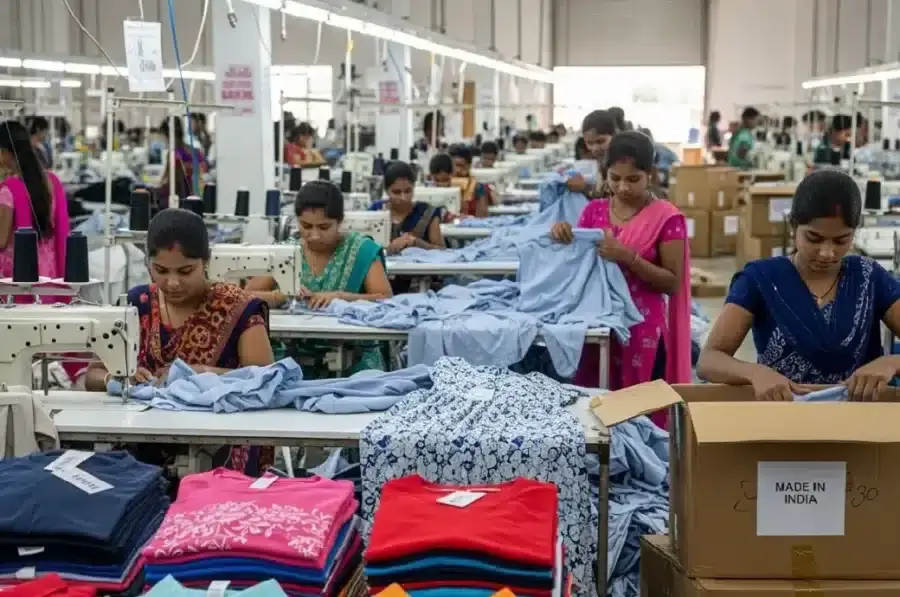
India’s gains, while less immediate, are more strategic and long-term. Preferential access to the EU market strengthens labour-intensive export sectors such as textiles, pharmaceuticals and chemicals at a time when US protectionism is rising. Equally important, the agreement reinforces India’s ambition to position itself as a credible alternative manufacturing and investment destination to China, supporting its deeper integration into global supply chains.
As one senior trade economist put it, “The EU gets faster commercial returns; India gets long-term industrial positioning.” In that sense, the deal is not zero-sum, but complementary – reflecting a convergence of economic and geopolitical interests.
What it means for Australia
Australia stands to benefit indirectly as trade and investment flows between the EU and India expand. Stronger manufacturing and industrial links are likely to increase demand for Australian exports of raw materials, critical minerals, energy and agricultural inputs, particularly in green technologies, pharmaceuticals and advanced manufacturing.
Australian firms may also find opportunities as third-country partners within EU-India value chains, especially in mining services, logistics, education, and professional services. Strategically, deeper EU-India integration aligns with Australia’s Indo-Pacific economic interests, reinforcing open trade norms at a time of growing global protectionism.
Taken together, the EU-India agreement signals a shift toward pragmatic, geopolitically informed trade policy – shaped not just by economics, but by the lessons of an increasingly unpredictable global trading system.
Read more: Deals, deals everywhere – but no value to be seen?