Home Blog Page 987

If you like Pina Coladas

0
Reading Time: 3 minutes

Smoothies

Grab a few of those spiky, juicy fruits and get that BBQ and blender ready

Surely you’ve been to a stack of parties by now, you’ve eaten way too much food and you’re starting to worry about making your New Year’s resolutions, or even just fitting into your pants. So why not buy some pineapples and have a bit of fun with these prickly fruits?

They’re high in fibre, vitamin C, fat free, and the best bit? They’re packed full of bromelain, an enzyme that breaks down proteins, so it’s great for digestion (yay!), and you can use it to tenderise meat. Meaning you just might be able to fit back into your work wardrobe after all.

And here’s a random pineapple fact for you to pull out at the dinner table, pineapple is not strictly speaking a fruit, rather it’s 100-200 fruitlets all fused together.

You don’t have to “like getting caught in the rain” for these easy recipes.


BBQ Pineapple

Serves 4


Ingredients

1 pineapple

2 cups Greek style yoghurt

4 tbsp crushed macadamias


Method

1. Cut the pineapple lengthways into eighths.

2. Grill on the BBQ for a few mins on each cut side of the fruit until you see nice caramelised grill marks.

3. Serve each quarter with a small bowl of Greek yoghurt topped with the crushed macadamias.

Note: No, don’t peel it. It looks divine with the skin still on. After cooking, just run a knife between the skin and flesh and cut into segments, but serve this dish intact, on the skin.


Pineapple green smoothie

Serves 2


Ingredients

½ pineapple, cut into chunks

½ banana (65g)

1 cup coconut water, chilled

Leaves from 2 sprigs of fresh mint

20g (1 cup) baby spinach leaves

1tbsp freshly squeezed lemon juice

Small Lebanese cucumber (70g) cut in half


Method

1. Put all ingredients into a blender and blitz for a couple of mins.

2. Pour over ice cubes into two long glasses and serve.


Roast pork with pineapple chilli salsa

Serves 4


Ingredients

1.5kg rolled pork roast

½ tbsp sea salt flakes

1 tbsp olive oil

Salsa

½ pineapple, diced into small pieces

1 red chili, sliced finely (seeds optional)

Handful of fresh mint, finely chopped

½ avocado, diced into small pieces

Juice of a lime

Pinch of sea salt

Cracked black pepper


Method

1. Preheat oven to 220 degrees Celsius. Rub salt and olive oil into skin and place in roasting tray. Roast for 30 mins, then turn down to 180 degrees Celsius and roast for a further 30 mins or until skin is crisp and cracking (use this method if the skin on option is chosen).

2. Mix all the ingredients for the salsa in a bowl and leave in the fridge for an hour for the flavours to develop.

3. Remove the pork from the oven, discard the fat layer and slice the meat.

4. Serve the meat topped with the pineapple salsa and serve with boiled kipfler potatoes and a big green salad drizzled with extra virgin olive oil and lemon juice dressing.

Note: Be aware that if you eat the crackling you are getting more fat and energy, but if you’re trying to lose weight, remove it before eating.


All recipes courtesy of nutritionist Dr Joanna McMillan for Australian Pineapples

Photos: Australian Pineapples

Do what you love, love what you do

0
Reading Time: 3 minutes

study_book

It was the usual Saturday night dinner with Indian Australian friends when the discussion turned to the recently released HSC results and the ATAR scores. Of the 20 people gathered, a quick whip around found that only four of the 20 could actually remember their Indian HSC results and whether it was selective amnesia or embarrassment, it seemed that 25 years on, those results made little difference to their lives. It was however, agreed that in their experience while the HSC allowed some an entry into their preferred options, others found their personal future in their own way.

The local Indian Australian community values good education. With the 2013 HSC results announced in mid-December, there is a scramble for university places, as the local Indian Australian families push for higher education for their children. Around dinner tables, an analysis of courses and universities and higher education options are being explored by students and their parents. While selection of the appropriate course is important, it is also important to note that future happiness is not decided by what your ATAR scores allows you to access.

The challenge for the youngsters and their parents is to find out what they enjoy and then do it. Admittedly, at times it may be difficult to get this right in the first go, but over time one hopes that there will be a gradual shift to align personal passion with professional endeavours.

Australia does offer the opportunity to learn from life experiences as perhaps compared to India. In India, with constant population pressures on the job market, along with social expectations, the ability to fine tune one’s life journey is more restricted. Society and other pressures make it difficult to leave a study course midterm, whereas in Australia the ability to fine tune is more acceptable. It is commonplace for young people to take a gap year and enhance their personal perspectives before embarking on a university course, whereas in India, to take time off after school to go travelling is unheard off. Often long term professional happiness is sacrificed as the pathways for advancements are restricted.

For parents of young Indian Australians, the realisation that the social systems are different between the two countries may help them in guiding their children as to their options as they go forward. For the parents helping their children to chart out the rest of their lives based on their ATAR scores, they need to take into account what their children enjoy doing, as well as balancing their own life experiences with the social options in their country of adoption.

They may well be advised to use the following words of wisdom from the famous Steve Jobs Stanford speech, “I’m convinced that the only thing that kept me going was that I loved what I did. You’ve got to find what you love. And that is as true for your work as it is for your lovers. Your work is going to fill a large part of your life, and the only way to be truly satisfied is to do what you believe is great work. And the only way to do great work is to love what you do. If you haven’t found it yet, keep looking. Don’t settle. As with all matters of the heart, you’ll know when you find it. And, like any great relationship, it just gets better and better as the years roll on. So keep looking until you find it. Don’t settle”.

And perhaps parents might also want to review their own life choices. Would they have done things differently if they had more flexibility with their options?


The HSC balancing act

0
Reading Time: 9 minutes

HSC finishers dissect the final year of school and offer advice for prospective students

HSC_HEADS

After an intense year of hard work and preparation, the results have finally come out for the Higher School Certificate (HSC) graduates of 2013. Indian Link spoke to a few local students about their HSC experience, how they maintained a healthy balance between work and play and their plans for the future.


What was your studying technique? Did you have any added support from a tutor or at home?

Rizul Makkar: My mum is a chemistry teacher. I only did a little bit of tutoring in English every two to three weeks, but other than that it was really just time management. I knew what I needed to do and I didn’t study too much but I knew that what I needed to study was right.

Harsharndeep Singh Kahlon: I had a couple of tutors and I went to Matrix Education for tutoring. Mostly it was about being organised, having a fixed timetable and sticking to it. I was tutored in physics and 4 unit maths.

Aayush Jain: I had a tutor for 4 unit maths and English, which was my weak subject. I thought it was a good idea to get tutoring for an extension subject. My parents helped me out with anything I needed in terms of textbooks and general stuff.

Vikram Kumar: I had a tutor for physics and for maths. My studying technique was basically just revising the topics and content of the course and going over it thoroughly at school and home and asking questions where I didn’t understand the content.

Aparna Balakumar: I was a pretty visual learner so would stick my English quotes all over my room, and history timelines of key dates up on my ceiling. For more content heavy subjects like Business Studies I made flash cards, and in the lead up to exams had my brother read out questions while I tried to recall the content. I also had a giant whiteboard in my room where I would map out responses to practice essay questions for my humanities subjects, linking different ideas with different coloured markers. It’s all about being creative! My motto was that there was no point making a hundred pages of meticulous notes unless I was going to be bothered to read them (and I knew I wouldn’t be).

My home support was really great. In the lead up to exams it was often my parents who told me to take a break from studying to take my mind off the workload. I live in a large household (seven people), so it’s not easy to keep the noise levels low, but they all tried really hard to make my studying environment comfortable. I really appreciated that the whole family never acted differently towards me, forced me to study, or stopped me from going to parties just because it was an important year. They understood that I would do what needed to be done, when it needed to be done by, and trusted me to have the ability to say no to commitments if I felt I needed to.

Amy Shah: Yeah I did go to tutoring, set time to revise a lot. My family was really supportive and they knew that I would do well.

Tanveer Singh Mokha: Studying technique was mostly keeping yourself organised and always planning how to study for each subject, to know how much time each subject needs, that way you’re not losing out on any effort needed to put into other subjects. I did tutoring at Talent 100 and got help from my sister and family.

Riddhi Joshi: Yeah I did tutoring. I tried to study 2-3 hours consistently every night, including homework, assignments, and extra work. Home support was definitely very positive, my family stuck with me through everything, all the ups and the downs. I don’t think I would’ve been able to achieve what I achieved without them.


How did you decide what subjects to pick and why did you like them?

Rizul Makkar: It was set up in junior school. I was always interested in maths and sciences, as I got the chemistry background from my mum. Most of the subjects I did were subjects I was interested in.

Harsharndeep Singh Kahlon: From the beginning I always had a passion for maths and I wanted to make sure I did the highest level. It was recommended to me that I should also do physics. Software had a little bit of maths, so I chose it. I also liked essay writing so chose English extension.

Aayush Jain: I did well in School Certificate science as I really enjoyed science back then and I thought that doing three science subjects would be a good idea. I also really enjoyed Legal Studies, which I picked because I enjoyed legal studies within commerce, but it didn’t count in my ATAR.

Vikram Kumar: From year 7-10  you develop an understanding of what you like and don’t like and at the end of year 10 you realise what you want to do.

Aparna Balakumar: I always loved spending hours researching and editing an essay, and simultaneously struggled through 10 minutes of maths homework. Whilst I enjoyed aspects of the sciences, I was not a ‘natural’ at them, and always found more interest in learning about societies both past and present. My marks also reflected the larger aptitude I had for social sciences. That’s why when it came to subject selection, my family and I made the decision to forget about ‘scaling’ or ‘weighting’ and just take subjects I would enjoy and was thus likely to excel at. Two years is a long time to sit in a class you don’t have an interest in! Writing my 6000 word major project on voluntourism was something I found incredibly fascinating rather than a chore, and similarly learning all about the Vietnam War came in handy when I recently visited the region and viewed the historical sites firsthand. I loved that the things I was learning about in the classroom were things I could see the effects of and apply to my everyday world.

Amy Shah: I always liked science, so I picked chemistry and physics. Maths was always challenging but interesting at the same time. I learnt my strengths and weaknesses before starting year 11.

Tanveer Singh Mokha: Always thought my strengths were towards sciences and maths. I always enjoyed doing them and was good at them. I decided to do economics because my sister did economics and it looked interesting as it is about what’s happening in current world, I enjoyed it.

Riddhi Joshi: I definitely liked maths, I always liked maths. I wanted to choose the greatest amount of maths possible. I also enjoyed science and was interested in general economics as an understanding of the world because of dad, but mostly because I enjoyed the subjects.

How did you and your family celebrate your results?

Rizul Makkar: We went out for dinner. Before doing the HSC, I was accepted for a cadetship in investment banking with a company called UBS. The process of interviews and tests started in March and ended in August. So the celebration was more for the cadetship than the ATAR.

Aayush Jain: My mum was still in India. My dad congratulated me. I wasn’t too happy with my mark, as it wasn’t the mark I wanted. I wanted a little bit better. My dad got me through it.

Aparna Balakumar: My family were so excited! I woke them all up in the morning just after I looked up my marks at 6am the day they were released. As I didn’t come out of many of the HSC exams thinking I aced the paper, and never made an estimation about my marks, it was a huge relief.  Coming first in the State for Society and Culture was the largest shock, and I called my parents straight after the Board of Studies called me and told them “you’re going to have to take Tuesday off work!” As a family, we all went out to the temple and then dinner afterwards. We were all just grateful that I received an ATAR likely to get me into the uni course I wanted. The bonus was just knowing that the effort I put in throughout the year was rewarded, and that I can look back proud of the marks I received.

Tanveer Singh Mokha: Tanveer Singh Mokha: It was a positive surprised and I wasn’t expecting it. I will probably celebrate with extended family and we’ll be going to India soon.

Riddhi Joshi: My parents were definitely happy with it. They would be happy with whatever I got because I tried my best. We went out for dinner.

What do you do in your leisure time? What are your hobbies?

Amy Shah: I like reading and craft. I volunteered at a retirement care village throughout Year 12. When I have too much time, I procrastinate, so keeping busy helps me do better.


Did you ensure you had a balance between study and play during the HSC?

Rizul Makkar: It was more about time management and getting on top of things, making sure that things never got out of hand and sticking to your plan. I think having a balance is the most important thing, if you don’t have balance you’ll never succeed.

Harsharndeep Singh Kahlon: I didn’t really ensure I had a balance. I did used to watch TV but that’s about it, I was mostly just studying. Once a month or so I’d go out and play cricket. I still think that having a balance is extremely important and I think that if I had a balance, I would’ve done even better.

Aayush Jain: Yeah I definitely tried to. I would go on the treadmill for half an hour everyday. The only time I would be able to do it was at 10pm at night (laughs). I lost a bit of weight during the HSC. I wouldn’t have been able to cope with the pressure without the half an hour break, you hit a wall and can’t understand things anymore, so it’s best to go away and come back.

Vikram Kumar: Yeah, I tried to keep a strong balance between the two. I think it’s extremely important because if it’s out of balance you tend to go towards extreme of either side, which hurts the other side of what you’re doing.

Aparna Balakumar: Definitely. I didn’t put things like watching my favourite TV shows or learning how to drive on hold for the year. Ultimately the study levels did increase during assessment periods, but I maintained balance by watching a movie or interacting with my family following a past paper. I also studied at the library with friends on a few days, so we could bounce ideas off each other and eat out after our work was completed. I really think it’s only a stressful period if you give the HSC too much importance, and stop doing the other things that make you happy. Continuing driving my brother to cricket practice, or organising a concert with the school prefects were small tasks that really helped take my mind off formulas and quotes. Keeping so busy outside of study helped give me more perspective that the HSC wasn’t the be all and end all. This then allowed me to stay much calmer when exams rolled around, and also forced me to use the study time I did have efficiently.

Amy Shah: Yeah at first it was hard, but it is important so I tried my hardest. I made sure I maintained my time wisely. I prioritised.

Tanveer Singh Mokha: It is definitely important to keep a balance as you don’t want to get bogged down in studies. You have to make sure you keep focused but also do other things to keep your mind fresh.

Riddhi Joshi: I tried to be as involved as I could with the school community, charities, breakfast clubs, 40 hour famine and Amnesty International. I completed ARANGETERAM in Indian Dance as I found dance as a way to take my mind of studies and used it as a way of relaxation. Dancing ensured I had a balance during HSC. I think it’s very important to have a balance, it will stimulate the mind and keep a positive attitude, which is very important.

What does the future hold for you? What do you hope your next accomplishment will be?

Rizul Makkar: Getting through my cadetship and doing really well to hopefully working my way up into investment banking. I also would like to study finance at UNSW.

Harsharndeep Singh Kahlon: I’ve chosen actuarial studies at UNSW Australian School of Business and I am doing that combined with Bachelor of Economics. Hopefully I will become a certified actuary and work in risk assessment. I like it because it’s maths based and will have a high income.

Aayush Jain: I plan on studying law at Australian National University and I want to end up being a lawyer. I’ll probably have to move out to Canberra.

Vikram Kumar: I hope the future holds a good job, and an easy-going lifestyle. I haven’t thought that far ahead about my next accomplishment (laughs). I would like to do media/arts at UNSW and I want to go into graphic design.

Aparna Balakumar: I have no idea. But that’s the most exciting part! At university I’ll be studying Media and Communications, so hopefully somewhere that I can continue writing, researching, and exploring all the world has to offer. 

Amy Shah: I want to study medicine at UNSW and become a doctor.

Tanveer Singh Mokha: Not too sure yet, have to see till offers come out. I’m looking in the science field.

Riddhi Joshi: Definitely going to be doing physiotherapy and the USYD. See where I’ll go from there I guess.


What would your advice to future HSC students be?

Aayush Jain: It would be to get help as soon as possible if you find that you are not doing as well as you would like to be doing, especially if it is a compulsory subject such as English. Although teachers will always be there to help, sometimes teachers alone cannot be enough.

Vikram Kumar: Try to keep a balance between study and whatever you like to do and don’t get too stressed, it’s not the end of the world.

Amy Shah: When revising stick to the syllabus and make sure your know the dot points really well for all your subjects. Just keep going and be determined to do well, and you need persistence!

Tanveer Singh Mokha: Probably the most important thing is to pace yourself out, don’t overkill in the beginning, but build yourself up towards trials and the end of the year. At the same time, make sure you don’t procrastinate and leave the things you don’t like towards the end. I did English first in my study as I wasn’t too happy to do it, but I got it out of the way to focus on other stuff. Just be happy with doing your best.

Riddhi Joshi: My best advice to give right now would be to just try your best and not let some small negative incident hold you back.

Teaching tolerance

0
Reading Time: 4 minutes

The gay rights debate continues in India after a devastating reversal by the Supreme Court. By Jyoti Shankar

INDIA-SOCIETY-GAY PRIDE

It was a Facebook spat between two young people I know, living in different parts of the world, that set me thinking. Do we have a right to judge what we don’t understand and what is beyond our sense of normalcy? Do we have to be intolerant? Do we have to voice our opinions and prejudices in social media? This whole business of likes and dislikes? Are we so into ourselves that we have stopped caring about things that really matter?

The topic was homosexuality. “Hats off to The Honourable Supreme Court of India. Homosexuality is illegal and a crime in India. I mean homosexuality is observed in 400 animal species but still it is not a natural way of sexually exploring yourself. Our ancient Ved Puranas also don’t allow this. We are proud of our own rules and culture,” said a friend in India. “Are you seriously proud of this? Is it a personal injury or insult to you if a man and a man or a woman and a woman want to be together? As citizens of India, these people have the same rights as you. Who are you to call these people criminals?” Was the reply from Australia. The argument continued, “thanks for your opinion… it is not my verdict but the verdict of Honourable Supreme Court Of India… those are far more intelligent people than you and me who lay the rules for the whole country. 1,000 years ago it was we who taught the world to be civilised and laid our own culture. Indian culture does not allow us to be homosexual. It is now vice versa we are now forgetting our own tradition and quickly adopting these western flaws.” Defriending ended this argument but it set me thinking. How many of us think along these lines?

Under section 377 of the Indian Penal Code 1860, it is an offence for a person to voluntarily have “carnal intercourse against the order of nature”. It wasn’t until 2009, in the Naz Foundation case that Delhi High Court found Section 377 and other legal prohibitions against private, adult, consensual, and non-commercial same-sex conduct to be in direct violation of fundamental rights provided by the Indian Constitution. This decision was welcomed by people all over the world.

Though hardly 200 people have been convicted under this law in over 150 years, homosexuals in India, and there are an estimated 50 million, are often harassed on this basis. On 11 December 2013, the High Court decision was set aside by the Supreme Court of India. While many in India welcomed this, like the first young person in my story, on the basis that it upheld “Indian culture,” many have been saddened by this retrograde step. Gay right activists believe that this will lead to further alienation of LGBT persons (Lesbian, Gay, Bisexual and Transgender) and cause a setback to AIDS prevention efforts. Naz Foundation who started the case that led to the Delhi ruling, will be filing a petition for review of the SC decision.

Seeing one of my favourite authors, Vikram Seth, so incensed with the judgement that he consented to appear on the cover of the recent India Today looking dishevelled and angry and holding a chalkboard that reads, “NOT A CRIMINAL – To not be able to love the one you love is to have your life wrenched away” is sad. Seth is a master of words and the heart-wrenching words in his essay on gay rights move.

“Of all the cruelties that we as human beings can visit on one another, one of the most cruel is to say: You may say you love each other, but I do not care,” says Vikram Seth. “No, you have not harmed me, but I will harm you. I will disown you, I will treat you with contempt, I will make you an outcaste or a criminal, I will lock you up. I will break your legs, I will fling acid in your face, I will hang you from a crane, I will stone you to death. If the mob helps me, so much the better. If the law helps me, so much the better. If I can wrap myself in a flag, so much the better. If I can drape religion around myself, so much the better… What makes life bearable is love – to love, to be loved, and even after death or parting – to know that you have loved and been loved. To not be able to love the one you love is to have your life wrenched away. To do this to someone else is to murder their soul…”

Can anyone who has loved and been loved, be so cruel as to deny another human being their basic right to love? What harm does this cause you, other than a perceived sense of damage to your so called morals? When will society wake up to the bigger problems of life? It is absolutely wrong for a person to sexually abuse a child, domestic violence is wrong, the rape of our environment to enrich private coffers is wrong, mistreating those who work for you is wrong. Let us make some noise about these wrongs. There can be no way to justify these kind of wrongs but homosexuality is no one’s business. If you are born inclined in this way, who am I to challenge your feelings? Wake up people, open your mind and your hearts. No one deserves to be treated this way.

A window to our world

0
Reading Time: 8 minutes

A guide to Sydney’s Indian restaurants, grocery stores, places of worship, charity organisations and events

 cov-jan-web

You know them as doctors, taxi drivers, gas station attendants, IT guys, international students, Parramatta residents… and the nerdy kids at your children’s school who manage to do well at sport as well as public speaking. Jai Hos.

But, how well do you know Sydney’s Indian community?

In this feature we introduce aspects of the Indian community to our non-Indian readers or Indians new to Sydney, hoping to answer simple questions that we are often asked at the Indian Link office, such as where can I buy a particular spice in Sydney, or where can I book a Bollywood act for my upcoming event.

Restaurants  

“So which are your top five Indian restaurants in Sydney?” Most Indian readers have probably been asked this question a few hundred times. Here’s a list of eateries that are popular with the Indian community.

The stalwarts for some years have been regular culprits Abhi’s at Concord, Manjit’s at Balmain, Nilgiri’s at St Leonard’s, Maya at Surry Hills and Zaaffraan at Darling Harbour. But in the last two years, new kid on the block Urban Tadka at Terrey Hills has splashed on to the scene with a bang, winning not only fans within the Indian community but also industry awards. Meanwhile, Thousand Spices at Homebush, Bijolias at Seaforth and Mantra and Dragon House Indo-Chinese at Ryde continue on steadily with their band of regulars. In specific pockets of the community, Maharaja’s Haveli at Quakers Hill, Castle Taj in Castle Hill and Indian Fusion at Pennant Hills are popular with locals. In the Parramatta area, Kings Indian and the new Anjappar Chettinad are doing well. For Harris Park, try Hyderabad House, Billu’s and Taj, and the new Durga Paan and Falooda House for its Indian style ice creams.

Many of these restaurants have function rooms if you want to organise an event or party. Some venues such as Nilgiris or Urban Tadka will organise high-class corporate or private events with all the trimmings, but for the Indian community, Manjit’s Concord Function Centre is the go-to place for large-scale events such as weddings.

Indian grocery stores

Well worth a visit if you haven’t ventured into one of Sydney’s many ‘spice shops’. What could you buy? Try the Basmati rice: heaps cheaper, and much better quality, than your usual supermarket variety. The wide range of Indian breads in the freezer sections could be interesting. Give paneer a try, Indian cottage cheese, which you could put in your salads, pan fry like haloumi or cook into a curry. Pappadums are a great snack if you are gluten-sensitive: give them a whirl in the microwave, or better still, roast with tongs over an open flame. If you’ve cooked Indian before, you will love the variety in lentils on offer, and you could pick up a bunch of fresh curry leaves for a tenth of the price at Harris Farm. How about some mithai (desserts?) Try the Nanak or Haldi Ram brand rasmalai from the freezer section – finger-licking good. And on your way out, don’t forget to pick up a free copy of the latest Indian Link issue.

Places of worship

A number of Hindu temples dot the city of Sydney, all built strictly to architectural guidelines listed in the ancient Hindu scriptures.

Sri Mandir (286 Cumberland Rd, Auburn) is Australia’s oldest Hindu temple, built in 1977. It caters to the spiritual needs of Hindus from diverse linguistic and cultural backgrounds.

Completed in 1985, the Sri Venkateswara Temple (Temple Rd, Helensburgh) is dedicated to Lord Venkateswara, one of the forms of Lord Vishnu (the Preserver of the Universe).

The Murugan Temple at 217 Great Western Highway, Mays Hill, is dedicated to Lord Murugan, the Hindu god of war and victory popular with the Tamils.

The Mukti Gupteshwar Temple at 203 Eagleview Rd, Minto, is dedicated to Lord Shiva (the Destroyer of the Universe). Built in a cave-style, it was consecrated on 14 Feb 1999 when certain planets aligned in a fashion described in the epic Ramayana, an arrangement that reportedly occurs once every hundred years. The temple houses an auspicious symbol relating to Lord Shiva, water from the five oceans and from 81 rivers from across the world, and two million hand-written notes from devotees.

Right next door at 201 Eagleview Rd, is another temple worth visiting, the Shri Shiv Mandir.

The BAPS Swaminarayan Temple (40 Eleanor St, Rosehill) and ISKCON Temple (180 Falcon St, North Sydney) are two other popular temples.

Sydney’s Sikh community worships at Sikh temples known as Gurudwaras (literally, ‘gateway to the guru’). The temples house the holy book of the Sikhs, the Guru Granth Sahib, and large dining halls where devotees eat Langar, the food of the Lord. The Gurudwaras in Sydney are at Revesby (14-22 The River Rd), Turramurra (81 Kissing Point Rd), Glenwood (8 Meurants Lane) and Penrith (15-27 Blaikie Rd, Jamiesontown).

Charity organisations

A number of not-for-profit organisations both within the Indian community and in the wider mainstream are working hard to raise funds for charitable purposes in India. Check out the work of I-India Australia, who save destitute children from the streets of Rajasthan and provide and care for them, helping them to break out of the poverty cycle through education and vocational training at the Jhag Children’s Village, located about 45 minutes south-west of Jaipur.

The Ekal movement raises funds for and trains primary school teachers who are sent out to remote and tribal regions of India. In single-teacher schools, these professionals teach 30-40 children in the age-group 5-14. The free schooling is centred not only around basic alphabetic and numeric knowledge, but also health and hygiene, and ethical values. Ekal Australia is currently sponsoring 350 such schools, ever since its inception in 2004.

Equally laudable are the efforts of Vision2020 and the 40K Foundation, to help the needy in India.

Cultural/Social

So you want to book a Bollywood act for your next fund-raiser. Try Ramona Lobo’s Sirens Dance Group who will enlighten your guests about the not-so-subtle nuances of Bollywood dancing and have them screwing in that light-bulb like experts.

For a touch of authentic bhangra, you can’t go past Platinum Indian Entertainment. Their drums will continue to reverberate inside your rib cage long after the event is over.

One of Bollywood’s leading choreographers, Shiamak Davar has chapters of his dance company in major cities of the world. Shiamak Davar Sydney may have opened only recently, but they’ve already won the heart of the city’s Indian community.

And if you want to understand the lyrics of that Bollywood number, or just want to learn how to say Hello in our language, or what Jai Ho! really means, you’ll want Hindi lessons. Give Mala Mehta a call at the Indo-Australian Bal Bharatiya School. Hello Namaste! She’ll have you nodding your head sideways in no time.

Speaking of Bollywood, we know you’ve seen Bride and Prejudice, Bend It Like Beckham, Monsoon Wedding and Slumdog Millionnaire. But Sydney’s very own Bollywood expert Anupam Sharma will tell you, these are not really Bollywood films, they are merely posing as Bollywood films! Bollywood films are those that are made in Bollywood, er, Mumbai, and have an impossibly impossible story that will make you laugh and cry and despair and feel hopeful all in one hour, do that very same circle again in the second hour, and again in the final third! Get out there right now and see Dhoom 3 at your closest Hoyts cinema or better still, on IMAX – the latest Bollywood thriller might still be on as we go to print, inching closer to that record Rs 600 crore mark (A$ 108,480,000) in one month.

After Dhoom 3 (starring no less than three of Bollywood’s biggest stars, move over Brad Pitt), you could probably settle down in your living room and see your very own city Sydney as it appears in Bollywood. Grab copies of the made-in-Sydney Bollywood films Chak De India and Dil Chahta Hai. (There are plenty of others, but most of them tanked at the box office so we won’t bother listing them here). Dil Chahta Hai (The Heart Desires) was made in 2001: reports are that the film made Sydney look so cool and sexy that the student community began arriving here in droves soon after.

Bollywood music, anyone? Try Indian Link Radio, Australia’s only 24-7 Hindi radio station easily accessible online here or downloadable as an app for your smartphone.

Worth waiting for in 2014

Whether you’re an Indophile or not, you’ll find something of interest in this list of events from the Indian community’s annual social calendar. Come join us as we talk about Gandhi, or smear coloured powder on each other, or light a lamp to mark our new year… and try out your light-bulb moves on the dance floor.


Gandhi Oration

Thur 30 Jan, UNSW The Gandhi Oration is delivered each year by a person whose life’s work exemplifies the ideals of Mahatma Gandhi. Previous speakers have included Patrick Dodson and Michael Kirby. The 2014 Oration will be delivered by Mr Thomas Keneally AO, the internationally acclaimed Australian author, at the Leighton Hall, (John Niland Scientia Building), UNSW Kensington campus, at 5.30pm.
Details

Holi Mahotsav

Fri-Sun 21-23 March Holi is India’s spring festival of colours, otherwise known as the annual ‘muck-up day’ for Hindus. Revellers smear coloured powder on each other’s faces, or throw them at each other in gay abandon. This feel good festival, a mega party in which the main element is to have fun, is a celebration of equality, a celebration of life itself.

The Sydney-based Bharatiya Vidya Bhavan organises this festival annually at Darling Harbour, marking 11 years in 2014.

Weekend of Carnatic Music

Queen’s Birthday weekend, June The best-known names in the thriving classical music circuit in southern India travel to Sydney in June each year to entertain local fans. Organised by the Swaralaya Fine Arts Society, the 3-day event features vocal as well instrumental presentations.

Sydney Sakhi Sangam

June, date TBA Some 900 women, dressed to the nines, kick up their beautiful heels at this annual women-only event. Organised by socialites Nandini Thadani and Sushma Ahluwalia, Sakhi Sangam (Hindi for ‘Girlfriends Gather’), is a ‘must-do-at-least-once’ kind of event, if you’re a woman in Sydney’s Indian community! Today it attracts women of all backgrounds who beg, borrow or buy those OTT Indian outfits and accessories for this day-long do.

Australia India Friendship Fair

Date TBA Held annually in August to mark India’s Independence Day, this day-long fair at the Sydney Olympic Park features cultural performances and multiple food stalls. Organised by United Indian Associations (Inc.), the event also attracts many federal and state level politicians who come out to greet the Indian community.

Deepavali Fair

Date TBA Another annual event that sees the gathering of ‘the clan’, this day-long event marks the festival of Deepavali or Diwali, the Hindu Festival of Lights. Organised by the Hindu Council of Australia in Oct-Nov, the event features cultural performances, food stalls and a fireworks display at dusk. Diwali is also celebrated at Martin Place in the CBD, and the exterior of the NSW Parliament House is decorated in lights to mark Hinduism’s most significant festival.

The Indian community in numbers: 2011 Census

Indians form the fourth largest migrant group in Australia, ranked below UK, NZ and China.

There are 309, 904 Australians of Indian origin. 295, 361 of these were born in India. Some 100,000 of these live in NSW.

The median age of the India-born in 2011 was 31 years compared with 45 years for all overseas-born and 37 years for the total Australian population.

The main languages spoken at home by India-born people in Australia were English, Hindi and Punjabi. 93.3 per cent reported that that spoke English very well or well.

Religious affiliations reported were, in order, Hinduism, Sikhism and Catholic.

The median individual weekly income for the India-born in Australia aged 15 years and over was $663, compared with $538 for all overseas-born and $597 for all Australia-born. The total Australian population had a median individual weekly income of $577.

79.8 per cent of the India-born aged 15 years and over had some form of higher non-school qualifications compared to 55.9 per cent of the Australian population.

Why do Hindus worship cows?

Here’s a rational answer to this question. According to Hinduism, what is divine is not God, or Heaven, but human life itself. So we must celebrate life. Every day of our living life is a special day. We celebrate life by acknowledging all the things that make us live our life better. These could be forces of nature, for example, the earth, the sun, the rain, and even plants and animals. So we have a Sun God, a Moon God, Rain God, etc. etc.

Also enabling us to live our lives well, are the special people around us: our parents, siblings, friends, grandparents and extended family, even our teachers. And so we have special days in the calendar earmarked for each of these special people – for example Ancestors’ Day, Brothers’ Day, even a Teachers’ Day.

With so many forces to acknowledge, it is no wonder we have so many “festivals”.

Do we really worship cows? In reality, we worship all animals. The cow is merely a symbol of all animal life. Just as Nagini (yes, the snake from Harry Potter!) is a symbol of all reptile life, and Garuda (the name of Indonesia’s airline) is a symbol of all bird life.

We might as well answer that other question Hindus are often asked: why do you believe in reincarnation? ‘Reincarnation’ is really an over-simplified way of saying that if you lead a good life, you will get another chance on this earth. Notice we don’t say you will be rewarded with heaven: because Hindus believe that if there is a heaven, it is right here, on earth.


HSC: The numbers game

0
Reading Time: 4 minutes

While achieving a high ATAR is considered essential, the true test of strength is in the struggle

2011-group-4-lg

I received a message just after the HSC results were released. It read in part, as follows, “I got 64 in English, 65 in Legal Studies, 68 in Business Studies, 73 in General Mathematics and 64 in Chemistry… that’s what I got and I can’t change it… I just need to continue to work hard to get somewhere”.

I also received three other messages, two from students who, against their expectations, got over 90 in Legal Studies. The third was about the student who came first with 100%, a student who sought my assistance when seeking to improve her responses.

The apologies, the relief, the joy from these different students was palpable. But none of them understand the meaninglessness of numbers, 100, 92, 90, 64! These numbers do not indicate the struggles each of these students shared with me through the year. The journey was individual for each one, and they faced their own specific difficulties and successes.

‘64’ for example, had to face a realisation that academic success framed around competition and time trials was not a personal strength. With work experience, he saw a manager who worked alongside his employees. He found out that the manager was personally paying for the medical care of a staff member suffering from cancer. He told me he wanted to be that kind of manager. During work experience, ‘64’ made an observation about the supply chain that has since been adopted by the business, saving it time and money.

The Australian Tertiary Admission Rank (ATAR) does not measure his observation or his insight. ‘92’ at 17 years, has already had considerable sporting success, competing nationally as a state champion for many years. A year younger than most, the HSC can be difficult when time and experience can affect the quality of analysis and insight. Nevertheless, after spending Year 11 struggling academically, ‘92’ finally started to believe that she could do very well academically by applying the same discipline and structure to academic studies, as she did to her sporting success. There were, of course, tears and frustration on the way. She sometimes stated aloud that she could never get over 12 marks in a section of the paper worth 15 marks. This did not stop her from sending draft responses again, and again, and again. She kept refining her answers and seeking her best form.

The ATAR does not measure her growth in discipline or humility in accepting that she needed to keep trying.

‘90’ has an older sibling in whose shadow her academic returns have always been compared. In this context, she waited a very long time before committing herself to trying her best. Fear of failure can paralyse.

‘90’ would never ask questions in class for fear of feeling exposed for ‘not knowing’. When submitting draft responses, they would usually carry an apology. A strategy was devised whereby she would create an outline to a question first, and that would be marked prior to her writing a complete response. This, she realised, reduced the tension around having to focus on achievement. Rather, focusing on the little steps helped manage her processes and anxiety. It also helped her to concentrate on skill-building.

The ATAR does not measure self-definition or the effect of the success of an older sibling on a younger sibling’s growth.

‘100’ worked consistently and quietly throughout the HSC year, displaying great discipline and tenacity. However, she came second in the trial HSC, not first. This means that within the school cohort she was not always the strongest candidate. The student who beat her in the trial exam worked extremely hard and both students displayed excellent organisation, tenacity and insight. Both sought specific mentoring to eradicate mistakes. ‘100’ competed against herself, whereas the other student sometimes competed against others. In this regard ‘100’ only wanted to do her best, whereas the other student wanted to do her best and also beat everyone else.

The ATAR does not measure how a person achieves against his or her own best self.

Of all these numbers, in some ways, ‘64’ displayed some character traits that none of the others did. ‘64’ captained a school team and would always help others. When asked to give a speech at a formal dinner, ‘64’ found qualities to celebrate in every one of his teammates. He was nervous speaking in front of a large, formal gathering, but ‘64’ prepared his speech as a leader would do: around the success of each of the others. During the year, ‘64’ befriended the most marginalised students and included them in the popular group. He also wore the put-downs from three teachers without anger – though his anger would have been justified. Veiled comments by these teachers implied that ‘64’ was dumb and would never achieve. It is hard to assess what impact the low expectations of these teachers had on the academic success of ‘64’.

It is very important that teachers and parents do not define success in terms of numbers. Numbers are inherently limiting and as shown, can be quite misleading.

Selfie of the Year Competition entries

0
Reading Time: < 1 minute

Check our best entries for the Indian Link Selfie of the Year Competition

And the winner is… Dharmica Mistry’s Wedding Day Selfie!! Congratulations!

[imagebrowser id=25]

Card trick king: James Galea

0
Reading Time: 6 minutes

An interview with Band of Magicians’ James Galea reveals his first job as a magician was in an Indian restaurant. By Kashif Harrison

james-galea


It’s been quite a while since I have spoken about magic, apart from the magic of what on air vibes can make you do and think of, but #ThrowbackThursday is all about going back and what better to do that than with the Sydney Festival show Band of Magicians. I was lucky enough to interview one of Sydney’s own and best card trick magician James Galea on Indian Link Radio, and did it bring back some awesome magic vibes just in time for New Year or what?

Galea was introduced to the art of magic at the age of 14, used to study magic for eight hours a day, gave his first stage performance when he was 18, he is known as introducing a fresh breath of life into the world of magic.

Here are some of the highlights:

Kashif Harrison (KH): how did you come across to becoming a magician?

James Galea (JG): Firstly I started off as a pianist, I really loved music, but my parents didn’t want me to do, as that they wanted me to get a real job. So, I said ok, I want to be an actor so that went on for a few years but then they said no, we want you to get a real job. Then I didn’t give up so I told them I wanted to be a magician and they thought I was joking, but then I just did it!

KH: You’re an actor, a director and a producer, so let me just say wow to that! How do you manage it all?

JG: Ahmmmm I…don’t sleep much, I do it by choice as I enjoy it. I enjoy planning the act and putting it all together, so yes, it’s a lot of fun for me.

KH: Now tell me, how did this inspiration to become a magician come to you?

JG: I did my first trick at an Indian restaurant. There was an Indian restaurant in Eastwood. I remember A Jays I use to work there three nights a week doing magic and that’s where I learnt my craft. I used to perform magic on the tables for people and yeah this is true. That’s how it started for me because I was taken under the wing of this magician. I was an apprentice to him and that’s one actual paying job that I got.

KK: Now tell us something about your first trick?

JG: Well, the first one was really something terrible and trust me I’m sure it’s not worth mentioning either. But after that you know I started getting good at it, I always use to practice by playing cards, so that kind of became my froth early on.

KK: Who inspired you?

JG: Well, there was the first magician I ever saw on television, um, I don’t know what shows you remember being on TV, but there was a show called the World’s Greatest Magic and it had like 30 magicians on doing tricks. Being a kid, I recorded it on VHS and kept on watching it over and over again.

KH: Now tell us something about the experience you have been having filming your own show on Discovery channel named Breaking Magic?

JG: Yeah! That was me with a bunch of other talented magicians; a strange very challenging froth of more science than magic. It was like magic is where I wanted it to go. The show did really well all across the world, but the new show we’re doing kind of dwells from that you know being a part of an ensemble with other magicians, which was really exciting for me. To be a part of a group, as opposed to doing magic alone was really interesting.

KH: I’ve heard of Band of Boys, I’ve heard of the Backstreet Boys, Boyzone and now even One Direction for that matter…

JG: So basically you’re telling me you love boy bands, fine KK, haha I can deal with that…

KH: But seriously, tell us something about Band of Magicians, what is it all about?

JG: Well, it is the world’s first magic super group and simply it’s me and three other very talented magicians, Justin Willman, Nate Staniforth, Justin Flom, who are incredible magicians in their own right. And these guys are really good friends of mine. I live in Los Angeles and I remember we were having dinner at my place one night, and despite all of us being from different parts of America, we all just happened to be in the right place at the same time. We were sharing some really great stories about magic, and it was like, you know, we should do this every night. What if there was a show we could do where we get to travel the world, and we could do this every night? And that was kind of the origin of how it came to be. I’m so excited this is the first time the guys would get to be in Australia and I’m really excited that Australia, and Sydney in particular will be able to see these guys on top of their game, which is some real original magic and really exciting magic. We’re on for 10 nights from the 9th-19th of January, with are online sydneyfestival.org.au/magician.

KH: Yes, I can totally sign up for 10 nights of magic! How does it feel working with a group, I mean I get it working alone, you’re the one man show, but how does it work with a group?

JG: It was certainly a different process for everyone I mean we’re all magicians to tour internationally in our own rights and do our own shows and I have our own directors and producers and this made us put on aside for the betterment of what is a better show what is certainly interesting I mean the idea was we can create something better to some of our parts and if one magician is amazing on our own imagine what would it be kind of like you know seeing I guess a bunch of magicians like you see any great band where people come together to make something better than they could do it’s something really exciting.

KH: That’s exciting for sure and as it goes I am going to flood you with questions about it but mainly how much planning and rehearsals go into coming up with an act ?!

JG: It is different for every act, with the Band of Magicians it’s probably the most intense period any of us has been a part of, and it’s different for every show. I mean, we kind of have the idea of what the show is going to be like and then the certain pieces within the act and pitch in like this is what I can do and this is what others say I can do and it’s like we combine and how we can make something amazing with the four of us as oppose to just having you know they’re plenty of shows with other magicians full magicians and pay magicians who just go on and do their tricks and it’s kind of really boring but this was really great where all magicians would be doing something together working together. The process of putting that together we had rehearsals in Las Vegas and Los Angeles and we have been diligently working getting ready for our Sydney audience to premiere on the 9th of January.

KH: Out of the two, performing live in front of the audience, or performing in front of a camera what’s your pick?

JG: Oh definitely an audience I mean there is no better experience especially for an audience member not just for us but seeing magic Live is a wonderful experience in itself !! I remember seeing my first magic show when I was a kid for I began my journey of what I’m doing now it cannot be discounted you know seeing this stuff Live and there are a lot of things in this show that are not available on the internet or on our TV shows and we’ve made sure this show has absolutely some unique pieces you can only see at the Live show!

KH: You’re definitely keeping the suspense here; now in the near future what can we expect from the Band of Magicians?

KH: So would you be performing any Bollywood tricks for us?

JG: Haha, you know what, I don’t know what a Bollywood trick is all about but I’m up for it and I’m sure all the other guys are up for it too. You can organise a Bollywood show for Band of Magicians and we’ll be there how’s that ?!

KH: Do you remember a Hindi word someone ever told you about and you still remember it maybe?

JG: I have been to a lot of Indian weddings, as I use to perform at most of them. I should know more about them, but I don’t yet. I’m ready to come back and know more about it though.

KH: Ok, there are few words you can attract the Indian crowd with just start, Main James Galea hoon and main leke aaya hun jadoo ka show to Sydney!

And there you go, though I am pretty sure James did try his best at saying the best Hindi possible, but I think we will always remember his debut on trying it out here at Indian Link Radio. It was indeed quite an experience and I would suggest you all to Google James Galea to see his awesome tricks. I know I am booking tickets for this one, and trust me you should do! About time we make 2014 a magical year ahead!

Rainforest relaxation

0
Reading Time: 4 minutes

Bask in luxury in the heart of nature at the beautiful Vivanta by Taj Madikeri in Coorg

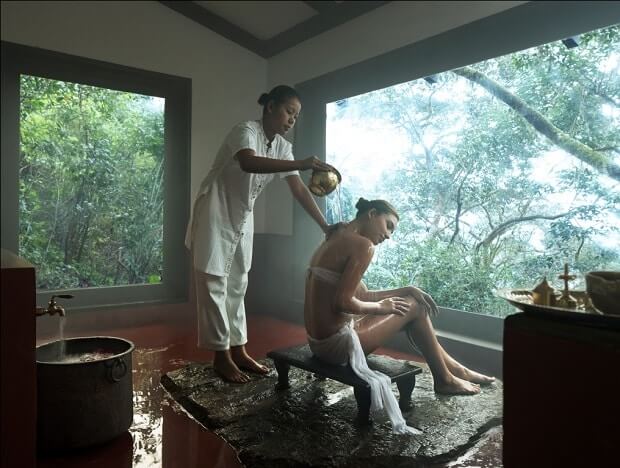
Gudda Bath at the Jiva Grande Spa

Imagine a five star luxury resort in the midst of a rainforest about 4250 sq feet above sea level, that houses over 370 species of birds. Trees and plants of all kinds surround your room, which is set in the side of the mountain. Then, add to it all the luxuries of a five star hotel, with activities for guests thrown in. And an uber luxurious spa that offers the best of massages from all over the world. That, in a nutshell, is the Vivanta by Taj Madikeri.

For those unfamiliar with India’s geography, Coorg is a part of the Karnataka state in South India, and is known for its coffee and pepper plantations. Also known as the Scotland of India, Coorg has several homestays (homes of plantation owners which double up as bed and breakfast places) and resorts set amidst shrubs of coffee and pepper vines.

As I arrived at the hotel, the wind blowing through the entrance was strong enough to blow me away. Walking into the lobby, I discovered why. After walking past the sunken seating area, open doors lead to an open space and a wooden deck that stretches towards the cliff. Only a small moat-like barrier of water full of pebbles separates me from a sheer drop down the cliff. Inspiration has been drawn from Coorg style houses with their sloping roofs, pillars and open-to-sky entrances.

Vivanta by Taj – Madikeri, is spread over 180 acres of living rainforest. The 63 rooms include cottages, suites and villas. The five villas are spread over 3,300 sq ft each, and come with a built-in indoor pool and a retractable sunroof. The Presidential Nirvana Suite is a stunning 9,000 sq ft with three bedrooms, a swimming pool, a pavilion by the pool, a jacuzzi and a central courtyard, among other features. Room rates start at approximately AUD225 and can go up to AUD1800 for the Presidential Nirvana Suite, excluding meals and taxes.

Each room is secluded from the others but since the property is so vast, one needs a golf buggy to move around. A call to reception and one arrives at my doorstep within five minutes. Muted colours, mud paints, displaced soil and recycled wood, tiles and natural river stones contribute to a seamless and undisturbed layout, and one which is built around trees. The hotel was built on the natural lay of the land, as it has existed forever.

My room is a Premium Indulgence room spread over 900 sq feet, with a sunken sitting area flanked by a fireplace. Glass windows doubling as walls offer an undisturbed view of the forest, valley and mountains in the distance.

Dining options are plenty. The Ferntree, which is the multi-cuisine all day diner; Dew, the wellness restaurant serving healthy and wholesome but tasty food at the spa; and Nellaki, the fine dining Indian restaurant serving Indian, and predominantly local Kodava cuisine.

We dined at Nellaki which is open for dinner and Pabitra, the head waiter who served us, impressed us with his knowledge of local cuisine. The name Nellaki means the place where the grains of the first harvest are stored. Pabitra made sure we sampled a range from the Neer Dosa, pancakes made with coconut water, to the Double Bean Curry and the local Chicken Pulao, and also what is perhaps the most famous Coorgi dish – Pandi Curry – or pork curry. We even sampled a purple coloured kheer (rice pudding) which gets it colour from the leaf of a plant known locally as maddu soppu. The leaf can only be plucked in August, 18 days after the plant starts flowering. It is then boiled in water and the concoction imparts its purple colour to the dish when mixed with the kheer. The food on the whole was tasty and well made, with no spice or chilli overpowering the other ingredients.

For guests, there are several activities such as hikes and nature walks which are an education on the flora and fauna of the forest. There is camping, biking, cultural performances on weekends, a conservatory documenting the history of Coorg and its people, among others.

Indoor activities include a golf coaching session, culinary and bartending sessions, and storytime for kids. I had signed up for a pottery session and my teacher was a young man named Vamshi. I was his only student that afternoon; he taught me about understanding the nature of clay and ways to mould it. Whatever misshapen creation you make, is baked, finished and returned to you.

The Jiva Grande Spa on the premises is the signature spa of the Taj Group. The 30,000 sq feet spa sports eight private treatment rooms with their own steam and showers, a relaxation deck and the signature Coorg experience – gudda bath (a wood-fired bath in an outdoor pavilion).

With so much to do and see, and so little time, my stay at the Vivanta in Madikeri was an unforgettable experience. Next time I plan to stay longer to really take in the rainforest and all that it has to offer.

Win exclusive VIP tickets!

0
Reading Time: < 1 minute

Like our Facebook page for a chance to  exclusive VIP tickets!

Chaka3_EDIT

What do you get? A double pass valued at $300 to Summer Sounds in the Domain, Sydney on Saturday January 11, 2014


You will be invited to enjoy pre-show hospitality with the menu designed by award winning chefs at The Star. Just prior to the night’s entertainment you will be escorted to the reserved area front of stage for a night which will be truly memorable.


Ten time Grammy award-winner Chaka Khan is set to light up The Domain with her powerful voice and charismatic presence.

Competition closes 2pm Wed January 8


Stay tuned to our Facebook page for the competition winner to be announced!

SummerSounds_13_Credit-Ernest Fratczak.(1)