Home Blog Page 982

Science as well as religion: Dr Pratish Chandra Bandopadhayay, OAM

0
Reading Time: 3 minutes

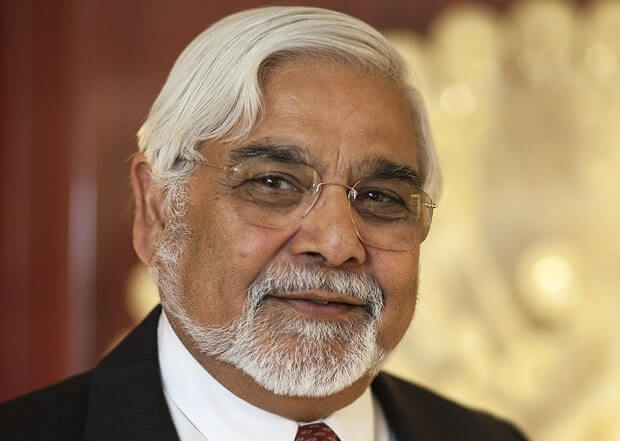
Dr Pratish Chandra Bandopadhayay, OAM

For service to the Bengali and Nepalese communities

IMG_3485a

“The hardest thing about the notification from the Governor General’s office was to keep it all a secret till the official announcement”, confessed Dr Pratish Chandra Bandopadhayay with a smile, whilst sharing his reaction to the news that he had been honoured with an Order of Australia medal (OAM) during this year’s Australia Day roll of honours.

Dr Bandopadhayay was recognised for his service to the Bengali and Nepalese community in Melbourne, and shared his journey from migrant to OAM in Australia.

Dr Bandopadhayay is a distinguished, well-published scientist who has worked for CSIRO (Commonwealth Scientific Industrial Research Organisation) for over 30 years.

“I have retired, but am still connected to CSIRO in other capacities”, said Dr. Bandopadhayay told Indian Link. “As the Senior Principal Research Scientist, my forte was mainly in Renewable Energy and Heat Transfer. My most defining moments professionally, were when I was involved in a project to run a diesel engine on brown coal oil mixtures, and also the project where CSIRO produced a cooling system for HAZMAT suits for soldiers in the Australian Army”.

According to Dr Bandopadhayay, his most successful personal achievement was raising his three children Pramita, Pratiti and Prateek, all of who are doctors. His wife Chhandashi, his children and grandchildren were delighted with the news that this inspirational man had deservedly been recognised with an Order Of Australia medal.

Dr Bandopadhayay first came to Australia from Nepal at 16, after receiving a United Nations Colombo Plan Scholarship in 1961. He went to Trinity Grammar School and then to the University of Melbourne, where he took a degree in Engineering. He continued his academic pursuits by receiving Monash Graduate scholarships that enabled him to complete first his Masters, and then a PhD.

As one of the first few Bengali migrants to Australia, Dr Bandopadhayay soon got actively involved with the local India Club and other student activities.

In 1975 Dr Bandopadhayay was awarded the Mahendra Vidya Bhusan Medal by the late King Birendra of Nepal, for being the first Nepalese citizen to achieve a PhD in Mechanical Engineering. He then went on to work for the University of Queensland in Brisbane, before joining CSIRO in 1978.

In the early sixties there were not many Bengali migrants in Melbourne, nor priests (purohits) who could conduct religious ceremonies. Under the tutelage of priest Sri Chintaman Datar Dr Bandopadhayay learnt to conduct various ceremonies and Hindu marriage ceremonies. He also gained formal training and registered as a civil marriage celebrant. Dr Bandopadhayay was appointed as the first purohit (priest) for the Durga Pooja conducted by the Bengali Association. Since then, he has conducted innumerable Hindu rituals and blessed thousands of devotees.

“As a community priest, one tends to become a counsellor cum confidante for many restless souls. A considerable chunk of my role is to offer advice to people who are desperate for solace and want answers. This can be most challenging, but also most rewarding and as a result, I continue to expand my knowledge of the human psyche”, said Dr Bandopadhayay.

What gives him enormous pleasure is to teach children and adults how to play Indian musical instruments like the flute as well as the guitar. He has taught music for nearly 15 years on a voluntary basis.

Dr Bandopadhayay also voluntarily translates literary material from Sanskrit, to English and Bengali.

“I strongly believe children should be exposed to many musical instruments as it is very beneficial to their development. The young ones should be proud of their heritage and be sensitive to other cultures”, he stated.

Amongst his many pursuits, Dr Bandopadhayay is also associated with a band called Teen Pagol where he plays the flute for Bengali folk songs along with two other artists. Any dakshina (donation) that he receives as a priest goes towards NGOs and charities that he supports in Kolkata.

“I value this honour and am humbled at being chosen for it, however it does not change anything for me. I will continue my work as long as I am able to, my reward is the pleasure I get from contributing towards my culture and towards the community”, said Dr Bandopadhayay with conviction.

“We are lucky to be living in multicultural Australia and if I was to get a second chance to settle anywhere in the world, Australia would still be my first choice”, he concluded proudly.
For more Australia Day honours

Australia Day Honours go to…

1
Reading Time: < 1 minute

 Indian-origin awardees are a not only a source of inspiration for the community, but also inform the mainstream of the wealth of talent that migrants bring in

pic1_WEB


A forest of opportunity: Dr Sadanandan E K Nambiar, AO

For service to science, particularly in the field of sustainable productivity and management of forests, as a researcher and author, and as a role model for young scientists

Read more


Green guardian: Scientia Professor Deo Karan Prasad, AO

For distinguished service to architecture, particularly in the field of sustainable urban design, as an academic and researcher, and to the solar renewable energy sector

Read more


Science as well as religion: Dr Pratish Chandra Bandopadhayay, OAM

For service to the Bengali and Nepalese communities

Read more


A lifetime in education: Kumarasamy Sivakumar, OAM

For service to education

Read more


Creating a classical culture: Radhey Shyam Gupta, OAM

Service to the arts through classical Indian music

Read more


Desi parents say the darndest things

0
Reading Time: 3 minutes

We hear and ignore words of wisdom from our elders all the time, but actually listening can help improve your life

Desi parents pic

My parents think I never listen to them and most of the time they are right, but here are a few gems from them (said in a very offhand passing manner which is probably why I remember them more than the ‘sit down and let me tell you about life’ lectures) that I have taken to heart.

I was sitting with my dad and whining about how hard my life is and how my friends could go wherever they wanted and do whatever they wanted, and how come I wasn’t allowed? He paused tapping away at the iPad, looked up at me over his glasses and said, “You are allowed. I raised you, fed you, educated you. I have done my job. You are now allowed to do whatever you like. But just remember that I have already been where you are. So if I tell you not to do something or not to mix with someone, there is usually a very good reason for it, a reason I do not always have to disclose to you. If you were strong enough in your faith to pull people into the gravity of your goodness, then you could mix with whomever you want. But you are not… neither am I. So be selective with whom you mix with!”

Ammu always tends to become very philosophical when she’s in the kitchen, as if peeling potatoes and chopping onions helps release her inner Confucius. One day as we worked together she said to me, “be ready for change. Wake up every day as if something good will happen today. It is only when you ready yourself for good things, that good things will come to you”. At the time I laughed it off, but in the coming days I would wake up and say those words to myself, “something good will happen today”. Slowly I began to dress more carefully, because something good would happen today. I began to live in the present and be more aware of my surroundings, because something good would happen today. And then I realised, something good was happening today! And every day! When I am dressed for today, when I am living in the present and thinking in the present, I am better placed to recognise the goodness in every day and be grateful for it.

At another such time in the kitchen again she said to me, “we can all pray for your future but till you pray for yourself and do something to help yourself, why should God help you?” I spend so much of my time watching TV shows or on Facebook, if only I had invested a small portion of that time on my mind, body and soul, on prayers, exercise and meditation, I would be much better placed as a human being and in my own spirituality to tackle life head-on. A small reminder to pray even for a minute each day makes a huge difference. A small step in stopping an action that causes you harm such as smoking, makes a huge difference. Only you can help your own cause.

And lastly, this one is for all you single ladies (and lads) out there. My dad has these words of wisdom to impart. “So what if you’re not married? You took a step towards God and He is testing how strong your step is. Are you faltering?” We are all amazing in our own ways, we all deserve love and happiness. When you stick to yourself, when you uphold your values, when you refrain from indulging your need for love for a greater purpose, it hurts. Sometimes a lot! But you are not alone. You are not the first to go through this, and you won’t be the last. So don’t falter. Be steadfast in your goals, pray, focus and achieve them. And go give a hug to your amazing parents who sometimes say the darndest things!


Creating a classical culture: Radhey Shyam Gupta, OAM

0
Reading Time: 3 minutes

Radhey Shyam Gupta, OAM

For service to the arts through classical Indian music

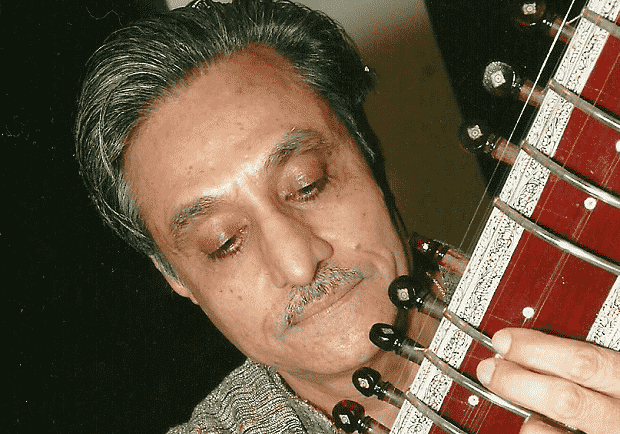
Radhey Sitar photo Updated

A lifetime’s involvement in music for Melbourne’s Radhey Shyam Gupta has been recognised with the Order of Australia medal for service to the arts through classical Indian music.

Delighted and ‘humbled’ by this honour, Radhey Shyam described his musical journey that has resulted in an immense contribution to the propagation of Hindustani classical music in Australia.

Born in Agra, India, Radhey Shyam has been involved with music from the age of 6. After winning several trophies and accolades for his musical talent during his school days, Radhey Shyam achieved the Sangeet Visharad (graduation in music) from Gandharva Mahavidyalaya in Mumbai in 1966.

In 1971, the young musician joined IIT Delhi to complete a degree in Textile Technology where he befriended many professors who supported his association with music. He went on to learn techniques and intricacies of the sitar from renowned Indian radio artist Anil Dhar, and he also did a stint at the Gandharva Mahavidyalaya in Delhi.

His career in Textile Engineering took him to various places around the country and abroad, but he continued to nurture his musical pursuits. In 1991, Radhey Shyam migrated with his young family to Australia. His work took him to Albury and Geelong, but he held musical events in his spare time, which were well received by the local communities there.

Around 1997, textile became a fading industry in Australia and jobs were hard to come by, so Radhey Shyam decided to join RMIT to do a Diploma and then Masters in IT. Along with a new career path in IT, Radhey Shyam also started teaching music to a small group of people. The same year saw the birth of the not-for-profit organisation Sharda Kala Kendra.

“During those days there were no institutions that taught Indian culture, music, arts and language in Melbourne, so with the help of like-minded music lovers and supportive friends I started classes in sitar, vocals and harmonium in a local school”, recounted Radhey Shyam, sharing his inspirational story.

According to Radhey Shyam, music can be divided into three distinct categories: “There is pop dance music that affects the body, light music (including ghazals) that pleases the heart, and classical music that is designed for the soul”, he said.

“My life is dedicated to promoting music. I believe sangeet is a way to attain spirituality and a pathway towards Nirvana”, he said with characteristic gentleness.

Radhey Shyam’s reverence towards his art is reflected in the numerous performances in which he has been involved within Australia and India. He was instrumental in starting the popular Sangeet Sandhya that has, for 17 successful years, been providing a free forum for amateurs and professionals to display their musical talent. The Sangeet Sandhya has since branched out to also offer Sahitya Sandhya (literature and poetry), Raag Rung (pure classical Hindustani music) and Swar Sandhya (karaoke-based singing).

In January 2013, Radhey Shyam was also awarded the Multicultural Award for Excellence by the Victorian Government for excellence in service delivery to the community through arts. He is currently involved in spreading musical education to the whole world at no cost, through his website www.sharda.org. Thousands of students around the world have access to printable notations and video lessons of the sitar, DVDs of vocals, sitar, bhajans and ghazals through this website. Radhey Shyam has been spending considerable time and effort in recording hundreds of videos where he teaches various musical instruments, making it easier for beginners to have a thorough understanding of Indian music and musical instruments.

Steeped in classicism and yet willing to explore the new without compromising on tradition, Radhey Shyam has illumined the local scene of music for decades. He is supported by his wife Anita and daughters Kokil and Vidushi, who are ‘absolutely thrilled’ with their dad’s achievements.

Awards in the Australian honours system represent the highest level of recognition accorded by Australia for outstanding achievement and service. These honours recognise community values and celebrate what is important and unifying in Australian life. Radhey Shyam epitomizes this sentiment towards the community as he continues his efforts to promote Indian music and culture.

For more Australia Day honours

Gandhi: Love him or hate him?

0
Reading Time: 4 minutes

Writer Thomas Keneally delivers the annual Gandhi Oration. RADHIGA DEY reports

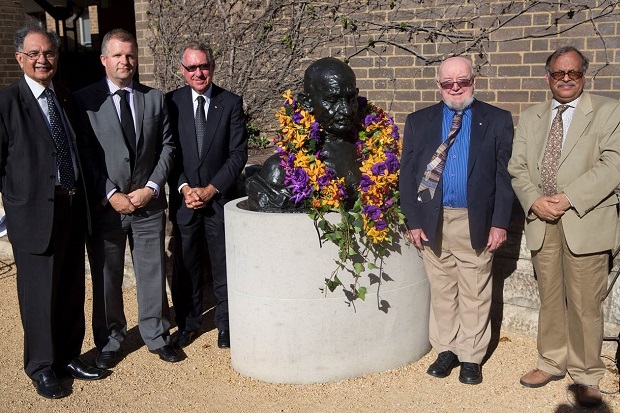
 Gandhi Remembrance Ceremony pic 10

The third annual Gandhi Oration was delivered by internationally acclaimed Australian novelist, playwright and Republican Thomas Keneally AO, to a packed auditorium at the University of New South Wales on January 30, 2014.

It is fair to say that Keneally’s life’s work exemplifies the ideals of Gandhi. Best known for writing Schindler’s Ark, the Booker Prize-winning novel of 1982 that was later adapted into the movie titled Schindler’s List, which won the Academy Award for Best Picture, Australia’s living treasure Thomas Keneally needs little introduction. One of the founding members of the Australian Republican Movement established in 1991, Keneally has also published a book titled Our Republic (1993). It was therefore fitting that Keneally was approached by the Australia India Institute (AII), to deliver the Gandhi Oration, commemorating Martyr’s Day at UNSW.

Keneally presented his speech titled ‘Gandhi-Lovers and Haters,’ skillfully transporting the audience to times gone by. A master storyteller, he enthralled his listeners, evoking a gamut of mixed emotions covering laughter, sadness and pensiveness, among others. It was definitely a challenge to portray the man, the Mahatma and our beloved Bapu, through the lens of those who were inspired by and loved him; and others who so passionately hated him, none more so than Winston Churchill.

The keynote speaker quoted Churchill’s infamous comments when Gandhi was invited by Britain for peace talks. Churchill commented, “It is alarming and also nauseating to see Mr. Gandhi, a seditious middle temple lawyer, now posing as a fakir of a type well known in the east, striding half-naked up the steps of the viceregal palace, while he is still organising and conducting a defiant campaign of civil disobedience, to parley on equal terms with the representative of the king-emperor”.

Keneally touched on the influence Gandhi had on world leaders like Martin Luther King Jr and Nelson Mandela. At the time when the world was at war, Gandhi wrote a letter to Hitler sharing insights on the plight of the afflicted men, women and children, and the peace they sought. Keneally reflected on what could have been avoided if Hitler had only chosen to heed Gandhi’s words.

Keneally also recalled his conversation about Gandhi with a young student in India. This particular student had described Gandhi as a “silly man” for pitting the simple spinning wheel as the symbol of resistance against the mighty British. But Keneally succeeded in highlighting the morality issue that Gandhi was confronted with, when locally sourced cotton was exported to Britain to be spun into fabric and the finished garments sold to Indians at exorbitant prices.

The moral responsibility of a governing authority to its people could not have been more pronounced than in the example Keneally offered of the lesser-known Bengal famine of 1943 that took the lives of 3 million starving men, women and children.

Famines were not uncommon in India because of alternating droughts and monsoons; however the man-made ‘holocaust’ as described by Gideon Polya, an Australian biochemist, shed light on the evil that man is capable of inflicting on his fellow human beings. It’s true that the damage to the rice crop was caused by a local tidal wave resulting in an epidemic fungal disease, but what followed was the British purchasing massive amounts of rice from neighboring Burma, then occupied by Japanese forces, and hoarding it for diversion to British troops overseas and for use after war.

The ineffective government controls on hoarding and profiteering led to prices that were impossible for millions to afford.  Keneally did not fail to remark on the opportunity for an interested student to delve into research related to this and the Irish famine of the 1840s.

Keneally also brought up the story of Gandhi’s relationship with Hermann Kallenbach, a German Jewish body-builder, and the controversial book that chronicles this relationship, banned in some parts of India. The case was discussed at length at last year’s Gandhi Oration delivered by Justice Michael Kirby, and while it may have been amusing to Australian members of the audience, the Indian-origin listeners were not impressed.

Gandhi’s famous Dandi March was another attempt in passive resistance to become self sufficient in the manufacture of salt. In describing the satyagrahi’s methods to raise awareness of the oppression endured by the masses and inspire them to protest peacefully by non-cooperation, Keneally raised the topic of international airports in India being named after leaders like Subash Chandra Bose (Kolkata) and Sardar Vallabhbhai Patel in Gandhi’s home state of Gujarat. What perhaps Keneally might be forgiven for, is that as an Australian, he might not be aware that almost every city and town in India would have at least one of its roads named after Gandhi, as these roads run throughout the country like nerves in a body.

During the vote of thanks, Rohit Kapoor representing Tata Consultancy Services, sponsors of the event, addressed the gathering by narrating Gandhi’s relevance in the corporate world. He reiterated Gandhi’s message that ‘one needs to be the change one wants to see in the world’. The ‘Keepers of the Flame’ as they are known in India, the Tatas, have a lengthy history of moral servitude; the book For the Love of India by Rusi Lala chronicles their role in India’s pre and post colonial development.

It wasn’t surprising that Keneally’s speech managed to split the audience into ‘Lovers and Haters,’ achieving just what the title of his presentation proclaimed – to the extent that Kapoor who had so ardently been taking notes to defend Gandhi, forgot to thank Keneally! He concluded his mini speech by thanking the audience and left the stage to Neville Roach AO, Patron of the AII, to thank Keneally for his mesmerising and thought-provoking oration.

Roach also remarked on the great responsibility Keneally has left them to find a speaker who would do justice to the oration for the following year.

The discussions that Keneally managed to spark in the audience as they left the auditorium, bears testament to the difficult task ahead for the AII.

Unfurling the tricolour

0
Reading Time: 2 minutes

Republic Day ceremonies bring Indian diaspora together

 Indian_Flag

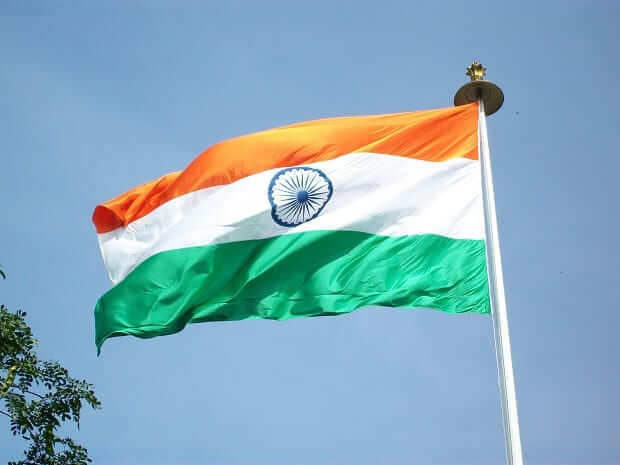
The Indian flag swayed in the wind as members of the Indian community in Australia sang the Indian national anthem.

They were gathered in different cities for the short and simple Flag Hoisting Ceremony conducted by the consulates on India’s Republic Day (26/01).

Consuls General Manika Jain (Melbourne), Arun Goel (Sydney) and Honorary Consul Archana Singh (Brisbane) conducted the flag hoist and read out the 65th 2014 Presidential address to the nation on the eve of their Republic Day.

India’s Republic Day, 26 January 1950, marks the date when the fully-fledged and permanent Constitution of India came into effect. It is the day when this special document assured its citizens justice, equality and liberty, and endeavours to promote fraternity among them. In addition, that day, sixty-four years ago, marked the end of British rule.

In his customary message to the people of India on Republic Day, the Indian President noted optimistically that 2014 will be the year of healing after fractured and contentious politics. The focus will be on the people, Mr Mukherjee noted. This is to ensure economic growth across all sectors, advancements in the education system and a continuing development of a harmonious society that is free from fear.

He concluded optimistically, “2014 will be a year of resurgence”.

And while in India’s capital New Delhi, citizens beat the cold to witness the 65th Republic Day parade at Rajpath, their expatriate cousins in far away Australia enjoyed their own national holiday to take in some Indian culture before heading off to enjoy the festivities of Australia Day. The Melbourne Consulate organised a film screening of a documentary Taana Baana: The Warp and Weft of India, which showcased the gradual revival of khadi handloom weaving. The Sydney Consulate organised a morning of cultural events. The Brisbane chapter kept the celebrations sweet and simple: both Archana Singh and Prof Sarva-Daman Singh, former Honorary Consul, addressed the gathering.

Of course the customary naashta was a welcome addition at each celebration.

And at each event, the Google doodle of the day, marking India’s Republic Day, invariably came up in the conversations!


Carl Buhariwala, Pawan Luthra, Tasneem Zavery

Multicultural March

0
Reading Time: 2 minutes

Minister Dominello launching MC March 2-web

It used to be called Harmony Day. Now the NSW state government’s annual celebration of cultural diversity extends to an entire month, and is called Multicultural March.

Perhaps it is appropriate, given that 25% of the state’s residents are born overseas, 40% have at least one parent born overseas, and some 200 languages are spoken here.

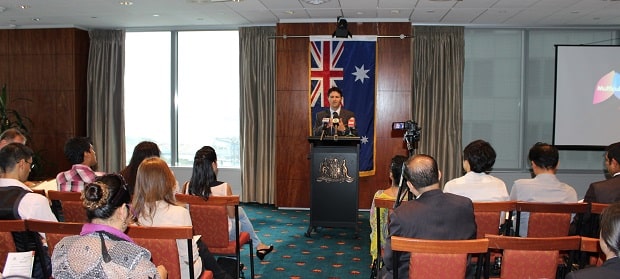
Launching the second edition of the event on 4 Feb, Minister for Citizenship and Communities Victor Dominello called upon people “to experience new cultures and celebrate our unique diversity”.

“By celebrating our differences, we grow our understanding of each other and strengthen our Australian identity,” he said.

Besides Harmony Day on March 21, local councils will hold events throughout the month such as community festivals, street markets, concerts, inter-faith forums and celebrations linked to Harmony Day. This year, the month-long program includes a Bollywood Movie Night, a Carnivale festival, a film festival, food events, Brazilian drumming, Latin American dancing, story time in languages, and a variety of other multicultural events.

The formal events include the Premier’s Multicultural Media Awards Night on 13 Feb and the Premier’s Harmony Dinner (which is a ticketed event).

Check out the website www.multiculturalnsw.com.au for details

Minister Dominello launching MC March-WEB

Blue skies with colourful kites

0
Reading Time: 2 minutes

The Indian community relives the famous kite festival of Gujarat

kite6

Gujarat in India may be miles away from Australia, but that does not deter Gujaratis living in South Australia from celebrating the popular kite festival also known as Makar Sankranti.

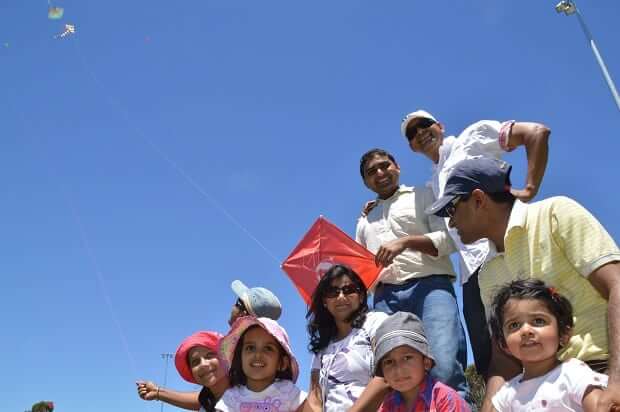
On a bright, sunny and windy day, some 200 members of the Gujarati community gathered at the Fawk Reserve, Athol Park in South Australia to decorate the blue skies with colourful kites. It was a treat to watch as other communities from India, Sri Lanka and Australia also participated in the day-long event.

Free paper kites from India, complete with Indian thread (manjo) were distributed, sponsored by Coles. Heartfelt Indian mehman nawazi was evident when all were individually invited to help themselves to the free food and drinks.

“The feeling of this festival is kept alive in our hearts here in Adelaide by the Guajarati people represented by Gurjari SA Inc,” stated a spokesperson from the organisation.

“Each year Gurjari endeavours to bring people from different communities together to celebrate the kite festival Uttarayan and participate in a healthy kite war. Kids are given kites to fly and food and drinks are provided for all at this popular free event”, added the spokesperson.

The star highlight of the afternoon was a taste of chikki (sweets made of jaggery and sesame seeds) which were reminiscent of Uttarayan in India.

According to the organisers, January is a month of changing winds and flourishing crops in India and is the precursor of festivities. Back in India, the kite festival is spent on terraces of houses with loud music, lots of snacks and full-fledged dhamal. All age groups participate in this festival and are judged by their kite flying/cutting skills (Kai po che)! Age, caste and creed are no bar at the festivities, which go on from dawn to dusk.

In Gujarat the festival of Uttarayan is one of the grandest holidays, with every family enjoying being outdoors. Crowded rooftops, fun-filled rivalry in outdoing each other in kite flying skills, and a delicious traditional Gujarati feast are the hallmarks of the day.

The fascination and the revelry associated with kite flying cuts across age groups, class and communities. Although, Uttarayan is predominantly a Hindu festival marking the awakening of the gods from their deep slumber, history has it that India developed a rich tradition of kite flying due to the patronage of the kings and nawabs who found the sport both entertaining and a way of displaying their prowess. Trained fliers were employed to fly kites for the royals. Slowly, the art started becoming popular amongst the masses.


Fond of Fraser (Island)

0
Reading Time: 5 minutes

Goanna-

Going ashore on Fraser Island, the world’s largest sand island, I found a landscape dense with rainforests, lakes and golden sandy beaches. I had arrived earlier that day on a flight from Sydney to Hervey Bay in Queensland, a pretty beachside town from where I caught the barge across for a short trip to the Kingfisher Bay Resort.

Early the next morning I joined other guests for a whale watching adventure. Before long we reached calm waters, spotting a lone humpback whale in the shallows. Further on, we saw a mother and calf, and then a pod of six. The mother brought her curious calf towards us, circling and going under, then rolling her body to reveal a white underbelly, before arching and rising gently from the water ending with a slap of the tail. But it was when several converged at the boat’s bow spraying water from their blowholes, their heads raised high for a close encounter, that I appreciated their mammoth size of up to 15 metres and weighing 40 tonnes. Each year an estimated 13,000 humpbacks migrate from Antarctica along Australia’s east coast to breed in the warm waters of the Whitsunday islands. From late July until early November they bring their young calves to Hervey Bay to rest before continuing south for 5,000 kilometres to Antarctica.

Back at the resort, high up in a tree canopy we spotted a sugar glider in motion, saw a female funnel web spider and a bandicoot foraging for food, but two boys from Switzerland were unimpressed on our night walk. Then Zoe, a Ranger from the Kingfisher Bay Resort, shone her torch downwards and the boys let out a squeal. There it was in all its ugliness, covered with dry warts, the largest Cane Toad that I’d ever seen (the largest on record weighed 1.3 kg). A species introduced to deal with the scarab beetle that were pests destroying sugarcane, the toad turned its attention to native species, wielding destruction in its path.

Walking back to the resort I saw Zoe showing the two Swiss boys how to manoeuvre a Segway or electric transporter. I joined in. With Zoe leading the way, we zipped along the shoreline while soldier crabs marched forwards as the tide receded. There were fresh dingo tracks on the sand.

It was another early start for an island tour with our driver/guide, Les. “This bit always gets them”, he laughed, pointing to the asphalt road. “People come here, see this and think too easy, paved all the way!” But the road soon turned to sand as fine as talcum powder that only the toughest tyres, an engine at full throttle, and skill could get through.

At 123km long and 30km wide, the World Heritage Listed Fraser Island lies at the southern end of the Great Barrier Reef with 100 freshwater lakes in which to swim, lush rainforests, huge sand dunes to climb, a 75mile beach that is a national highway, and over 325 bird species plus wallabies, possums, turtles, echidnas and dingoes.

After driving along the 75 mile beach we stopped at the rusting Maheno wreck stranded since 1935, when it ran aground in a cyclone. The battered hull belies its history as a luxury liner and WWI hospital ship. At the nearby Pinnacles, cliffs are coloured by sand rich in minerals. The day was heating up so we cooled down with a swim at Eli Creek before heading for Central station, once home to a small community during the 1920s when the island’s timber was logged. Walking alongside Wanggoolba Creek under a thick rainforest canopy with rare, seemingly prehistoric king ferns with the largest fronds in the world, majestic Satinay and brushbox trees, slender cabbage tree palms, hoop and kauri pines, elkhorns and orchids, we agreed that this was an enchanting place.

The highlight to end a perfect day was experienced as I floated in the clear blue freshwater of Lake McKenzie with a fine-silica white beach set against a backdrop of thick forest.

But the main reason I had come here was to explore on foot some of the 90kms of walking tracks that make up the Fraser Island great walk. Having done my research, there was much said on the dangers of the dingo, less on the walks themselves. Taking no chances, I set off with a water pistol, torch, whistle, fold out umbrella and stick as protection from attack, taking no food as even a whiff might attract them. Somewhat hesitantly I set off, despite warnings to not walk alone. I followed the beach before heading inland along a track lined with dense grasses and open woodland of scribbly gums and banksias. Then onto a road so powdery that each step made my feet disappear beyond the ankles. Wildflowers were in full bloom, boronias with waxy purple flowers and the small white flowers of the wedding bush.

A young couple drove by so slowly I could hear their conversation in German in a less than robust 4wd. Then four well-equipped 4wd vehicles with fishing gear drove by, covering me with a fine layer of dust. No one slowed to ask if I was okay, though perhaps my dingo defence gear was a deterrent. Later, a pick-up truck passed by, meaning someone was bogged in the sand. It was the German couple with the fishermen stuck behind. After five hours of walking, a large 4wd approached. It was the resident policeman. “Where is the walking track?” I asked. “Hop in, we’ll go take a look”, he responded hospitably. Up ahead was the track, but nothing indicated to where it led. So I set off using the direction of the sun, making it back to the resort just as the sun was beginning to set.

Just in time for the bush tucker demonstration, I tasted native berries and fruit locally sourced on the island, my favourites being the intensely flavoured bush lime smaller than a grape, and the sweet native rosella with a strong rhubarb flavour. The Butchulla aboriginals who inhabited Fraser Island for over 5,000 years called it ‘K’Gari’ or ‘paradise’ for its abundance of food.

Several days after my return to Sydney, I was near Kings Cross when I felt a nudge at the back of my knee and looked down. “Don’t worry”, said the Aboriginal stockman wearing large boots and an Akubra hat, “She’s a dingo, she’s harmless”.


Travel Notebook

Getting there

Fly with Qantas Link from Brisbane or Virgin Australia direct from Sydney or Melbourne, to Hervey Bay. If driving, follow the Bruce Highway 255kms north of Brisbane to Maryborough, then 34 kms to Hervey Bay.

Getting around

You can hire suitably robust 4wd vehicles from Kingfisher Bay Resort. Not for the novice since navigating the sand tracks requires considerable skill. If you are aged between 18-35, Cool Dingo offers guided 2 or 3 days tours representing great value and providing an in-depth look at the island. (www.cooldingotour.com) If you are short on time Fraser Explorer Tours provides 1 and 2 day tours (fraserexplorertours.com.au)
Where to stay
The Kingfisher Bay Resort is vast, spread out amongst wetlands and native trees on the edge of a beach. With spacious rooms the interconnecting rooms or self-contained villas will suit families.

Insider’s tip

While the Kingfisher Bay Resort has a general store, bring pharmaceuticals and provisions, including fruit and snacks along. The resort offers many activities that children will enjoy and during school holidays and weekends, a junior ranger program is organised.

The Queensland Minister for Environment and Heritage Protection advised that a new management plan for dingoes is being worked on.

Book review: Is there an alternative to democracy?

0
Reading Time: 3 minutes

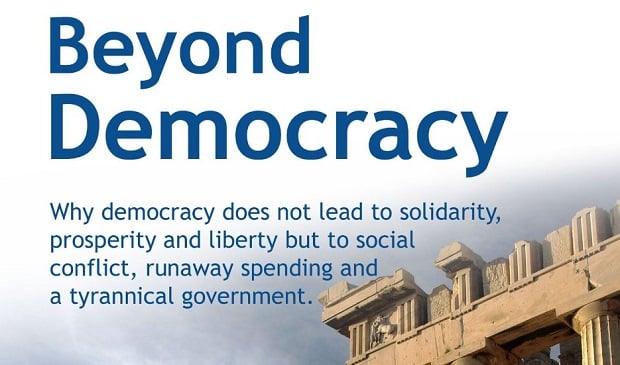
Why democracy does not always lead to solidarity, prosperity and liberty but to social conflict, runaway spending and a tyrannical government

BEYOND DEMOCRACY

Each year, the United States government releases a Human Rights Report on China. In this report it waxes eloquent about the lack of democracy in the Communist Party controlled state, as if it were beyond question that democracy is an unambiguously good thing. So confident is the US government about the moral infallibility of democracy, that in the president’s National Security Strategy document, promoting democracy abroad is stated as an explicit goal.

In Beyond Democracy by Frank Karsten and Karel Beckman, the authors dissent from the mainstream perspective on democracy and focus on its negatives. After reading this book it would be difficult to ever again view democracy in a positive light. Instead of promoting freedom, democracy takes it away.

It is an inherently collectivist system that can be likened to totalitarian ideologies such as Nazism, Fascism and Communism. “In principle, no freedom is sacred in a democracy, every aspect of the individual’s life is potentially subject to government control… At the end of the day, the minority is completely at the mercy of the whims of the majority” (page 27).

Frank Karsten and Karel Beckman point out that while democracy may work well when implemented in a small city-state, there is much less accountability when applied to large countries with millions of people of varying cultural and ethnic backgrounds. In smaller jurisdictions, politicians can be expected to be closer to the people and to be hesitant to depart from what a majority wants, due to the personal nature of their electorate (everyone knows everyone else). In larger jurisdictions however, political parties frequently do things that a majority of people do not want.

Accountability is also diminished by the indirect nature of democracy which relies on the election of representatives. Citizens have less say than in a direct system where they are allowed to vote on every legislative proposal: “Everyone knows that governments regularly take decisions that most people oppose. It is not ‘the will of the people’, but the will of politicians – prompted by groups of professional lobbyists, interest groups and activists… they all know how to work the system to their advantage” (page 18).

Votes that are cast in large countries are vague preferences by which politicians are only loosely bound, since there are no legal consequences for breaking an election promise. For this reason, the authors suggest that “(v)oting is the illusion of influence in exchange for the loss of freedom”, arguing that the probability of one vote making a difference is so small that it would undoubtedly be better to remove many decisions – over healthcare, education and so on – from the democratic arena, and instead have them made by individual citizens through the private sector.

Moving away from voting, Karsten and Beckman also argue that democracy has broader effects on society, including on crime (“The democratic welfare state encourages irresponsibility and antisocial behavior”); educational and cultural standards (“[D]emocracy may be expected to lead to a dumbing down of the population and a lowering of general cultural standards”); and poverty (“Democracy doesn’t lead to prosperity, it destroys wealth”).

My only concern is that an undecided reader would find the book’s arguments lacking in detail and sophistication. A closer inspection of contemporary democracies would have illustrated their points more convincingly. For example, with respect to democracy and crime, a comparison of cases such as Australia – where crime is comparatively lower than in other democracies such as South Africa and America – would have made the arguments stronger.

Karsten and Beckman do a superb job however, when discussing alternatives to democracy. In response to the question ‘What would we replace democracy with?’, Beyond Democracy provides a nice answer: secession should be allowed, and a contractual society should be encouraged. “Diversity in governance implies that people can decide more easily under what system they wish to live”, the authors write.

“They can go to another municipality or county if they desire different governance. Such competition ensures that rulers are held accountable, which is hardly the case when a citizen’s influence is restricted to elections once every four years”.

The authors see a positive future for realising freedom. Human beings are not opposed to decentralisation per se: it is just that they demand a high threshold before seeking to break away. Unless there is some urgent pressing reason, people prefer to tolerate their differences.

Thus when Pakistan seceded from India in 1947 and the Indian government decided to accept Pakistan’s departure, it was probably due to an acknowledgement of irreconcilable cultural differences (in this case the clear division between Hindu Indians and Muslim Pakistanis).

All in all, Beyond Democracy is a refreshing breath of fresh air. The authors have done a great service in compiling the main arguments against democracy in an accessible manner.