
Home Blog Page 927

Love your lips!

0
Reading Time: 3 minutes

Fresh habits to include in your beauty regime to ensure petal soft lips

When you see advertisements for those luscious you lip glosses, don’t you wonder how those models have such perfect lips? Surely it can’t all be Photoshop? No pigmentation, no peeling skin, and they look like they are baby soft. Well, like with most skincare routines, there are tips and tricks to maintain your lips without using botox or fillers.


Whether it is discolouration, peeling skin due to dry weather, or fine lines due to smoking or ageing, it’s easy to take care of your lips just by trying a few home remedies. So you can have dewy fresh lips just like those models, here are some beauty tips to add to your routine.


Moisturise
We all use lip balms and chapsticks most of the year, especially in winter, but it is important to keep in mind that the lips can tan just like other parts of the skin. For the day time, get a lip balm which has a sunscreen, and at night, after you have applied your night cream, use some regular chapstick on your lips. This will help your lips stay moist for longer.


During the day you can use a lip balm with a pink tint to give your lips a natural colour, but try to use lip balms which have some essential oil or natural emollients, as those with chemicals will only dry your lips further.


Interestingly, when we lick our lips, our saliva, instead of moistening them, actually does the opposite and dries them further. So make your lip balm your best friend if you want soft lips at all times.


Natural moisturisers like aloe vera or coconut oil, help you to have soft lips without burning a hole in your pocket.


Exfoliate
When we exfoliate, we usually purse our lips and scrub the rest of our face and neck. Next time, apply some exfoliant to your lips as well to scrape off the dead skin cells. A simple home remedy is to apply a bit of oil to your lips then rub a mixture of sugar and lemon juice on them. The lemon will rid you of any tan and the sugar will remove dead skin.


You can use a soft toothbrush on your lips in gentle, circular movements to clear the lips of dead skin. Apply a bit of coconut or olive oil after you do this to soften your lips further and have the skin absorb the oil.

When you use a face mask, you can make a mixture of honey and olive oil to nourish the skin of your lips. You can even use Vitamin E which is available in the form of oil or capsules. Break one open, apply to your lips, and all around them, for best results.


Be healthy

Drinking lots of water, coconut water and citrus juices can help replenish your body’s moisture requirements.


Increase your intake of fruits and vegetables rich in Vitamin A and beta-carotene, as this will help your lips look pink at all times.


Most of us tend to bite our lips when we are stressed. Try and break out of this habit as biting lips is a surefire way to make them dry and have the skin peel off.


Avoid smoking. Nothing darkens the lips like the butt of a cigarette. What’s worse, the constant pursing of the lips as you inhale the nicotine creates small vertical lines above the upper lip, and below the lower lip, which make you look older.


If you must smoke, then, every time you break an egg, run your finger along the inside of the shell and apply the egg white around your lips. It is a great source of collagen and as it dries on your skin, it tightens and works as an anti-ageing aid.


And if you are strong enough to quit smoking, you can use the money you save on cigarettes to buy yourself that lovely red lipstick and gloss you have been eyeing for a while…




“Fanny” found not guilty

0
Reading Time: < 1 minute

The Delhi High Court has dismissed a Public Interest Litigation (PIL) case seeking a ban on the release of Homi Adajania’s new movie Finding Fanny due to the use of the word “fanny”.

A division bench of Chief Justice E.G. Rohini and Justice R.S. Endlaw found nothing wrong with the title and refused to halt the film’s release.

Additional Solicitor General Sanjay Jain opposed the plea, saying the censor board had passed the film after due consideration and no obscenity was found in it.

Starring in the film are Deepika Padukone and Arjun Kapoor.

The PIL also challenged the UA certificate given to the movie, which also features Naseeruddin Shah, Dimple Kapadia and Pankaj Kapoor.

Nandini Tiwari and NGO Jai Jagriti Foundation filed the PIL through lawyer Abhishek Krishna. It stated that the word “fanny” was a slang term and should be removed from the movie as well as songs, posters and banners.

It also said the dictionary meaning of the word “fanny” was sexually explicit, and using the word in the movie would offend people.

Ms Tiwari, a mother of a four-year-old, said allowing such words in films and television would pollute children’s minds.

The PIL was filed against the information and broadcasting ministry (IBM), and the film’s producer, director and actors.

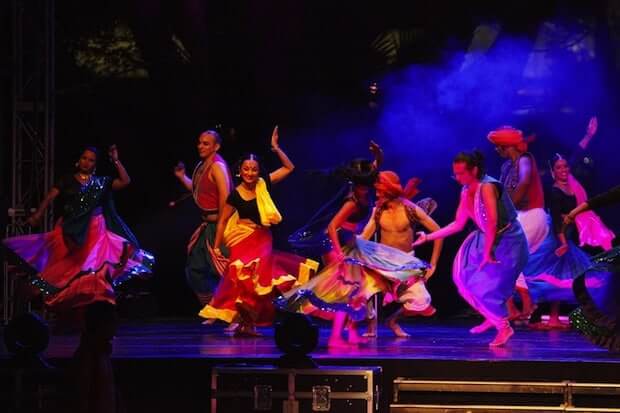
Let Parramasala be about the arts, not community politics

0
Reading Time: 4 minutes

The point of Parramasala is to promote the arts, not local businesses and leaders

There has been some comment in recent weeks about the community’s “dissatisfaction” with this year’s Parramasala, the South Asian performing arts festival, which is to be held from 17-19 October.

This was sparked by the launch of the festival at the end of August. The displeasure seems to stem largely from who was invited, and who wasn’t.

The note of discontent started off as a Facebook rant that got shared around (not even a media release), and was picked up by a community newspaper and turned into a poorly-edited story with not even a spell-check run through.

Apparently, “big promoters in Sydney who do shows all year around”, were not invited to the launch, or even consulted on the organisation of the festival.

Parramasala, it was pointed out, is going to be run by a “select coterie with, disappointingly, the blessings of the local government”. It has been claimed there are no “mechanisms in place to have more broad-based consultations with several sections of the subcontinental communities”.

Parramasala has lost touch with the communities of the western suburbs, it was claimed, with neither South Asian businesses nor community media groups involved in the event with a view to spreading the word and getting more involvement from them, as well as other sections of the community.
It was concluded that “some sections of the subcontinental communities of the western suburbs of Sydney feel excluded and disappointed with the way the festival is being organised”.

As the article proclaimed: “If big festivals do not involve the local community groups, businesses and leaders, what is the point”.

Surely the point of the festival is to promote the arts, and not local businesses and leaders?

At Indian Link we’ve pointed out before that Parramasala provides an opportunity for community artists to showcase their stuff. It is hard enough as it is for the arts in this country, and even more so for migrant artists. Now, here’s a chance to see community-based theatre groups, local poets, and home-grown film-makers get on that stage and strut their stuff. Why are the detractors taking the glory away for the artists?

Let Parramasala be about the arts.

Parramasala is a platform for our artists, not for organising committees.

Or for community bigwigs to get their photo ops and media mentions.

It’s time to back our artists instead. Let them show us what they are made of.

Some unique acts have been picked this year and, from our research, seemingly through proper procedure, where interested parties put in for their work to be recognised.

If Parramasala can give rise to a few more Anh Dos, Nazeem Hussains, or Akhmal Salehs – all new Australians who have made it big in an arena where brown faces are hard to come by – then it will have done its job.

Members of the Indian community in Australia have already made their mark as doctors, academics, IT experts, even service providers like taxi-drivers, security personnel and retail staff.

It’s time we did our bit to help those who have a talent in the performing arts, so let’s not diss Parramasala: it is providing artists a valuable platform to get a foothold into the mainstream entertainment industry.

As for the detractors, the “big promoters” no doubt do a good job and meet the entertainment needs of the community, but Parramasala is a different kettle of fish that showcases South Asian arts to the mainstream. What is suitable for the community (a vernacular or regional entertainer perhaps), might not be suitable in the mainstream. The “big promoters” must indeed continue to do what they are doing, but let Parramasala be a different affair.

By “a select coterie”, the detractors are no doubt referring to the organising committee? Surely as a government-funded large-scale event, there will be a government-appointed organising committee that will oversee the affair. Perhaps we should wait for the event itself, to see whether the organisers have done a suitable, credible job. If they haven’t, then of course you can make your displeasure known to all concerned authorities (hopefully not via Facebook but through a more credible forum), and indeed the public too.

You might not have confidence in the current organising committee, but at least wait to see what they put up on offer and how they conduct the festival.

Regarding losing touch with the community, attempts have actually been made to include the community in the neighbouring suburb of Harris Park. South Asian businesses and community media groups were both involved in the launch. (Were not a local restaurant and a spice shop part of it? Or is that your problem, that your businesses were not picked?) Formal letters of invite did go out to all major media outlets. Indeed, at the launch itself, speakers directly addressed the media about spreading the word.

Yes there’s more than a few things wrong with Parramasala –poorly picked acts in previous years, latching on to other events around at the time to increase the profile (for example the Shah Rukh Khan show), the lack of A-list acts this year, an over-reliance on Indian as compared to other South Asian features, and a rather subdued program thanks to depleting funds.

But at least it continues to be about the arts.

And we continue to have a South Asian arts festival!

Kenny and the Chromosomes

0
Reading Time: 2 minutes

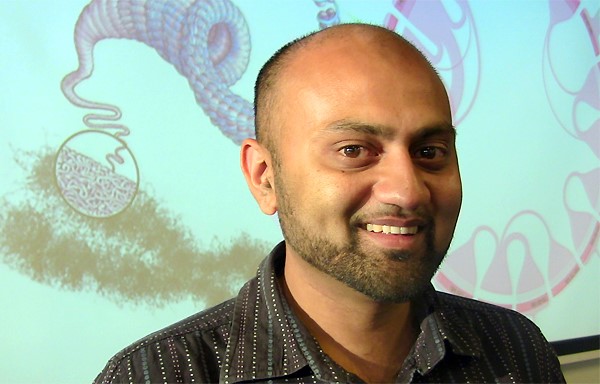
When University of Sydney PhD candidate KENNY SABIR isn’t composing music he is deconstructing chromosomes

The musician and information technologies student won the University’s Three Minute Thesis finals held on the weekend with his presentation on understanding chromosomes’ structures.

A simple explanation of his thesis project ‘Visual analytics of the chromosome structure’ won Kenny the challenge. As part of his PhD research Kenny is studying the complex structure of chromosomes using the best computer in the world, our brains, he explained.

He believes the human brain has the ability to recognise complex patterns quickly and, by visualising the structure of the chromosomes, biologists will be able to see patterns on how the genome operates.
“Biologists could also see differences between a cancer and normal cells, helping them to understand how cancer works, ” states Kenny.

An overpowering fascination with biology, bioinformatics and next-generation genome sequencing lead Kenny back to tertiary studies. He left a successful career in IT research and development to join the Garvan Institute for Medical Research where he is working with the Sean O’Donoghue’s Biodata Visualisation group.

“It became clear to me that complex problems in biology required computer science expertise to deal with the massive amounts of data being generated. Bioinformatics is where the exciting problems in computing lie, ” he says.

“The study of the chromosome structure is a relatively new field and scientists are still working out the best ways to gather the data, let alone how to comprehend it.”

“We are looking at a new way to combat cancer. All of us are complex machines that operate on a set of instructions written on two metres of DNA. Over the past five decades scientists have been analysing DNA as a long string of information. A DNA string is so thin that it can be squished into every cell nucleus of your body.

“Recently scientists have realised that the structure of how this string is folded matters because, while two genes look far apart on the string, they may be right next to each other when squashed together.” explains Kenny

Kenny says his experience of live performances with his band ‘The Herd’ helped with his confidence in public speaking. He also says understanding music composition helps explain the problem.

“We can understand form and structure in popular music, as verse, chorus and bridge. When looking at the genome it is like all we are seeing is unstructured random notes, and my work is to try and figure out an overarching form to how the chromosomes work.

“Just like a chorus has a purpose, I want to find the purpose of the different sections of the genome.”

Reproduced with permission from The University of Sydney

Social media connects India with flood victims

0
Reading Time: 3 minutes

Social media connects India with flood victims

As the worst floods in 60 years continue to ravage Jammu and Kashmir, social media is abuzz with heart-touching messages highlighting the immediate needs of those affected.

Lists of basic needs like cough syrup, sanitary napkins, milk powder, mosquito repellents and first-aid boxes are being re-tweeted on micro-blogging site Twitter, along with pictures of flood-ravaged Jammu and Kashmir, and pleas of people whose families are trapped in the floods.

A group of organisations have also come together to accelerate the process of reaching out to the flood victims and donors through a website www.jkfloodrelief.org.

They have made a list of items, compiled by volunteers and reliable on-ground connections, to create a consolidated platform to take small steps in the relief operation.

The hashtag #Kashmirfloods is connecting those who are looking for various avenues to donate, to share, to find their loved ones or to applaud rescue operations.

“Sending clothes is a nuisance at this point,” Anshu Gupta, founder and director of Goonj, an NGO whose expertise lies in flood-rescue operations, stated.

“What is needed right now are medicines that can fight water-borne diseases, utensils to eat, torches, good-quality solar lanterns, blankets and woollens,” he added.

Along with Goonj, Twitter India, pharmaceutical firm Cipla, Said Iqbal Memorial Trust, Uday Foundation and IndiGo Airlines have collaborated to run the website and reach out to millions who want to donate but are not sure “what and how”.

“This is a systematic way of reaching people. At times, people give food items like aloo puri. But at this stage, this is not required. What people can donate is dry fruits,” said Gupta, whose organisation did a remarkable job following the Uttarakhand disaster.

Apart from basic items like medicines and torches, people are asking for sanitary napkins that are much needed during this calamity.

“So I wrote to P&G for sanitary napkins for #kashmirfloods, they informed me they are already on it and are working to save the children. Awesome,” posted Twitted user Surekha Pillai.

Similarly, another user Hemant Purohit posted: “Donate for #jkfloodrelief here’s list of essential needs via on-ground sources – sanitary napkins, medicines”.

As the floodwaters have inundated most of Srinagar’s residential and commercial areas, mobile coverage has become patchy across the city and there is no computer access. Relatives and friends have taken to Twitter to share information about families feared to be trapped.

Haris Zargar said: “SOS: A family is stuck in Basant Bagh. There are 12 people trapped. The phone may/may not be working: 7298871569 #KashmirFloods”.

People have also been frequently re-tweeting information about various helplines.

Arif Maghribi wrote: “Kashmir helpline: Srinagar: 0194-2474040, 2452138, 2455883, Shopian: 01933-261312, 9596028060, Budgam: 9906960666, 9419034370”.

The death toll is said to have crossed 150, in the worst floods in Jammu and Kashmir in over 60 years.

Heart-touching pictures of people wading through floodwater, broken bridges and images of boats being used to rescue people, are also being shared on social media.

Sooner rather than later

0
Reading Time: < 1 minute

Encouraging Indian and Sri Lankan women to attend breast cancer screenings


This year the Cancer Institute of NSW and the NSW Multicultural Health Communication Service are aiming to improve breast-screening rates among women in the Indian and Sri Lankan communities of NSW.


According to the latest ABS census, Indian and Sri Lankan communities are one of the fastest growing populations in the State. This means there will be a significant increase in women aged 50-74 from these groups in the upcoming years.


Therefore, Indian and Sri Lankan communities and groups, along with welfare organisations and BreastScreen NSW services, are encouraged to promote breast cancer awareness and help increase breast screening for women in these communities.


A Community Leaders Forum is being held to provide an update on the latest breast screening information, and to identify potential areas of collaboration between organisations.


Saturday 13 September 2014

10:30am (for 11:00am start) – 1:00pm

Thornleigh Community Centre,

Cnr Phyllis and Central Avenues, Thornleigh


For more information contact Caroline Chen, NSW Multicultural Health Communication Service on caroline.chen@sesiahs.health.nsw.gov.au or phone 9816 0303.


Indian links at Sydney’s Anzac Day parade

0
Reading Time: 4 minutes


2007: The Sikhs make a debut

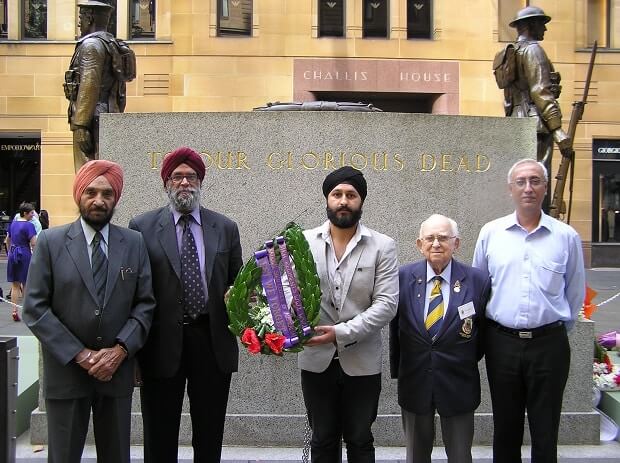
The Sydney Anzac Day parade had its first Indian participation in 2007, when a small Sikh group marched as part of the contingent called British Commonwealth Forces, made up of a number of other nationalities. The Sikh Council of Australia and the Sikh Scout Group got in touch with Anzac House and RSL Headquarters with a request to be allowed to march. They established a case by putting forward accounts from history of the Sikh participation in Gallipoli gathered from various sources.

The evidence was compelling, and the authorities were convinced.

It was an emotional experience for all involved. Vickram Garewal, executive member of the Sikh Council revealed, “One of our senior members ended up rather teary – he said he had never imagined that he would wear his medals with pride ever again, let alone march in the city streets to the adulation of the crowds”.

Since then the Anzac Sikhs have only gone from strength to strength, prompting the Nepali and Indian contingents to also follow suit.


2008: Marching to their own tune

The next year in 2008, their numbers had increased to 36 and they marched as a separate contingent all on their own, under a Sikh Regiments banner.

The turbans made them look different from others, and they received encouraging remarks, overwhelming applause and were very well received by the onlookers, who cheered and waved flags at them.

Chris Perrin, then the secretary of the New South Wales RSL specially congratulated the Sikh float.

“I am glad that you were able to march on Anzac Day and that Sikhs were received so well by the crowd of onlookers, despite inclement weather. From my part, I thought the Sikhs were one of the better “turned out” units/associations marching in that part of the parade. I look forward to assisting you once again in arranging your participation in the 2009 Anzac Day march, and the conduct of a Wreath Laying Ceremony,” he said.


2009: The young ones join in, and bring the music

In 2009, eighteen-year-old Shubhdeep Singh Bhangu was part of the 30-strong Sikh contingent. He proudly carried the Australian flag, resplendent in his RAAF uniform. A first-year cadet training to become an armaments engineer, Shubhdeep told Indian Link then, “I’ve been wanting to march in the parade ever since I heard there would be a Sikh presence”.

An added attraction was the professional bagpipe band that accompanied the Indian contingent. Dasmesh Band, the largest private Indian band, second only to those of the Indian Army, were specially flown out for the event. With their turbaned get-up, their “Sikh take on the Scottish tradition” won hearts wherever they went. At the end of the parade, they got into an impromptu jugalbandi (jam session) with a Scottish band, as people stopped on the streets to watch. At the end, as Dasmesh played Happy Birthday for an elderly wheelchair bound passer-by, she openly cried tears of joy.


2010: A symbol of goodwill and kinship

A critical time or the Indian community as the students’ crisis was playing out, the Indian contingent at the Anzac Day parade, resplendent in dark blue turbans and suits, with medals shining on their chests, was cheered on enthusiastically by onlookers. It generated much goodwill and brought in a sense of unity and kinship.


2011: Community highlight

By 2011, word had spread within the community. The Sikh Regiments contingent now boasted more serving members of the Australian Armed Forces, and even more ex-servicemen, many of who were less mobile and had to have transport organised for them. The Indian community came out to support.


2012: Wider acceptance

In 2012, the Anzac Day parade’s Indian contingent was covered gushingly on TV, bringing the Regiments’ participation to a larger mainstream audience.


2013: One more

In 2013, a second Indian contingent won approval to participate in the parade. Ten veterans from the Indian Navy and Army marched under the ‘Indian Defence Forces’ banner.


2014: Hundred years

This year, in a special Anzac Day parade to make the start of the 100-year celebrations, the Indian contingents were rubbing shoulders yet again with mainstream veterans.

“Anzac Day is a reminder of the debt of gratitude that we owe as a nation, to those who are currently serving and to those who have served in the past,” Ajmer Singh Gill, President of the Sikh Council of Australia, told Indian Link.

“As we marched past the Cenotaph with our heads down in reverence, we could imagine, the pain and suffering of those who laid their lives so that we could live free, and the sounds of the bullets from the guns in their hands and the noise of the battle in the distance”.


Usha Arvind, Rajni Anand Luthra and Sheryl Dixit


Swan Festival of Lights

0
Reading Time: 3 minutes

Once again Perth will go on a multicultural journey of the senses

The Swan Festival of Lights is set to take Perth once again on a multicultural journey of the senses, adorning the foreshore with a vivid experience of colours, rhythms and flavours.

Since its inception in 2008, the Swan Festival of Lights has flourished each year, attracting great crowds in union to celebrate the vivacious and enriching Indian festival of Deepavali (Diwali).

Presented by Annalakshmi Cultural Centre of WA and Temple of Fine Arts, this year’s event will be held at Langley Park, commencing on the auspicious Deepavali day, 22 October and concluding on 26 October.

Swan Festival of Lights 2014 showcases not only the diversity and vibrancy of traditions across various cultures but the celebration of a union and harmony of our rich origins. In keeping with our tagline “Celebrating Deepavali Together”, the Festival explores these traditional roots of cultures as unifying links through the multicultural merging of heritage, identity and philosophy.

This year’s Festival features an exquisite line-up of local and international multicultural talent, including internationally acclaimed composer and violin maestro Dr L. Subramaniam, who is equally adept at Indian classical and Western classical music.

Globally renowned Sitar maestro Ustad Usman Khan will also be performing, alongside vibrant dance and music performances from Temple of Fine Arts International and collaborative works with other cultures.

With delectable vegetarian delights prepared by Annalakshmi satisfying appetites throughout our Festival, and exclusive handicrafts by Lavanya Arts as well as a range of cooking, art, music and dance workshops, demonstrations and family friendly activities, the Festival provides an atmosphere sure to enrich Perth with an extraordinary experience of sights, sounds and smells.

Paying homage to the Inner Light residing in all of us, Deepavali revels in the essence of ‘Light’ as a symbol of hope, peace, harmony, knowledge and truth. Although vastly celebrated throughout India, Deepavali’s heart lies in the journey of every being and the universal theme of light triumphing darkness. This cultural ‘festival of lights’ serves as the foundation of the Festival and it is this illuminating element of Light that inspires a unifying experience throughout the Festival.

Through our offerings of art, music, dance and food, the Festival honours the vivacious and dynamic Indian culture along with a myriad of other ethnic groups that constitute Western Australia’s eclectic society.

For more details on the 2014 Swan Festival of Lights, please visit www.sfol.com.au.


Deepali’s Delights

0
Reading Time: 3 minutes

Flavours of India, bottled in Australia

Win or lose, MasterChef Australia is all about re-discovering your inner strengths and making your culinary dreams come true. And it was no different for Dr Deepali Behar, the only Indian contestant to make it to the top 24 of MasterChef Australia, 2014.

Post MasterChef, Deepali is busy bottling her food dreams. She has always wanted to share her food with the world as she believes that Indian cuisine still remains a largely unexplored territory. MasterChef re-ignited this passion and today, Deepali’s Delights is a reality.

Featuring a wide range of pickles, spice blends, jams, preserves and chutneys, Deepali’s Delights will not just tickle your taste buds but transport you back to your mom’s kitchen. Deepali says that every single product has been prepared and packaged with love and care, but it is the Marcha athanu (green chilli pickle) that remains close to her heart. “It packs a punch and only gets better with time,” says Deepali, with a twinkle in her eye.

With Gujarati heritage, born and bred in Wigan, UK, Deepali graduated from the prestigious University of Leeds as a dentist. She migrated to Western Australia in 2009 with her husband, Jordan and set up home in Secret Harbour. “We fell in love with the lifestyle and have bought a house, two dogs and a dental practice, Golden Bay Dental Clinic,” Deepali says.

In spite of having spent her entire life on foreign soil, Deepali is the quintessential Indian when it comes to food. While talking to Indian Link, she takes a minute to reminiscence fondly about her mum’s curries, the flavours and textures still lingering on her taste buds. And it is her mum’s batatu nu saak (dry potato curry) and spicy puri which eventually won her a spot in the competition.

Deepali’s food philosophy is simple yet powerful, ‘Cook with your heart, be generous and respectful to the food and enjoy the whole process’. It is this philosophy and encouragement from family and friends, that inspired her to take part in MasterChef and, after an arduous audition, reach the top 24. But self-doubt plagued her, especially when it came to international cuisines, resulting in her elimination.

“Believe in yourself and in your strengths,” is the biggest advice Deepali gives to future MasterChef aspirants. She says, “It is a once in a lifetime experience, so embrace it with the right spirit, don’t shy away from hard work and it can change your life forever”.

Deepali mentions that the idea to start her own food products range has always been lurking in the back of her mind, but it is MasterChef Australia that gave her the much needed boost and confidence to bring her dreams to fruition.

So what does the future hold? Deepali’s Delights range of products are currently available at all local markets in WA and will soon be selling at many specialty stores too. She is also planning to start a blog where readers can find her favourite recipes, an online store to sell her products, cooking classes and maybe even an Indian sweet store in WA!

Keep an eye out at www.deepalisdelights.com. You can also follow her on Facebook at Deepali’s Delights and on Instagram @deepalisdelights

108 salutes

0
Reading Time: 3 minutes

YOGACHARINI KOMAL leads this year’s Adelaide Yogathon

At the end of the yoga session, I felt as though I had had a whole body massage!

I had just finished 90 minutes of 108 Sun Salutations (or ‘Surya Namaskars’, as they are called), and my body felt heated up as if each cell was vibrating with life force (‘Prana’).

The most beautiful part was the cool down at the end, Savasana with Yoga Nidra relaxation for 20 minutes. The guiding voice of Sri Sri Ravi Shankar took me into a deep state of peace.

Completing 108 Sun Salutations boosted my confidence in myself as a yoga practitioner. I felt truly blessed!

The marathon yoga session was part of this year’s Yogathon, an Art of Living event that brings thousands of people together on the mat for a cause.

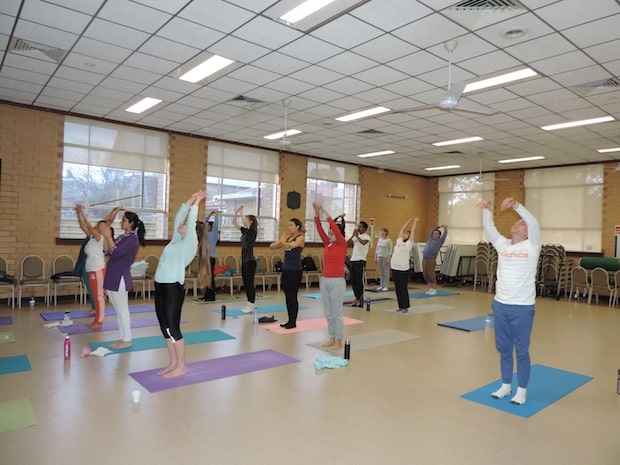
In Adelaide, a small group of nearly 25 enthusiastic yogis took the challenge of 108 Sun Salutations Marathon at the Plympton Community Centre. Putting up with the early morning chill, male and female participants of all ages came out in their white Yogathon t-shirts along with their colourful yoga mats.

The session started with a quick informative presentation on the benefits of Sun Salutations, followed by a demonstration of the actual sequence. Teams of four were made and names were chosen to bring about greater team spirit. A voice recording of the counts, with light music, was used as instructions to maintain a regular pace.

Light refreshments and photographs finished off the morning beautifully. Three participants took home lucky-draw Yogathon t-shirts.

The event marked a new beginning for me personally too, as this was my first ever attempt at the 108 salutations – even though I’ve been an instructor for two years. I was not sure whether I would be able to complete the full 108 Sun Salutations (that is, 54 rounds of the ‘Surya Namaskar’ routine), but at the end I felt I could go on! To my surprise, almost everyone completed the full event, with only a few participants taking a break in the middle. The key to completing the 108 rounds is awareness of breath and mindfulness. I realise now that it is not the body which holds us back, it is our mind!

The whole session seemed like ‘meditation in motion’.

The Sun Salutation is a powerful sequence of 10-12 poses specifically designed to work out all parts of the body and stretch the spine. It involves a wide range of movements: forward bend, back bend, being still, lengthening the spine, grounding the feet, strengthening the upper body, stretching the hamstrings, expanding the lungs and more. It is the ideal way to warm up at the beginning of a yoga practice.

It is also a great way to start the day as it also works on the mind. Concentrating on the breath and holding the gaze (drishti), allows us to centre ourselves and to quiet our wandering mind.

Like many rituals in yoga and in Hinduism, the Sun Salutation is repeated 108 times (the number is sacred and refers to the wholeness of existence).

Yoga is the first step towards physical, psychological and spiritual wellbeing. According to Swatmarama the author of Hatha Yoga Pradipika, ‘By regular asana (yoga) practice one attains steadiness of body, diseaselessness and lightness (flexibility) of the limbs’.

Nearly 40 cities around the world participated in the 3rd annual Yogathon this year, with approximately 2500 participants raising nearly $100,000 for ‘Care of Children’, a program that provides education and educational infrastructure for thousands of children in rural India. All proceeds go to Care for Children schools – a program of the Art of Living Foundation, a registered non-profit.

The world-wide yoga event was first held in 2012 in Canada.

According to Amit Taneja, the organiser of the Art of Living volunteers, “Yogathon is a way to spread the awareness of Yoga, even though people are getting involved more for a cause than just for Yoga”. The volunteers themselves benefit under the Art of Living Foundation’s Happiness Programme, as they help to “spread the cause of yoga and yoga for a cause”.