Home Blog Page 914

Modis Operandi

0
Reading Time: 3 minutes

Indian Prime Minister Narendra Modi’s highly anticipated visit to Melbourne was a grand success for the business community

Drawing attention to his economic agenda, Prime Minister Modi’s one-day trip to Melbourne was set to cast a positive influence on the advancement of bilateral ties and promotion of mutual trust between Australian and Indian businesses.

During his visit the Indian Prime Minster met CEOs of Australia’s top industry companies including BHP Billiton Linfox, Hancock Prospecting Group and Visy Industries.

Accompanying PM Modi were CEOs from leading Indian industry organisations including Gautam Adani of the Adani Group, Anand Mahindra of multinational automobile manufacturers Mahindra & Mahindra, Vishal Sikka of Infosys Ltd and Shashi Ruia chairman of Essar Group.

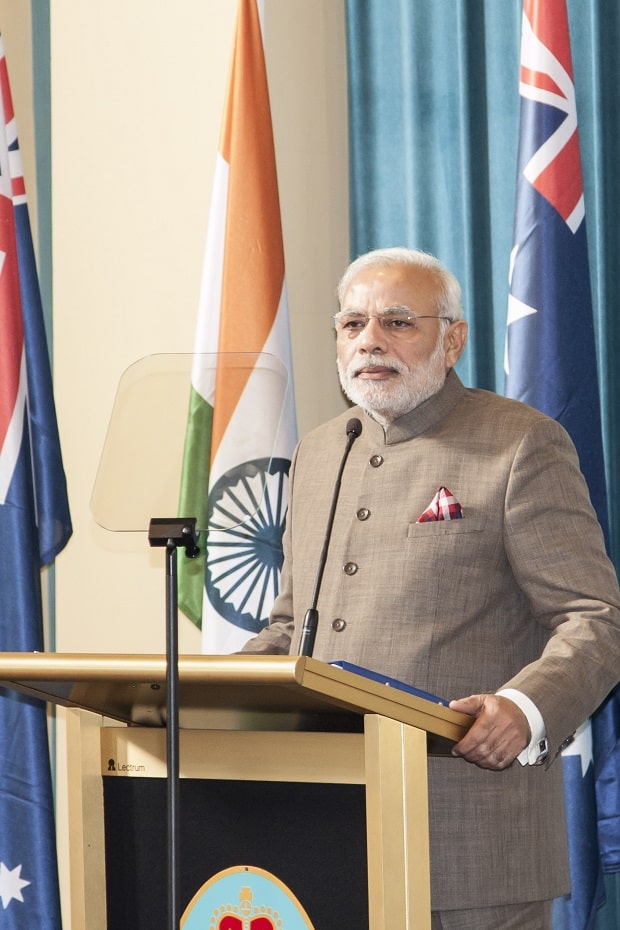
Victorian Governor Alex Chernov hosted the round table conference at his residence where the Indian PM chose to address the leaders in Hindi which was translated into English for everyone’s benefit.

The forum comprised of business leaders, delegates from India, journalists and members of the Australia India Business Council (AIBC).

Amitabh Mattoo, Director of the Australia India Institute, was the moderator of the round table event. The Victorian Governor later described Australia India Institute as the primary credible think-tank in this country on Australia India relationships.

During the private event, Treasurer Joe Hockey commented briefly on how, along with mining, education and the financial sector, it is paramount to focus on small and medium size enterprise.

According to Mr Hockey the business-to-business opportunities will play a key role in helping to further the trade relationship between India and Australia.

The business leaders unanimously acknowledged the extraordinary growth that India is poised to experience. This will create several opportunities for Australians to engage with India whilst forging a bond based on common strategic interests, trade and economic outlook.

Responding to the suggestions put forward to him, the Indian Prime Minister said he was personally committed to looking at environmentally-friendly ways of furthering development. According to Modi, India requires a substantial amount of energy to continue its growth. With the push to make India a gas-based economy, any package that combined these two sectors would be of interest to India.

Praising the Victorian Government for its initiatives in promoting education, the Indian Prime Minister shared his two main areas of focus in the education sector. One was to encourage young people from India and Australia to collaborate and conduct better quality research, and the other was for selected schools from both countries to coordinate with each other, through student exchanges, to create quality education opportunities.

The PM also drew attention to the tourism sector and its tremendous possibilities. According to Modi, India has a long coastline and the required clientele to set up a successful business in cruises. He invited people to invest in developing tourism infrastructure in India and in finding new avenues to develop relationships through tourism.

According to the PM a large number of Indian students have come to study in Australia and have helped to create a better understanding of India amongst the common man in Australia. This people-to-people contact has generated confidence and as a result Australians are more willing to take risks by investing in and trading with India.

Prime Minister Modi concluded his address by inviting Australians to explore the many possibilities in India and reminded them of his promise to implement, very soon, a visa on arrival service for all Australians – including people making business trips to India.

Dispensing compassion

0
Reading Time: 4 minutes

The 2014 Young Pharmacist of the Year, Taren Kaur Gill is determined to provide health solutions for all communities in Australia, writes USHA R ARVIND

The title of Young Pharmacist of the Year, awarded by the Pharmaceutical Society of Australia to skilled pharmacists under the age of 35, has been presented to Taren Kaur Gill. This accomplished young woman has been recognised for her outstanding contribution to the community through meticulous and innovative dispensing practices and proven leadership traits, as well as her sociable personality.

Besides her extensive work in aged care and university mentoring, Taren is well regarded for her commitment to quality program development.

“I am humbled to receive this recognition as an early career pharmacist and look forward to using the Symbion Education grant for research and development,” Taren told Indian Link. “It is a great opportunity to meet new people, explore innovative pathways and build better pharmacy services to help communities. I look forward to a long and rewarding career as a community pharmacist,” she added.

A second generation Sikh-Australian, Taren holds a degree in Pharmacology and a Masters in Pharmacy and currently works in rural NSW as a network pharmacist for Lion Retail Management Group. Besides being an accredited pharmacist and consultant, Taren is also a smoking cessation clinician and trained supervisor from the Australian Institute of Management (AIM).

As a Network Pharmacist, she manages over 500 employees and seven dispensaries, including Priceline and BestBuy across NSW, WA and Victoria. She holds an academic position at Charles Sturt University and is also a valued member of the National Student Leadership Forum on faith and values in the Australian parliament.

After a stint in Sydney, Taren and her husband moved to Orange six years ago to broaden their horizons.

Cherishing her work as rural pharmacist, Taren has enjoyed a warm working relationship with her close-knit community.

“I have worked both in Bega with a population of 4500 and Orange with a population of 40,000. It has been a positive and enriching experience,” she said.

For Taren, the highlights of her career are the daily wins. It could be improving someone’s medication compliance, making them more comfortable in the last days of their life, helping a new mother feed her newborn, managing a diabetic’s medicines, tending to a patient’s mental health issues, or helping a staff member or young pharmacist become more confident, enabling them to reach their full potential.

“I enjoy communicating and connecting with people from all walks of life and my overarching aim is to build better pharmacies to help communities,” Taren said. “There is no profession that brings together health science, talking and helping people like pharmacy does.”

The price-cutting and discount wars that are threatening to undermine the industry disturb Taren to a large extent.

“Discounting by some major pharmacy groups is dumbing down our profession. Pharmacists are not just shopkeepers, we are experts in medicine and are there to help people. I urge the community to shop at a pharmacy that gives exceptional advice and service, not because it is the cheapest. Go to a pharmacist who sees you as a human and treats you as a patient in need and not just another customer.”

Taren finds great inspiration in Sikh ideology and her Punjabi culture. “As a staunch Sikh, my husband wears a turban and my son will also be keeping his hair. We definitely stick out in the crowd, but this has always worked to our advantage. A little bit of education goes a long way and we are loved and respected here. If someone asks us a question about being Indian or Sikh we answer it and we encourage our friends to ask us.”

Currently on maternity leave, Taren already has ambitious plans for when she returns to work. “I would like to keep my finger on the pulse of our industry and who knows – maybe buy a pharmacy of my own! I see this recognition as a springboard to further learning.”

Taren sees plenty of growth opportunities for Indian-origin pharmacists in Australia.

“Often there are communication gaps between the GP or pharmacist and the migrants with English as their second language. I believe multilingual pharmacists could bridge this gap.”

Taren plans to further research and incorporate traditional Indian medicinal practices with modern medicine, and to continue to help in educating people who need medical attention to achieve a better quality of life.


A letter to PM Modi by Australians of Indian Muslim background

0
Reading Time: 5 minutes

Submission to Hon Narendra Modi, Prime Minister of India by Australians of Indian Muslim background

Dear Hon Prime Minister Shri Narendra Modi Ji.

We are highly honoured for this opportunity to share our views with you.

Although we call Australia our home now, we wish to see India, our country of origin for which we have great love, progressing on all fronts. We also appreciate your governance potential in leading India to new heights of progress, peace and harmony.

However we, at times, get concerned about marginalisation of minority communities including Muslims in India. In the spirit of strong bond with our motherland, we wish to bring to your kind attention a number of issues that are of concern to us as Australians of Indian Muslim background.


Great initiatives

We highly appreciate a number of innovative initiatives that you have taken since your assuming office for the betterment of the country. Your efforts in opening the Indian economy including “Make in India” campaign, “Your Bank Accounts Program” and “Cleanliness Drive” are efforts that are being appreciated by all.


Australia-India relations

We are keen to see India-Australia relationships develop further which brings benefit to both nations. We are pleased to see close cooperation between the two governments ever since you became the Prime Minister. Granting of dual citizenship to Australians of Indian origin will further allow the Indian diaspora to be able to better contribute to India-Australia relationship facilitating improved investment opportunities and better say in national affairs. Visa on arrival, as being considered for US citizens, should be extended to Australians as well.


Indian perception of Australia

Indian media groups should be encouraged to send well-qualified journalists to Australia so that incidents related to Indians in Australia are not unnecessarily given a racial tone and magnified for no reason. It is important to learn that Australia is a multicultural society and people from all parts of the world come here to live. Indians are only one of the hundreds of nationalities living in Australia and in general there

is no racial bias against them or against any other people. We believe it is important that for mutual relationship to enhance, Australia is not seen as a racist country in India which seems to be the case even today.


Engagement of Muslims

It is important that all segments of Indian society share benefits from national development and we are particularly keen to see Indian Muslims not being left

out in any manner. We find them lagging behind in all spheres of life including the political, social and economic fronts. We find it particularly disconcerting that your ruling coalition has just one Muslim representative in the Lok Sabha. We urge you to rectify the problem by nominating at least 25 Muslims in the Rajya Sabha from your party. This step alone can open a new vista of relationship between Indian Muslims and your party under your leadership. Adequate representation of Muslims in the nation’s parliament has to be ensured if their political empowerment is to be achieved.


Representation of Muslims

We also feel deeply perturbed about inadequate representation of Muslims in the public service sector, in particular administrative services, police, military, foreign services as well as in businesses including the corporate sector. It is important that Muslims have adequate representation in these important sectors of the country.


Affirmative action

Indian Muslims seriously lag behind in education. Special efforts are needed to ensure that literacy amongst Muslims, including Muslim women, are at par with the national average. Their representation in institutions of higher education has to rise in proportion to their population. As India has adopted a policy of reservation on the ground of backwardness, there is no reason why underprivileged sections of the Muslim community should not be allocated reservation. Affirmative action by your government will go a long way in improving the condition of this second largest, but most disadvantaged, community in India.


Safety and security

We are deeply concerned about safety and security of Muslim Indians. Communal tensions have risen in the recent past in many parts of India. While you talk of inclusive development and have spoken about your concern for Muslims, your party cadres, particularly at the state and district levels, have been spreading communal tension by raising non-issues like “Love Jihad”, “Forced Conversions” and “Appeasement of Muslims”. As a leader of all Indians, we wish you take appropriate steps in order to counter divisive politics so that peace and harmony prevails between all sections of Indian society.


Justice

We urge the current government to take appropriate action to bring justice to victims of communal riots in Gujrat and elsewhere. Adequate compensation should be granted for their physical, emotional and material losses.

Sachar Committee recommendations

The Congress government failed miserably in implementing the Sachar Committee recommendations, although it had constituted this committee. It is an extremely well researched report which has touched all aspects of issues relating to Muslims of India. If its recommendations are implemented in full, it will provide an ideal solution to bring Muslims at par with other communities in India.


Empowerment

The Sachar Committee report was published in 2006. More works have since been done by a few intellectuals which may also help in developing guidelines for an allround empowerment of Muslims within India’s secular fabric.


Cordial relationships

It is significantly important that India maintains cordial relations with all Muslim countries in general and Pakistan and Bangladesh in particular. Family visits, tourism, exchange of cultural and sporting teams, may greatly help in strengthening ties between the three neighbours that share history, culture and language. We urge you to also continue with India’s long term policy of support for the genuine rights and aspirations of Palestinian people and peace building in the Middle East.


Removal of visa restrictions

Visit restrictions between the neighbourly nations should be eased. In particular, we find ourselves in a difficult situation when an Australian national of Indian origin marries an Australian national of Pakistani origin. In such cases, Pakistani

origin spouses find it hard to visit India due to difficult visa formalities and vice versa. We urge both Indian and Pakistani governments to remove restrictions on travel for such spouses so that they can visit their families with freedom.


Urdu

The language of Urdu, fine arts and great monuments of the Moghul period have provided India with its rich heritage. These need to be preserved. We urge your government to restore respect to the great monuments and revive Urdu language and associated fine arts.


Access to Indian media in Australia

It is important that India’s national television and radio become accessible to the audience worldwide generally and to Australians in particular.


India House

To bring Australians of Indian origins together, we propose the establishment of India House (Bharat Bhavan) in Sydney. This will consist of various halls to exhibit

paintings and portraits, art objects, busts of national heroes as well as a library and facilities to hold regular Indian arts and cultural shows.


Promotion of harmony, peace and prosperity for all

You hail from Gujarat, the land of Mahatma Gandhi and Sardar Patel, the pillars of Indian secularism. We urge you to help create conducive environment for Muslims and other minorities to prosper and contribute to the growth and development of India as a land of peace, harmony and prosperity for all.


We wish to thank you for you kind consideration of this submission and anticipated action in this regard.

With best wishes

Representatives of Australians of Indian Muslim background

Spreading the message of the Ramayana

0
Reading Time: 2 minutes

Nagai Sri Mukundan gave a series of pravachans [religious discourses] under the aegis of the Vedic Society of Victoria, at the St Scholastica Centre in October

Nagai Sri Mukundan is a well known pravachan pandit in Tamil, who spreads the message of the Ramayana and the Mahabharata, and is able to reach out to large audiences. He has travelled to most cities in India, and several overseas destinations. So popular are his lectures that they attract audiences of all ages. It was not surprising, therefore, that his talks in Melbourne were a roaring success.

Although Sri Mukundan’s favourite epic is the Ramayana, he is famous for his dramatic rendition of Villi Bharatam [Mahabharata in Tamil] as well. He is well known for his lectures on Kamba Ramayana, the 13th Century Ramayana written in Tamil by the great Tamil poet Kamban.

His two lectures on the Ramayana in Melbourne – one on the ‘Avatara mahima’ of Sri Ramachandra, and the other on Paduka Pattabhishekam of Bharata – were excellent commentaries that fleshed out the beauty and significance of the Ramayana.

Sri Mukundan brought a new and fresh perspective to this timeless epic, keeping the audience enthralled with his witticisms, anecdotes and double entendres.

He knew how to engage and work an audience – and remembered the names of almost all the adults and children he had met during his short stay in Melbourne – and would pause to ask them questions.

His two discourses on the Mahabharata were filled with a deep understanding of Krishna as a messenger and of the special significance of Krishna avatara.

The Chairman of the Victorian Multicultural Commission Chin Tan, inaugurated the talks and was presented with the VSV’s first souvenir on the occasion.


A new footing

0
Reading Time: 4 minutes

India’s Narendra Modi charms Australia’s Parliament as the two nations rebuild their relationship

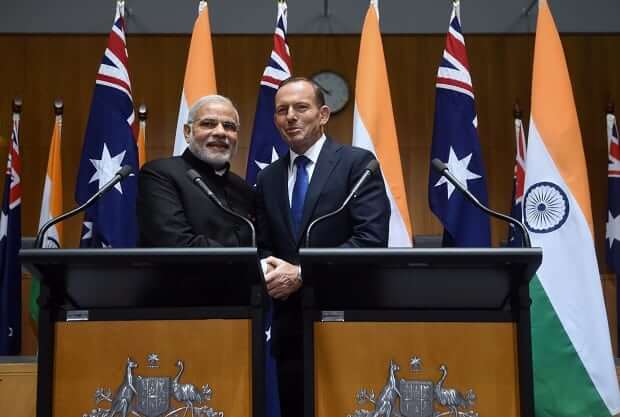
Narendra Modi is officially the first Indian Prime Minister to address the joint houses of Australian Parliament. On 18 November at approximately 10.20 am, Modi rose to share his views on a wide range of topics including the shared military history, democratic systems in the two countries, and security in the region.

That it was a historic occasion was evident from the packed-to-the-rafters chamber and the pin drop silence as Mr Modi spoke.

In a most refreshing way, the Indian Prime Minister commenced his address as he did in Sydney the day before, with a special acknowledgement of Indigenous Australians. Very early on, he made sure he had the attention of his audience by cleverly incorporating a new term in political parlance, one coined by Prime Minister Tony Abbott only weeks ago. Modi had the House smiling when he acknowledged their endurance in hearing a third international leader speak in as many days: “Maybe this is Prime Minister Abbott’s way of shirt-fronting you,” he suggested with a smile.

Their interest captured, PM Modi went on to speak about the common bond between the two countries which is etched deep into history. He spoke of the soldiers from both countries who died at Gallipoli; the architect of Canberra, Walter Burley Griffin, who lies buried in the old city of Lucknow in India; and of Australian novelist and lawyer John Lang who fought the legal battle for Indian freedom fighter, the Queen of Jhansi, Rani Laxmi Bai against the British East India Company in India’s first War of Independence 150 years ago, and who now lies buried in Mussorie.

But what PM Modi highlighted was the principle of democracy binding the two nations. In a full frontal attack on China, whose Premier was still in Australia, Modi said, “Today, as I stand in this temple of democracy, I consider nations such as ours to be blessed, because democracy offers the best opportunity for the human spirit to flourish, because we have the freedom to choose, the right to speak and the power to remove – and, for us in politics, with no option but to leave with grace.”

Warming to the theme, Modi spoke about the need for Australia and India to work together to maintain stability in the Asia Pacific and Indian Ocean regions.  Welcoming Australia’s role in the prosperity and security of this region, Modi further said, “We should collaborate more on maintaining maritime security. We should work together on the seas and collaborate in international forums. And, we should work for a universal respect for international law and global norms.” The message was clearly sent to China that they need to be aware of India’s desire for a pact with Australia and Japan to counter their growing naval strength.

With the security issue on the table, Mr Modi then built a case for greater economic engagement between the two countries. Dangling the carrot of India’s growing economic middle class, Modi urged Australia to engage more with India. He said, “I see Australia as a major partner in every area of our national priority. In providing skills and education to our youth; a roof over every head and electricity in every household; the most affordable healthcare for the most difficult diseases; the next generation of infrastructure that does not take a toll on our environment; energy that does not cause our glaciers to melt – clean coal and gas, renewable energy or fuel for nuclear power; cities that are smart, sustainable and liveable; villages that offer opportunities; agriculture that yields more and farms that are better connected to markets; practices and technology that save water.”

He also promised that “Australia will not be at the periphery of our vision, but at the centre of our thought. So, we stand together at a moment of enormous opportunity and great responsibility. I see a great future of partnership between India and Australia and, a shared commitment to realise it.”

The message was clear. India seeks Australia’s help to counter balance the growing influence of China in the region. At the same time, India is open for business, something which PM Tony Abbot has himself said about Australia. It seems that both are singing from the same hymn sheet.

The reference to cricket, but of course, found its way into Mr Modi’s address to highlight the shared passions as well as the sporting rivalry between the two nations.

As Mr Modi concluded with a simple “Thanks a lot”, it was clear that a watershed moment in the history of the two countries had occurred.

To read the full text of PM Modi’s address to Australian parliament click here

Still playing it his way

0
Reading Time: 3 minutes

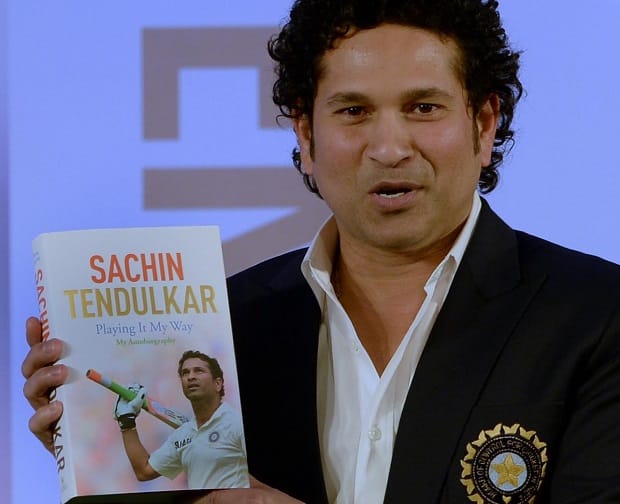
The new Sachin Tendulkar autobiography depicts events without providing much fresh analysis

It may have ruffled a few feathers in Australian media circles, but to any follower of Indian cricket over the past three decades, Sachin Tendulkar’s recently released autobiography Playing It My Way is, lamentably, more recount than reflection. While it is interesting to read about his somewhat brattish childhood adventures, and revealing that he played a large majority of his career in significant, apparently unbearable pain, in his book, Tendulkar manages to maintain the detached, almost mundane streak that characterised his off-field persona throughout his long and illustrious playing career.

The book, co-written by prominent cricket historian and scholar Boria Majumdar, takes us through 28 chapters, each dealing with various stages of Tendulkar’s career. Although the series-by-series recounts soon become tiresome, and he fails to analyse some important issues that must have resonated with him in a certain capacity, Tendulkar does provide a few fascinating insights into his world.


Childhood

Surprisingly, Sachin Tendulkar the child was far removed from the mild-mannered and softly-spoken man many came to admire. For instance, Tendulkar would regularly play annoying pranks on others in his neighbourhood – locking neighbours in their apartments, pouring water on passers-by, and disguising deeply-dug holes in the sand on a construction site, waiting for unsuspecting victims.

It wasn’t just the pranks. By his own accounts, Tendulkar’s unreasonable behaviour caused his parents a lot of embarrassment. When most of his friends got their own bicycles, Tendulkar’s stubborn attitude led to him getting his head stuck in the grille of the apartment’s balcony – while sulking and refusing to go outside to play in an effort to guilt-trip his parents into buying a new cycle for him.

The Chappell brothers

Much of the hype surrounding Playing It My Way are Tendulkar’s “explosive” allegations that one-time Indian coach, former Australian captain Greg Chappell attempted to overthrow Rahul Dravid from the captaincy, threatened to remove Ganguly and Laxman from the team and aspired to “control” Indian cricket with Tendulkar. Unfortunately, there is not much more to the chapter than what was already leaked to the press in advance by Tendulkar’s wily PR team.

Indeed, while commentators such as Robert Craddock have absurdly suggested that Tendulkar’s book reveals a ruthless political mastermind who pulled the strings of Indian cricket for two decades, it is widespread knowledge that Greg Chappell comprehensively failed to understand the culture of cricket in India, especially the reverence with which the senior players were held.

It was certainly interesting to read about the confrontation between Tendulkar and the oldest of the Chappell trio, Ian Chappell. The exchange between the pair took place in Durban in 2010, almost three years after the debacle of the 2007 World Cup, following which Ian Chappell had called for Tendulkar’s retirement. After commenting favourably on Tendulkar’s weight of recent runs, Chappell must have been surprised to hear Tendulkar tell him that he had “conveniently changed his stand”, and that “critics like him change with the wind”. When the conversation moved to his younger brother, Tendulkar advised Ian that he did not want to share a dressing room with Greg Chappell again.


Overwhelmingly though, Tendulkar’s autobiography is a missed opportunity to finally shed some light on a number of deeper, more significant aspects of his experiences. What is it like being revered like a religious figure? What are his thoughts on the science of batting? What did he make of the match-fixing scandals that threatened to bring cricket to an end in the 1990s?

Unfortunately, just as fans learned during their 25-year love affair with the perennial boy genius – Tendulkar always leaves you wanting more.

Justice the Jayalalitha way

0
Reading Time: 4 minutes

Is it triumph or tragedy for India’s most controversial and colourful politician? 


Amma is the most pervasive palindrome in Tamil Nadu. Unless you are totally blind, there is no way of missing that word and its owner, moon-faced matronly-looking Jayalalitha, plastered on every wall in the poster-polluted provincial capital, Chennai.

With the populace of this state neatly divided into two political camps, any excuse is good enough to start wall-to-wall coverage glorifying their leaders. So it is only normal to expect Chief Minister Jayalalitha’s achievements to be publicised in larger than life format on every street corner.

But when I arrived in Chennai early October, the texts had a twist. I saw a variety of posters with a single message – demanding her release from prison.

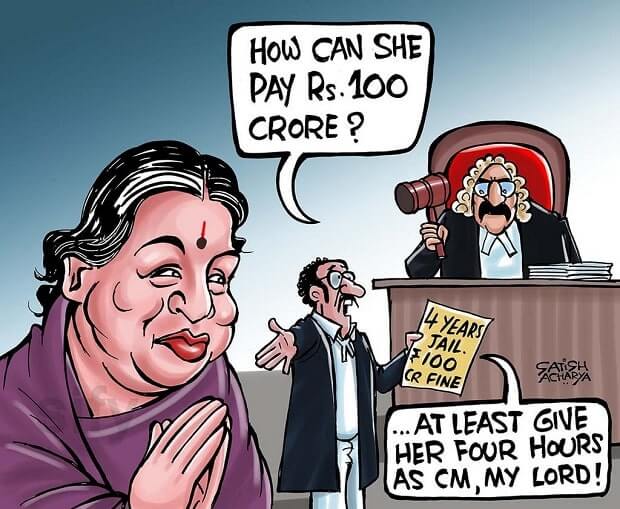
Jayalalitha was convicted on 27 September in a Bengaluru special court on charges of accumulating assets worth Rs66.5 crore, disproportionate to her earnings and entitlements.

That sum works out at one crore and a bit for every year of age for this 66-year-old former movie star. She was sentenced to four years imprisonment and given a Rs100cr fine. This judgement came 18 years after the case was filed thanks to her legal team successfully seeking so many adjournments.

Amma applied for bail to appeal against the judgment, but the Dussehra holidays delayed the hearing. So her loyal party men conceived various protest movements, ranging from ridiculous to religious, to demand her release.

First the posters accused the judge of getting even with Amma because of her successful fight against Karnataka over the Kaveri water issue. Some of them even had an undertone of threat.

This did not cut the mustard with the judiciary and drew some condemnation. Some of the Members of the Legislative Assembly, being lawyers, should have known better. In their eagerness to exhibit their loyalty to Amma, the party’s big-wigs vied with each other to organise bigger and more bizarre protest marches, many of them with religious overtones.

To mention a few, special ‘pujas’ were held at many temples praying for the bail hearing to be speeded up. These prayers may have prevailed upon the divine Lord, but not the special court lord. Next they started holding havans at famous temples in large cities attended by hundreds. Trying to send some smoke signal?

Not to be outdone by temple throngs, some churches and mosques held mass prayers. Crossing the caste barriers?

For women supporters, their loyalty for Amma went to their heads, literally. Some 3000 women took out a procession carrying pal kudam (pots of milk) to offer to a local temple in Madurai.

Women’s support for Jayalalitha comes not only out of gender affinity, but also due to a number of freebies offered to them on her birthdays – saris, grinders, maternity packs containing goodies for newborns and much more.

But men too went head over heels in their support. Thousands of them had their heads shaved in a mass tonsure event. Some men pierced their cheeks and tongues with thin sharp metal lancets as they do at the ‘Thai Poosam’ festival. Some MLAs undertook four-hour fasting – not eating between lunch and dinner!

Every event was given extensive coverage on Jaya TV (Amma’s own) to the exclusion of any other news. On the other hand, it was total sunset on the Opposition’s Sun TV.

The star attraction for the former movie queen was due to her new ventures like Amma Cafe where a plate of idli (typical Tamilian breakfast) is sold for five rupees as opposed to Rs60 in any restaurant; while Amma Salt and Amma Mineral Water are among other low-price offerings.

And to cement her place in public esteem, the latest venture is Amma Cement offering a few hundred bags at half the standard price to encourage the poorer sections of the community to build a house.

At last when the bail application was being heard, one reporter prematurely announced it had been successful. On hearing this, women well past their fifties danced in the streets a la Bollywood and loads of laddoos were dished out. But when the official announcement of bail refusal came a few minutes later, the dancing women felt so desolate they started rolling on the roads beating their chests. A few days later the issue was taken to the Supreme Court which allowed bail albeit with some stiff conditions. Minutes later, loads of laddoo trays re-appeared followed by deafening firecrackers. All those prayers seemed to have been answered.

But not for the 173 people who lost their lives. Amidst all those frivolities there was a very sad chapter in this saga of sycophancy.

Grieving over Amma’s arrest, 75 people committed suicide, 17 of them set themselves ablaze, and some poisoned themselves or jumped in front of heavy vehicles. Others were reported to have died of heart attacks, shocked by the sentence.

Coming out on bail, Amma announced a relief amount of Rs3 lakhs for every victim’s family. None of them belonged to the coterie of ministers, MLAs or their family members. Common folks consumed by passion for their leader. Is it really worth it?


With photos from A.S. Diwakar, Chennai

Indian media loves Australia

0
Reading Time: 5 minutes

The Indian students’ crisis lies all but forgotten by the very people that started it all

Just over five years ago, the Indian media turned its blowtorch on Australia and in one broad brush, painted the country as racist and unsafe for Indians. With little research or analysis, the attacks on Indian students were loudly denounced as racist and headline after headline screamed that there was a jihad against Indians in Australia. That most of the racist claims were unfounded and the problems random was soon clear, but the media had moved on and Australia was another story of the past.

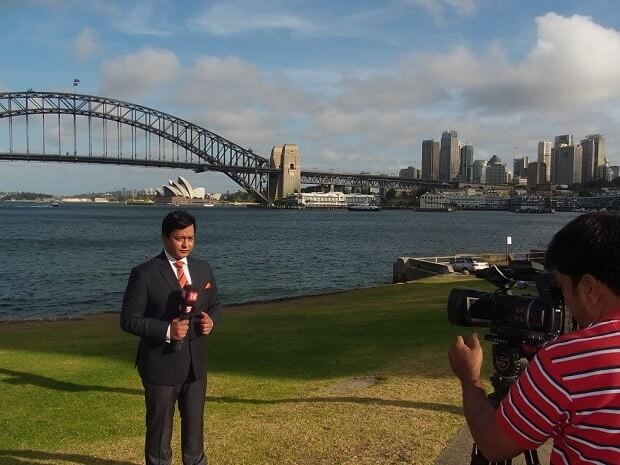
Now six years down the track, the Indian media descended on Australia to report not only on the G20, but also the great Modi mega event which now seems set to follow the new Indian Prime Minister whenever he goes overseas. If there are over a 100 TV channels in India, it seems more than half were in Australia trying to find that special story about Australia and Australians that could make good coverage.

Fortunately, the time difference was such that the stories filmed in Australia at midday could be televised live during the next morning’s peak viewing hours. While some TV channels sent only one crew, the anchor and the camera man, a number sent two crews, one each for their Hindi and English platforms.

And so, for four days running, viewers in India saw the front of the Allphones Arena, with TV reporters pointing excitedly to the posters behind them of Katy Perry who was slated to perform there only days after PM Modi spoke at the venue.

The TV-wallahs were busy scouting for ideas to fill in their time – and no doubt to justify to their bosses in India that their trip was money well spent. This of course allowed a number of Indian Australians to get their 15 minutes of fame on Indian television. While the Modi event organisers had run up a number of activities for them, such as a visit to Sanskrit schools or a walk down Little India in Harris Park, the visitors down under wanted their own stories.

One crew spent a few hours on the harbour on the Sydney Showboat filming the breathtaking cabaret show by the Moulin Rouge girls in their full dance costumes and feather headgear. Weaving these shots through interviews of guests on what they expected from the Modi visit, would have made for great visuals no doubt, but we wonder what the staunch Hindu allies of the BJP thought of this.

Another crew got a group of local Indians together who recited poems about the Indian Prime Minister.

Another spent a day filming at the local radio studio with talkback about the PM Modi visit.

And even as restaurants with a Modi flavour menu were visited, the Australian garbage collection system (with different bins for refuse, recyclable bottles and paper) were explained to viewers in India as a supplement to Modi’s swatch bharat campaign. In fact, by hook or crook, the Modi-fication of Indian Australians, or of the Australian lifestyle, was grabbing prime time in India.

Not a single TV crew though, decided to relook at the students’ issue with a fresh perspective: why did you not hunt down Saurabh Sharma, the Melbourne youth who was brutally attacked on a train, and whose CCTV footage you aired all-day long on a loop, creating the diplomatic impasse between the two countries that has taken years to rebuild? If you had, you would have found out that he is happy and healthy, and travelled by the same train at the same time of night each night, long after the incident, and that a compassionate Australian dentist actually paid all of his medical costs. Now would that not have been a story?

And while all of this was on, experts were paraded on split screens in India as they spoke about mutual opportunities between the two countries. While the concept was good, it was painful to watch so-called experts who had little idea about ground realities. According to one ‘expert’, there are over 700,000 Indians in Australia currently, and numbers will be up to 1,000,000 in three or four years. Sure, inflate the initial number by 40 per cent and be out by over 10 years in your analysis, as long as the facts do not get in the way of a good story! (Post the event, one ‘expert’ even claimed that Narendra Modi had staged the entire Allphones Arena event himself by flying planeloads of people from India to Australia.)

The anchors on India’s many news channels threw to their reporters in Australia frequently, but too often mouthed the words “Indo-American relationship”, perhaps by sheer force of habit, instead of “Indo-Australian”, and nearly all of them referred to the Australian PM as Tony ‘Abort’. Let’s just hope this does not translate into action as far as the renewed relationship between the two countries is concerned!

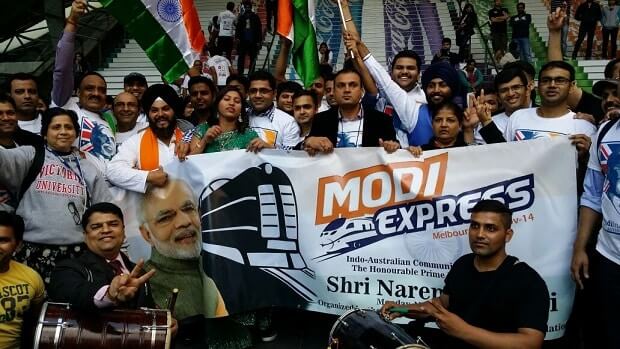
Meanwhile, for Indian viewers themselves, the news segments were sometimes sketchy, and many people actually believe that the “Modi Express” is a regular train that now runs between Melbourne and Sydney, inaugurated to coincide with Modi’s visit.

As for the local Indian-Australians, everyone claimed repeatedly that they were ‘excited’ about the PM’s visit, but failed to say why or to elaborate any further.

But on ‘Modi magic Monday’, the TV-wallahs did their job well, taking up positions around Allphones Arena as hordes of Indian Australians found their way to the stadium. Local media also joined in with four channels – 7, 9, 10 and ABC – also having their teams at the venue. With plenty of colour and with the clashing of the garba sticks and the drums and the exuberance of the people, there were some fantastic filming options.

And as the crowds moved into the arena, the TV crews followed and a lot of Australia beamed its way into the living rooms of India. Friends and families seeing their loved ones from down under on their TV screens were busy calling up or Whats-apping.

The media filled its role to inform and entertain and the chest beating about racism and student violence were a thing of the past.

Meeting on hallowed ground
0
Reading Time: 3 minutes

PM Modi outlines potential for Australian opportunity in India

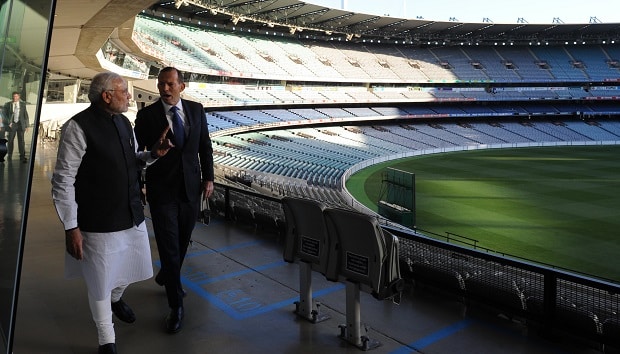
After a full day of activities – addressing the Australian parliament, meeting with business leaders – the popular Indian Prime Minister Narendra Modi was whisked to the hallowed grounds of the iconic 161-year-old Melbourne Cricket Ground (MCG).

There he was joined by Australian Prime Minister Tony Abbott as well as cricketing legends from both India and Australia, including Sunil Gavaskar, Kapil Dev and V.V.S. Laxman, Steve Waugh, Glenn McGrath and Alan Border, for a tour of the turf.

Later, at the gala dinner hosted by PM Abbott, Prime Minister Modi sought Australia’s assistance in accelerating India’s urbanisation process.

“A successful India will be a vast opportunity and a force of good for the world. We look forward to closer partnership with friends like Australia,” Modi said at the dinner.
“India is experiencing urbanisation at a rapid pace. Studies suggest that by 2031, 11 per cent of the world’s urban population might be in Indian cities.”

He added that India already has more than 50 cities with a population of over one million. “Urbanisation can be an enormous opportunity,” Prime Minister Modi said.

He spoke of his plans to build 100 smart cities, revive heritage cities, build modern solid waste management and waste water treatment systems in 500 cities, and clean up the country’s rivers.

“This is part of our larger vision of a sustainable future for our country, and transforming the quality of life of our people in cities and villages alike,” the Prime Minister said.


He hoped that India could learn from Australia’s experience and benefit from its expertise and noted that Melbourne is regarded as the best city in the world to live in.

Modi said he wanted to build a future in which every Indian can say that his life has improved and his environment has become better.

“I am confident that we will achieve it with the support of the people of India, and through the talent and energy of 800 million youth, below the age of 35 years,” he said.

“(It is) a generation that is eager for change and committed to work for it,” the Prime Minister added.

Modi also stressed on the importance of relationships between people.

“One thing we all agree on. The bonds between the countries are made strong by the joined hands of our people.”

The Prime Minister also spoke about the love for cricket that both India and Australia share. “No business is serious enough to keep an Australian and an Indian from discussing this great game,” he said.

He recounted India’s glorious cricket triumph at the MCG in the Champions Trophy in 1985 and said that the Ground would be a deserving venue for the final of the Cricket World Cup in 2015.

“I hope that our two teams will play that match,” Modi said.


The Prime Minister also said that India can learn from Australia’s famous sporting skills in other areas too. “We have decided to collaborate on a sports university in India,” he revealed

“Our exchanges in sports, tourism, education and culture are great sources of strength for our relationship,” he stated.
The Prime Minister thanked his Australian counterpart Tony Abbott for being “truly generous with your hospitality and warmth”.

PM Modi concluded, “My memorable visit to Australia ends tonight, but a new journey of our relationship has begun.”


All aboard!

0
Reading Time: 3 minutes

The Modi Express was a train journey with a twist

Delhi ho ya Ahmedabad, Narendra Modi Zindabad chanted the people aboard the famous ‘Modi Express’ as it trundled towards Sydney to afford a rousing welcome to Indian Prime Minister Narendra Modi.

Decorated with garlands and festoons, draped in Indian colours, the Modi Express transported 220 passengers to Sydney to witness a historic address by the Indian Prime Minister at the Allphones Arena.

Much has been said and written about the train that was flagged off, amidst great ceremony by Victorian Multicultural Minister Matthew Guy, from Melbourne’s Southern Cross Station.

In an attempt to capture the mood and excitement, we spoke to some passengers about their experience on the Modi Express.

Dharmendra Patel from Ahmedabad was one of the supporters on board the train. “The crowd was exultant from the moment we left Melbourne. No one would have slept for more than a couple of hours as we danced and sang through the entire trip,’ Patel said.

“There were arrangements for dhol and other musical instruments and an enormous amount of talent to keep the entertainment going,” he continued. “I am a big fan of Prime Minister Modi and so were a lot of other people that I met on the journey. Our common respect for him created the foundation for new friendships as we exchanged contacts and made promises to keep in touch.”

According to Patel, who is the Managing Director of Aussizz Group, the Modi Express added great weight to the welcome that the Indian Australian community wished to offer to the Indian Prime Minister.

Aloke Kumar from Mumbai Spices provided the catering for the trip. “It was in honour for us to be involved in any way with this experience of a life time,” Kumar said. “We wished to pay tribute to the Prime Minister by offering food of his choice. Vegetarian food was provided including vada pao, vegetable biryani, paneer makhani, salad and gulab jamun. For breakfast we had Khaman Dhokla. We also got special packaging created for the Modi Express.”

Kumar continued, “We were so proud to be on that train. It was wonderful to see so many people come together for the same cause.”

The train’s journey was a symbolic tribute to PM Modi’s humble beginnings as a tea vendor at a railway station, Kumar said. It also reflected on the Indian diaspora’s love for the Prime Minister.

Molina Asthana, Principal Solicitor at the Victorian Government’s Solicitor’s Officer agreed. “It was an interesting experience and it was good to be part of the euphoria and connect with like minded people,” she said.

“The journey reminded me of the train trips in India that involved food, family, friends and lots of fun. I particularly enjoyed the discussions we had on India and its future as well as the singing and dancing all the way,” Asthana continued. “Whilst there was no official welcome party for us when we arrived in Sydney we received a lot of media attention and it was good to be involved with something so big.”

Sharing her experience of the expedition, Monica Raizada from Ramon Consulting and Financial Services said, ” It was a very well organized event by the Overseas Friends of BJP Australia (OFBJP) with positive energy all round in support of a good leader.”

According to Raizada, the trip was like being part of an Indian wedding procession (baraat) with endless good food and non-stop entertainment.

“While the trip was lots of fun there was also a sense of community interest, with talks on how the community can make a difference under an inspiring leader,” Raizada continued. “Prime Minister Modi has made a difference with his new government and clean up campaigns offering great hope to India. He has also been instrumental in creating a better relationship with Australia and other parts of the world. It was a delight to be part of his welcome to Australia.”