Home Blog Page 1022

Bad weather hinders rescue

0
Reading Time: 3 minutes
Uttarakhand toll expected to cross 1,000
 floods
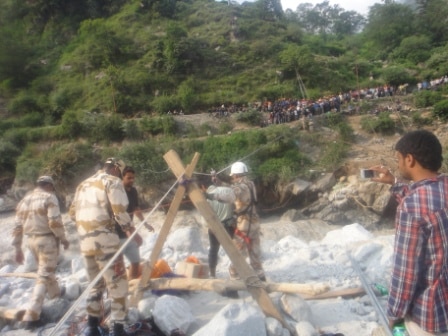
As bad weather, fresh rains and dark clouds briefly halted rescue operations in Uttarakhand, Chief Minister Vijay Bahuguna admitted it will “take another fortnight to evacuate flood victims” and that over 1,000 may have perished in one of the worst disasters to have hit the hill state.With most parts of flood-ravaged Uttarakhand witnessing overcast skies and the Met department forecasting heavy rain in the next two days, the thousands who are still stranded in a devastated terrain face a frightening challenge.Although heavy rains on Jun 23 hindered the Indian Air Force (IAF) aircraft’s landing on the flood-ravaged state’s Dharasu airstrip, the army and the Indo-Tibetan Border Police were able to evacuate hundreds of stranded people from jungles and remote areas of the region.Bahuguna, who is overseeing the rescue and relief efforts following the cloudburst and humongous floods, said the deaths could “well cross 1,000″.”The tragedy is still unfolding and a conclusive figure can only be arrived at after the rescue teams reach the areas devastated by the rains of the last weekend,” he said.He also said that the rescue teams will take another fortnight to evacuate flood victims as the roads leading to affected areas have been badly damaged.”It’s very tragic that so many people have died in this calamity. It will take a long time to rebuild Uttarakhand. There will be no Kedarnath Yatra for at least next two years,” he said.The chief minister said scores of houses had caved in after the cloudburst near Kedarnath, while slush in many areas had buried locals and pilgrims, raising the spectre of a frightening death toll.On the basis of reports reaching Dehradun from the hills, the Uttarakhand police control room also said the toll would rise much above 1,000.Congress general secretary Ambika Soni, who is also in charge of the party’s affairs in the hill state, said that efforts would be made to reconstruct the areas near the revered shrine of Kedarnath that were devastated in the floods and cloudburst last week.According to official figures so far, over 550 people have died, while over 20,000 have been evacuated.
Lt. Gen. Anil Chait, commander-in-chief of the army’s Central Command which is spearheading the rescue operation, told IANS that the army will rescue every single person stranded even in the remotest hills.
Admitting that this was “by far the worst tragedy” he had come across in his career, Gen. Chait said about 8,500 soldiers of the mountain division and medical corps have been deployed in the rescue and evacuation efforts.
“We have also been able to shift more than 18,000 people stranded for days in Gangotri, Joshimath, Badrinath, Kedarnath and Pindari glacier,” Gen. Chait said.
He said fresh rains and inclement weather were a frightening prospect, and that army helicopters were able to rescue only seven to eight people at a time.
The most difficult place to reach was Jangal Chatti area, one official told IANS, adding that more than 15,000 people were still to be evacuated in the state.
Heavy rains are expected between June 25 and 27, and even multi-layered clouds will hamper flying.
Heavy rains are forecast in Pithoragarh, Uttarkashi and Chamoli districts, among the worst hit areas.
With more than 1,000 major and minor roads washed away, officials say air rescue is the only way to get trapped people to safety. But some roads have now been opened and some made motorable.
Besides the army, the Indo-Tibetan Border Police (ITBP) has rescued around 24,000 pilgrims and tourists from the flood ravaged Uttarakhand so far.
“We were able to rescue over 4,613 people from the flood-affected areas today (Sunday) itself,” ITBP spokesperson Deepak Kumar Pandey said at a media briefing.
Rescuers said they are doing their best to ensure that the “last living soul” in the rain-ravaged areas is brought back to safety, but admit that airlifting of stranded people may become impossible when rains and downpours begin.
 
IANS

Bear necessities

1
Reading Time: 4 minutes

website low res version
When I first met Mary Hutton, she was speaking at the Sydney office of World Expeditions, the Australian adventure travel company, and she was about to lead a tour to India to visit the sanctuaries established there to care for rescued bears.
In 1993, Mary, a grandmother living in suburban Perth was contemplating her retirement. Instead, her life took an entirely different and unexpected turn. When she switched on the television one night she saw gut-wrenching news footage of traumatised Asiatic black bears, confined in boxes, unable to move, with catheters piercing their gall bladders to extract bile for use in traditional Chinese medicine. On learning that thousands of bears suffer extreme cruelty, Mary embarked on an unstoppable mission to free them.
Mary swung into action collecting signatures at the local shopping mall. Within months she had a group of volunteer supporters and by 1995, the ‘Free the Bears Fund’ was formed. She also learnt of the plight of other bears like the Cambodian Sun bears, killed to make bear paw soup. She brought some that had been rescued to Taronga Zoo, and later to Perth Zoo to start a regional breeding program. Mary then set to work building a sanctuary in Cambodia, now the world’s largest sanctuary for sun bears. In Laos, Mary also established sanctuaries and continues to campaign for the closure of bear bile farms in Vietnam and Laos. Hundreds of thousands of local school children have visited the sanctuaries in an attempt at educating them about the environment and the need to protect animals in the wild.
Mary’s involvement with India was prompted by an email from Maneka Gandhi in 2002, that led to the Free the Bears Fund joining Wildlife SOS (an Indian based conservation group) and International Animal Rescue, in the seemingly impossible challenge of rescuing India’s dancing bears.
The tradition of dancing bears had existed since the 13th century, when nomadic Kalandar tribespeople would visit the palaces of Mughul Emperors with performing wild animals, including sloth bears. Unfortunately, the practice continued through to the twentieth century, with the bears used to entertain foreign tourists at popular sites such as the Taj Mahal. Although the sloth bear has been protected by Indian law since 1972, and bear dancing has been prohibited since 1998, with all bear dancing licenses eventually revoked, it was difficult to enforce this law, since no facilities existed to place the bears.
The Free the Bears fund financed the construction and ongoing care of rescued bears at the Agra Bear Rescue Facility. All the sloth bears that were turned in remained in the sanctuaries due to health and behavioural problems.
The Fund also financed the Kalandar Rehabilitation Program, which enabled the owners/masters of former dancing bears to develop new livelihoods. In collaboration with Wildlife SOS, the Fund made ‘seed’ money available to over 500 Kalandar families to buy equipment and learn new skills, so they could begin new sustainable forms of income, with a basic education provided for their children, in exchange for turning in their bears. Some chose to remain with their bears and gained employment at the sanctuaries.
The Fund paid for 554 rehabilitation packages for the rescue of former dancing sloth bears and supports four sanctuaries. Sadly due to deaths caused by illness, mainly tuberculosis, the Fund currently supports 370 sloth bears at the sanctuaries at Agra, Bannerghatta near Bengaluru, West Bengal and Bhopal (Van Vihar) providing a safe and secure home. When the last dancing bear entered the Bannerghatta sanctuary in December 2009, the pitiful sight of bears being dragged on ropes through the streets was consigned to the past.
Mary maintains contact with the Kalandars, visiting a village recently where cottage industries had been established, with women sewing and the children attending school. Mary is currently developing a volunteer program in India and welcomes volunteers, as the sanctuaries that could not continue without the generosity of donors, whether companies or individuals.
Mary advised that she would be accompanying another tour to Laos and Cambodia to visit the bear sanctuaries in November, after just having her autobiography Free the Bears published.
“Will you ever stop? ” I asked this unique lady. “Unlikely,” replied Mary, with conviction. “With each country facing a unique set of issues to overcome, we employ a range of strategies including environmental education, conservation research and strengthened law enforcement, to ensure that we achieve our mission to protect, preserve and enrich the lives of bears throughout the world,” she added. I don’t think Mary will be retiring any time soon.
At Free the Bears, 100% of donations go directly to the rescued bears. At last count, 554 bears in India and 31 bears in Laos have been rescued so far, with 25 moon bears placed at the Tat Kuang Si Rescue Centre. In Cambodia, 168 sun and moon bears have been rescued, with 127 at the Phnom Tamao Rescue Centre.
As I was completing our chat, Mary mentioned that a little one year old male sun bear had been brought to the sanctuary, rescued by a policeman from a province nearby. Over 80 bears have been rescued in Indonesia, Thailand and Vietnam, and brought to sanctuaries built with support from Free the Bears Fund. Overall, over 800 bears have been rescued and reside in the safety of sanctuaries built or supported by Free the Bears, with over 500 bears relying on the Fund fortheir ongoing care.
For opportunities to volunteer, with commitment the main criteria visit: Freethebears.org.au

Meeting India’s youngest minister

2
Reading Time: 3 minutes

Sachin Pilot greets the Indian community in a whirlwind visit to Sydney, writes MALIKA GOEL
DSC04364_1
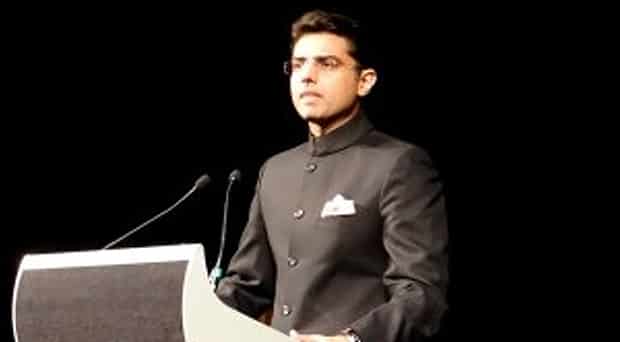
When Sachin Pilot, Minister of State for Corporate Affairs in the Government of India strides to the podium, the silence is palpable. Articulate, young, infinitely presentable – and did I mention young? – he could be India’s saving grace, and we are all eagerly gathered to hear what he has to say.
This is the Minister’s second visit to Sydney, following in the footsteps of a wider Australia trip that included stops to Melbourne and Canberra, in a detailed programme drawn up by AusTrade – the purpose of which was to discuss commercial and company related matters. Three other senior members of the Competition Commission of India accompanied him this time.
Mr Pilot’s previous visit to Sydney was in May 2012 to attend CeBIT, in his previous position as Minister of State for Communications and IT.
Organised by the Indian Consulate and hosted at the Four Seasons at Circular Quay, this particular evening however, is an opportunity for the Indian community in Sydney to enjoy a brief Q&A with Mr Pilot. And for many – myself included – this is an exciting first.
The Minister talks about the “cohesive workable partnership” between India and Australia. It is a relationship that’s going in the right direction as “there are no divergent views on anything of major significance between our two countries”, he states.
He notes, “The relationship is one that has potential to grow especially in areas of technology and telecom, where India has been doing tremendously well, and can share its considerable expertise with our friends in Australia”.
Happy to see “such proud smiling faces”, Mr Pilot encourages us to diligently keep doing the work we have done so far, so both countries may benefit and ultimately do better, bigger things together. He ends by inviting us to “get together and share a few ideas”.
Sprinkling his words with a touch of humour, always a crowd-winner, Mr Pilot asks us to shelve the difficult questions for later, as it’s Saturday night. A good-natured chuckle follows, after which he spends a good half hour listening to and allowing himself to be photographed with various members of the gathering.
I hear a range of questions directed at him, from heavier topics about recent corruption scandals in India and what he plans to do about them (not going into detail, he acknowledges it is a problem, and that more transparency in public life is needed), to the current state of innovation and entrepreneurship in the country. What more can be done between India and Australia? What’s his vision for the future? How has his youth been received?
The Minister is diplomatic and polite, tactfully sidestepping questions when required, not quite encouraging conversation, but responding to questions curtly, before moving on to the next circle.
“Working the room” is the expression someone near me uses, but it is said in a positive light – after all, time is scarce and much of the questions are being repeated.
Before we know it our time is already up and Mr Pilot is gone in the whirlwind of a meet and greet. There is a possibility that he might visit Sydney again later this year for a regional PBD (Pravasi Bharatiya Divas) on November 10-12; however this will only be confirmed closer to the time, given that the Minister’s home state of Rajasthan is due for state elections around that time.
An MBA graduate of Wharton Business School, there should probably be no surprise that Sachin Pilot is well-spoken. I think it is more relief than anything, that is the lingering sentiment in the room, that someone so young – in fact, the youngest Minister in Indian politics! – is in a position of power.  Sachin Pilot symbolises a new relevance for India. Even the good relations between him and NSW Premier Barry O’Farrell bode well for the future of both countries. Sachin Pilot gives people the feeling that they can connect to him, relate to him and most importantly, share hope with him! A second-term MP, he is obviously doing something right and it’s clear that he resonates with the people both back home and here.
It has been a long time coming, but maybe India is in for the start of change it needs.

Women as leaders

0
Reading Time: 3 minutes

PAWAN LUTHRA’S Editorial on women in politics

133918-julia-gillard
The Indian Australian community may be forgiven in not fully understanding the misogyny statements from the Prime Minister recently. While that rant directed against Tony Abbott, delivered in Parliament last October, went viral, the blue tie- misogyny speech of earlier this month has not gone down well. To many it ranked of crass opportunism.
Indian Australians are no strangers to having women in leadership positions. Some of the strongest leaders in contemporary Indian politics are women: Sonia Gandhi, Mamta Bannerjee, Sushma Swaraj, Mayawati, and Jayalalitha. You may or may not agree to their politics, but you will agree that they are all able to command a leadership position.
One of our best known prime ministers, Indira Gandhi, was so strong she was once described as ‘the only man in her (kitchen) cabinet’.
Going back a couple of centuries, Jhansi ki Rani was revered as a true leader in the first war of independence of 1857. In the Independence movement, strong women leaders like Sarojini Naidu, Kasturba Gandhi, Vijaylakshmi Pandit, Kamla Nehru, Aruna Asaf Ali, Sucheta Kripalani all walked shoulder to shoulder in the country’s march towards independence.
Even our neighbouring countries have had formidable female forces that galvanised the nation. Benazir Bhutto, Shaikh Hasina, Khalida Zia, Aung San Suu Kyi, Srimavo Bandarnaike, Chandrika Kumaratunga, all rose to top political office in their countries.
Recent polls may have suggested (rightly or wrongly) that South Asian countries may be the worst places to be a woman, but never has misogyny been an issue for these leaders. There may have been loud disagreements on policy (Mamta Bannerjee, take note!) and governments may have changed or been driven out, but personal life choices, dress sense, size or shape of body parts, and sexuality of partners have never the question of debate or comment.
As Prime Minister of Great Britain, Margaret Thatcher ruled with an iron fist. Single-handedly busting up the unions, she did not allow gender to even come into the equation. She led with her own brand of politics, and while many openly despised her, none brought gender into question. In the current Euro crises, the two individuals who worked the hardest to save the Europe Union were the German Chancellor Angela Merkel and the President of the Euro Union zone Christina Lagaard. While austerity measures were imposed in a number of countries, the protests were against the measures rather than the women per se who advised on these cutbacks.
Australia as a nation has come far in transforming society as a more open society for women.
Amongst women in power we have the governor-general Quentin Bryce, the prime minister Julia Gillard, NSW state governor Marie Bashir, Tasmanian premier Lara Giddings, ACT Chief Minister Katy Gallagher and ex premiers Queensland’s Anna Bligh, NSW’s Kristina Kennelly, Victoria’s Joan Kirner, and WA’s Carmen Lawrence. All have stood tall during their tenure. Who can forget the fortitude with which Anna Bligh handled the aftermath of the Queensland floods? Other than Gillard herself, none of the other women in the list above have brought up the issue of misogyny, at least publicly; they will all be remembered as leaders who did a tough job in trying circumstances (Kristina Kennelly is a shining example).
The gaining of political office, in whichever part of the world, has always been based on merit. The debates in such positions have, until recently in Australia, been centred around policy. It’s time for our leaders to let the gender issues slide, before they reach a new low, if that is possible.

Better than Bollywood

0
Reading Time: 12 minutes

A radical breed of Indian filmmakers are conquering the global audience with unique and thought-provoking films, reports RAJNI ANAND LUTHRA
Untitled
Rarely has an independent film raised so much interest in India in the weeks before its official release, but Ship of Theseus, made by filmmaker Anand Gandhi is one such film. The film screened at the recently concluded Sydney Film Festival where it won rave reviews, as it did at the London, Dubai, Hong Kong, Tokyo, Mumbai, Brisbane, Rotterdam and Transylvania Film Festivals. The film is but one of the many new movies making the international circuit and showcasing an immense and untapped well of talent for storytelling, screenplay and acting from the Indian film industry. These are award-winning films that grasp concepts of reality and present them with simplicity, finesse and authenticity that make them tremendously appealing, however, to a larger international market than a domestic one.
 
New ideas
With one of India’s leading film personalities Kiran Rao presenting the film and a strong online campaign promoting it, Ship of Theseus seems to be the first of independent films sailing into the year’s top ten list of many critics, nationally and internationally.
An ‘independent’ film is defined loosely as a non-studio funded film. But that, says filmmaker Ritesh Batra and one of Gandhi’s contemporaries, is outside of India. Within India, according to Batra, an independent film is one that is ‘independent in spirit’.
And Batra should know. His first feature film Dabba (The Lunchbox), won the Viewer’s Choice Award Grand Rail d’Or at this year’s Cannes Film Festival.
As films ‘independent in spirit’, the Indian audience is likely to classify The Lunchbox and Ship of Theseus in the ‘art’ film category, variously called arthouse, alternate, parallel, sometimes even ‘meaningful’ cinema. This is the kind of cinema that has no commercial trappings – it does not have songs or dances, or even heroes and villains, is low budget, has no stars, might win an award or two, but typically, is the kind that has no takers in terms of a mass audience.
And yet, Ritesh Batra and Anand Gandhi are heralding a new era in Indian cinema, one which is seeing the paradigm shift considerably. Their particular brand of cinema asks more questions than it gives answers, and leaves you thinking long after you’ve left the theatre. Their movies have already won over cinema buffs internationally; so can the domestic market be far behind? While there is still a long way to go, these films are finally creating furrows in the mindset of an audience that is conditioned to the removed-from-reality and escapism fiction of commercially successful films.
 
Sailing towards success
Ship of Theseus is a story that interweaves the dilemmas faced by three separate individuals as they grapple with issues of identity and change. A blind photographer who receives a cornea transplant wonders whether her art has changed after her operation. A kidney transplant recipient is consumed by the plight of his anonymous donor. A dying monk refuses medication because he has spent his life fighting against animal testing. In a classic Satyam-Shivam-Sundaram tale, writer-director Gandhi addresses the notions of truth, justice and beauty. The title itself comes from the fabled paradox of Theseus, in which the question is asked, if a ship has each of its parts replaced, is the new ship the same as the original?
“The idea of the film came to me as I nursed my grandmother in hospital and saw the disease and death around me,” Anand Gandhi revealed, speaking to Indian Link at the sidelines of the Sydney Film Festival. “As the story developed, my own artistic, ethical, social and philosophical struggles defined the struggles of my characters”.
The film was a hit at Toronto last year, with acclaim for its unusual story as well as for its stellar performances, and Kiran Rao got wind of it.
“She made it a point to see it, and loved it,” Gandhi divulged. “We talked about working together, and when I suggested she could present the film, she came on board”.
Having produced a philosophical treat, it is quite surprising to learn that Gandhi actually started off in the industry at 19 as a writer on the TV soaps Kyonki Saas Bhi Kabhi Bahu Thi and Kahani Ghar Ghar Ki. (Another example of the dichotomy that characterises his work, perhaps?) He laughed at the suggestion that at first he gave us trash, but now he wants to make us think.
“In my defense, I was only 19! Look, every artiste wants to reach out to the mass audience. I am glad I got it over with early on!” said Gandhi. “I was just telling Hugo Weaving, my friend and co-jury member here at Sydney, that if we have the luxury and the leisure to dream and imagine and invent, we also have a responsibility to do something interesting and thoughtful. If I have privileges, I must put them to good use”.
Hopefully the Saas-Bahu audience will think the exact same thought, and move up a notch along with him!
 
Guns ‘n’ rain
Amit Kumar’s first feature, Monsoon Shootout also featured at this year’s Sydney Film Festival, and was included in the competition category. The film is about the dynamics of split second decisions that could change your life forever. To shoot or not to shoot, that is the question faced by a rookie cop in this action-packed police thriller set in monsoonal Mumbai. Three different scenarios play out, based on the decisions that could compromise his morals.
Kumar claims he has always been intrigued by the decision-making process, like how much of the other person’s perspective do you take into consideration while making a decision that will affect them?
“The idea has been sitting in my mind for ten years now,” Kumar told Indian Link. “The UK Film Council that was supposed to fund it closed down, and when I found an Indian producer they wanted a well-known star in the film, so it stalled again. Finally Anurag Kashyap helped out”.
Nawazuddin Siddiqui gives a stunning performance as the baddie at the other end of policeman Vijay Verma’s gun.
Nawazuddin (the new Naseeruddin?) also appeared in Kumar’s first offering, a short film called The Bypass (2003).  Kumar must surely be thrilled with the way Nawaz’s career has taken off in the last ten years.
“Having Nawaz on board makes it all very powerful,” he admitted. “You have him, you’ll have the producers.”
 
Dabba dreams
Written and directed by the talented Ritesh Batra, Dabba (The Lunchbox) is set in Mumbai and revolves around a mistaken delivery in the dabbawala (lunchbox service) popular in Mumbai. This leads to a relationship between Saajan, a lonely widower who is about to retire, and Ila, an unhappy housewife. They start exchanging notes thorough the daily lunchbox that inspire them to create a fantasy world together. The film was screened on May 19 as a part of the International Critics’ Week at the 2013 Cannes Film Festival, where it received a standing ovation of over 15 minutes and very positive reviews. Dabba also won the Critics Week Viewers Choice Award, also known as Grand Rail d’Or.
Batra is a graduate from New York University’s Tisch School of the Arts film programme, and his talent has been lauded at Sundance, the Indian Film Festival of Los Angeles (IFFLA) and by French-German TV channel ARTE. The Dabba screenplay has also been applauded and awarded an honourable Jury Mention at the Rotterdam International Film Festival and was promoted at the Goa NFDC Film Bazaar, the Berlinale Talent Project Market and at the Torino festival screenwriter’s lab.
 
International recognition
So, what were Gandhi and Kumar expecting from Sydney?
“I got exactly what I was expecting,” Anand Gandhi confided. “A warm welcome. A full house. A curious and interested audience, who treated me to wonderful Q&A sessions, which often spilled out of the theatre!” (He forgot to add, modestly, a standing ovation).
Amit Kumar was more romantic in his reply saying, “I came expecting simply that the Sydney audience will love my film, and come to India to see the monsoon… but maybe not a shootout!”
Kumar added however, that he hoped to see his film challenge the existing notions of Indian cinema.
“My film was in competition, so viewers were primed to see something different, but yes, I’m hoping to change perceptions about the kind of films we make in India”.
We can safely conclude that these filmmakers did exactly that, given the more-than-warm response. The other Indian links at the festival, namely Algorithms by Geetha J and Ian MacDonald (a documentary on blind chess players); Char: The No-man’s Land (a documentary on the social effects of the environmental problems with the Ganges); and Midnight’s Children, no doubt added to the growing realisation that Indian cinema goes well and truly beyond Bollywood.
 
Home truths
While Bollywood has been whinging for years about the lack of international recognition, it is a fact that the Indie industry seems to have gone and won it through sheer talent. Ritesh Batra, Anand Gandhi and Amit Kumar were all at Cannes this year where India, celebrating its 100th year in cinema, was the special guest country. While Cannes did its bit to honour the Indian industry, did the Indian industry live up to its part of the bargain and showcase its strengths fully?
Amit Kumar seemed to think not.
“It could have been a bit more balanced,” he claimed. “Hindi cinema is not representative of Indian cinema. But then, it is more visual and widely known. Still, the new breed of film-makers did manage to impress. Lunchbox did very well. My own film was well-received, but it is a genre film and will travel well. Anurag Kashyap’s Ugly was interesting, you can always expect something different from him. And Bombay Talkies was good too, in sending the new message out.”
Anand Gandhi’s response was dismissive. “Hundred years on, the issue that engages me the most is, where do we stand today. Right now, my peers are making really exciting cinema – cinema that will change the game,” he said.
The interesting fact about both filmmakers is that though their stories are largely set in contemporary Mumbai, they are suitably global enough in theme to reach out to a wider audience. They are also based on real-time situations and episodes offering a slice of actual life in India, something that resonates more with an international audience than the song and dance fare that seems to characterise Bollywood. Perhaps this is where the new breed of filmmakers is different from those in Bollywood.
Another challenge that radical Indian filmmakers face is in finding funding for their movies. Producers within the domestic film industry are simply not interested if the film is not commercially viable. Anurag Kashyap and Guneet Monga came on board to produce Kumar’s Monsoon Shootout, and actor Sohum Shah stepped in as producer of Ship of Theseus, “to safeguard the artistic integrity of the project”. With Dabba, the film was jointly produced by Indian, British, German, French and American film bodies. And while these award-winning films have been shot around themes mostly in Mumbai, funding for these has been, either partially or wholly, through international producers. Perhaps it’s time Bollywood looked beyond its boundaries towards supporting new talent that brings recognition to the Indian film industry as a whole. And what better time to promote this than in 2013, as India celebrates 100 years of cinema.
 
The Indian response
It’s early days yet for Ship of Theseus in India, but Gandhi is confident that his film will do well.
“I am greatly surprised at the response already,” he said. “It is unprecedented, I should say, to hear people talk about a film that is art-house yet entertaining.”
Twitterverse is replete with eager viewers who have liked the trailer.
The film was released in five centres only – Mumbai, Pune, Delhi, Bangalore and Kolkata. But the online push has been so strong that Kiran Rao has just announced an online voting system for other cities. The film will be screened in the city that gets the maximum votes.
“With our online campaign, our effort is to gauge the interest of that audience, and hopefully, based on that, to take the film to them,” Rao said recently, adding, “It’s an exciting new way to reach out to viewers, a democratisation of cinema, where audiences decide what they want to see”.
For Amit Kumar, the expected Indian response to his film Monsoon Shootout is also clear. “It will probably be similar to Gangs of Wasseypur. Although Monsoon Shootout is slightly different in tone, I think it would be safe to say, those who enjoyed Gangs will enjoy my film too,” he claimed.
And perhaps the audiences are ready for it in their own way, given that some recent commercial releases that blur the line between mainstream and art-house have been well-received, like Chak De India, Rocket Singh, Kahani, Vicky Donor, OMG and Ankur Arora Murder Case.
Anand Gandhi tellingly observed, “I think it is quite an arrogant response when Indians (outside of India) come up to me and say, ‘I love your film, but I don’t think the Indian audience will get it’. Everyone wants to think! We just have to give them more food for thought!”
Hope they dish it out by the platefuls.
 
With details from Sheryl Dixit and online sources
 
 
10 recent independent films from India worth a watch
Kshay
Shot completely in black-and-white, Kshay directed by debutant Karan Gour, is a psychological drama about obsession. Rasika Duggal’s portrayal of an obsessive housewife is outstanding. The film played in four festivals including Dubai International Film Festival 2011.
Gattu
A heart-warming tale of childlike innocence hidden within us, this film was made with the help of Children’s Film Society of India. The story of a young boy obsessed with kite-flying, Gattu, directed by Rajan Khosa highlights the power of hope.
Mumbai Cha Raja
Manjeet Singh’s film explores the underbelly of Mumbai during the rainy Ganesh festival. Touted to be India’s answer to Slumdog Millionaire, this film is a perfect blend of joy, sorrow and misfortune. The film was screened at the Toronto International Film Festival 2012, the Abu Dhabi Film Festival New Horizons Competition and the Mumbai Film Festival Indian Competition.
Miss Lovely
Ashim Ahluwalia’s film traverses through a long forgotten era of C-grade Bollywood horror and porn films. Starring Nawazuddin Siddiqui and Niharika Singh, the film competed in the Un Certain Regard section at the 2012 Cannes Film Festival. It also won two awards at the 14th Mumbai Film Festival the same year.
Supermen of Malegaon
The film takes us through the lives of people who are united over a single goal to produce a Malegaon version of Superman by making spoofs on Bollywood films. Before its theatrical release last year, the film bagged 15 awards at various film festivals.
Good Night Good Morning (GNGM)
Shot completely in black-and-white, GNGM plunges into the psyche of the viewers by highlighting the strong desire to be loved. Following screenings at several international film festivals, the tragic yet comic film saw a theatrical release in 2012 and opened to mostly positive reviews.
Shuttlecock Boys
The film revolves around the lives, successes and failures of four friends who hail from lower middle class backgrounds in Delhi. It made its way to festivals including the Gotham Screen International Film Festival, New York, the Seattle South Asian Film Festival and the Chicago South Asian Film Festival.
Delhi in a Day
Prashant Nair’s debut feature, set against the backdrop of a rich family in Delhi, makes a strong statement on the socio-economic strata without deviating from the crux of the plot. The film used flashes of comedy to shine a light on the uncomfortable realities of contemporary life.
Peddlers
This crime-thriller, an ode to Mumbai, revolves around destitute boys who get trapped in the drug trade and a young cop, who tracks them. The film was screened as part of the 2012 International Critics’ Week, an independent film event which runs parallel to the Cannes Film Festival in southern France.
 
Ugly
A story about a divorced couple who find their daughter missing, this is Anurag Kashyap’s short film that screened at Cannes this year.
 
Haricharan Pudipeddi, IANS
 
 
Lots of soul food, but not many Indian takers
 
Once again, the Sydney Film Festival had a varied and enticing menu on offer, but lacked the subcontinent audience, by DARSHAK MEHTA
 
The 60th Sydney Film Festival which concluded over the weekend of June 15-16 screened approximately 155 movies.
Yours truly (and, Mrs Truly!) were fortunate to see about 35 of them in an 11-day marathon test of stamina and sanity.
Some of the movies were highly challenging and/or bleak. Not to mention, confronting. Others were uplifting, entertaining and even inspiring. It was the usual gamut of festival cinema.
One of them (Only God Forgives) caused us to walk out in repulsion at the highly gratuitous, sadistic and sickening violence on offer. To see it get the Jury Prize as the best competition movie of the festival is extremely disappointing. That it will polarise audiences when released commercially, is a certainty.
Though there were a handful of Indian movies screened, it is dispiriting to see the continuing lukewarm response of the Indian community in Sydney to serious cinema. Fortunately, local Australians attended in droves. One is hard-pressed to explain why a proud and sensitive (at least to public criticism!) ethnic minority which feels mightily miffed when ignored, does little to support the propagation of their culture and “soft power”. It would be difficult to demand more Indian movies of the organisers of the Sydney Film Festival in the future, if there is such woeful patronage of the movies screened.
In stark contrast, when we went to see a couple of Iranian movies, their community’s support for movies from their homeland was enthusiastic.
Maybe, Indians are too industrious for their own good and have deferred the need of food for their souls?
What were the highlights?
The Audience choice award winner The Past from Iranian master, Asghar Farhadi, was certainly one. It starred Berenice Bijo who won the Best Actress award at this year’s Cannes Film Festival. It is sure to be commercially released in Sydney. Another standout Iranian film was Pardé (Closed Curtain) by the highly acclaimed director, Jafar Panahi.
The Act of Killing, a powerful re-enactment of the Sumatran genocides of the mid-‘60s, from documentarian Joshua Oppenheimer, was my favourite. Man’s inhumanity to man knows no bounds and this doco was a disturbing reminder.
An engrossing movie, set in Romania, Child’s Pose featured Luminita Gheorghiu. She gives a sensational portrayal and overall it was a riveting cinematic experience. It is easy to see why it won the Golden Bear at the Berlinale.
You will not regret seeing Wadjda, the first ever film shot entirely in Saudi Arabia, or The Rocket, a charming story set in Laos, which warmed the hearts of audiences.
The Indian films screened were:
* Ship of Theseus, directed by Anand Gandhi (who was also a member of the jury)
* Algorithms, a touching documentary of three young, talented (though blind) young chess champions
* Monsoon Shootout, in the crime genre, set in the Bombay underworld and starring the ridiculously talented Nawazuddin Siddiqui. From all accounts, run – don’t walk, to see this entertainer, if it is released here, or get it on DVD.
This correspondent was not fortunate enough to see the above due to scheduling clashes of other movies.
Deepa Mehta directed Midnight’s Children based on the Salman Rushdie book. Rushdie adapted and wrote the screenplay of his novel and also narrates the story. After a promising beginning, the movie flags and ultimately flounders. The novel was never going to be easy to film, though. The movie is worth seeing for the sumptuous colours and periodic details. I was certainly transported back for a while!
The contrast in the films of the two Booker Prize winning novels (Life of Pi being the other) with a sub-continental theme, is stark. Life of Pi is a far superior film, in all respects.
Char-The No Man’s Island, Sourav Sarangi’s multiple-award-winning documentary, filmed over a number of years, tracks a young boy and his family’s uncertain future due to the Farakka Dam altering the flow of the Ganga on India’s border with Bangladesh. A highly compassionate though ultimately troubling experience.
Maybe, next year the Sydney Film Festival might consider publicising the Indian movies extensively, well in advance. Awareness amongst the generally cinema-loving Indian community of the Festival’s stupendous breadth certainly seems to be lacking.
Ultimately, it is up to us, Indian-Australians, to try and support our culture much, much more: wherever, whenever and as often as we can.


Rain or tears?

0
Reading Time: 2 minutes

Inseparable in life and death, true love endures the ravages of time and tide, writes CHITRADEVI KASILINGAM
 Rain-Drops-Wallpaper
The old woman lay on the bed staring out of the window. She did not see that it was raining heavily. Her thoughts were on her son. She knew that she did not have much time left. But she was not ready to go without seeing her son who was her joy and pride. Her little boy. Not that he was a little boy anymore! He was a grown man working in the city. She knew he would come. There was a flash of lighting followed by thunder, as the rain came down in heavy torrents. She sighed and closed her eyes. The pain was unbearable. Part of her longed for relief, while part wanted to live.
Her husband walked out to the porch. He too knew that the end was near. He knew she was in a lot of pain, but not once did she complain. She had been a strong, active person before this terrible illness struck her down. How was he going to live without her, he wondered unhappily. Thirty-two wonderful years together. A wife, lover, friend and companion, is what she had been to him. Tolerating his temper, encouraging his business ideas and cheering his successes. He knew that with age he had mellowed, and could see things much more clearly.
He walked back into the house hoping that the rain was not going to prevent his son from coming to see them. He noticed that the floor in the living room was wet. He realised that the rain was beating in through the glass of a broken window higher up in the wall. He decided to wait until the rain stopped, and then do something to fix it, if only temporarily. The rain finally stopped, and he walked to the shed in his backyard. He picked up a large piece of plastic sheeting and the ladder and walked out towards the window. He leaned the ladder against the window frame and climbed up carefully, with the plastic sheet in his hand. He managed to push one corner of the sheet between one end of the other window and the frame, and turned to try to do the same thing with the other end. But he lost his balance and fell hard to the ground. He lay there, as the rain began again, beating down on his face.
Inside, the old woman saw a bright white light shining, and saw a youthful husband beckoning. With a radiant smile she rushed into his arms.
The son ran in from the rain, surprised that his father was not there to greet him. “Mum, Dad, I am home,” he called. But only silence answered him. Outside the rain continued to pour down like teardrops from heaven.

Beating the blues

0
Reading Time: 4 minutes

We are all susceptible to mood swings, but when a low mood turns persistent, it’s time to take notice, writes SAROJA SRINIVASAN
bigstockphoto_clinical_depression_48761522
As we come into winter, the weather changes with shorter days and perhaps less sunshine during the day. For many people, quite often this triggers a lowering of their mood. Called seasonal mood variation, it is common in countries closer to the Arctic. For those who come from tropical countries where there is guaranteed sunshine almost all through the year, this variation in sunshine is quite uncomfortable. This is when it is important not to let a low mood take over and allow one to insidiously lapse into feelings of helplessness and hopelessness, which are a hallmark of early depression, the persistent ‘blue’ mood.
Feeling sad and blue are the milder level emotions we feel when faced with many everyday situations when we are disappointed. Everyone feels sad or blue at some time. But when it stops one from meeting their normal everyday commitments, stops them from being active and begin to show serious physical symptoms such as loss of weight, appetite, and sleep disorders, it is important to seek professional help. Many of the mild symptoms of being blue are triggered by the way we evaluate a situation. We have certain expectations about a way the situation should be and when they are not met, we can become frustrated and angry, or become sad and dejected.
Reaction to loss, be it a material thing, employment, a person or a pet, makes us sad. Sometimes this sadness continues for longer periods, making it more counterproductive to continue effective handling of future situations. It is at these times that we need to take time to reflect on the immediate situation and begin to deal with it without procrastinating for too long.
Grief and bereavement fall into a different category of experience. They may take much longer to resolve depending on the situation of those left behind. Even grief following bereavement warrants some limiting of the time spent in grieving.
 
Understanding depression 
Mild to moderate levels of depression are a pervasive malady of our times. Depression is a response that is located on a continuum. Beginning with feeling sad or blue and moving on to mild, moderate and severe levels, sometimes as a reaction to a situation and sometimes for no known reason, the term depression is easily misunderstood. It is a term that is increasingly used to describe even a brief lowering of mood.  Statistics tell us that the likelihood of anyone born in the later half of the twentieth century suffering from some level of depression is three times or greater than that of their grandparents. The age group of those likely to suffer from any level of depression is decreasing dramatically. It seems the chance of a young adult, adolescent or older child suffering from depression is alarmingly high. Often depression is not something like an infection that comes and goes once you have treated it. The trigger may be a situation that is something quite trivial.
Evidence is now mounting that feelings of depression are often triggered by social causes, and hence need to be addressed at the individual level. Since it is a frame of mind, lingering feelings can stay on just below the surface and that is why it is important to become aware as early as possible, so that something can be done about it. Understanding the early warning signs and getting them under control is an important aspect of early and effective management, before this escalates to a more severe level.
 
What makes you feel ‘blue’
Many life and everyday events in adulthood, some even though pleasant, such as marriage and pregnancy, can often prove to be quite stressful. Combined with fewer traditional ‘buffer’ resources such as religion and extended families, these events can just as easily foster a sense of hopelessness and helplessness. It is also possible that as a sense of isolation increases, one may look to ways of counter-balancing the situation by seeking to satisfy the need for recognition, material success and a need to be seen as ‘special’. The need to achieve is overvalued, leading only to further stress when one does not achieve. When this occurs at times of increased uncertainties because of economic conditions, employment becomes a major source of stress, be it obtaining a position or keeping it. The frustration of being unable to confront the ‘systemic’ stress which is beyond one’s control, further fuels a feeling of helplessness, leading to feelings of mild depression.
People who move their place of residence are particularly susceptible to many situational stresses. The need to adapt to new environments, often completely different to what their expectations were becomes onerous. One way to cope under such stress is to strive for material success, as a way of counteracting the self-doubts that arise. But hope turns to fear when success does not follow immediately. This in turn, places enormous physical and emotional stress that can also lead to further feelings of helplessness.
Many children of migrants feel they are in a ‘no man’s land’ in the clash of cultural values and beliefs. The options may seem equally inappropriate, leading to considerable distress. Often youngsters feel constrained, and a sense of increased helplessness is quite common. Peer pressure in adolescence and young adulthood to seek maximum monetary and material reward for preferably minimum effort, further fuels the stress. Increasing levels of discontentment are experienced when this is not achieved. The accelerated social and technological changes that lead to greater demands on one’s ability, further add to the vulnerability. A sense of failure, hopelessness and helplessness may begin to surface, starting the spiral of depression ever so insidiously.
Increased awareness of early signs of persistent changes is very important in dealing effectively with any level of depression.

Saraswati symbolism

0
Reading Time: 3 minutes

Indonesia’s gift of a statue of Saraswati to the USA is a profound expression of its heritage and legendary beliefs
indonesia_6016_600x450
Indonesia has gifted a beautifully crafted white statue of Saraswati, the Goddess of Learning and the Arts to the USA, as a gesture of friendship. Most Western reports have expressed surprise that this Muslim majority country (with the largest Muslim population) has gifted the statue of a Hindu goddess, when Hindus make up only about three per cent of that country’s population.
But such reports have got it wrong. Indonesia cherishes its Hindu past which incidentally, is termed within the country as its ‘Golden Age’ (Zaman Emas). Two famous Hindu epics, the Mahabharata and the Ramayana were declared as the official legends of Indonesia a long time ago. These are taught in Indonesian schools and thus all Indonesians are conversant with these legends.
The choice of Saraswati as a gift does not represent a minority, but a vast majority of the Indonesian people. As the Indonesian spokesperson said, Devi Saraswati was chosen because “her representation at the Indonesian Embassy was not decided only out of any religious grounds, but more on its symbolised values that parallel with several key principles of Indonesia-US relations under comprehensive partnership, in particular education and people-to-people contact.”
It was Indonesia’s founding President Sukarno who provided official recognition for this already existing situation. He had a Javanese father and a Balinese Hindu mother, and he made Garuda, the vehicle of the Hindu God Vishnu, as the country’s symbol. Garuda also was chosen as the name of Indonesia’s airline. Garuda, depicted differently, is also the symbol of Thailand.
Freedom Square in Jakarta was erected to showcase Indonesia’s various historical epochs. Amongst the large statues built, the first one is a chariot showing Krishna preaching the Bhagwad Gita to Arjuna. Indonesian television has shown the entire Mahabharata series produced for Indian audiences dubbed in Indonesian, several times. The Ramayana is very important in the country. In honour of Laxman who led the fleet against the demon-king Ravana, Indonesia calls its admirals ‘Laxmanas’.
When Indonesia became an independent nation, thanks to the intervention of Australia and India at the United Nations, it was a large archipelago with diverse cultures, several religions and sects. The founding President Sukarno invented the slogan ‘Unity in Diversity’ which is now Indonesia’s motto, and he set about to create unifying bonds.
He did this by making the Mahabharata and Ramayana official legends and by invoking the Buddhist concept of the Pancha Sila or five principles. The statement of the Indonesian spokesperson concerning the non-religious nature of the Saraswati statue is correct, because She emanates from Indonesian legends which transcend all religions and sects in that country.
The island of Java where a majority of Indonesians live, practice a syncretic form of religion. The legends of the Hindu epics are celebrated in unique puppet shows, drama and dance. This writer saw this fascinating blend between Jakarta and Jogjakarta. On the way to Bandung, there exist places at which puppets are meticulously manufactured.
When Suharto assumed the Presidency, he went a step further than Sukarno, by Sanskritising Indonesia’s educational terminology.
Most Indians with whom I have spoken do not realise the Indian-ness and the Hindu-ness of Indonesia. When BJP leader Lal Krishna Advani visited Indonesia recently, he expressed his astonishment at the Indian things he had encountered, including banks with the names of Hindu deities and Ganesha on an Indonesian banknote.
Bali is a concentrated culture house of Indonesia. It has some of the finest craftsmen who create incredible representations of Hindu art. This writer was thunderstruck with their creations. It was fortuitous that the Indonesian Ambassador Dr Dino Patti Djalal came up with the idea of the presentation to the US, along with the regent of Badung.
The statue of Saraswati has four hands which is a common feature of Hindu deities. One hand holds prayer beads (aksamala) symbolising learning; two hands play a string instrument (veena) symbolising the arts; and the fourth holds a manuscript symbolising learning. Saraswati is shown on Her vehicle, a white swan (hansa). This is a faithful depiction of Saraswati as idealised in the painting by Raja Ravi Varma, India’s most famous painter of mythological themes. The adherence to Her symbols has been meticulous.
In Bali, there is temple dedicated to Saraswati and an educational institute called Maha Saraswati University. In Thailand, Saraswati is known as Surasawadee.
Indonesia’s choice of Saraswati as a gift to the USA is a tribute to India, from where the concept of Saraswati originated.

Creamy custard apples

0
Reading Time: 4 minutes

Australians are getting to know and love the unique look, flavour and texture of this unusual fruit
 IMG_1745
In India, it was always the strange fruit with the strange name – a green apple-shaped monstrosity with a bumpy, serrated outer skin and lots of big black seeds within, clothed in the most delicious creamy flesh. It is the custard apple or sitaphal.
Living in Mumbai, the sitaphal milkshake for dessert on a drive down to Bandra Bandstand was almost a Saturday night ritual, as any true Mumbaikar will know. And sitaphal ice cream was a Sunday afternoon delight!
So its just fantastic that the custard apple is causing a sensation right here in Australia, and is expected to be a big hit this winter. According to Adam Liaw, Destination Flavour host and MasterChef Series 2 winner, Aussies are now embracing the quintessential dessert fruit as they broaden their palates and experiment with more exotic foods when it comes to home cooking. “In Australia, custard apples are becoming increasingly popular for their delicious sweet flavour and soft creamy texture, and they can be used to give a tropical accent to drinks and desserts like cheesecake and smoothies,” he says.
Custard apples are highly nutritious; 100 grams of their sweet flesh provides 110 per cent of the recommended daily intake of vitamin C. They are also low GI, and a source of protein, fiber, vitamins and minerals. And that’s to satisfy the health fanatics.
For us foodies, custard apples can be eaten as a snack, pureed for dessert recipes including fruit sorbets, ice creams, cakes and pies, made into smoothies, and even sliced raw and added to Asian salads. Adam suggests that custard apples can also be added to hot dishes like Thai red curries with chicken and stir-frys. Now that would be an interesting combination for gourmands to try and enjoy!  But until you decide to get more adventurous with cooking this delicious fruit, here are some sitaphal recipes that are delicious, nutritious and simply irresistible…even in winter!
 
Custard apple, passion fruit and coconut ice blocks
Recipe by Christina Soong-Kroeger
 
280ml water
¾ cup caster sugar (170 grams)
350 grams ripe custard apple flesh (approx. 1 custard apple)
120ml passion fruit pulp (no seeds)
120ml coconut cream
Make up sugar syrup by placing water and sugar in a small saucepan and bringing to the boil. Stir to dissolve sugar, then turn off heat and leave to cool. Blend custard apple in a processor until completely smooth, and then mix blended custard apple with half of the sugar syrup. Evenly spoon custard apple mixture into eight 100ml ice block moulds. Insert ice block sticks and then freeze moulds for four hours. Mix 120mls passion fruit pulp with 3 tablespoons (45 mls) of the remaining sugar syrup and pour into four of the moulds. Mix 120mls coconut cream with 3 tablespoons (45 mls) of the remaining sugar syrup and pour into the remaining four moulds. Freeze for another four hours. Serve when set.
 
Custard apple, rum and coconut panna cotta
Recipe by Adam Liaw
 
400ml pouring cream
400ml coconut milk
2 tsp dark rum
1 tbsp honey
2 tbsp caster sugar
18g powdered gelatine
400ml custard apple pulp and juice
Toasted coconut and macadamia nuts, to serve
Place the pouring cream, coconut milk, rum, honey and caster sugar in a saucepan and sprinkle the gelatine over the top. Heat the liquid gently until nearly a simmer, stirring until all the gelatine has dissolved. (To check this, lift your stirring spoon out of the mixture and make sure there are no gelatine granules sticking to it). Allow to cool for 5 minutes, then stir through the custard apple pulp and juice. Freeze in individual moulds or glasses for at least 2 hours, or until the panna cotta is set. To serve, scatter the top of the panna cotta with either toasted coconut or macadamia nuts.
 
Custard apple pots
Recipe by Christina Soong-Kroeger
 
210 grams ginger biscuits (approx. 18 biscuits)
70 grams shredded coconut
525 grams custard apple flesh (approx. 1.5 custard apples)
280mls coconut milk
2 tablespoons brown sugar
1 lime, zested and juiced (reserve zest)
Process biscuits until they resemble fine breadcrumbs then divide evenly amongst six serving glasses. Toast shredded coconut in a dry fry pan (no oil), stirring occasionally until it turns brown. Remove from heat and leave to cool. Blend custard apple flesh, coconut milk, brown sugar and two teaspoons lime juice until smooth. Spoon into glasses on top of biscuits crumbs, dividing the mixture evenly. Sprinkle toasted coconut evenly on top of custard apple mixture and garnish each pot with lime zest. Store in refrigerator until serving.
 
Custard apple and honey frozen yoghurt
Recipe by Adam Liaw
 
3 cups organic full-cream yoghurt
1 cup custard apple pulp and juice (about 1 large custard apple, or you can use frozen pulp)
3 tbsp honey
Line a fine sieve with muslin or a clean tea towel and place it over a large bowl. Pour the yoghurt into the muslin and leave in the fridge to strain for at least 2.5 hours but preferably overnight. Put the strained yoghurt into another large bowl and mix through the custard apple pulp and honey until well combined. Freeze in an ice cream maker for 1 hour and then transfer to the freezer to set for a further 2 hours. If you don’t have an ice cream maker, you can just freeze this mixture in a large bowl in the freezer, whipping vigorously with a whisk at 45 minute intervals until it is set (about 3-4 hours).
 
© Recipes and visuals are courtesy of Custard Apples Australia

Preaching to the audience

0
Reading Time: 3 minutes

My Cornerstone is an Indian Oz film that looks at racism within the community, kidnapping in India and the church, with a few chuckles along the way, writes MELISSA TWIST

 L2hvbWUvdGhlbG9vcC9zaXRlX2RhdGEvcHJvamVjdHMvaW1hZ2VzLzQ4MzQxNi1sLmpwZywxMzY2NzA3NzMyLGltYWdlL2pwZw,,
 
My Cornerstone is a film that describes itself as a tale concerned with a young Indian nurse who travels to Sydney to look after the unwell grandmother of the Pintos, a wealthy Indian-Australian family. Naturally, there’s a love story between the nurse and the son of the family, some cracks between the husband and wife’s relationship and a mysterious character called Chris.
The World Pictures Australia film is directed by Stanley Joseph (also screenplay writer), and stars James Morcan (also the writer of the story), Zenia Starr, Gil Ben-Moshe, Oren Ben-Moshe and Romin Khan. It’s a drama meets romantic comedy meets religious flick (if you can get your head around that), which premiered in Sydney this month.
Although it’s fantastic to see another addition to the Australian film scene, especially an Indian Australian one, it doesn’t quite hit the mark.
Shot between November last year and March this year at various locations in Mumbai AND Sydney, this film isn’t quite sure what it wants to be. The big secret about who the character Chris is, is worked out by the audience early into the piece. This renders the shots of him on Sydney’s Eastern suburbs coastline with wind through his hair as quite comical, especially with the choice of music. The film might have been best left as a comedy, rather than trying to introduce elements of drama and religion into it, which leave the audience feeling confused. For the non-religious audience members, you might end up feeling preached to by the end of the film, leaving a bad taste in your mouth. It might have been a good idea to have transformed Chris into Cupid instead.
Crowned Miss India Australia 2013, Zenia Starr is Adina David, a nurse who secures a job in Australia through an employment agent in Bangalore. There are constant flashbacks to Adina’s previous attempt to get placed in a job in Australia, which ended in her being kidnapped. This is played up as her past, which haunts her. There’s a love story, a wedding and characters who evolve along the way.
“She was somebody I felt growingly attached to as I read through the script,” Zenia Starr told Indian Link. “Her desire to stay attached to her faith and cultural roots despite the pressures of popular society is something I respect. I was also intrigued by the fact it sought to marry Indian and Australian cultures, promoting the best of both and this is something my identity is tied up in so I thought it would be fun to be a part of. Overall, it has a great message for people of all faiths, cultures and generations!”
My Cornerstone was made over the space of 36 days (along with another feature length film), and the “the cast and crew pulled some pretty long hours at times, sometimes working at 20 hours at a stretch,” says Zenia.
The grandmother Lydia shines in her role, however, some of the other actors don’t seem as comfortable in their roles, like the vain mother Miriam, who is quite stilted in a few scenes. Miriam plays the mother who wants the best for her son (in terms of a marriage match)and acts as a voice of racism against Indians, despite the fact that she is Indian Australian herself. “I think most Indian migrants take pride in their roots, however I would agree there is a minority who have superficially ‘over-assimilated’ in order to fit in,” Zenia says of Miriam and her attitudes. “The intention is probably simply to feel more accepted in a foreign land, but it is unfortunate that it can drive people to be heirarchical amongst their own community. I hope this film reveals how unattractive that attitude is”.
Zenia hopes that audiences walk away from My Cornerstone feeling ” the sweetness of life is in the relationships we build and nurture, rather than the possessions we have or the status we hold”. However, it’s easy to be distracted from this message by the unfinished looking film, which could have done with a tighter edit. The version that we saw however, was a slightly different version to the one that other audiences will be treated to, so here’s to hoping that these flaws are removed, along with the drawn out shots of Chris meditating, with the same music track played again and again.