Indians in Sydney founder Nadeem Ahmed is clearly a man who wants to do the right thing. The difficulty, listening to him talk about multiculturalism, racism, politics and the role of Australia’s Indian community, is that he doesn’t always have a neat answer for what that “right thing” is. Perhaps that’s what makes his views interesting. There is a degree of uncertainty in his thinking, but also a willingness to wrestle with some of the uncomfortable contradictions that sit beneath the increasingly confident story of multicultural Australia.
Forty-eight hours after hosting the Indians in Sydney multicultural gala dinner, he is still buoyed by the experience. He describes himself as “very content”, largely because he believes the evening achieved its central purpose: bringing diverse communities together. Indians, Arabs, Africans and Asians were represented, alongside politicians from across the political spectrum, faith leaders and international representatives.
For Ahmed, the evening was a picture of the Australia he first encountered arriving in 200 – a country where different cultures could meet, understand one another and work together.
He is unequivocal about one thing: multiculturalism is now part of Australia’s identity.
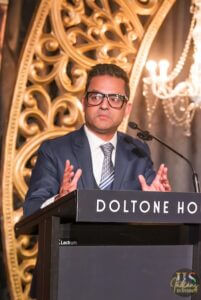
“Monoculture in the modern world cannot survive,” he says. Yet as the conversation progresses, that certainty gives way to a series of questions about what multiculturalism actually means, and whether Australia is practising the version it celebrates.
Ahmed is particularly critical of governments and councils funding cultural celebrations that can end up being attended primarily by the same community that is celebrating. Diwali becomes an Indian event attended by Indians; Eid an event attended by Muslims; Italian celebrations largely attended by Italians.
“Cultural events must be genuinely multicultural, rather than simply a collection of separate cultural celebrations operating alongside one another,” he says.
Ahmed’s suggestion is striking – government grants could perhaps require 20 or 25 per cent of participants to come from other cultural backgrounds.
There is, of course, an obvious contradiction. Ahmed himself leads an organisation called Indians in Sydney. He acknowledges the point. The name sounds monocultural, he concedes, but he argues that the work is not. Its activities, from homelessness initiatives to media literacy and community programs, involve people from a range of backgrounds. Indeed, he says, the volunteers who regularly turn up to some initiatives are overwhelmingly non-Indian.

It is a contradiction, but an illuminating one. Perhaps communities need an identity before they can build bridges to other communities. A strong cultural identity doesn’t necessarily have to be a barrier to integration; it can be the starting point from which people engage with others. Ahmed’s challenge, and perhaps the challenge for Indians in Sydney more broadly, is working out where community identity ends and a genuinely broader multicultural role begins.
Ahmed is similarly conflicted when discussing Australian values. He believes migrants should embrace Australian values while retaining pride in their heritage. He talks about democracy, equality, humility, civic responsibility, mutual respect and, above all, the Australian concept of a “fair go”. But then comes the uncomfortable question: is there really a fair go when subtle discrimination still exists in Australian workplaces?
Ahmed’s answer is no: “Discrimination exists on both sides. There can be prejudice against migrants, but I also acknowledge criticism that some Indian businesses employ predominantly Indians.”
Again, he finds himself wrestling with an uncomfortable reality: the values he wants everyone to embrace are not always practised by everyone. His answer is not to abandon those values, but to try harder to make them real. That same tension appears when he discusses racism.
“Australian political leaders generally support multiculturalism,” he notes, adding that some politicians have done considerable work to promote social cohesion such as initiatives involving police, community engagement and anti-racism. But he remains dissatisfied with the tendency for multiculturalism to become an occasion rather than an ongoing responsibility.

“Politicians attend community functions, speeches are made and photographs are taken, but the harder work of changing institutions and grassroots behaviour can remain unfinished”.
Yet Ahmed is reluctant to simply blame politicians. The community itself, he says, has to accept responsibility. And this is perhaps where his frustration is greatest.
“Indian and wider South Asian communities are too fragmented to exercise the political influence their numbers might suggest. Regional, linguistic, religious and cultural differences create competing groups, often operating independently. There is no sufficiently powerful advocacy organisation speaking with one voice.”
When asked why, Ahmed’s answer again turns inward: the community itself is partly responsible.
First-generation migrants are often too busy building careers, businesses, families and financial security to devote substantial time to politics. Ahmed knows exactly what he is talking about. He estimates that his own community work can consume four or five hours a day, often at the expense of family time. There is a certain irony here. He wants Indians in Sydney to become more engaged with governments and policymakers, but he also understands the personal commitment required to turn community participation into sustained advocacy.
That may be the next challenge for Indians in Sydney. It has demonstrated that it can bring people together. The question is whether it can turn that ability to convene into something more purposeful: a stronger, more organised and more consistent advocacy voice. There is a considerable difference between having a politician attend a community event and having that politician respond to a clearly articulated community position. One is access; the other is influence. Strong advocacy requires more than relationships and good intentions. It requires choosing issues, developing positions, gathering evidence, building alliances and being prepared to keep pushing after the photographs have disappeared from social media. It may also require occasionally making people uncomfortable – including politicians, governments and perhaps community organisations themselves.
Nadeem Ahmed Indians In Sydney

Perhaps that is why his solution lies partly with the next generation.
“Young Australian Indians, the second generation, born and raised here, may be better placed to bridge the divide. They understand their heritage but are also thoroughly familiar with Australian society. They could well become the political and community leaders the first generation has struggled to produce. The challenge is creating the pathways that allow them to do so,” Ahmed says.
The gala dinner was therefore more than a celebration for him. It was an experiment in the kind of community engagement he wants to see. He deliberately included Indian traditions from different parts of the country, from food to classical dance, while also incorporating Turkish and Aboriginal performances. He wanted people to understand Indian culture, but he also wanted Indians to share a room with people who were not Indian.
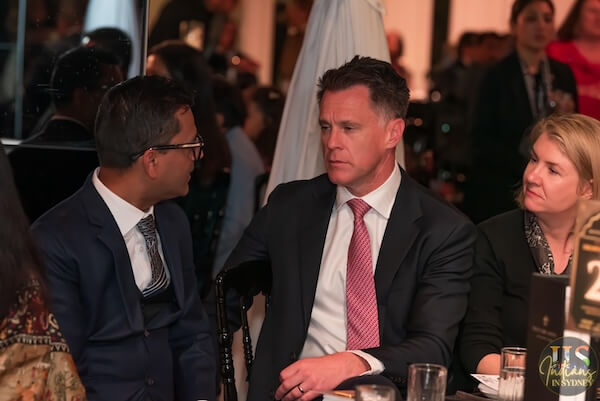
Ahmed is a community organiser trying to work out the practical version of it. He sometimes contradicts himself. He criticises monocultural celebrations while leading an Indian-focused organisation. He demands more from politicians while acknowledging that migrant communities themselves are often reluctant to engage politically. He talks about Australian values while openly admitting that those values are imperfectly practised.
But those contradictions do not necessarily weaken his argument. They reveal someone grappling with the complexity of the society he wants to improve.
And whatever the unanswered questions, there is little doubt about his intent.
The more interesting question now is whether that activity can evolve into greater influence, whether his organisation can move from being a community that gathers to a community that advocates, from creating connections to pursuing outcomes.
Ahmed may not have figured out exactly how multicultural Australia should work. But he is clearly trying to make it work, one dinner, one conversation, one community initiative and, hopefully, one uncomfortable question at a time.
READ ALSO: Beyond Dialogue: Building the next chapter of Australia–India Relations