


The Indian Film Festival of Melbourne has always danced between being a film festival and a grand Indian celebration, and this year it threw its arms around both with gusto.
For its 17th edition, IFFM 2026 came to Melbourne with over 130 films from more than three dozen languages, plus premieres, retrospectives, conversations, festivities in Federation Square, and star power.
There was an abundance of it.

Rani Mukerji, Rekha, Dulquer Salmaan, Rishab Shetty, Pankaj Tripathi, Vijay Varma, Kirti Kulhari, Rasika Dugal and Malaika Arora were among the names descending on Melbourne. For a few days, spotting Indian cinema royalty against familiar Melbourne backdrops became strangely normal.
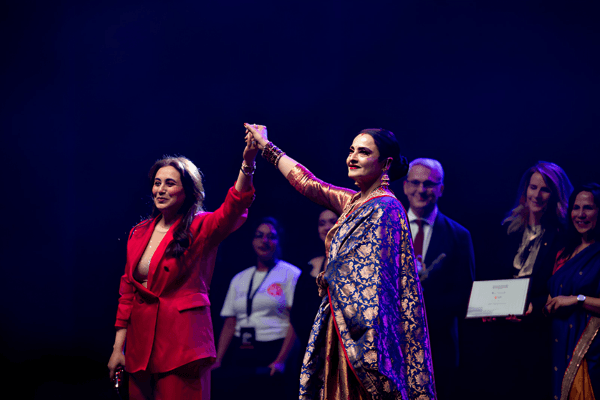
The conferral of an Honorary Doctorate of Letters on Rani Mukerji made for one such showstopper moment, the star shedding tears as she took to the stage for her speech.
The glamour peaked at the Palais Theatre for the IFFM 2026 Awards Night. Hosted by Dolly Singh, the evening had all the ingredients: gowns, saris, flashbulbs, screaming fans and Indian stars walking a red carpet in St Kilda.

Speeches were a recurring feature of the evening.
Local politicians and government representatives attended, and the familiar vocabulary of multicultural events appeared repeatedly: impact, culture, diversity, community. Opposition Leader Jess Wilson announced from the Awards Night stage that a Liberal-National government would commit $2.8 million to IFFM over four years. The Labor Government had announced its own $600,000 election commitment over two years.
Indian cinema, evidently, has political capital in Victoria too.
Only later, when IFFM 2026 moved from celebrations to screenings, did the talk of cultural impact become more complicated.
IFFM 2026 Opening Night featured R. Gowtham’s Tamil film Members of the Problematic Family, which had just come from Berlinale and had not yet premiered in India. The story, set during a 16-day funeral in rural Tamil Nadu, was messy, personal, sometimes uncomfortable, and intensely human. It was one of my favourite moments of the festival, but seemingly was a harder sell than Awards Night, with many seats going empty once the dignitaries departed.

A few hours later, I was at Pakka Local, a South Indian DJ night, dancing to Tamil and Malayalam music among a much larger crowd. The contrast was almost comical. Maybe audiences willing to pack a dance floor for regional music aren’t looking for independent cinema? Their loss.
The choice to program R. Gowtham’s groundbreaking Tamil-language film was one of many clear efforts to bring South Indian cinema into the spotlight, and a showcase of Indigenous language films was an equally welcome inclusion that will hopefully last for successive festivals. But such regional, independent films still struggle to get noticed next to all the celebrity attention – a mixture of flawed marketing, audience disposition, and the film industry’s barriers for independent films.
It was heartening to see the trend bucked on the last days of the festival – the Australian premiere of Punjabi indie film Kikkran de Phull (Flowers of Acacia) was one of the most memorable in recent history; a deeply disquieting look at the vicious, insidious claws of misogyny that should be essential viewing for all men. Closing Night film Full Plate, and accompanying short film Graveyard Shift, continued this examination of the patriarchy, but, refreshingly, left viewers with a kernel of optimism for the power of female friendship.
In a week where the Sydney Swans’ distressing sexual assault allegations dominated the headlines, and as femicide continues to grow at an alarming rate in this country, these films were potent reminders of the power of cinema to draw attention to injustice and advocate for change.
The latter context also made these films come down forcefully without adequate accessibility measures, but to its credit, IFFM is also a festival capable of reflection, and more detailed content warnings were quickly adopted. Here’s hoping these will be a festival fixture.
Nonetheless, we can chase dignitaries and celebrities. Impact sounds excellent in a speech. Diversity looks better for an election campaign. So, who really is here for the films?
I found some answers during my cab rides home.
One Greek driver told me he loved Indian films from the 1980s and 1990s. On another night, a Somali driver remembered fighting with his friends as a kid to watch Indian movies at their local theatre.
At the IFFM 2026 Awards Night, an Indian diplomat offered an even stranger anecdote, recalling how, during a kidnapping ordeal involving Somali militants, Indian movie DVDs somehow entered the ransom negotiations.
Forget the red carpet. That’s cultural reach.
IFFM 2026

Long before streaming made films easy to access, Indian movies found their way into theatres and homes far from India. They stayed in people’s memories for decades.
Cinema can be a force for good, if we allow it the space to speak. So, with all the red carpets, speeches, celebrity appearances, and talk about cultural impact, both we as an audience, and IFFM as a festival must remember to do the thing that started it all: Watching the films.
With contribution from Lakshmi Ganapathy.
READ ALSO: Family, fractured: R Gowtham on ‘Members of the Problematic Family’