


For Jinal Parmar, a doctoral researcher and educator at Western Sydney University, improving health has never been simply about treating illness.
Her interest in public health grew from a question that has stayed with her throughout her career: why do some people have better opportunities to be healthy than others?
Early in her career, Parmar saw how education, culture, language and access to services could shape people’s health outcomes. It made her realise that many of the factors determining health lie beyond the walls of a hospital or doctor’s clinic.
“Public health gave me the opportunity to work on prevention and create broader impact, and that’s when I knew this was the field I wanted to build my career in,” she tells Indian Link.
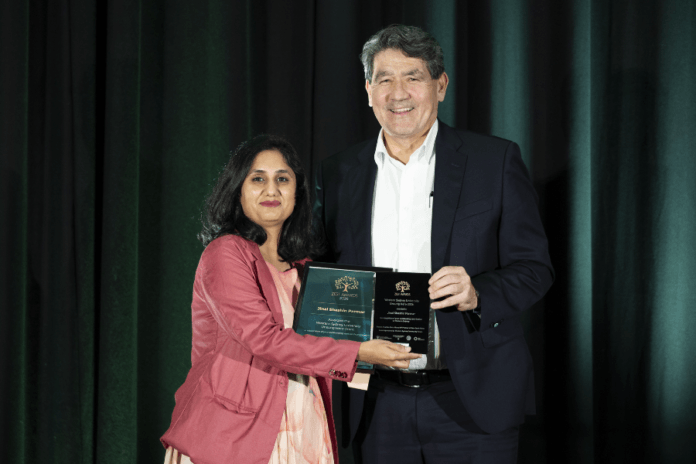
With this belief driving her work, Parmar recently earned the 2026 Western Sydney University Unsung Hero Award.
The award is part of the annual ZEST Awards, led by the Western Sydney Community Forum to recognise the diverse contributions of the community sector across Greater Western Sydney. The initiative also aims to recognise and nurture emerging leaders helping shape the region’s future.
View this post on Instagram
MAKING HEALTH FAIRER
Today, Parmar is a PhD researcher at Western Sydney University, where she works within the Health Equity across the Lifecourse (HEAL) Research Lab, while also teaching undergraduate and postgraduate health science and public health students. Her work has increasingly focused on the barriers faced by culturally and linguistically diverse communities, particularly around health literacy and access to care.
Her path back to Western began in 2015, when she enrolled in a Master of Public Health, completing it in 2017. After spending the following years working in research and health-related roles, she returned to the university in 2021 to begin her PhD.
Those years away from university helped her move beyond theory and understand the complexities of working with communities.
The experience, she says, taught her the importance of listening to people’s lived experiences and developing solutions that are practical rather than simply academically sound.
That philosophy now runs through her research.
Her recent research, involving 309 Indian migrants with Type 2 diabetes in Greater Western Sydney, found that more than two-thirds had low health literacy and almost 69 per cent reported low medication adherence. The study found a strong association between health literacy and adherence to diabetes medication, highlighting the need for culturally tailored support.
But for Parmar, statistics and research papers are only part of the picture.
“There wasn’t one single moment. Rather, it was hearing similar stories from different people and communities over time,” she says of what first changed her understanding of health inequality.
Parmar has encountered people who wanted to take care of their health but struggled with language, health literacy, cultural differences or simply navigating a complicated healthcare system.
Those encounters reinforced an important lesson: health inequality is not always the result of individual choices.
“They have taught me the importance of listening before trying to solve a problem,” Parmar says of the communities she has worked with. “Every community has its own strengths, values and experiences.”
LOOKING AHEAD
For Parmar, the value of her work cannot always be captured in research findings or statistics. Much of it happens through conversations – listening to people, understanding their circumstances and gradually building trust.
“Because the impact is often seen in people rather than numbers,” she says. “Building trust takes time, and many meaningful conversations happen one person at a time.”
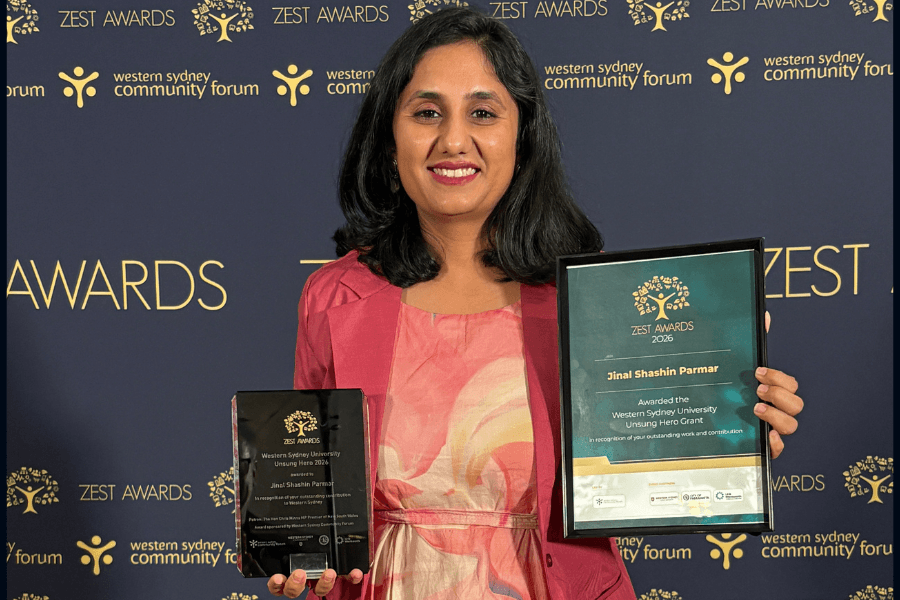
The Western Sydney University award has prompted Jinal Parmar to reconsider what success means to her.
Earlier in her career, she measured success more through achievements and milestones. Today, she places greater value on whether her work has made someone’s experience better, helped another person or contributed to a healthier community.
Her definition of success has also been shaped by the people closest to her.
Her supervisors have taught her persistence and the importance of research with real-world relevance. Her husband and wider family have supported her through the demands of study, work and family life. And her four-year-old daughter has given her another perspective on why healthier and more equitable communities matter.
Her advice to the younger version of herself would be simple: “Be patient and trust the process.”
Not every opportunity or setback makes sense when it happens, she says, but each experience can teach something valuable.
Looking ahead, Parmar is less interested in being remembered for one particular paper, award or professional milestone than for the difference her work makes.
“I hope my work is remembered for helping people,” Jinal Parmar shares, smiling.
Whether that happens through research, teaching students or working alongside diverse communities, she wants her legacy to be one of listening, empathy and action.
“If my work helps create more equitable and inclusive health outcomes for communities, that would be the greatest achievement.”
Read more: UNSW scientist Ashish Sharma bags top American award in hydraulic engineering