




The world today faces enormous challenges: climate change, technological disruption, mass migration, and geopolitical rivalries. Typically, we would look to solve these by recognising that we can do better if we collaborate. Is that happening, however?
America is divided. In Europe and Australia, anti-immigration rallies are on the rise, while in the US, the same group that protests anti-Hindu hate there can turn around and seek to prevent Muslim prayers back home.
In an age of increasing political polarisation, extreme ideologies are shaping public discourse in ways that fracture communities and undermine shared values. The far right, with its emphasis on ethno-nationalism, exclusionary identity politics, and conspiratorial narratives, has gained visibility in the United States and abroad. The far left has also produced intolerance: against anyone who opposes its orthodoxy. Often, they attack each other directly: when Charlie Kirk espoused views seen to be racist (which is, nevertheless, legal), he was killed (which is horrifying).

The Far Right: Fear as a Weapon
The resurgence of the far right has been most visible in events such as the 2018 Pittsburgh synagogue attack, the rise of violent white supremacist networks like “Terrorgram”, and conspiracies like the “Great Replacement” theory. These movements thrive on fear – fear of demographic change and fear of losing dominance. They find fertile ground when economic dislocation or cultural shifts occur, and they promise certainty through exclusion: “us” versus “them.”
Globally, this pattern is evident as well. In France, far-right violence against Muslims has been on the rise, while in Slovakia, a gunman radicalised by online propaganda attacked a gay bar in 2022. These examples show how extremist rhetoric can migrate across borders in the digital age. What begins as fringe discussion on obscure message boards can metastasize into acts of terror in real communities.
The Far Left: Intolerance in the Name of Justice
Far-left currents present their own challenges. Beyond the assassination of Kirk, groups like Antifa, Redneck Revolt, and the John Brown Gun Club are animated by anti-fascist and anti-racist thought – and become a lot worse than just thought. Beyond the US, the far-left can express admiration for authoritarian regimes, excusing repression if it is carried out under anti-hate banners, as when Justin Trudeau froze the bank accounts of those protesting vaccine mandates. On social media, so-called “tankie” communities glorify violence against political opponents as long as they serve a revolutionary cause.
The risk here is not only physical violence – but also the erosion of democratic dialogue. As a GWU study on anarchist/left-wing extremism reveals, these groups show how even moral certainty can become hypocrisy. Just as the far right weaponises fear of the “other,” the far left can weaponise purity and orthodoxy to silence dissent, replacing pluralism with a new form of dogmatism.
The murder of Charlie Kirk is part of a disturbing rise in political violence that threatens to hollow out our public life.
A free society relies on the premise that people can speak out without fear or humiliation.
No more political violence. pic.twitter.com/SR71FJkiDz
— Sen. Bernie Sanders (@SenSanders) September 11, 2025
The Human Cost of Division
What unites both extremes? Their rejection of shared humanity! For the far right, the line is drawn by race, religion, or nationality. For the far left, it can be drawn by ideology or class. In democratic states, polarisation weakens institutions and makes compromise nearly impossible. In fragile states, it can spill into civil conflict.
The Way Forward
How, then, can we resist extremism and work toward a more united human community? Several principles are essential:
- Re-centre human dignity. Every major religious and ethical tradition recognises some form of the Golden Rule: treat others as you would like to be treated. We must elevate this principle above partisan identity. Whether right or left, no ideology should excuse denying another’s humanity.
- Build shared narratives. People need stories that bind, not divide. This means highlighting contributions from diverse communities to national life, teaching histories that acknowledge injustices while celebrating resilience, and framing democracy itself as a shared achievement worth protecting.
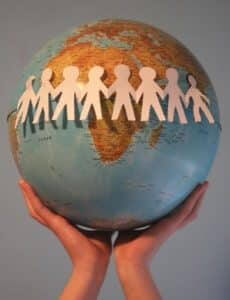
Humanity comes before Far-Right Far-Left (Source: Canva) - Invest in economic inclusion. Extremism feeds on despair. When people believe the system has abandoned them, they are more susceptible to absolutist answers. Policies that expand opportunity, reduce inequality, and ensure basic security undercut the breeding ground for radicalisation.
- Defend open dialogue. Pluralism requires the ability to disagree without violence or intimidation. Universities, media, and digital platforms should safeguard spaces for debate, resisting both the censorship of uncomfortable truths and the amplification of hate speech.
- Foster global solidarity. In an interconnected world, extremism does not stop at borders. Countering it requires international cooperation – sharing intelligence, regulating extremist online networks, and promoting exchanges that highlight our common humanity rather than our divisions.

To be clear, critique of extremism is not a critique of legitimate political engagement. It is about disagreeing without being disagreeable. If we are to unite as one human community, we must learn from the failures of both extremes. The task is not to erase difference, but to weave difference into strength. In the end, our survival – and our flourishing – depends less on the banners we wave and more on the bridges we build.
Read more: Unfairly targeted. Undeniably vital.