


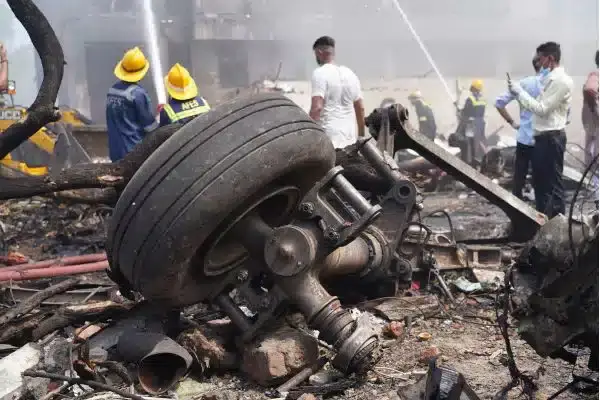

On the fateful afternoon of June 12, 2025, a metal bird fell from the sky into the heart of a government medical college in western India, claiming at least 270 lives. Within minutes of take-off, Air India’s Flight AI171, a Boeing 787-8 Dreamliner bound for London Gatwick, lost altitude and crashed into a residential area scarcely two kilometres from the airport. Of the 242 people onboard, 241 lost their lives almost instantly. Another 29 lives were lost on the ground – some of them aspiring doctors, gathered for lunch in the mess hall. The scale of the tragedy was so mammoth that the deaths of dozens of hardworking medical students were but a footnote in the news reports.
Images of the crash site, spread over 200 metres, are among the most confronting to hit our screens in recent memory. Within minutes of the incident, smartphone videos and CCTV footage of the massive fireball and the billowing smoke flooded our screens. The rawness of the visuals triggered a collective trauma for not just millions of Indians but deep within the Indian diaspora. The cycle of tragedy continues for India, for Boeing and has now engulfed Air India, with repercussions for India’s corporate world, the global aviation sector, and Indian travellers worldwide.

Indians reeling from one tragedy after another
India is no stranger to grief. However, the string of devastating tragedies in 2025 has been relentless.
Stampedes, one at the Mahakumbh and another one recently during the IPL victory parade in Bengaluru, took scores of lives.
The brutal and calculated terror attack in Pahalgam, followed by a military clash just short of a full-fledged war, served as a chilling reminder of the dangers still facing India. The fact that many Indians instinctively asked whether terrorism was involved in the crash speaks volumes about the deep scars.
Though AI171 was enroute to London, its impact was global. Among those on board were professionals, families, and students – the quintessential Indian diaspora. Two young girls in London, aged 4 and 8, were orphaned when their father, Arjun Patoliya, boarded the flight after performing last rites for his late wife in Gujarat. Dr. Kaumi Vyas was a young doctor migrating to the UK with her husband and three children. Irfan Shaikh, a 22-year old crew member, had just returned to work after the Eid break. Their journeys ended brutally. As we learn more about the victims, many more heartbreaking stories of lives and dreams cut short are emerging.
The Indian-Australian community, thousands of kilometres away, felt the aftershocks deeply. Reports that the same aircraft flew in and out of Australia days earlier left many realising how closely connected they were to the tragedy. Flights from India to world cities like London and Sydney are full of suitcases that look like Indian festivals – crisp new sarees and kurtas from that hometown shop, leak-proof packets of sweets and spices made with love by families, and loads of memories surviving the transcontinental travel.

So when news of the AI171 crash broke, it wasn’t just grief – it was a gut punch. In WhatsApp groups and living rooms across Australia, Indian families reacted with shock and shed tears of grief for the bereaved families. Leaders of community organisations in Sydney and Melbourne issued heartfelt statements, organised candlelight vigils and signed condolence books. Mourning transcended borders.
Air India may never be the same again
This is undoubtedly a massive setback for Air India, which had been hoping to turn its sagging fortunes around following its sale to the Tata Group. For people of Indian origin, Air India holds a deep connection. Elderly family members travelling alone choose it for the cultural familiarity. For many immigrants, it is their first memory of migration and the comforting bridge between their adopted land and motherland.
There was hope until three days ago that the Maharaja would rule the skies again. But now, it’s all in jeopardy. Regaining public trust after a high-casualty crash is near-Herculean and many worried flyers are rethinking their bookings.
Malaysia Airlines offers a chilling parallel. After MH370 and MH17, its brand was so damaged that many flights flew near-empty and fares were slashed well below market rates. The Malaysian government paid out the minority shareholders, delisted the airline and declared the old firm bankrupt. The airline took nearly a decade to turn profitable again, strongly supported by its shareholder, the Malaysian government.

The Tata Group may have to commit itself to that level of support to Air India to keep it afloat. Passengers would need a lot of incentive to fly Air India in the short term to overcome the stigma and the airline would have to fix systemic issues at the same time.
Boeing: A crisis renewed
For Boeing, AI171 is yet another gaping wound. Still reeling from the 737 MAX disasters and the Alaska Airlines door-panel debacle in 2024, the US aerospace giant had been clawing its way back into credibility. The Dreamliner was once hailed as a marvel and had until now maintained an impeccable safety record. This crash changes everything. What’s raising eyebrows is that whistleblower complaints about the 787’s production quality have been surfacing in the recent past.
CEO Kelly Ortberg brought out of retirement to steer the company in 2024, has already cancelled his plans to attend the Paris Air Show where he was planning to present an “upbeat progress report on Boeing’s recovery to financial health”. If trust in Dreamliner erodes, the consequences will be systemic for Boeing.
The broader fallout
For global aviation, AI171 is more than a statistic. Images of mangled fuselage and burning wreckage linger far longer in public memory than safety statistics in annual reports. Expect greater passenger hesitancy, greater scrutiny of Boeing fleets, and regulatory reviews across the world. Some aviation experts have already flagged concerns about urban construction patterns near airports like Ahmedabad’s. With the black box recovered, the world awaits answers and accountability.
A future written in grief
In the aftermath of AI171, what remains is raw, collective grief. To address the concerns about air safety, Air India and Boeing must confront their internal demons, lead with transparency, and demonstrate changes in safety culture. Families must once again be able to wave goodbye to their loved ones at the airports without a shadow of fear.
Flight AI171 will forever be remembered as a tragic chapter in India’s modern history. India will yet have time to mourn every lost life individually. And that’s the saddest part – there is plenty of grief already, but there is much more still to come as the nation begins to reckon with the life story of each unfortunate victim of #117.
READ ALSO: Racism rears its head after Air India crash “We grieve, they troll”