

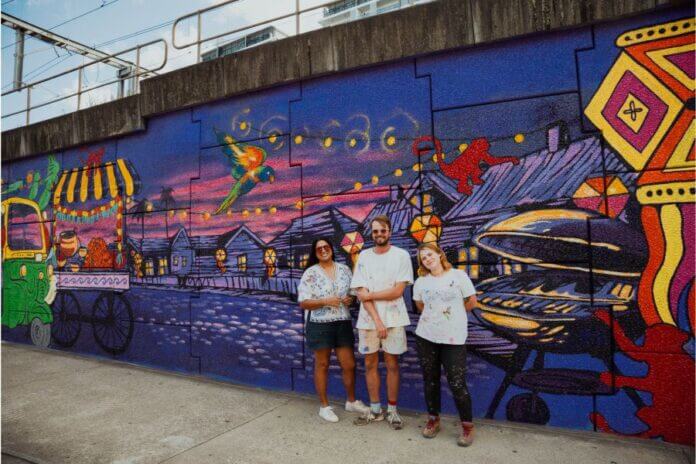
At Sydney’s Harris Park, affectionately called ‘Little India’, a 120-metre mural transforms Station Street East into a living, breathing canvas. There is no single story, no single narrative — and that refusal to simplify sits at the heart of this project.
The artwork, as artist Gauri Torgalkar describes it, is a layered visual journey through “memory, adaptation, and assimilation”, capturing not just what the South Asian diaspora looks like, but what it feels like to live between worlds.
Titled ‘A Tapestry of Harris Park’, the mural marks the first stage of a broader cultural precinct project led by the City of Parramatta with support from the Australian government. Beyond its scale, the collaborative work, inaugurated on April 2, stands out for its insistence on complexity – resisting the easy, often flattened narratives that diaspora communities are reduced to in public art.
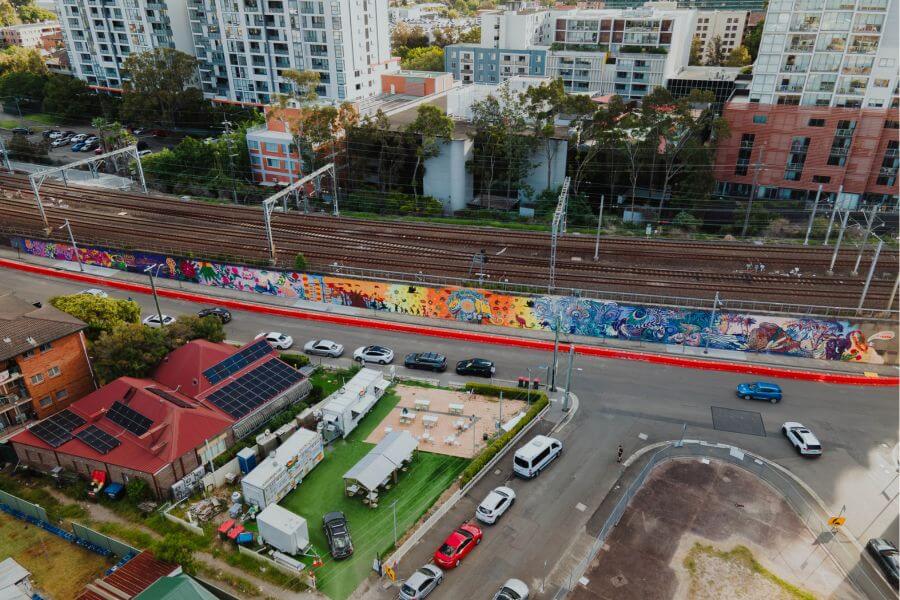
Harris Park itself embodies that complexity. Once home to early European settlers, later a thriving Lebanese community in the 1960s, it is now widely frequented by the South Asian diaspora. Yet, as Torgalkar points out, even in its current identity, the suburb carries “markers of its previous iterations and journeys, alongside the newer more nuanced and layered hybridity it experiences on a regular basis”.
For Torgalkar – who has lived in India, the US and now Australia – that hybridity is deeply personal. Her practice, she says, has long explored “the immigrant experience, particularly the need to forge cultural connections within new communities”. In this mural, that translates into a refusal to offer a singular version of South Asian identity. Instead, the work embraces multiplicity, allowing different stories to coexist.
The birth of a unique concept
Extensive community consultation was a huge part of creating the mural. Torgalkar, along with collaborators Em Hatton and Patrick Hunter, gathered stories ranging from first-generation migrants’ early struggles to younger voices navigating dual identities. The team merged these voices – so they are “nostalgic for those from the diaspora, while exciting for visitors unfamiliar with the culture”.
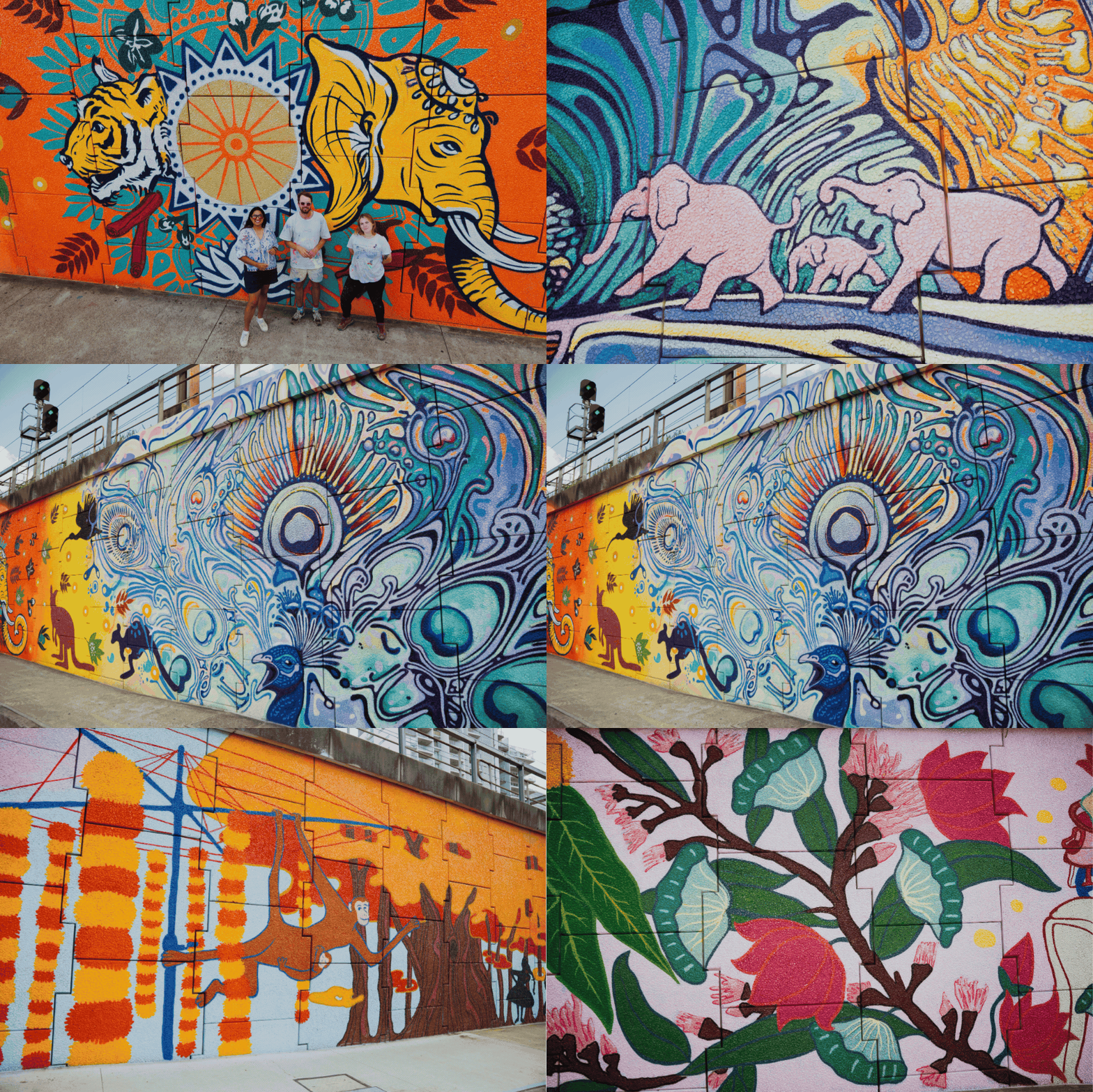
At the centre of the mural sits a powerful metaphor: food. Not as cliché, but as connection. Drawing from the Dharug meaning of Parramatta – “the meeting place of eels” – the three artists created a gathering scene around a radiant golden sun, sending spices and herbs outward. Indian elements such as chillies, cinnamon, cloves and anise sit alongside Lebanese olives and wheat, and native Australian ingredients like lemon myrtle. An elephant welcomes visitors with a garland, embodying ‘Atithi Devo Bhava’, the Indian ethos of hospitality.
Food, Torgalkar explains, is often the first entry point into culture – “No celebration is without food”. But here, it becomes something more: a shared language across communities.
That idea of coexistence runs throughout the mural. The duality of janmabhoomi (land of origin) and karmabhoomi (land of action) – a concept echoed by community members – is visually embedded across the work. Indian motifs are never isolated; they are always grounded in Australian contexts. Marigold garlands hang from a Hills Hoist. A monkey swings through a suburban backyard. Diwali lanterns illuminate heritage buildings. A peacock dances alongside a lyrebird.
Art attack
But not all stories are loud. Embedded within the mural are quieter, more intimate narratives: two girls practising Bharatanatyam, perhaps alongside ballet or jiu-jitsu, reflecting parents’ efforts to preserve culture through the next generation; children playing cricket under a banyan tree – a symbol both deeply Indian and universally communal.
If one looks closely, the mural’s structure carries meaning – it moves from sunrise to nightfall, becoming a metaphor for migration itself — “beginning with arrival… moving towards assimilation and adaptation… and then toward belonging,” Torgalkar tells Indian Link. The shifting colour palette mirrors this journey, evolving from cool morning tones to vibrant midday hues and softer evening shades.
For contemporary artist Em Hatton, navigating this complexity required restraint. “The highest priority for us has been in not coming in and making assumptions,” she says, particularly as someone outside the South Asian diaspora. Instead, her role became one of facilitation, centering community voices and ensuring that “all elements in the mural are directly related to stories from the community.”
Hatton’s own connection to the diaspora – through her South Indian Tamil partner’s family, who migrated to Western Sydney in the 1980s – also shaped her understanding. She speaks of the “third culture” experience, where second-generation individuals exist not within one identity, but a hybrid of both.
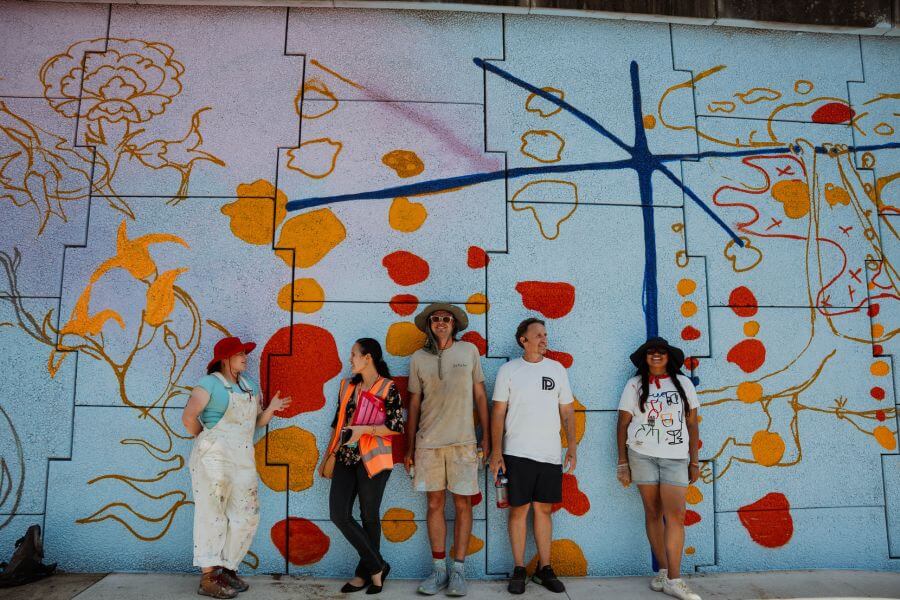
For Patrick Hunter, the scale of the mural offered a different kind of challenge. “At that size the mural becomes an environment rather than an image – you move through it, you don’t just look at it,” he shares.
Rather than pre-defining the entire composition, Hunter worked from sketches, allowing the piece to evolve organically. The key, he explains, was rhythm: “tension and release… areas of complexity that reward close looking, and then moments of breath”.
The left-most section of the mural, featuring the cockatoo surrounded by paisleys and floral motifs, was brought to life by community members, residents and shopkeepers.
“When people feel connected to a work, they care for it,” Torgalkar adds. “In that sense, this mural is not just for the community and of the community, but it is also, in part, created by the community, for all to experience.”
Read more: Gauri Torgalkar: An Australian floral tribute to Diwali