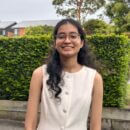




Vedika Rampal
A virtual visit to Hampi in southern India is featured in Sydney-based artist Vedika Rampal’s Blake Art Prize for works with religious and spiritual themes.
The archaeological remains of this extensive complex of temple architecture, built between the 14th and 16th centuries, are a travellers’ delight to this day. The ancient structures — part of the living landscape — age and change alongside nature.
In Rampal’s work, the ruins at this UNESCO World Heritage Site become a material inquiry into history, erasure, and the act of re-inscribing Indian heritage.
View this post on Instagram
Titled “inscription against inscription”, the immersive installation pairs two large sheets of copper suspended in a darkened space, their surfaces etched with repeated, enigmatic script-like marks drawn from landscapes of Hampi’s ruins. These hand-transferred prints mirror fragments of lost and fragmented Indic inscriptions, blurring the lines between text, image and the material’s own weathered history. Across the reflective copper faces, a video of Nandi the bull beside the flowing Tungabhadra River is projected, its presence merging myth, nature and memory.
For Rampal, it all began during a visit to the Ajanta Caves in Maharashtra in 2023. There, she experienced something unexpected. In the 1800s, diary notes by students from the Bengal School of Painting described their journey here as a “great pilgrimage” — a moment of discovering a part of their history they had never known existed. Rampal found herself feeling much the same.
“My experience of visiting the Caves in 2023 (and reading these notes) made me realise that living in a diaspora isn’t new, and cultures like ours are always changing,” she told Indian Link.
It’s a feeling with which many Indian-Australians will be instantly familiar.

Travelling in India and encountering its history through a new lens, is a privilege and a realisation that your relationship with your own heritage is never fixed but always evolving.
And so, the India-born and Sydney-raised artist describes her practice as ‘existing in a space where clear binaries dissolve’.
Colonial ideas, she explained, have long shaped what gets called art and what gets called artefact, determining which cultures are “civilised” and which are not. Her work pushes back against that.
“When I cannot fit historical pieces of art into binary categories, I start thinking about how we can write over colonial assumptions rather than simply rewriting,” she offered. Vedika Rampal
The ‘writing over’ is an essential element of her Blake Art Prize work. Re-inscription carries the object with all its symbols and meanings — its inherited meaning derived from colonial viewpoint, and the modern perspective through re-encountering it.
Like a palimpsest.
A palimpsest is a manuscript written over and yet bearing the traces of what came before. For Rampal, this creates a non-linear style of art where the original work, its colonial influence, and modern reinterpretations exist simultaneously.

Of course, there are messages in the materials too.
Rampal works with unfixed copper, jute, acrylic sheets — materials available to her in present-day Sydney, not romanticised relics of the past. Copper is her favourite, precisely because it cannot be controlled.
“It is a conservationist’s nightmare,” she revealed. “I refuse to seal it with wax to preserve it, because that would reflect the mindset of capturing and controlling objects. If humans are able to live, grow and die, then why must art live forever?”
To deliberately choose impermanence takes courage. It interrogates the imperial urge to preserve and control, while acknowledging that Indian heritage has already been subjected to centuries of Western intervention. In Rampal’s work, there is a constant push and pull between honouring what remains and refusing to keep it frozen in the past.
It is a quiet challenge to the colonial instinct to preserve, to fix, to own.

Meditating on layered histories, erosion and the idea of re-inscription, it asks what a counter-colonial signature looks like on materials that resist preservation.
Inviting people to engage with Inscription against inscription, Rampal offers the audience a chance at their own encounter with history. A video installation runs on an endless loop. “You can either spend hours watching it, or seconds,” Rampal described. “(Listen to) the sound piece made at the Tungabhadra riverside – I’d like to know if you can hear snippets of a language you recognise, or something that sparks a memory in you.”
Vedika Rampal is a Finalist in the Blake Art Prize, 2026. The winner will be announced at the official launch on 1 May. See the exhibition from 2 May-14 June at Liverpool Powerhouse, Sydney.
READ ALSO: Meet Talwinder, the graffiti artist repainting heritage