
Home Blog Page 935

A (Modi) rose by any other name

0
Reading Time: 3 minutes

A new, specially developed variety of rose – dedicated to Prime Minister Narendra Modi – has been unveiled at the Dombivli Rose Society in Mumbai

The ‘Modi’ rose

The rose named “Saffron-Vermillion Red with Yellow River” has German parentage and has been carefully developed after nearly five years of research and development at the world famous KSG Roses, Bangalore.

Vinod Tawde, Leader of Opposition in the Maharashtra Legislative Council, and legislator Ravindra Chavan formally inaugurated the ‘Modi Rose’ at the DRS rose garden on 13 August.

As soon as the curtain was lifted off the ‘Modi Rose’, displayed on a special platform, a huge crowd of rose lovers and guests cheered and clapped to welcome the latest entry into the country’s rose family.

It will take at least another two years for the ‘Modi Rose’ to be commercially available in the markets, the organisers said.

This is one of the rare instances in the country when a rose – the universal symbol of love – has been named after a top politician.

In the past, special rose varieties have been named after prime minister Jawaharlal Nehru, President S. Radhakrishnan and Netaji Subhash Chandra Bose.

Some decades ago, late prime minister Indira Gandhi had a special rose dedicated to her – Pink with White River – and called ‘Indira Priyadarshini’.

KSG Roses managing director Sriram K. Rangan said that usually they do not part with their global exclusive creations, but since the DRS wanted to immortalise it by naming it after the prime minister, they agreed.

“This year, we developed over two dozen new varieties, of which the ‘Modi Rose’ turned out to be the best and healthiest,” Rangan told IANS from his nursery in Bangalore.

After tending to it dedicatedly, with considerable research and efforts over the past five years, the new rose became ready earlier this year when Modi was still campaigning for the Lok Sabha elections.

The company’s 84-year-old chairman, Kasturi Rangan, said there are presently around 4,000 varieties of roses, authentically documented and catalogued.

“Besides, worldwide, there are around 25,000 varieties and another 25,000 varieties which are yet to be properly documented,” Rangan told IANS.

Referring to the roses named after VIPs, he said there are a variety of protocols to be followed before a rose can be dedicated to any dignitary – the most important being his or her consent.

Confirming that Modi has given his consent, a pleased Ravindra Chavan, DRS patron and Bharatiya Janata Party (BJP) legislator, said that when they saw this particular rose at the KSG Roses nursery they fell in love with it.

“It is of a medium size, but appears unique and stands out among others, emits a soothing and sweet fragrance. We requested Kasturi Rangan to allow us to dedicate it after the prime minister,” Chavan told IANS.

According to Chavan, they toured around the entire country to acquire the best and unique rose saplings for the DRS before they finally went to KSG Roses and settled for the varieties there.

It was a sea of beautiful roses of different shapes, sizes, colours; single, dual or multi-coloured, each with a unique fragrance and texture.

Rangan said developing and selling roses was a huge business in the country with Maharashtra’s Pune city alone accounting for over 10 million saplings annually, followed by West Bengal with 7.5 million and Karnataka with 1.5 million through some 60-odd nurseries around the country.

“The sad part is that most customers still insist on imported varieties of roses, though the Indian varieties are among the best available in the world,” rued Rangan, who heads the 100-year-old company.

KSG Roses supplies the flower to some of the top government bodies, residences of governors and chief ministers, ex-royalty, top corporate houses and private individuals and rose lovers around the country for their unique gardens or nurseries.

The country’s single largest collection of 2,500 rose varieties can be found at the famed Ooty Rose Garden.

Legendary horticulturist and rose master M.S. Viraraghavan lives in Kodaikanal and his creations are globally patented and adorn the homes of the rich and powerful worldwide, Rangan said.
Indian-origin Princeton prof snares ‘Nobel Prize of maths’

0
Reading Time: 2 minutes

Two Indian-origin mathematicians have won prestigious global prizes in the field of mathematics with one being awarded the Fields Medal – the “Nobel Prize of mathematics”.

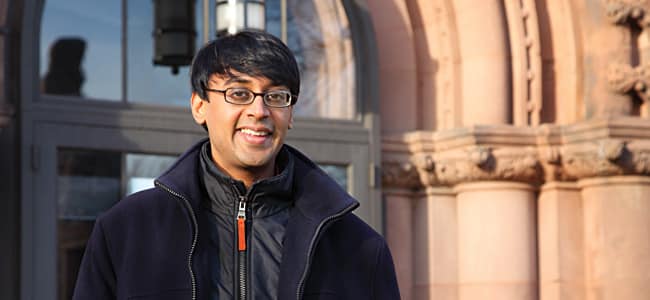
Manjul Bhargava, a professor of mathematics at Princeton University, was Wednesday conferred the Fields Medal at the International Congress of Mathematicians 2014 hosted by the International Mathematical Union (IMU) in Seoul, a press release issued by the Fields Institute for Research in Mathematical Sciences said.

Also on the same occasion, another Indian-origin mathematician Subhash Khot won the Rolf Nevanlinna Prize, awarded by the IMU, for his “prescient definition of the ‘Unique Games’ problem, and leading the effort to understand its complexity and its pivotal role in the study of efficient approximation of optimisation problems”.

Bhargava, born in 1974 in Canada, was awarded the Fields Medal for developing powerful new methods in the geometry of numbers, which he applied to count rings of small rank and to bound the average rank of elliptic curves.

He is the recipient of the Mathematical Association of America prize in 2003, the SASTRA Ramanujan Prize in 2005, the Cole Prize in Number Theory of the American Mathematical Society in 2008 and the Infosys Prize in 2012.

Other three winners of the Fields Medal are Maryam Mirzakhani, the first Iranian and the first woman to win the medal, and Artur Avila, the first Brazilian, and Martin Hairer, the first Austrian to win a Fields Medal.

Mirzakhani, a mathematics professor at Stanford University, was awarded the prize for her outstanding contributions to the dynamics and geometry of Riemann surfaces and their moduli spaces.

Avila, a professor at the Instituto Nacional de Matemática Pura e Aplicadab in Brazil, was awarded the prize for his profound contributions to dynamical systems theory, which have changed the face of the field, using the powerful idea of renormalisation as a unifying principle.

Hairer, a mathematics professor at the University of Warwick, was awarded the prize for his outstanding contributions to the theory of stochastic partial differential equations, and in particular for the creation of a theory of regularity structures for such equations.

The Fields Medals are awarded once every four years by the International Congress of Mathematicians (ICM) in order to recognise outstanding mathematical achievements.

John Charles Fields was a Canadian mathematician who had a major impact on national and international mathematical studies and research.

Khot is a professor in the Computer Science Department at New York University’s Courant Institute of Mathematical Sciences. He has a PhD from Princeton.

His work has led to breakthroughs in algorithmic design and approximation hardness and to new exciting interactions between computational complexity, analysis and geometry.

The Rolf Nevanlinna Prize is awarded once every four years at the International Congress of Mathematicians, for outstanding contributions in Mathematical Aspects of Information Sciences, including all mathematical aspects of computer science.

The Fields Medals were started in 1936 and the Nevanlinna Prize in 1982.

Indian-origin Princeton prof snares 'Nobel Prize of maths'

0
Reading Time: 2 minutes

Two Indian-origin mathematicians have won prestigious global prizes in the field of mathematics with one being awarded the Fields Medal – the “Nobel Prize of mathematics”.

Manjul Bhargava, a professor of mathematics at Princeton University, was Wednesday conferred the Fields Medal at the International Congress of Mathematicians 2014 hosted by the International Mathematical Union (IMU) in Seoul, a press release issued by the Fields Institute for Research in Mathematical Sciences said.
Also on the same occasion, another Indian-origin mathematician Subhash Khot won the Rolf Nevanlinna Prize, awarded by the IMU, for his “prescient definition of the ‘Unique Games’ problem, and leading the effort to understand its complexity and its pivotal role in the study of efficient approximation of optimisation problems”.
Bhargava, born in 1974 in Canada, was awarded the Fields Medal for developing powerful new methods in the geometry of numbers, which he applied to count rings of small rank and to bound the average rank of elliptic curves.
He is the recipient of the Mathematical Association of America prize in 2003, the SASTRA Ramanujan Prize in 2005, the Cole Prize in Number Theory of the American Mathematical Society in 2008 and the Infosys Prize in 2012.
Other three winners of the Fields Medal are Maryam Mirzakhani, the first Iranian and the first woman to win the medal, and Artur Avila, the first Brazilian, and Martin Hairer, the first Austrian to win a Fields Medal.
Mirzakhani, a mathematics professor at Stanford University, was awarded the prize for her outstanding contributions to the dynamics and geometry of Riemann surfaces and their moduli spaces.
Avila, a professor at the Instituto Nacional de Matemática Pura e Aplicadab in Brazil, was awarded the prize for his profound contributions to dynamical systems theory, which have changed the face of the field, using the powerful idea of renormalisation as a unifying principle.
Hairer, a mathematics professor at the University of Warwick, was awarded the prize for his outstanding contributions to the theory of stochastic partial differential equations, and in particular for the creation of a theory of regularity structures for such equations.
The Fields Medals are awarded once every four years by the International Congress of Mathematicians (ICM) in order to recognise outstanding mathematical achievements.
John Charles Fields was a Canadian mathematician who had a major impact on national and international mathematical studies and research.
Khot is a professor in the Computer Science Department at New York University’s Courant Institute of Mathematical Sciences. He has a PhD from Princeton.
His work has led to breakthroughs in algorithmic design and approximation hardness and to new exciting interactions between computational complexity, analysis and geometry.
The Rolf Nevanlinna Prize is awarded once every four years at the International Congress of Mathematicians, for outstanding contributions in Mathematical Aspects of Information Sciences, including all mathematical aspects of computer science.
The Fields Medals were started in 1936 and the Nevanlinna Prize in 1982.

Nice try officer, but I have “Whatsapp”

0
Reading Time: 2 minutes

Helpline launched on smartphone app to report corrupt policemen

The next time a police officer seeks a bribe or harasses a member of the Indian public, they no longer need to feel frustrated. Help is literally at hand in the form of their smartphone, if it is equipped with chat application ‘Whatsapp’.

Apart from calling and registering a complaint, a recorded audio or video clip can be sent to the newly launched helpline via the popular chat engine and action is taken within hours.

Since its launch, the app has resulted in action being taken against three policemen.

“This helpline number is launched under the guidance of Delhi Police Commissioner B.S. Bassi to make the force corruption free,” said Additional Commissioner of Police (Vigilance) G.C. Dwivedi, under whose observation the helpline operates.

Officers found guilty are booked under Section 7 of the Prevention of Corruption Act, where public servants take gratification other than legal remuneration in respect of an official act, and Section 13, criminal misconduct by a public servant. They are also booked under sections of the Indian Penal Code.

“After we receive a clip with the evidence against an officer, we inform a senior about the complaint,” said a police officer when explaining the workings of the 24/7 helpline launched by Delhi Police’s vigilance department.

“We then call the complainant and get detailed information about the case while the clip is sent to the forensic science laboratory in Rohini to check its authenticity. If it’s genuine, a complaint is registered and the guilty officer is arrested and suspended with immediate effect,” he explained.

According to Deputy Commissioner of Police (Vigilance) Sindhu Pillai, within three days of its launch, the helpline has received 43 calls.

“We got 14 calls on the first day, the following day we got two complaints and 27 were received on the third day,” Pillai stated.

Pillai said that of the total calls only five were genuine registered complaints while the rest were just blank calls. This was possibly due to people’s curiosity and lack of awareness.

“We have given advertisements in several Hindi and English newspapers as well as on nine FM channels,” said Pillai.

“Those who are being harassed by a police officer must inform us… any police indiscipline will not be tolerated”.

The new helpline will work in tandem with the existing anti-corruption helpline which at present has four lines attended by at least 20 constables and head constables who work round the clock under the guidance of an inspector.


Hairy is the new black

0
Photo from The Daily Star
Reading Time: 2 minutes

Woman with beard promotes message of ‘loving yourself’

Photo from The Daily Star

Appearing in a photography exhibition celebrating the world’s best facial hair, a British Sikh woman, who has grown a beard for seven years, is seeking to convey a public message to love yourself.

According to the Daily Mail, 23-year-old Harnaam Kaur, from Berkshire County, has been growing a beard since age 16 when she was diagnosed with polycystic ovary syndrome, a condition that causes excess hair growth.

After being bullied as a teen, the teaching assistant tried waxing, shaving and bleaching to hide her facial hair. However, once she was baptised a Sikh, a religion which forbids cutting body hair, Kaur decided to accept her body as it was.

“When I first started growing my beard it was for religious reasons but as the years have gone by I’ve kept it for more personal reasons… It makes me feel like a brave, confident woman who isn’t afraid to break society’s norms,” Kaur stated proudly.

Kaur is the only woman to appear in the collection of photographs after she spoke against those who criticised her appearance. She is one of 60 people chosen to appear in the exhibition called Project 60, which marks the launch of Beard Season, a non-profit organisation seeking to raise awareness of skin cancer by urging people to grow facial hair through winter.

“It’s incredible to be the only bearded woman among all these men. It makes me feel really strong,” Kaur said.

“Raising awareness for such a good cause is like a cherry on the top”.

“We’ve had a lot of interest from some truly amazing people and Harnaam is one of them. To have her on board is such an exciting prospect for us,” claimed photographer Brock Elbank.

“I like the fact that she has embraced having a beard and she’s very striking with it”.

Kaur’s portrait along with the other 59 portraits will be displayed in London later this year.

IANS

India’s Next Top Model (Prime Minister)

0
Photo from Liberty Voice
Reading Time: 2 minutes

Narendra Modi’s choices are making global headlines… his fashion choices that is

Photo from Indilens

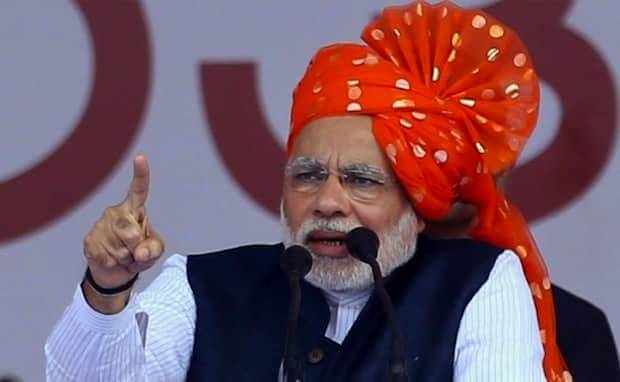
It seems as though India’s next big thing in fashion is none other than the leader of the country himself. It’s not his politics making headlines so much as Prime Minister Modi’s fashion sense, which commentators say so accurately represents the cross culture of modern and traditional Indian style.

Usually sporting well-cut Indian suits and bright colours, Modi portrays a patriotic style in his preference of traditional Indian clothing, particularly the kurta.

In fact, according to TIME, the “Modi Kurta” has been trademarked as his signature outfit which, like his politics, adds a contemporary quality to the Indian tradition.

Modi’s kurta is a “shorter, crisper version of the traditional tunic,” TIME wrote. His addition of name-brand accessories signifies the modernity of Western commodities, while still respecting old traditional values of dress.

According to The Wall Street Journal, during a recent visit to Nepal, Modi wore a gold kurta with white leggings, and when visiting a temple in Kathmandu, sported a saffron kurta with a paisley shawl.

A recent significant recognition of Modi’s fashion was during a visit to the US, where Americans acknowledged and embraced the traditional style of Indian culture through Modi’s dress.

“Every time he is seen on camera his awe-inspiring white beard is trimmed and neat, every stitch of clothing is freshly pressed and smooth and all of his colours coordinated just so,” stated an article in Liberty Voice.

The publication also claimed the Indian PM is “clean cut and presentable” and that the colours he wears accurately match the significance of the appearance or event he is attending.

“He will never wear green because it is indicative of the Muslim culture, and tries to wear Hindu orange as much as possible,” stated the article.

Modi’s clothes are all tailored locally in his home state, Gujurat.

However, the “crowning jewels” of Modi’s fashion are his hats, stated the article: “Most of Modi’s votes probably come not from what is within his head but what is on top”.


Photo from Liberty Voice

Bollywood 101

1
Reading Time: 5 minutes

QUT students travel to Mumbai to get a feel for the world’s most prolific film industry

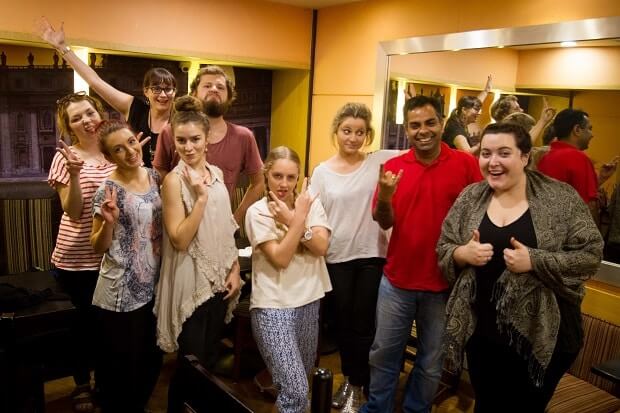
The first Bollywood ‘masala’ film that Queensland University of Technology student Katy O’Hagan ever saw was in a Mumbai cinema hall. It was a premiere, no less, at which she and her friends from Brisbane were VIP guests. They walked out of Humpty Sharma Ki Dulhania, with the song ‘Saturday’stuck in their heads.

“It was an amazing experience,” the second year Bachelor of Entertainment Industries student told Indian Link. “Of course I’d seen many films from India before, but not a full-on musical. There were no subtitles and we knew no Hindi, but we managed to stay on track. We understood everything!”

The experience was part of a tour to India’s entertainment capital that QUT put together in partnership with the Mumbai-based India Study Abroad Centre (ISAC).

The two-week immersive study tour was led by academic supervisor Joe Carter from the university’s Creative Industries Faculty.

“We visited film sets, TV shows, reality TV shows and ad agencies,” Carter told Indian Link. “We spoke to directors, producers, film distributors and marketing professionals. We visited post-production facilities, including a full-day special effects workshop. During a visit to a sound recording studio, one of the students was even asked by a film director to read a small part and she will appear in the film’s credits upon release”.

Watching a feature film colourist at work

QUT’s Bachelor of Entertainment Industries degree, the first of its kind in the world, teaches the business, legal and creative skills needed to work in the field of entertainment. A trip to Bollywood for students, therefore, makes perfect sense.

What insights did the visitors gain, and how is Bollywood different from “Aussiewood”, to coin a term?

Inside the Sunshine TV studios on the set of a daily soap

“The sheer size is an obvious difference,” Carter observed. “It is a much larger industry which makes 3000 films a year while we make a fraction of that. An interesting observation was the tiny spaces they worked in. We saw small spaces converted to studios, and they seemed to work well. The number of people involved was also an eye-opener. Hundreds of people worked on a TV set, for instance. Obviously the industry is providing employment for a lot of people”.

Hansal Mehta of ISAC, a noted film-maker himself, is currently touring Australia with his partner Arun Pal, and was at QUT in early August lecturing and interacting with students. He has been organising tours of India’s entertainment zones for nearly twenty years now, educating students from many countries who have an interest in the field.

Meeting with Hansal Mehta

“In the QUT program, we completely turned the idea of Bollywood around for the students,” Mehta told Indian Link. “With interactions with film-makers like Anurag Kashyap (Wasseypur), Sameer Sharma (Luv Shuv Te Chicken Khurana) and Anand Rai (Tanu Weds Manu), the students got to see that we do make sensible films after all! They realise now that there is diversity. They watched the films with the film-makers and then interacted with them”.

Chatting with Abhishek Chaubey

As well, there were meetings with other film experts, such as a session with a marketing professional who worked on the film Gattu (Rajan Khosa’s film about a kite obsessed nine-year-old who wants to rule the skies).

With a marketing guru from Pulp

Katy O’Hagan recalled, “To promote the film, they dressed up the child actor as famous people who have achieved their dreams. We thought it was a fascinating strategy. In Australia, we would just have posters or see ads online, but this was interactive and interesting”.

A noteworthy by-product of the tours by the students, Hansal revealed, is that the film-makers themselves enjoy the sessions, gathering some interesting take-aways from it all. “They’ve reported to me that the students lend new energy. They challenge and question and help the film-makers reinvent themselves”.

Watching a 3D artist at work at TeamWorks Post Production studios

On this particular trip to Australia, Mehta has been talking to students not only in Brisbane, but also Sydney, Canberra and Melbourne, where he will catch a film or two at the ongoing Melbourne International Film Festival. He will also present his critically-acclaimed City Lights at the Beyond Bollywood film festival.

By a strange coincidence Mehta started his film career in Australia in the early 1990s, and then moved to Mumbai to make films such as Dil pe mat le yaar, Woodstock Villa and Chhal.

Today he loves his film-making just as much as showing his industry to visitors – chaos and all.

“Oh yes, it was chaotic,” Joe Carter said. “And yet organised, somehow. There was order in chaos”.

“It was disorganised chaos,” Katy laughed in agreement. “And you could say that for all of India too”.

It was the first visit for all members of the study tour, and Joe speaks for the group when he says, “The sheer density of the population hit us almost immediately, but other than that, all our expectations and presumptions about India were completely thrown out. We went with innocent assumptions from Slumdog Millionaire about the terrible poverty, but found that India was prosperous and thriving; even in the slums we saw people that were happy and friendly, and we felt safe”.

Katy O’Hagan recalled, “It shocked me completely, for instance, to see a slum on the beach at Mumbai! It was like nothing I’ve seen before. But there was a great sense of community – the little kids talked to us and ended up taking us to their homes. It was one of our best days there”.

“This trip has been a teaching career highlight for me,” Carter said. “Bollywood is an amazing concept, and the welcome we received from directors, producers and film stars has been astounding. But the best part has been watching our QUT students confidently interact with major film and TV professionals, demonstrating their knowledge and understanding of the global entertainment industry”.

Feedback from the trip was so good from all sides, Carter is taking students back again next year, twice!


 All images – Joe Carter

Sounds of the monsoon

0
Reading Time: 4 minutes

Debashish Bhattacharya brings his unusual guitars to Adelaide

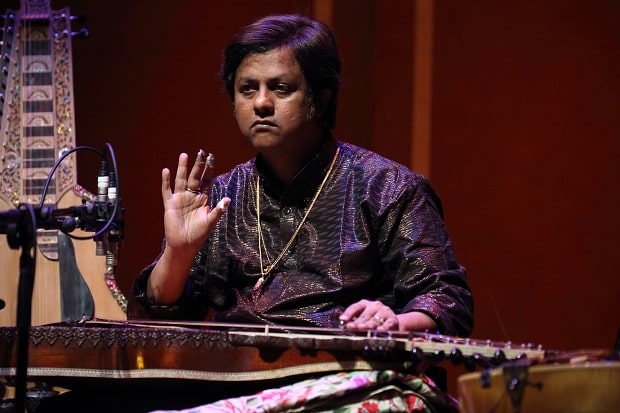
Classical musician Debashish Bhattacharya was the sole Indian invitee at the recent International Guitar Festival in Adelaide. He played to a packed house who gave him a standing ovation at the end!

Pandit Bhattacharya is known for the unique instruments he has invented.

“I got my first guitar at the age of three,” he told Indian Link. “I loved it, but thought its sound was somewhat foreign. The sitar, sarod, sarangi appealed more, as the original voice of my culture”.

Then began a journey of passion, training in lap slide guitars, classical Indian guitars and 35 years of experimenting with changing guitar strings and positions of keys to suit Indian ragas. The result has been the invention of 19 different slide guitars that you can play just about anything on!

Pandit Bhattacharya told Indian Link, “All my guitars are very special, but of these, three are very successful. They are being used all over the world by guitarists. I have named them Chaturangi (a 24-string guitar); Gandharvi (a 14-string guitar) and Anandi (a 4-string guitar). These I call the trinity of guitars or tri-nayans”.

He used all these three and one other at his concert in Adelaide last month. The evening began with Debashish Bhattacharya’s beautiful introduction to his music which, he said, he would like to give to people with “darkness in their hearts” to heal them and soothe them. Music is all about the expression of the “human mood” he said, and it certainly was! Debashish was accompanied by his daughter Anandi on vocals and Subhasish Bhattacharya on the tabla.

The first item of the concert was a rendering of raga Yaman by 16-year-old Anandi. With a teenager’s fresh voice, a little raw at the edges but showing the anticipation of an exciting adulthood, Anandi started off with some feet-tapping bols and moved effortlessly into the high notes – drawing out the best of dancing Yaman melodies. Debashish stayed very much the accompanist, adding to the singing, taking his cues from the singer and letting the music flow.

Anandi continued into a new song, again in raga Yaman and delineated it beautifully. As I sat back and closed my eyes to listen to ‘Main bhali mar jaaoongi pritam bina pyare’, the accompanying guitar sounded more like a sitar, and yet not a sitar. Traditional raga, universal music.

When Debashish introduced the next raga Desh, he asked us to visualise the monsoon in India – warm humid weather, highly perfumed beautiful white flowers, nature waiting for the rains to fall. This raga was played on the 24-string Chaturangi he created in 1978. His intricate playing, with a variety of sounds, kept all the monsoon promise of raga Desh and you could feel the gentle rain washing over you.

What struck me, though, in this piece and later, was the unconventional tabla playing by Subhasish Bhattacharya. The tabalchi had magic in his fingers and kept up with the varying speeds and tempos. Thoroughly enjoyable. But I wondered, would a more traditional tabalchi have added greater enjoyment to the delineation of this raga and the jugalbandi of guitar and tabla?

Next came raga Charukeshi, this time on a huge Gibson Super 400 guitar. This was his Guru’s instrument, Debashish Bhattacharya revealed, and told us the story of how Padit Brij Bhushan Kabra forced him to play on it, even though it kept sliding off his lap because it was too big for him (it still did slide!) Charukeshi came alive under Debashish’s magical fingers and the jugalbandi with the tabla was just amazing!

Another monsoon raga was Miya ki Malhar. In India, Debashish said, it rains as if it is a joy for the sky and when the rain meets the land, it is love, pure love. On another slide guitar Gandharvi, Debashish Bhattacharya definitely expressed these emotions and more. You could feel the water-filled clouds just before the rain starts and the peacock dancing in anticipation in the first half of the raga and then, the rain coming down…Megh Malhar had it all.

The night ended with a Sufi bhakti geet, on the little ukulele kind of guitar that was called Anandi after his daughter. Just four strings, sharp and sweet, and a joy to listen to, accompanied by more of Subhasish’s unconventional tabla playing and Anandi’s vocals.

The evening was pure magic on an instrument that sounded vaguely familiar, and yet was absolutely not!

Debashish Bhattacharya certainly soothed our hearts that night. His music not only filled us with peace, but took us to sublime heights of awareness with his magnificent playing of the ragas on his unique guitars.

Lessons from the Master

0
Reading Time: 2 minutes

Perth author Vidagdha Bennett is set to release a new book about the golden days of Sri Chinmoy

A frequent pilgrim to the spiritual shores of India for writing inspiration, Perth author Vidagdha Bennett has spent time in Dakshineswar and Pondicherry, but it was in the mountains and cooler climes of Kashmir where she recently found inspiration to put her thoughts to paper.

“The brown kites outside my window wheel gracefully on motionless wings and then dip down to skim the mirrored surface of Dal Lake, raking it with their claws. A fisherman is perched motionless on the prow of his shikara, his long bamboo rods lying on the glassy waters with bait hanging temptingly beneath,” Bennett writes about her experiences in Kashmir.

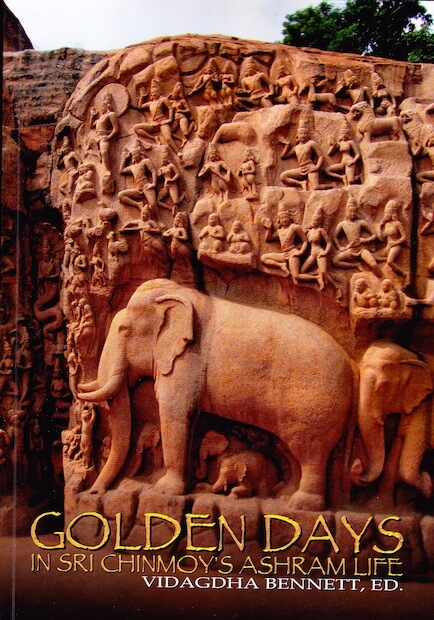
This month, Bennett will launch her fourth book, Golden Days in Sri Chinmoy’s Ashram Life. With a doctorate in English from the University of Western Australia, Vidagdha Bennett’s recent books have explored the child and adulthood of her own teacher, Sri Chinmoy. She began studying meditation under Chinmoy’s guidance in 1976.

Sri Chinmoy resided in New York from 1964 and was himself a prolific author, publishing over 1500 books in his lifetime. Bennett’s related academic qualifications did not go unnoticed by her teacher, and after moving to Queen’s, New York she played a major part in editing many of his uplifting books and plays on poetry, spirituality, eastern philosophy and children’s short stories.

After serving and residing in the USA for many years, and following Sri Chinmoy’s passing in 2007, Bennett returned to her home state of Western Australia and redirected her literary energies to her own projects. Working at her brother’s law firm, Bennett and Co, she finds time to write outside work hours and in her travels.

Golden Days in Sri Chinmoy’s Ashram Life focuses on the youthful childhood of Sri Chinmoy, growing up in the Sri Aurobindo Ashram with his siblings, friends and mentors, surrounded in the surcharged and innocent atmosphere of sports, selfless service and spiritual discipline.

“The inner experiences of a spiritual Master are what we crave to hear above all else,” Bennett explained. “Even a few spellbinding insights into the vast realms of the soul, a world that we ourselves have perhaps glimpsed only on rare occasions, fall like sweetest nectar on our ears”.

“Those were the days,” Sri Chinmoy said of his time in Pondicherry. A time, pre-New York, where his life was still full of the simplicity and purity of India. “The golden days, in my Ashram life”.

The book will be launched in New York this month and is available in Australia.

It’s not ‘just a game’!

0
Reading Time: 4 minutes

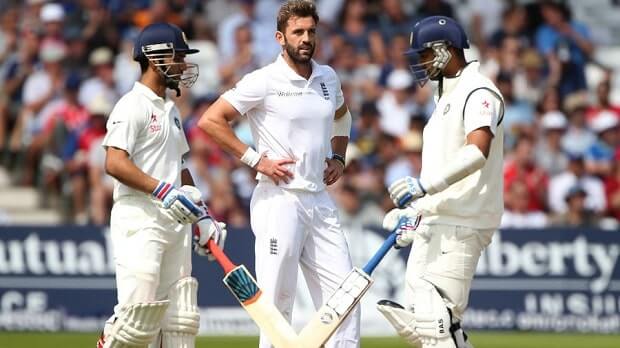
SANAM SHARMA still hoped India would save face, until England handed the team an innings defeat

It was 10pm on Saturday night Australian time. Lunch had been called at Old Trafford, England on the 3rd day of the 4th test match between India and England. India, as they usually do on away tours, were struggling big time to save the game. England were already 180 odd runs ahead in the first innings with a couple of wickets to go. The pitch was evidently assisting seamers and quickies. All ominous signs for India going into the 2nd innings.

I quietly hoped for India to get through day three with minimal further damage and then wished for some divine assistance from the rain gods on days four and five. Just to save face. And the test match. Winning the game was never an option after the first 30 minutes on day one.  The heartache of the underperformance by the Indian team was too much for me to put up with in a conscious state of mind. So I went off to sleep.

Around 3.30am I somehow woke up. My mind went straight to the game being played at Old Trafford. “Let me go switch the TV on in the living room and watch the rest of the game,” I thought to myself. As I started to wriggle out from under the quilt, I glanced at my wife sleeping next to me and decided to refrain from turning on the TV. For the next few moments I lay in bed staring at the ceiling. My mind furiously trying to contemplate the status of the match.

“Perhaps India managed a deficit of 190 runs and then the Indian openers put in a 200 run partnership in the second innings while I was asleep,” was the positive thought in my mind. I felt so good even thinking about that scenario, as improbable as it seemed in reality. “What if India were four down for 80 odd by now, still trailing by 100 runs?” was the next thought. I think I actually shivered and then abruptly discarded such a blasphemous thought and stuck with the former scenario. The best case scenario from an Indian’s perspective. Albeit a wishful scenario.

I wriggled a bit more in bed, trying to figure out a way to sit in front of the TV and see what had transpired at Old Trafford. I felt a little nudge from my wife, as if to say “stop moving and go to sleep, for God’s sake, you silly man”. I went back to staring at the ceiling, my head still bursting with permutations about the test match. Then, a light bulb went off (pun not intended) in my brain. I fiddled in the darkness across to the bedside table, stumbling to find my phone. A sharp manoeuvre and I had my arm below the edge of the bed, almost touching the carpet, with the phone in my hand. I held the phone and lit it up, without alarming my sleeping wife with the bright glare.

Then, a deep breath as I punched in the website to check the live scores. As the website loaded, I awaited with eyes closed in anticipation – and a  quick prayer, much like I used to do prior to checking exam results in school. It worked most of the times in those days, so I hoped for a similar miracle here as well. I squinted from the corner of one eye to see if the website had finished loading. I mustered all my courage and faith to open both eyes. And then with one big hurrah, I looked straight into the phone screen. Anticipating a miracle from the Indian Team, yet again, for the millionth time.

The phone glared back at me with the headline: “Ten Men England Team Smash India by an Innings”. I rubbed my eyes a bit to make sure I was reading it correctly. Then looked at the phone again. It still read that India had been decimated by an innings and 54 runs. I felt like throwing the mobile phone against the wall. But then felt another nudge from my wife, in good time, to refrain from doing so.

My mind went numb all of a sudden. And so did my body. My first thoughts went to a good friend from Pakistan who I knew would have been itching to message me on Facebook to rub in the result of the game. For the past three days he had been pestering me about India’s performance, since India were reduced to eight for four in the first hour of the game. He even sent me a few screen shots of the Indian dismissals to rub it all in. I had kept assuring him that I would have the last laugh. Like you do with anyone from Pakistan. On any national matter. I now knew that I would not have much of a comeback to respond to his taunts.

As I finish writing this post I have three Facebook messages flashing on my phone from my Pakistani friend. Damn!