


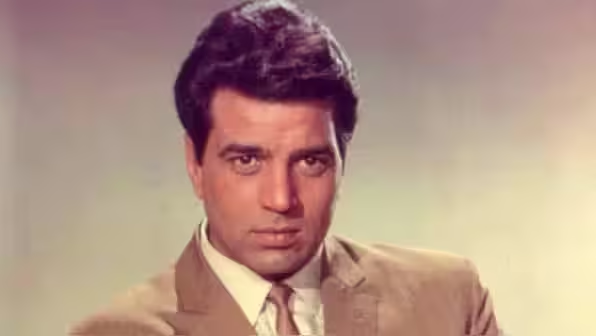

There are certain lines in Hindi cinema that don’t just live in dialogue books, they live in us. They become common speech, family jokes, nostalgic reenactments at dinner tables, and punchlines performed with exaggerated baritone in college canteens. And one of the most iconic of them all, “Kutte, kameene, main tera khoon pi jaunga!” belongs to Dharmendra.
The line came from the 1973 film Yaadon Ki Baaraat, but by the time he delivered it, Dharmendra had already become something far greater than a film star. He was an idea — the idea of the Hindi film hero who did not need sculpted six-packs or calculated swagger. His grit came from presence, his power from emotion, and his charm from ease. The country loved him not simply because he could fight villains and woo heroines, but because he made both look honest.
Growing up in Indian households, Dharmendra flickered through our living rooms like a familiar elder who always knew the right thing to say. For many of us here in the diaspora, he was Bollywood in its most unfiltered form: dramatic, unabashed, romantic, and larger-than-life in the best possible way.
The rise of the people’s hero
Dharmendra was never a sculpted icon who appeared untouchable. He was the man you rooted for. Born Dharmendra Deol in Punjab, he entered the industry at a time when Hindi cinema’s leading men were shifting from the gentle tragedy of Dilip Kumar and the debonair Shakespearean sweep of Raj Kapoor. Dharmendra brought something raw — a masculine sincerity that was rugged but uncomplicated, like a man who had lived before he acted.
He could play the angry young man, yes — but his anger was not brooding cynicism; it was moral. That distinction mattered then, and it matters now.
The dialogue that became cultural currency
His delivery wasn’t just about volume or threat, it was rhythm, breath, chest, voice. It was theatre woven into daily speech.
“Kutte, kameene…” or “Basanti in Kutton ke aage mat naachna…” was not just a threat. It was catharsis. It was vengeance sung in melody. Even today, say it once in a room full of Hindi movie lovers, someone will respond with applause, someone with imitation, someone with laughter rooted in affection.
Dharmendra didn’t repeat dialogues. He lived inside them.
The lover who softened the hero
But to paint him only as the He-Man of Hindi cinema is to do him a disservice. For every fight sequence and charged one-liner, there was a love song where he softened — almost luminously.
Opposite Hema Malini, he was all smouldering gaze and half-smile tenderness. Their chemistry was not mere cinematic pairing — it was kinetic, effortless, and time-resistant. It was vulnerability wrapped in masculine dignity. It was the dreamiest lessons of old-school romance: a look, held just long enough, was enough.
The performance that proved his depth
If anyone doubts Dharmendra’s dramatic abilities, point them to Satyakam (1969). Here is Dharmendra stripped of glamour, wrestling with moral conscience, institutional corruption, and private pain. It is one of Hindi cinema’s most quietly devastating performances, and to this day, one that critics return to when calling him one of Bollywood’s finest actors, not just its most beloved stars.
The diaspora’s memory of him
For those of us outside India, Dharmendra represents a memory-scape more than a filmography. Watching his films transported us to living rooms back home. They remind us of grandparents sipping evening chai while Sholay played in the background, parents telling stories of cinemas with fans whistling and coins flying at the screen, and cousins imitating Dharmendra’s swagger on rooftop terraces in winter sunlight.
In a diaspora where “home” is a shifting idea, Dharmendra is the still point that is familiar, warm, and unchanging.
The man behind the star
Off-screen, Dharmendra has always remained surprisingly grounded. The stories of his humour, his occasional emotional outbursts, his enduring poetic streak — yes, the man wrote poems — make him even more real, more human.
He did not cultivate mystery. He cultivated connection.
Why he still matters
Because Dharmendra represents an era when Bollywood was not afraid to be cinematic. When emotion was widescreen. When lines were written to be felt. When movies were communal and not consumed alone on streaming screens.
His dialogues remind us of when films were shared experiences with families, with neighbours, with friends squished on one scooter on the way back from the theatre.
Dharmendra is not nostalgic. He is a living memory.
Read more: Asrani: A lifetime of laughter