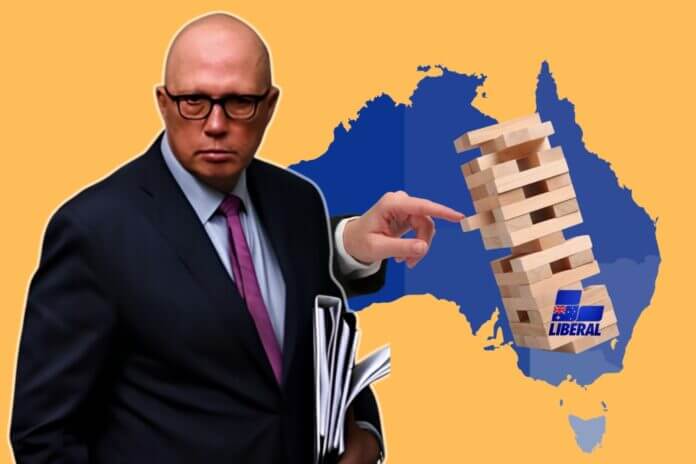
Liberal party’s electoral decline
The current decline of the Liberal Party of Australia may one day be traced back to a single political calculation: 5 April 2023, the day Peter Dutton formally announced the party would oppose the Indigenous Voice referendum.
At the time, it looked politically smart. The Referendum was divisive, emotions were high, and polling suggested scepticism in suburban and regional Australia. Dutton saw an opportunity to unite conservatives, frustrate the government, and position himself as the voice of “ordinary Australians” against what many saw as elite identity politics.
In narrow political terms, he succeeded. The Referendum failed.
But that victory may also mark the moment the Liberal Party began losing something much bigger: its ideological centre, its moral confidence, and perhaps ultimately, its electoral identity.
For decades, the Liberal Party survived because it was ‘a broad church’ as John Howard described it. It appealed to migrants building businesses, suburban families chasing stability, professionals in the cities, and conservatives in regional Australia.
It balanced economic liberalism with social moderation, and understood modern multicultural Australia.
That balance began to collapse after the referendum.
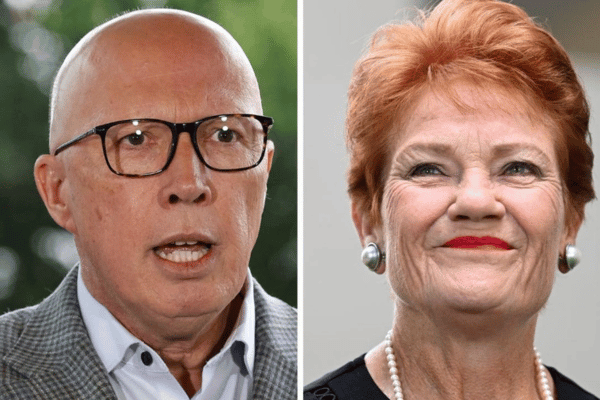
By campaigning so aggressively against the Voice, the party moved into territory long occupied by One Nation: grievance politics, culture wars, anti-establishment rhetoric, and growing suspicion around migration and identity.
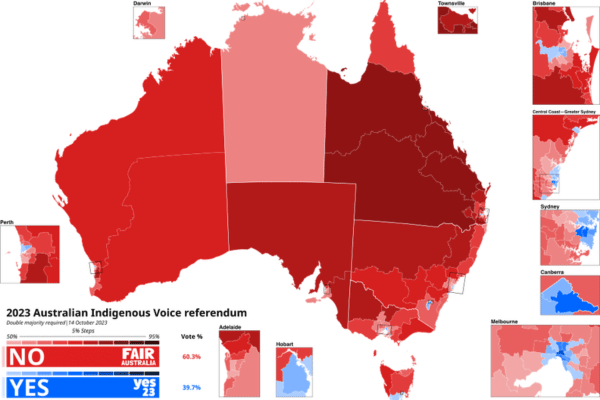
But One Nation already owned that political lane authentically.
The Liberal Party’s problem was not simply that it moved right. Parties shift positions all the time. The deeper problem was that it never looked comfortable there. Historically, the Liberals were a party of business, institutions, and economic management, but not populist nationalism. The harder they tried to compete with One Nation, the more they looked like an imitation rather than a conviction-driven movement.
And voters usually prefer the original over the copy.
Regional voters increasingly drifted toward One Nation, while moderate metropolitan voters continued moving toward the Teal independents. The Liberals now find themselves squeezed from both directions, losing country Australia to populism and urban Australia to centrism.
The result is, a party trapped between two identities and trusted by neither.
This shift has also contributed to a broader hardening of public debate. Australia remains one of the world’s most successful multicultural societies, but the national conversation has become more divisive, suspicious, and tribal in recent years.
No one is suggesting the Liberal Party deliberately empowered extremist or neo-nationalist voices. But political ecosystems matter. Once mainstream parties begin framing politics through fear, resentment, and cultural division, more radical elements inevitably feel emboldened.
That carries consequences for social cohesion.
Australia’s success was built not on ethnic nationalism but on a shared civic culture where migrants integrated, contributed, and prospered.
The Liberal Party once benefited enormously from that aspiration. Many migrant families saw the party as representing opportunity, enterprise, and stability.
Today, many of those same communities feel politically disconnected.
Younger Australians, meanwhile, increasingly associate conservative politics not with economic competence, but with anger and division. That is a dangerous long-term problem for any party hoping to govern a modern multicultural democracy.
Dutton may argue, and with some justification, that he simply reflected public sentiment during the referendum campaign. Politics is about reading voters.
But leadership is also about choosing the kind of country – and the kind of party – you want to build.
The Referendum became more than a constitutional debate. It became a turning point for the Liberal Party itself. One path led toward rebuilding a modern centre-right movement capable of winning both cities and regions. The other led deeper into culture-war politics.
The party chose the second.
And now the consequences are visible everywhere: Teals dominating affluent city seats, One Nation growing in regional Australia, moderates disappearing from the Liberal ranks, and voters increasingly unsure what the party actually stands for anymore.
Dutton won the Referendum battle.
But in doing so, he may have lost the larger political war – and perhaps accelerated the slow decline of a political empire that once defined modern Australian conservatism. Liberal party’s electoral decline
READ ALSO: Peter Dutton’s Liberals have picked a side – and it’s not ours