Home Blog Page 954

Top Indian-Australian charity organisations

0
Reading Time: < 1 minute

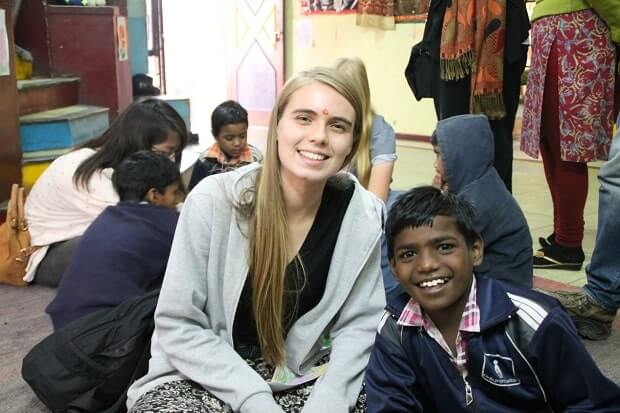
A number of not-for-profit organisations both within the Indian community and in the wider mainstream are working hard to raise funds for charitable purposes in India. Check out the work of I-India Australia (www.i-indiaproject.org.au), who save destitute children from the streets of Rajasthan and provide and care for them, helping them to break out of the poverty cycle through education and vocational training at the Jhag Children’s Village, located about 45 minutes south-west of Jaipur.

The Ekal movement (www.ekal.org.au) raises funds for and trains primary school teachers who are sent out to remote and tribal regions of India. In single-teacher schools, these professionals teach 30-40 children in the age-group 5-14. The free schooling is centred not only around basic alphabetic and numeric knowledge, but also health and hygiene, and ethical values. Ekal Australia is currently sponsoring 350 such schools, ever since its inception in 2004.

Equally laudable are the efforts of Vision2020 (www.vision2020.org.au) and the 40K Foundation (www.40k.com.au), to help the needy in India.

Top upcoming Indian events in Sydney

0
Reading Time: 2 minutes

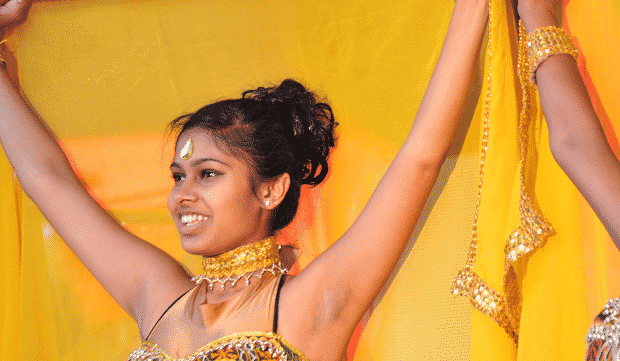
Whether you’re an Indophile or not, you’ll find something of interest in this list of events from the Indian community’s annual social calendar. Come join us as smear coloured powder on each other, or light a lamp to mark our new year and try out your light-bulb moves on the dance floor.

Weekend of Carnatic Music

Queen’s Birthday weekend, June The best-known names in the thriving classical music circuit in southern India travel to Sydney in June each year to entertain local fans. Organised by the Swaralaya Fine Arts Society, the 3-day event features vocal as well instrumental presentations.


Sydney Sakhi Sangam

June, 22 June 11am

Some 900 women, dressed to the nines, kick up their beautiful heels at this annual women-only event. Organised by socialites Nandini Thadani and Sushma Ahluwalia, Sakhi Sangam (Hindi for ‘Girlfriends Gather’), is a ‘must-do-at-least-once’ kind of event, if you’re a woman in Sydney’s Indian community! Today it attracts women of all backgrounds who beg, borrow or buy those OTT Indian outfits and accessories for this day-long do.


Australia India Friendship Fair

Date TBA

Held annually in August to mark India’s Independence Day, this day-long fair at the Sydney Olympic Park features cultural performances and multiple food stalls. Organised by United Indian Associations (Inc.), the event also attracts many federal and state level politicians who come out to greet the Indian community.


Deepavali Fair

Date TBA

Another annual event that sees the gathering of ‘the clan’, this day-long event marks the festival of Deepavali or Diwali, the Hindu Festival of Lights. Organised by the Hindu Council of Australia in Oct-Nov, the event features cultural performances, food stalls and a fireworks display at dusk. Diwali is also celebrated at Martin Place in the CBD, and the exterior of the NSW Parliament House is decorated in lights to mark Hinduism’s most significant festival.


Check out our calendar of all events in Sydney here

It’s a ‘Modi’fied India…

1
Reading Time: 4 minutes

… where a thousand lotuses bloom

It was Saturday, May 17, around six in the morning. Being an autumn day, it was still quite dark.

Namo Narayana”.

I woke up uttering this simple two-worded devotional line: I bow to the Almighty. It is a childhood habit I have carried into my adult years. Like most Indians, I have a habit of seeing or saying something godly first thing in the morning so that the rest of the day goes well.

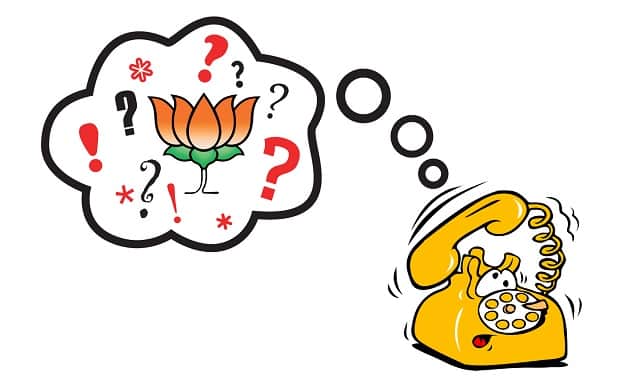
As I rolled out of the bed, the phone rang. Unusual in our household. I quickly grabbed the handset and shafted to the next room so that my wife’s beauty sleep was not disturbed. She loves her early morning sleep. Me, I am just the opposite. Having married in the pre-internet and matrimonial website days, we had no opportunity to discuss such compatibility issues.

Namaste. NaMo wants to talk to you,” the voice on the other end of the line said.

OMG! I couldn’t believe my ears. Having uttered ‘namo’ only a few seconds back, the good Lord (Narayana) had chosen to talk to me. How blessed, I thought, for one who is only moderately religious to have such a stroke of fortune.

“Ayerji, this is Narendra Modi,” a familiar voice came on the phone. “I learn that you occasionally write for the Indian Link. Through your column, I wish to convey to my fellow Indians, my plans for the development of our nation and seek their contribution. I know there is a growing Gujarati community out there in Australia”.

While my elation eased somewhat on realising that it was the ‘namo’ of human kind and not the celestial, I was still thrilled that Modiji had chosen to give me his first interview while stalwarts like Tony Jones and Laurie Oakes waited in queue.

“You’ve made my day, Sir,” I said with humility. “Please go ahead”.

I grabbed a notepad and pencil and was all set.

Next minute there was some static on the line and I began to hear some cross talk. Cross lines on the Indian telephone, it seemed, had not changed a bit since the days of Mr. India, one of the best comedy movies to roll out of Bollywood.

Waiting for the call meant for me to come through, I decided to listen in on the conversation.

Faint voice in the distance: Naren bhai, I would like the job of …

Modi:  Lal Kishanji, I can hardly hear you. Please speak up.

LK Advani: That is what I am after. I want to be the Speaker.

NM: Advaniji, in your advancing years, won’t it be difficult for you to control the House? The Opposition always indulges in cat calls, walk-outs and dharnas. We did that too while in Opposition.

LK: No problems there, there is hardly an Opposition this time. RaGa (Rahul Gandhi) was not even in tune with the masses during the campaign. What Sonia says is Greek and, certainly, Latin to most. Think I can manage.

NM: I have already pencilled you in for the prestigious post of Aged Care Minister.

Modi’s trusted secretary Jiten Patel (interrupting hastily): Nawaz Sharif is calling from Islamabad.

NS: Salam alekum, Modi saab. Thank you for your invitation for your inauguration. I think I will make it to your party. See, I’m concerned that if I leave the country the Army may not let me back in. They may follow my example and do what I did to Mushy as he flew back from his visit to Sri Lanka. Anyway, dekhi jayegi… I’ve made my mind up. My team’s already saying Dilli chalo!

Jiten: Sir, Bangla begum Mamta didi is on the line.

NM: The last time she was the Railways Minister, she took the (train) toys and went home half way in the game. What is she signalling now? She can’t derail me anyway. Tell her I’ll call back soon.

Jiten: Sir, Amma from Chennai! She’s decided to support you.

NM: Didn’t she pull the rug under Atalji’s feet last time and let the Gandhi mob in for the next ten years? Anyway put her through.

Jayalalitha: Vanakkam Modiji. We have decimated the godless gang of Karuna and his corrupt cohorts. With 37 of us we can stand solidly behind you. Can you offer…

NM: Sure, an invitation for my inauguration.

Click went the phone at the Chennai end.

NM: Jiten, only Mayawati hasn’t called yet. With her poor showing she has become ‘Mouna wati’. During the campaign, I thought she would prove the elephant in the room. Thank god she is a jumbo failure. Before the results were announced I was concerned I would need the co-operation of these three regional queens. Imagine being forced to listen to the dictates of three women. Just one Sonia was enough to undo the good Sardar. Bidding her orders, the poor guy became Man maun Singh.

At this point, my dear wife entered the room.

“What has come of you, holding the phone for ten minutes and not saying a word?” she chastised me.

Powerless to admit the loss of an exclusive interview with the leader of the world’s largest democracy, I answered sheepishly, “Some telemarketer… wants to sell some cheap power”.

Honourable end

0
Reading Time: 6 minutes

Harsher laws and stricter punishments are needed for crimes against women

‘Judge Jagdish Sinha found dead’. Every newspaper in the country carried this news in bold print on its front page on Monday morning.

The five-word headline shocked the nation to its core. Only three days earlier, he had been hailed as a national hero in all those newspapers after he delivered his judgement on the infamous gang rape case that not only rocked India but reverberated around the world. He was on every one’s lips, on TV chat shows and editorial columns – all heaping praise on him. Women’s groups in capital cities marched along roads to the local high courts hailing Sinha’s judgement and demanding stern action against perpetrators of violence against women. Politicians of all hues, with an eye on the female franchise in the forthcoming election, were profuse in their praise for the judge.

Until a couple of months ago, no one outside Patna’s legal circles had heard of Judge Sinha, but his name became a byword the moment he was named to hear the Patna rape case. The national media went into an overdrive in analysing every case he had heard in his judicial career, dissected every judgement he had delivered. They built up a profile of him as a softie who would prefer a reformist route to a hard-line verdict since he believed that even the worst human will have a soft spot and that should be given a chance to sprout. So it came as a huge surprise when he delivered, at the end of his 180-page judgement, a death sentence for two of the three accused. Legal pundits and the public were, at best, predicting a life sentence. The crudity of the crime, the callousness of the criminals, bad publicity world-wide and the wrath of women groups forced the court system to fast-track the case in a country where even a prime minister’s killing took a decade to come up for hearing. No wonder the national rage turned into a rave on hearing the sentence from Sinha ‘the softie’.

But within three days the celebratory mood turned sombre. Speculation was so rife that everyone had a theory for Sinha’s sudden death.

“He had a weak heart that couldn’t stand such a harsh trial”.

“One culprit’s father, a local political strongman, organised this”.

Jagdish Sinha was living on his own in a modest bungalow after losing his wife to cancer some years ago. His cook cum domestic assistant Ganga Ram, found his body when he turned up for work on Sunday. Sinha, after an illustrious career, was only a few months from his retirement and the gruesome rape case was one of his last.

*     *         *

Gruesome was as understatement to describe the tragedy that struck on that fateful February evening in a passenger train on its way to its final destination Patna. With most of the passengers having alighted at previous stations, the only two persons left in that coach were Shanta, a pretty junior nurse returning home from work at community health centres in distant villages, and an elderly man Ram Kishan Laxman, wearing thick glasses. As the train pulled out of the last station before Patna, three young men jumped on and sat next to Shanta. She knew one of them, Manohar, casually. He lived a few streets from her humble cottage. He was known by Shanta to make unwelcome advances, but she ignored him. As he and his friends sat on either side of her she felt apprehensive but did not want to show it. But within minutes they set about executing their carefully sketched plan.

The old man heard the commotion and easily guessed what was happening. He shouted, “Arre chokras, kya karthe ho”. The youngest of the three, Suresh, rushed and stood in front of Laxman with a pen knife. In one swift move Manohar ripped Shanta’s blouse and stuffed her mouth and went about fulfilling his fiendish urge as his buddy Salman held her down. Next Manohar and Salman swapped their roles. Then Salman called Suresh to have his turn taking his place in front of the old man. As Suresh was of slim build, Shanta thought she could throw him off balance and wriggled vigorously. Manohar tightened his grip on her chest so tight she choked and within seconds breathed her last. He panicked at this unexpected turn; as the train was only some ten minutes away from Patna, he dragged her body and pushed it out the door hoping it would fall in the river below and never be found. Poor Laxman couldn’t see any of this in the winter darkness.

On arriving at Patna, the boys jumped out and disappeared in the crowd. Laxman, as he slowly walked towards the exit gate, saw a girl briskly walking ahead and assumed she was the girl subjected to sexual assault and was running away from the wicked boys. On reaching home he told his daughter of the incident and decided to go to the police next morning.

Shanta’s mother, in her sixties, wondered why her daughter hadn’t come home. She consoled herself that she had probably missed the train and decided to stay at the community health centre as she had done once before.

Next day the driver of a passing train noticed a body on the trackside and called the station master who informed the police. In the post-mortem, it was found the girl had been repeatedly raped and choked. The news spread like wildfire sparking mass demonstrations in every major city demanding stern punishment for the culprits. With overseas media giving saturated coverage the State Government felt the heat and pressured the police to find the culprits. Learning the sad end of the girl, Laxman gave the police a good description of the two boys who stood in front of him. The police were hesitant to take him seriously as they thought with his thick glasses he would have had difficulty with his sight, that too in the winter dusk. Then Laxman drew pictures of the two boys exactly as he described earlier. The police swung into action as the younger one was a known pick-pocket. Under rigorous questioning Suresh gave a full account of the sordid incident. The police soon found the other two and arrested them.

The case was fast-tracked. Manohar’s father, Mrualidar Rawal, a much-feared local political identity of the ruling party was confident of getting his son out by bribing, brow-beating or burying the judge. He hired top criminal lawyer Jethram Malani, who was equally cocky of blowing the account of the prosecution’s main witness, an old man who did not actually see the incident but could describe the accused in fine detail, and a pick-pocket who the police would have forced to admit the offence.

After grilling other prosecution witnesses, Malani asked the star witness, Laxman, his trump question as to how he could describe in such great detail the boys seen in dim light on a winter evening.

“Sir, I worked for 40 years as a cartoonist in Patna’s leading daily The Searchlight. It is a cartoonist’s trait, to be able to pick the features of someone even without seeing them in person. These two boys stood in front of me for some time and it was more than enough for me. Here is a caricature of you, sir,” RK Laxman concluded, producing a piece of paper.

Jaws dropped all around. The fate was sealed for the accused. Sinha debated within himself for over a week and decided on a five-year jail for term for Suresh due to his being below age and his co-operation with the police, giving hope for reform.

“I recommend the death sentence for the two older boys since violence against women has gone beyond shame in a land that gained its freedom without a single act of violence. Regrettably someone has to be set as an example,’’ his judgement concluded.

***

But not conclusive was the judge’s autopsy report. There was no indication of murder. Possibly it was death caused by several medications he was taking for his heart condition after a triple-by-pass six months ago, or, shock caused by his own verdict against his strong faith in human goodness.

***

A fortnight after performing the last rites for his father, Sachin Sinha, returned to his IT job in Silicon Valley. There was a letter waiting for him.

“My dear Sachin, for the first time I have today given death sentence to two boys for their crime; not murder, but rape causing the girl’s death. When I was in my thirties, I did a similar shameful act on a young unmarried maid who killed herself upon falling pregnant. I was the cause for her death. I give myself now a similar punishment. I have left no trace. It is the only honourable end I can think of.

I love you”.

Crimes and intrigues in the Raj

0
Reading Time: 4 minutes

1920s India is an unlikely setting for crime fiction, but British writer Barbara Cleverly has been quite successful with her Joe Sandilands series

From Rudyard Kipling, E.M. Forster, John Masters, M.M. Kaye, Jules Verne, Arthur Conan Doyle, to Bapsi Sidhwa, Manohar Malgaonkar, Gita Mehta, Ruth Prawer Jhabvala, and R.K Narayan, the British Raj has been a fertile setting for works of some of the best-known authors – in differing styles of narration.

The colonial viewpoint yielded to critical post-colonialist narratives focussing on the subject, and then to a certain synthesis offering more nuanced views of both the ruler and the ruled.

The last can be seen in Sangeeta Bhargava’s The World Beyond – a poignant inter-racial romance set in princely Lucknow before and after the 1857 revolt; Thalassa Ali’s Paradise trilogy dealing with a similar issue in the Punjab of the 1840s, and Indu Sundaresan’s The Splendour of Silence, with the same plot device during World War II.

Romance is, however, not the only genre on offer. Imperial intrigues and sensational crimes can be seen in Timeri N. Murari’s The Imperial Agent and The Last Victory, which take up the adult career of Kimball O’ Hara (better known as Kipling’s Kim), or in Vithal Rajan, who chronicles the (hitherto) unknown exploits of The Great Detective in British India in Holmes of the Raj.

Unfriendly neighbours, antagonisms between diverse ethnicities and religions, and ferment in the wake of strengthening nationalism make post-World War I India an apt setting for whodunits and thrillers, but not many have exploited this setting.

Barbara Cleverly has – with her war hero-turned-policeman Joe Sandilands.
A Commander in Scotland Yard (not a typical police rank but one he holds for his work of discretely solving crimes, including murder, in the political sphere or in high social echelons), Sandilands is in India in 1922 to teach modern police methods but, on the verge of returning home, is persuaded to deal with some murders, which could be “highly inconvenient” for the Raj.

The settings are uniquely Raj – a cantonment town, Simla; a fortified post on the Northwest Frontier near Waziristan, and, finally, a princely state, somehow simultaneously straddling locales reminiscent of the Himalayan foothills and Rajasthan.

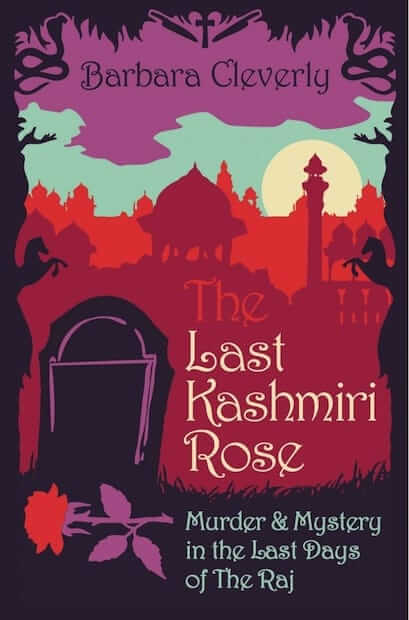
The adventures begin with The Last Kashmiri Rose (2001). Acting governor of Bengal Sir George Jardine, on the urging of his niece and the district collector’s wife, prevails on Sandilands to go to Panikhat, 80 km from Calcutta, where wives of officers in a cavalry regiment have been dying in violent but apparent accidents every March. A bunch of small red roses is then found on their graves on their death anniversaries.

Aided by a smart Indian havildar, Sandilands tries to uncover the links while grappling with the ramifications, particularly the killer’s identity – Indian or European? Both could have disturbing consequences, and, yes, March is still not over.

Ragtime in Simla (2002) sees Sandilands coming to the hill town as Jardine’s guest and getting dragged into another mystery when his travelling companion, a Russian opera singer, is shot dead at his side on the road up to the town. Investigating this and an identical killing a year before, Sandilands unearths a dark underside to the glittering life of the Raj’s summer capital and someone prepared to kill to safeguard a secret.

The Damascened Blade (2003) is set on the unforgiving frontier with Afghanistan. Holidaying with an old army friend, Sandilands is dragged into becoming bodyguard to an American heiress visiting the fort among an ill-assorted group – which includes a RAF officer and a bureaucrat with varying perceptions of border policy. The trouble starts when an Afghan nobleman, who has come to escort one of these guests to Kabul, is found murdered and his aide slips out with hostages. Sandilands and his friend have seven days to identify, arrest and punish the killer before the frontier erupts into war.

The Palace Tiger (2004) sees him visit the princely state of Ranipur. The old maharajah, a British ally, is dying, and the succession is unclear with the first son dead in suspicious circumstances while the second dies dramatically right before Sandilands’ eyes. He has to ensure survival of the last heir, a 12-year-old, while seeking to identify the killers from an array of powerful, manipulative characters at the court. Then a tiger hunt goes very wrong.
Cleverly’s stories appear interesting, with their exotic settings and complex characters, both British and Indian, all with their own agendas and allegiances, and unable to be easily categorised as good or bad.

A modern, fresh approach is also ensured with the author not skirting issues that older writers would never address, least of all directly – homosexuality, infertility, surrogate parenthood and so on. And Sandilands is far from the virtuous, restrained British hero of yore, not averse to liaisons with pretty women, single or married.

The rest of Sandilands’ adventures – seven, with the latest one due this year – are set back home in Britain as well as France and are wonderful portrayals of the dark side of the glittering 1920s. But his Indian cases have a special resonance, offering a rare peek into a bygone era: catch them.

When the planets align

0
Photo credits: Binu Photography www.binuphotography.com.au
Reading Time: 2 minutes
Photo credits: Binu Photography www.binuphotography.com.au

The monkeys play, leaping over each other on stage, and the audience laughs. One monkey is lifted up by the others in his quest to capture the sun and the audience giggles as he topples off his friend’s shoulders. Alas, the sun is not to be caught, and an almighty thunderbolt strikes the Monkey-God Anjanaya down.

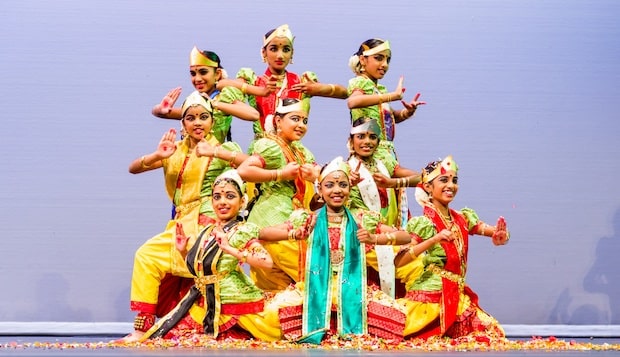
The monkeys were the junior dancers of Rasika Dance Academy, and an integral element of The Sacred Grahas. The show was an exploration in dance of the planets and their relationship with each other in Hindu mythology.

Presented in early May at UNSW’s Science Theatre, it was a show that raised funds for OZINDCARE, a local charity that provides for the needy in India.

The performance’s success is attributable to the high calibre of Rasika Dance Acadamy’s dancers, as well as the creative choreography of their guru Manjula Vishwanath. Over the course of a few hours, the audience were taken through the stories that surround the planets (‘grahas’) in Hinduism, many of these tales being the origins of frequently practised Hindu rituals.

In Chandran, Lord Ganesh was portrayed comically trying to ride his protesting mouse vahana (vehicle). The moon, Chandran, was watching and unable to contain his mirth, laughed out loud. Indeed, the audience was laughing with him, so delightful was the portrayal. Ganesh was insulted and declared that no-one shall look upon the moon on Ganesh-Chaturthi day.

There were well-known stories such as the one when Vishnu as Vamana asked Mahabali whether he could take three steps; he then proceeded to place a foot on Earth, then heaven and finally on Mahabali’s head.

The much loved tale of Princess Damayanti and her beloved King Nala was depicted in Sani.

Then, there were lesser known tales such as when Muthuswami Dikshithar taught Thambiappan to relieve himself of his stomach pain through prayer, portrayed in Guru.

Each planet was described through intricate, innovative choreography by Mrs. Vishwanath and the mature, captivating performance by her students of all ages. The youngest in the group stole the audience’s hearts, while their seniors displayed an expressiveness and technical finesse that was uniformly excellent across the group. Special mention must be made of Anjana Chandran who managed to draw and hold the audience’s attention with her graceful, charming performance. To stand out in a group of such a high standard is no easy task, and it really seems as if Anjana was born to dance.

Interestingly, each segment of the program was introduced by a small skit, in which a marriage is being arranged and the Hindu priest is explaining the planetary arrangement to the young couple. Like the dance performance itself, these skits were a unique and well thought-out addition.

Rasika Dance Academy’s The Sacred Grahas was a well-choreographed, beautifully performed dance recital by a group of Bharathanatyam dancers that are one of the best in Sydney. The fact that it raised funds for a cause as good as those represented by OZINDCARE added to its appeal, and made it truly meaningful in every way.


Wistful look at a porn-writer’s life

0
Reading Time: 2 minutes

Film: Mastram

Starring: Rahul Bagga, Tara Alisha

Director: Akhilesh Jaiswal

Rating: ***

Unzip those inhibitions, will ya?
If in Mastram, you expect a Boogie Nights kind of all-encompassing panoramic peek-a-boo at the porn industry, then you are in for an anti-climax. Mastram chronicling the life-story of a man who would be kink(y), is a sad, glum, wistful look at the life of a litterateur who was persuaded to give porn a chance, just to make ends meet.
Director Akhilesh Jaiswal lets the porn writer Rajaram, aka Mastram, played by Rahul Bagga, grow within the space where sex is a synonym for survival. He must write dirty books to make a living. In Guru Dutt’s Pyaasa, the poet Vijay faced the same dilemma. Write pulp, or perish, he was told. Vijay preferred to perish.
Rajaram is a product of consumerist culture. With creditors knocking down his door, he chooses a life without debt. For those expecting to see the rise and fall of a generation fed on porn, Mastram is not your cup of tea. It never goes into the author’s libidinous craft. It stays in his mind, probes and punctuates the protagonist’s perverse practice dispassionately.
There is a pronounced absence of frenzied excitement in the narrative. We feel the pain beneath the porn. Director Jaiswal tears at the layers of titillation and touches upon the pain and loneliness of an artiste compelled to sell sex when all he wants is to write literary works.
Rahul Bagga plays Mastram with an air of boyish curiosity and impassive mystery. We never know what he is thinking, maybe because he isn’t thinking much. Could this man be faking his enthusiasm for erotica? We never touch the man’s soul but feel its presence in his life and specially in his bond with his wife, played with understated grace by Tara Alisha.
SUBHASH K. JHA

Wistful look at a porn-writer's life

0
Reading Time: 2 minutes


Film: Mastram
Starring: Rahul Bagga, Tara Alisha
Director: Akhilesh Jaiswal
Rating: ***
Unzip those inhibitions, will ya?
If in Mastram, you expect a Boogie Nights kind of all-encompassing panoramic peek-a-boo at the porn industry, then you are in for an anti-climax. Mastram chronicling the life-story of a man who would be kink(y), is a sad, glum, wistful look at the life of a litterateur who was persuaded to give porn a chance, just to make ends meet.
Director Akhilesh Jaiswal lets the porn writer Rajaram, aka Mastram, played by Rahul Bagga, grow within the space where sex is a synonym for survival. He must write dirty books to make a living. In Guru Dutt’s Pyaasa, the poet Vijay faced the same dilemma. Write pulp, or perish, he was told. Vijay preferred to perish.
Rajaram is a product of consumerist culture. With creditors knocking down his door, he chooses a life without debt. For those expecting to see the rise and fall of a generation fed on porn, Mastram is not your cup of tea. It never goes into the author’s libidinous craft. It stays in his mind, probes and punctuates the protagonist’s perverse practice dispassionately.
There is a pronounced absence of frenzied excitement in the narrative. We feel the pain beneath the porn. Director Jaiswal tears at the layers of titillation and touches upon the pain and loneliness of an artiste compelled to sell sex when all he wants is to write literary works.
Rahul Bagga plays Mastram with an air of boyish curiosity and impassive mystery. We never know what he is thinking, maybe because he isn’t thinking much. Could this man be faking his enthusiasm for erotica? We never touch the man’s soul but feel its presence in his life and specially in his bond with his wife, played with understated grace by Tara Alisha.
SUBHASH K. JHA

At last, an intelligent Bollywood whodunit

0
Reading Time: 2 minutes

Film: The Xpose

Starring: Himesh Reshammiya, Yo Yo Honey Singh, Zoya Afroz, Sonali Raut, Ananth Mahadevan

Director: Ananth Mahadevan

Rating: *** 1/2

When was the last time we saw an intelligent and entertaining whodunit? Normally, all they do is line up a slew of stiff cardboard suspects trying to look guiltily into the camera, and pick one of the gallery of eccentrics as the one whodunit and impute a silly motive on him.
Director Ananth Mahadevan goes at the whodunit with a relish that communicates itself to the audience. Set in the film industry during the late 1960s, there is a flouncy flair and glossy aura to the story telling.
Mahadevan recreates the impassive allure of the entertainment industry with his tongue lodged firmly in his chic. You can’t miss the broad references to the gossip, scandal and rivalry of the film industry. Playing a southern superstar with an arrogant self-regard that rivals the legendary haughtiness of ‘Jaani’ Raaj Kumar, Himesh Reshammiya is reborn as an actor. His piercing icy-cold eyes give away nothing, and everything. He is a man in love… with himself, then with a woman who he can’t bear to see go astray.
Every actor, from Nakul Vaid as a matinee idol grappling with suspicion, to newcomer Zoya Afroz as a star on the rise struggling to remain virtuous in a world built on artifice, and Sonali Raut as the slutty ambitious star on the rise who sleeps around for a price, is cast well and given a chance to effectuate his or her playing-time with punctuation marks that may not be written in the plot.
Yo Yo Honey Singh makes his Bollywood acting debut. Playing a spoilt, pampered, deceitful music director who marries into money and undeserved inheritance, Yo Yo imparts a certain innocence to his character’s duplicity and greed. He isn’t the villain but a victim of his unquenchable appetites.
Himesh plays a superstar who falls in love with his latest heroine but is unable to confess all to the girl. The theme of unexpressed love provides a tantalising subtext to the sizzling, boiling, simmering plot filled with characters who can’t tell the difference between life in the studios and outside.
The murder happens in the second overture during a grand after-party where two rival actresses come to blows. The eventful colourful film never fails to take swipes the world of the make-believe. Intrigue, envy, jealousy, rivalry, suspense and murder… this is the masalaland of the 1960s as seen through the winking, glinting eyes of a director who understands the machinations of the entertainment industry.

Normally films set in the entertainment industry end up taking themselves too seriously. The Xpose careens between a mood of gratuitous satire and earnest regret for a world where sham is the name of the scam.
Yup, there is no business like show business.

SUBHASH K. JHA

Impressive debutante

0
Reading Time: 3 minutes

Sydney dancer Minakshi Srinivasan presents her Arangetram

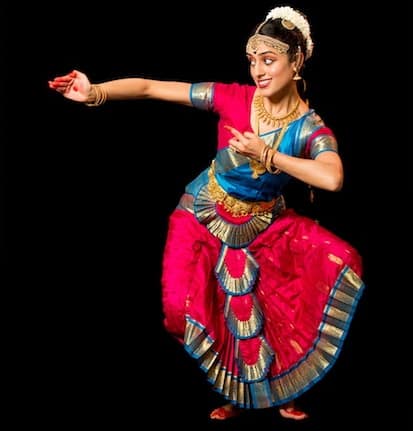
The best performances are those in which the audience is fully absorbed, far too caught up with what the artiste is going to do next to play with the smart-phone or chat to their neighbour. Earlier this month, Minakshi Srinivasan performed her Bharathanatyam arangetram to pin drop silence and undivided attention from an enraptured audience. A student of Sydney guru Nikhila Kiran and her dance academy Natyanivedan, Mina performed her debut solo performance at Sydney Bahai Centre.

Arangetram in Tamil means ‘to ascend the stage’. Ascend she certainly did, taking her audience with her as she told stories punctuated by crisp jathis and with beautifully clean lines. In the past two decades in Sydney, an arangetram has moved away from what it once was, a first time stepping-stone by a young, inexperienced dancer, to dance recitals from dancers who have the maturity and confidence to deliver close to professional performance. Minakshi’s was one such arangetram, her poise, unwavering confidence and ability to connect deeply with the audience making it difficult to differentiate her performance from that of many professional dancers.

Mina’s ability to immerse herself wholly into the character she is portraying ensures that those who are watching can’t help but believe she is the Goddess Andal preparing for her wedding, or Lord Shiva caught up in his cosmic dance, or the ardent devotee of Lord Ganesha. A stand-out piece was one that strayed from the classical theme of gods and goddesses. It was a social parody of sorts, a light exploration of marriage in the bygone era, when girls were married off as children before they had the maturity to handle such a concept. Mina, as the playful, excitable, sulky girl who can barely sit still long enough to take in her mother’s advice on how to interact with her husband-to-be, had the audience at once laughing and tearing up.

The piece de resistance of any Bharathanatyam recital is the Varnam, an extensive arrangement of jathis (abstract dance) and expressive enactments. An important story is always told, and more often than not a god or goddess is showcased. Mina’s Varnam explored the relationship between Lord Shiva and his beloved Goddess Parvathi, as well as the adoration of their devotees. The piece was a spectacular combination of thoughtful choreography by Mrs Kiran and skilful execution by the dancer.

Another captivatingly expressive piece was Bho Shambho, a tribute to Lord Shiva. It is quite a challenge to both choreograph and perform to this piece. The music is so hauntingly beautiful that only a strong dance performance will hold its own, and Mina’s certainly did. It was a remarkably athletic, yet graceful portrayal of the dynamic Lord, with excellent choreography at its foundation.

If the Varnam is the centrepiece of a repertoire, the Thillana is its crowning glory. A final display of the by-then exhausted dancer’s technical finesse, it requires the artiste to somehow conjure up that last bit of energy after presenting the rest of the repertoire. Minakshi performed this piece as if it were the first of the evening, with precise, energetic execution of the complex choreography, crisp footwork, and incredible agility, all the while smiling charmingly.

Music is a main element in dance, and Mina’s performance was accompanied by a delightfully young and talented set of musicians. Anand Sadasivam Dixit lent his dulcet voice, while the seasoned Balaji Jagannadhan played the violin. The mridangam, a prominent instrument in Bharathanatyam, was played skilfully by Janakan Raj, and young Venkatesh Sritharan provided the melodious flute accompaniment. Nattuvangum was delivered by the guru Nikhila Kiran. The MC role was performed by the well-spoken Charishma Kaliyanda and Mina’s brother Krishna Srinivasan.

Minakshi’s performance made it clear that she is an artiste to watch on the dance scene. Her precise, energetic execution of abstract dance as well as her ability to convince and draw in the audience with her artful expressiveness are sure signs that she will continue to excel in this beautiful, challenging art form that is Bharathanatyam.


… she is (convincing as) the Goddess Andal preparing for her wedding, or Lord Shiva caught up in his cosmic dance, or an ardent devotee of Lord Ganesha.