Home Blog Page 952

An ode to the city’s invisible populace

0
Reading Time: 3 minutes

Film: Citylights

Starring: Rajkummar Rao, Pratilekha, Manav Kaul

Director: Hansal Mehta

Rating: ***

The city sucks. Sucks in the uninitiated, swallows up the innocent wholesale, diminishes the ego. If you happen to be one of the multitude of faceless migrants, you are in for a really gruelling time.

Citylights is Hansal Mehta’s ode to the invisible people, those people populating the pavements we often see from our moving cars. Mehta zooms in on the life of one such family – with such intensity and passion that we cannot come out of their world even when their lives become unbearably hurtful.

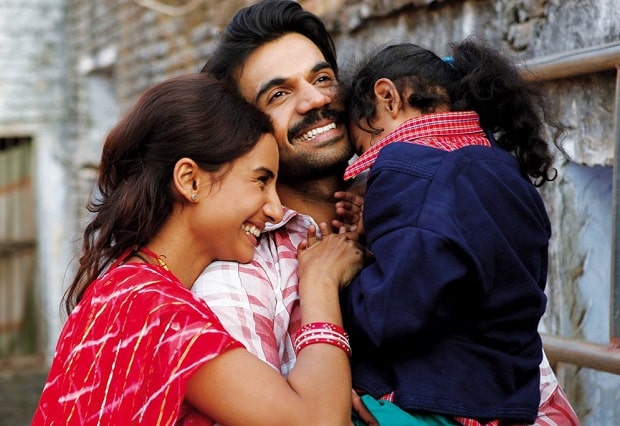
As Deepak Singh (Rajkumar Rao), his wife Rakhi (Patralekha) and little daughter relocate from their small universe in Rajasthan to Mumbai, we watch in numbed silence their initiation into the world of disillusionment and heartbreak.

Mehta’s camera captures the happy family’s world come apart at the seams. The brutal cruelty of the concrete jungle leaves us flummoxed and frozen. The plot as it thickens in the second half, doesn’t allow any elbow room for distractions. The protagonist’s journey into the heart of darkness is immediate, and irreversible. What Mehta does is to show us the fatality and finality of lives thrust into the bowels of the city.
Not that Mumbai is shown to be entirely lacking in kindness and compassion. Deepak and his wife encounter good people too. It’s not the people who are callous. It’s the daily grind that makes them self-centred and uncaring.

Mehta’s ode to the remorseless city is suffused in a lived-in pain. Only an artiste who has suffered the first-hand humiliation of rejection and compromise could do the sequence such as the one where Rakhi auditions for a bar girl’s job. Mehta furbishes such stark moments with an astute and rigorous honesty.

In that scene, Pratilekha strips herself of dignity. She’s a revelation. But then so is the actor (Vinod Rawat) who plays the bar owner. If she epitomizes the exploitative underbelly of the city, he too is a victim of a system that thrives on exploitation.

Moving completely away from the original material (Sean Ellis’ Metro Manila), Hansal Mehta constructs a vertiginous spiral of desolation and dejection. And yet if there’s so much cruelty happening all around to the people who know no better life than the one that the city doles out to them, there are also bursts of empathy from the most unexpected places.

The arrival of the character played by the very accomplished actor Manav Kaul signals the “thriller” movement of the plot. Miraculously Mehta never loses grip of the film’s exacerbated emotional quotient. He charts the migrant family’s craggy path to doom and destruction with a fatal inevitability. The film uses natural sounds and incidental images from everyday life to imbue visceral vividness and vitality.

A remarkable equilibrium runs through the moral fibre of the film. Ritesh Shah’s sensitive script doesn’t look for villains to make his protagonists look sympathetic.
Mehta could have avoided the wall-to-wall songs in the background. Though the music is evocative, it tends to overplay its welcome. This film doesn’t need to depend on adornments for effect.

Rao’s stark performance seems like no performance at all. Just like the city that swallows the impoverished migrant, he disappears into his character, much like Balraj Sahni in Bimal Roy’s Do Bigha Zameen, the classic tale of the homeless migrant to which Mehta’s haunting saga of the indignity of poverty owes emotional allegiance. Patralekha with her haunted eyes and evocative pain-lashed voice is the find of the year.

Citylights will remain with me for a long time. Gripping, glorious and unforgettable, it is a shattering, life-changing experience.

Subhash K. Jha 
 

An ode to the city's invisible populace

0
Reading Time: 3 minutes


Film: Citylights
Starring: Rajkummar Rao, Pratilekha, Manav Kaul
Director: Hansal Mehta
Rating: ***
The city sucks. Sucks in the uninitiated, swallows up the innocent wholesale, diminishes the ego. If you happen to be one of the multitude of faceless migrants, you are in for a really gruelling time.
Citylights is Hansal Mehta’s ode to the invisible people, those people populating the pavements we often see from our moving cars. Mehta zooms in on the life of one such family – with such intensity and passion that we cannot come out of their world even when their lives become unbearably hurtful.
As Deepak Singh (Rajkumar Rao), his wife Rakhi (Patralekha) and little daughter relocate from their small universe in Rajasthan to Mumbai, we watch in numbed silence their initiation into the world of disillusionment and heartbreak.
Mehta’s camera captures the happy family’s world come apart at the seams. The brutal cruelty of the concrete jungle leaves us flummoxed and frozen. The plot as it thickens in the second half, doesn’t allow any elbow room for distractions. The protagonist’s journey into the heart of darkness is immediate, and irreversible. What Mehta does is to show us the fatality and finality of lives thrust into the bowels of the city.
Not that Mumbai is shown to be entirely lacking in kindness and compassion. Deepak and his wife encounter good people too. It’s not the people who are callous. It’s the daily grind that makes them self-centred and uncaring.
Mehta’s ode to the remorseless city is suffused in a lived-in pain. Only an artiste who has suffered the first-hand humiliation of rejection and compromise could do the sequence such as the one where Rakhi auditions for a bar girl’s job. Mehta furbishes such stark moments with an astute and rigorous honesty.
In that scene, Pratilekha strips herself of dignity. She’s a revelation. But then so is the actor (Vinod Rawat) who plays the bar owner. If she epitomizes the exploitative underbelly of the city, he too is a victim of a system that thrives on exploitation.
Moving completely away from the original material (Sean Ellis’ Metro Manila), Hansal Mehta constructs a vertiginous spiral of desolation and dejection. And yet if there’s so much cruelty happening all around to the people who know no better life than the one that the city doles out to them, there are also bursts of empathy from the most unexpected places.
The arrival of the character played by the very accomplished actor Manav Kaul signals the “thriller” movement of the plot. Miraculously Mehta never loses grip of the film’s exacerbated emotional quotient. He charts the migrant family’s craggy path to doom and destruction with a fatal inevitability. The film uses natural sounds and incidental images from everyday life to imbue visceral vividness and vitality.
A remarkable equilibrium runs through the moral fibre of the film. Ritesh Shah’s sensitive script doesn’t look for villains to make his protagonists look sympathetic.
Mehta could have avoided the wall-to-wall songs in the background. Though the music is evocative, it tends to overplay its welcome. This film doesn’t need to depend on adornments for effect.
Rao’s stark performance seems like no performance at all. Just like the city that swallows the impoverished migrant, he disappears into his character, much like Balraj Sahni in Bimal Roy’s Do Bigha Zameen, the classic tale of the homeless migrant to which Mehta’s haunting saga of the indignity of poverty owes emotional allegiance. Patralekha with her haunted eyes and evocative pain-lashed voice is the find of the year.
Citylights will remain with me for a long time. Gripping, glorious and unforgettable, it is a shattering, life-changing experience.
Subhash K. Jha 
 

Malladi Brothers mesmerise Adelaide

0
Reading Time: 3 minutes

After a drought of almost two years, Indian classical music lovers of Adelaide were treated to a top deck concert on the last day of autumn by the renowned Malladi Brothers.

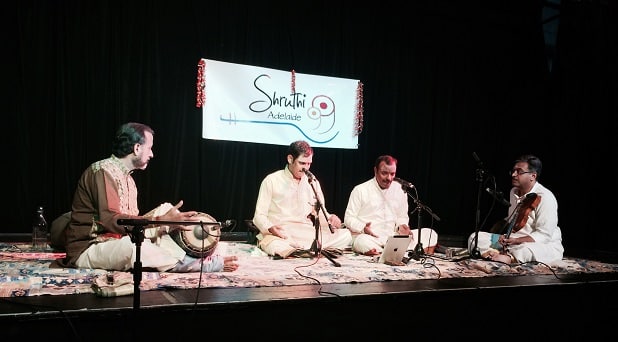
The event was presented by Shruthi, the only organisation to cater for the aficionados of carnatic music in this Festival City.

Weatherwise too, at the close of the warmest May on record, rain god Varuna came down in time as if not to miss the mesmerising music of the Malladis. It was a record crowd as well at the Nexus Multicultural Centre, an unusual venue for this kind of event. It is a cabaret space with restaurant style seating with professional lighting for stage plays, bar and kitchen facilities. For the Indian programme the seating was modified and the bar was cordoned off.

Perhaps for the first time this venue, accustomed to hearing western drums, would have reverberated to mridangam beats. Multiculturalism in full play! It is just incidental that the mridangam player at this concert, V.K.Prasad, started as a drummer.

The repeated applause from the audience was an endorsement of how well it was appreciated by the audience. The Malladi Brothers, Sreerama Prasad and Ravi Kumar, started the three-hour concert with ‘varnam’ in saveri raga, an appetizer that sounded somewhat modest. But the rest was just rapturous. Next, the Ganesh krithi Gajavadana in Sri Ranjani raga was rendered with extended kalpana swaras. This was followed by popular Dikshitar’s popular Swaminadha paripalaya in raga Natai. Then came St.Thyagaraja’s composition Naada sudharambilanu in Arabhi with alapana and the krithi sung in an awesome manner.

The brothers showcased their vast repertoire by choosing compositions such as Matru Bhutaiah’s Nee madi challaga in Anandabhairavi, Swathi Thirunals’s Bhogeendra sayinam Papanasam Sivan’s Kumarn thal paninde.

Dikshitar’s Rama namam bajeham in Panthuvarali was a treat with niraval and kalpana swara.

Then came the main piece for the evening Dasaradhee nee runamu in Thodi. Mridingist Prasad’s thani avarthanam added to the allure of this piece de resistance.

When the audience were just recovering from a state of ecstasy came Ragam, Tanam and Pallavi set in raga Natakuranji. Ravi Kumar brought the intricate structure of the raga with the fine timbre of his voice and the raga bristling with many brugas.

It might have been raining outside, but inside it was a downpour of delight when the brothers took up Ragamalika choosing ragas Valaji, Hindola, Charukesi and Hamir kalyani as shining pearls in the string. It was mind blowing.

Throughout the performance both Prasad on mridangam and Venktraman on violin provided excellent support. Violin is a second string to the bow for Venkat, a full time IT professional. But his performance was as good as any in the business.

After such an array of awesome krithis, the Malladi Brothers switched to thukdas (minor items). Even here their armoury was extensive. Besides the well-known Purandaradasa and Annamacharya, they chose pieces from not-so-mainstream Badrachala Ramadasu and Ganapathi Ssachidananda (Hanuman bhajan).

Their virtuosity extended until the end as they concluded the concert with marali marali mangalam in Madhyamavathi.

The evening before the concert, a couple of dozen rasikas had an hour-long meeting with the Malladi Brothers for an informal Q &A session. The questions ranged from personal to professional, their career path to classical music technicalities that many of us had in our head for a long time but were afraid to ask. It was an opportunity worth grabbing and well rewarded.

Notwithstanding the jet lag after a long flight from India, they sat well past dinner time to answer every one of the questions. Music seems to run in their family’s veins as their grandfather, father and uncle were all musicians of note from whom the brothers cut their teeth. Like most musicians of today, they are both university educated. They did not decide on settling in a musical career until the completion of their degrees even though they regularly accompany their father and uncle – the original Malladi Brothers – at their stage performances. They had their own first public performance in 1989, major breakthrough in 1993 and from then on, never looked back. Since their first overseas tour in 2001, they have been to every country wherever Indians carry their love of classical music with them.

LP Ayer and Bharathy Subramanyam


The challenges of teaching classical Indian dance

1
Reading Time: 3 minutes

 A researcher at QUT examines the innovative techniques Bharatanatyam teachers use in their instruction

Bindu Rajendren

Teaching classical Indian dance to students outside of India, Bharatanatyam dancer Bindu Rajendren found she has had to constantly adopt new techniques in her instruction.

Over the course of ten years as a teacher, she picked up a few lessons in the process of negotiating her training practices for an audience that was not immersed in the culture of the dance. Yet she was still not convinced whether she was adapting her classical dance knowledge in a way that led to meaningful comprehension by her dance pupils.

This prompted her to pursue a Phd in Dancing from the Queensland University of Technology (QUT).

“I remember an instance when I tried to teach a dance movement of dressing up through adornment,” Bindu tells Indian Link. “The action required the showing of the wearing of an earring. The dance movement is typically shown by the turning of the hands in a particular hand gesture (mudra) near the ear. Traditional Indian earrings have a screw-type closure. However my student could not comprehend this and questioned this action as she had only seen a push-type earring back! She said, ‘Why turn a screw, can’t we just push the earring in?’ I had to take out a jhoomka (traditional Indian earring) and show her the screw-type earring back behind it. Then she was able to comprehend what I was trying to teach her”.

Bindu always wondered whether other teachers of dance have encountered similar situations and challenges.

Her research aims to understand how Indian classical dance teachers negotiate their teaching practices when they teach their traditional discipline in a multicultural Australian setting where contemporary educational strategies are implemented.

“In India the teacher teaches and the student imitates, but in Australia there is more conversation between the teacher and student,” says Bindu.

This is almost a part of the training where the teacher needs to explain the reasons to a student about a certain dance phrase or step in a particular way.

In India, Bindu notes, students of dance have awareness through Indian mythological stories that they have grown up with, and by being immersed in the culture. They also learn through newspapers, magazines, or television, whereas in Australia it is a blank canvas; there is no exposure, therefore it makes it difficult for students to comprehend the nuances of Indian classical dance forms.

“I believe that for most Indian classical dance teachers, what they know of teaching comes from imitating their teacher and learning to teach as they go. I am myself a classic example of this,” says Bindu.

For teachers of dance, their learning and their teaching are both processes that they continue to build on. Most Indian classical dance teachers who teach in a multicultural Australian context want their students to experience the same level of knowledge and access to dance as they themselves experienced when they learnt the dance back in India. However in the process of shifting the teaching space to a multicultural Australian context, and teaching students who come from this new setting, teachers often have to adapt and repackage what they teach in ways that are meaningful for their students.

“This is what I intend to understand in my research: the methods teachers use to teach and how they package and deliver Indian classical dance (to a new cultural audience)”.

Currently in her first year of research, Bindu is working with three Indian classical dance teachers, two of who are based in Brisbane and one interstate.

The duration of this research spans four years; the first year involved laying the foundation for the research, the second will encompass data collection, the third year will focus on the analysis through the themes emerging from the research and the final year will be spent in writing her research.

Bindu is looking at applying for a grant to QUT to present her study at conferences.

“I am hoping that this research will not only benefit and be of value to Indian classical dancers but will also hold some usefulness for teachers of dance of other cultures, for example Salsa, African dance etc, who want to or have adapted their dance in new cultural contexts and spaces. I think there is potential to build on this subject”.

Even though Bindu’s irresistible urge to dance remains suppressed currently, there is no doubt that as her research unfolds, she will return to it not only with renewed passion but with new insights as well.

Seniors hit the Barossa

0
Reading Time: 4 minutes

A touch of wine, an enjoyable Indian lunch and numerous strolls were to be had by the Adelaide seniors


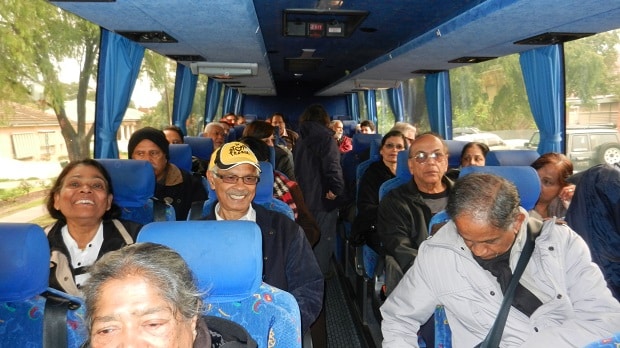
It was a bleak morning with a grey sky. Drizzle and mist left over from the night before blanketed the horizon. As we began to arrive there were anxious looks up into the sky to see if there was a chance of the weather clearing up. A day trip to the famous wine growing region of the Barossa Valley had been organised. A coach had been hired, commitments made and there was never a doubt that fun was to be had. There was plenty to look forward to and the weather was soon forgotten in the midst of the chatter of friends.

It was nice sitting high up getting a different perspective of the scenery all around. As the coach cruised along in no time at all and we were passing Barossa Fruit Wines, who are one of the few wineries that make wine, but not from grapes. It was their rose petal wine that intrigued me, which conjured up romantic images of a bygone age.

Along the route to the Barossa Valley is the Whispering Wall. This wall, or rather; dam, is in fact, a retaining wall of the Barossa Reservoir and was built between 1899 and 1903. The construction was a very advanced design for its day and received worldwide attention. Its arced shape helps to disperse the pressure of water on the wall but also gives it the unique ability to be able to transport a softly spoken word from one end of the wall to the other – a distance of some 100m. What a spot for a coffee break! Out in the bush amongst trees, looking over the serene lake, while walking along the curve of the dam, surely was something to remember. Many tried to test the acoustic credentials of the wall; I suspect with varying degrees of success.

We hardly had time to regret not having stopped for a tasting earlier when the coach pulled in to the Kies winery. Nice gardens surrounded a busy little cellar door with a polished dark wood bar and the walls covered with assorted memorabilia. For some, it was a stroll around the gardens and for others, there were wines to taste, compare and enjoy. For me it was the soft reds and mild rieslings that won out. We left satisfied, with some of us carrying bottles to take back home.

We were now travelling into the heart of the Barossa Valley with its undulating hills and fields covered with vines of autumn leaves. Yellows, rusts and reds predominated with the leaves strung out in straight lines with green tracts in-between the trellises. This was a beautiful sight. Liquid amber trees had turned a deep red and set against the grey skies, simply magnified the effect. Every now and again there were fields with new-born baby lambs frolicking around. Autumn is the season for the new lambs and then they have the winter to gather their strength before facing the sometimes harsh summer weather ahead.

We drove past many wineries, some of which are household names. One name that is known world-wide is Jacobs Creek and that was our next stop. There was not so much as a cellar door here, but rather a wine centre. A modern glass and chrome building with tasting areas, restaurant and conference facilities. Once again the group split into those for tasting or those for strolling. As we were boarding the coach we could see shafts of the sun’s rays lighting their way through the clouds. With the day brightening, the colours of the countryside took on their natural vibrancy.

It was getting close to lunch and the coach wound its way through Tanunda and onto Nooriutpa to our lunch venue at the Barossa Indian Cuisine restaurant. With the rapid expansion of Indian migration into South Australia soon there will be Indian cuisine available in every corner of the state. Such is the popularity of our food. Lassi to start, gulab jaamans to finish and the comfort of simple vegetarian food made for a good familiar meal.

A regular and much loved feature of the Adelaide Seniors meetings is a quiz prepared and conducted by Rajan. In the quiz on this trip he used questions that he has used many times previously for which we have been given answers in the past. So it was a cause for great hilarity that we could still not get the answers right. I suppose, as a group, we were acting our age.

It really was necessary to walk around the town for a bit, to help the digestion before boarding the bus again for the afternoon’s leg of the journey. The soothing gentle movement of the bus found many eyes closing. Next was the pretty town of Angaston, a base of much of South Australia’s heritage. In Springton we saw The Herbig Family Tree. Not much is left of this large, hollow, red gum reputed to be over 300 years old. In 1855 Freidreich Herbig and his family arrived here and made the tree his home. The Herbig descendants still have annual reunions at the site.

A final stop in the Adelaide Hills for a warming cup of tea and Mother’s Day cake at Woodside and then it was back to the IASSA hall where a weary but satisfied bunch of seniors, very much feeling their age, said their goodbyes. It had been a long day, but in our senior years when day follows day, perhaps this one will stand out as one to remember and recall with pleasure.

A modern twist to an old classic

0
Photo: Masterchef
Reading Time: 3 minutes


It was a moment of pride and honour for all Indian foodies to see acclaimed Michelin-star chef Vikas Khanna, appear on MasterChef Australia currently being aired on Channel Ten.

He was invited to set up a pressure test challenge on the 6th season of the show.

And the challenge he set up – chicken tikka masala! Now before you think that would have been easy, remember this is Vikas Khanna and this is MasterChef. The hosts were pleasantly surprised and the contestants filled with dread when Chef Khanna lifted the cloche to reveal his signature creation, rose tea smoked chicken tikka masala with coriander oil, rice pappadum and lemon rice.

Khanna said that this dish incorporated the numerous traditional elements that he learnt while growing up and travelling in India along with some modern and contemporary Western influences that he learnt while living and cooking in the US. He explained to the contestants that the smoking technique is a traditional one followed in India where spices are added to ghee and poured over hot charcoal to infuse flavour and aroma into the dish. In this particular dish, he used a mélange of spices, dried rose buds and Darjeeling tea leaves to lend a distinct tandoor flavour to the chicken.

There were many modern elements but Chef Khanna said that the main one was the chicken itself; instead of using regular boneless pieces, he created a chicken roulade stuffed with roasted tomatoes, garlic, Madras spice mix and figs to create the traditional sweet and spicy flavour tones of chicken tikka masala. The rice pappadum was the other surprise element where he infused boiled rice with orange blossom, white wine vinegar and mustard seeds and then oven baked it to create the pappadum.

The dish was a challenge for many of the contestants who were not familiar with Indian flavours and in spite of being a pressure test, Khanna was present with each contestant throughout the challenge offering advice, boosting morale and sometimes, even lending a helping hand. In spite of being such an acclaimed celebrity chef, he is an extremely warm, kind and friendly person which really came across on the show.

Khanna’s cooking journey began in his original home town of Amritsar, Punjab. He was interested in food from an early age, so naturally, his grandmother became his first teacher. She passed on to him the traditional art of his family’s cuisine. From then, it wasn’t long before he started to share his love of cooking with others. At the age of 17 he started his own catering business.

Today his accomplishments are numerous and varied, and his recognition is wide. Khanna is an accomplished chef, restaurateur, filmmaker, author, and television personality. He also runs and owns Junoon, a highly acclaimed restaurant in New York showcasing modern Indian cuisine. He admits running a restaurant is no easy task and still works very hard to prove his potential.

Other successes include catering for events at the White House in the US and authoring many books including The Spice Street and Modern Indian Cuisine. Producing and filming the series Holy Kitchen is also on this list, where Khanna takes a look at the role that food plays in our spiritual lives, festivals, traditions, and how cooking food and sharing food can bring people, and the world closer. His successes also include becoming a television chef and personality, starring in Gordon Ramsey’s Kitchen Nightmares and Hell’s Kitchen, with Martha Stewart on her show, and hosting MasterChef India.

During his brief visit to Melbourne, Chef Khanna took a whirlwind culinary tour of the city with the MasterChef hosts, Gary, George and Matt. He said that he enjoyed sampling local Indian fare which also made him realise that there is much more to explore and experience in culinary Melbourne and promised that he will be back soon.

What advice does Khanna have for fellow young Indians here in Melbourne who have migrated from the east to live now in the west like he did? Was he ever lonely, did he struggle with cultural differences, how did he get his confidence?

“New York is a place where everyone is from everywhere else,” he replied. “Everyone is a self-starter and everyone is moving and creating, and that is the culture of the place. There was no one particularly lonely, there is not that sense, what you do is, you just get stuck into it, into plans and into creating a life for yourself too”.

Watch the full Masterchef episode, if you missed it, on http://tenplay.com.au/channel-ten/masterchef/episodes


Vodafone doubles data and shakes up international roaming prices!

0
Reading Time: 2 minutes

Vodafone’s push to continually offer greater value to customers continues with the latest offering on the new Samsung GALAXY S5, which has proved to be extremely popular with its larger and brighter full HD super AMOLED screen and faster processor.


Vodafone mobile plans have been built around the internet so customers can get the most out of their devices. The new GALAXY S5 is available for $19 per month on our $60 a month plan over 24 months (total min cost $1896) with 3GB of included data (double the usual 1.5GB).


Recognising that customers in Australia are now becoming more and more global, customers on new Vodafone Redplans can also get the added bonus of being able to take their Red plan overseas for $5 extra a day to over 47 countries, and also enjoy the newly launched Pay-As-You-Go rates when travelling to another 200 countries.


Vodafone’s Chief Marketing Officer, Kim Clarke said Vodafone has removed complicated charging structures when you travel overseas. “After launching our $5-a-day roaming offer last year which is available in 47 countries on our Vodafone Red post-paid plans, we wanted to take it one step further and provide peace of mind to our customers travelling to countries outside these destinations so they won’t be hit with excessive fees when they return to Australia”.


“Vodafone is a truly international mobile company and we are proud to offer consistently good value for our customers in Australia who travel abroad. No different price rates, no confusing zones and no need for add-on data packs’ Ms Clarke said.


Vodafone has simplified its calling and data rates to more than 200 countries including India making the new Pay-As-You-Go rates an easier way to calculate international roaming costs and avoid arriving home with an excessive bill. With data charges reduced by a staggering 90 per cent, Vodafone customers can enjoy Pay-As-You-Go international roaming rates while overseas of:

  • $1 per minute to make or receive calls
  • $1 per MB of data used
  • 75c per TXT or PXT sent

Hindu pontiff on Oz visit

0
Reading Time: 2 minutes

While NRIs today have access to an increasing number of temples that employ priests from India and offer an increasing array of religious practices, what is sorely missing is the absence of visits by Swamijis or heads of religious institutions, also called Mutts.

In some Hindu sects it is believed that one should not travel across the oceans. While with over 30 million NRIs and many more millions visiting abroad regularly, this is practiced more in breach than in adherence, it is still the case that Swamijis from very old religious institutions rarely, if at all, go overseas.

One Swamiji thought otherwise. He believed that his primary mission in life is to go where the devotees are, irrespective of where they are in the world, and offer spiritual advice and support. Amidst stiff opposition from fellow Swamijis and some in the community, he started making regular overseas visits. This brave and far sighted Swamiji is Sri Sri Sugunedra Tirtha from Puttige Mutt in Udupi, Karnataka.

Udupi is a famous temple city where Shri Madhwacharya, the proponent of Dvaita philosophy, set up the Krishna Mutt in the 13th century. He handed over the administration to 8 disciples with their own mathas (monasteries). To this day, all the eight Mutts take charge of the worship and administration of Udupi Krishna temple for two years on rotation

Puttige matha is now headed by its 30th pontiff SS Sugunedra Tirtha Swamiji. He is the President of the World Conference on Religion and Peace and heads over 35 religious and spiritual institutions in India and abroad. In line with his belief that the whole world, not just India, is a holy land and that devotees, no matter where they are, deserve to be served, he has set up three Krishna temples in the USA and one in Canada.

Thanks to the valiant efforts of Sri Raghavendra Seva Samiti (SRSS) in Melbourne, SS Sugunendra Theertha Swamiji visited Australia last year. This year he made his second visit for over a month in March-April and met devotees in Perth, Sydney, Canberra, Brisbane and Melbourne.

What thrilled the devotees no end was that they got to see and worship the 750-year-old Vithhala idol that has been handed over by Sri Madhwacharya and worshipped ever since at Puttige Mutt. The Swamiji was accompanied by priests who brought the same religious fervour and atmosphere that one gets to see only in ancient Indian temples with their rendition of mantras and veda pathana. The cook that came with Swamiji rounded up the experience with the famous Udupi cuisine.

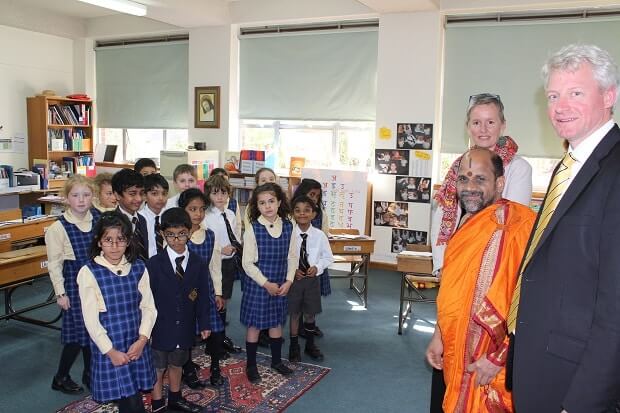
Another highlight of Swamiji’s visit was his informal Q & A sessions where he replied to all the questions, especially from youngsters, with patience, affection and deep knowledge. He also met local Australians at many functions organised by various educational institutions in his honour. To the delight of SRSS, the organisers of his visit, the Swamiji has decided to set up a Krishna temple and Sri Raghavendra Swami vrindavana in Melbourne in the near future.

For more information about the mission and activities of SRSS, visit


Mohan Thite


The Pied Piper

1
Reading Time: < 1 minute

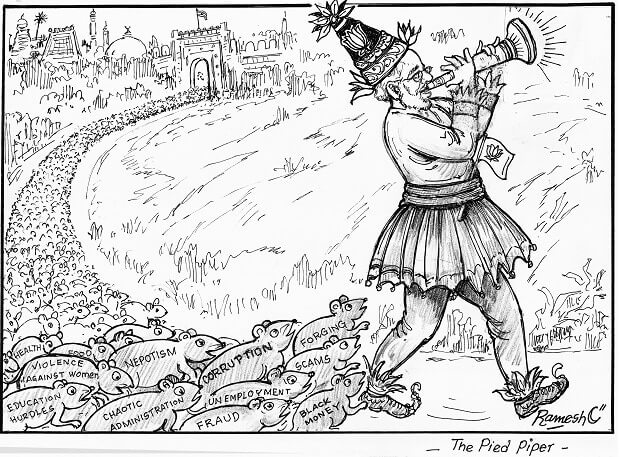
RAMESH CHANDRA ALANDKAR’s political satire of Modi as the Pied Piper leading corruption, scams and unemployment out of India

Poetry: Ode to dusk…

0
Reading Time: < 1 minute


A dusky glitter spread across the sky,

to bid a shimmering farewell to another day.

As a lonely ship wandered out of the horizon,

and slowly sailed towards the silent bay.

The golden sun in the distance, too,

had lost its burning might.

Ready for its daily plunge, its melting sunshine,

decorated the calm waters into a soothing sight.

The ship eclipsed the descending sun,

and sailed past it like a snail.

Its rudders slitting the still water,

leaving behind a dancing golden trail.

Stars sprouted in the dim sky,

and the sun’s demise was taken over by twilight.

The ship steamed to its safe harbour,

and in a while, went out of my sight..