
Home Blog Page 951

Top Ten: Comedians with Indian Links

0
Reading Time: 4 minutes

Indian origin comedians who can laugh at themselves are hitting a home run with audiences globally

It takes a stroke of genius to be able to state the obvious in a manner that is side splittingly funny. Take this one liner for instance, ‘I started out with nothing and I still have most of it,’ or ‘I can handle pain until it hurts.’Michael Caine once said, “I enjoy making people laugh. The trick is to tell them jokes against yourself. If you praise yourself, your stories aren’t funny”.

To be able to laugh at yourself requires courage and confidence and Indians have mastered this art of making people laugh. They are achieving great success in the field of comedy doing just that and much more. Here is our round-up of Indian origin comedians making a splash on the global entertainment scene.

10. Paul Varghese, USA

This Indian American comedian resides in Dallas and has often been dubbed the funniest stand-up comic in Dallas. His acts revolve around his observations on being an Indian. He has performed in the Just For Laughs festival in Canada, Last Comic Standing and the HBO comedy festival.

9. Dan Nainan, USA

Dan Nainan is half Indian, half Japanese and usually bases his stand-up comedy performances on his personal ethnic experiences. He is an American comedian with a mission, in 2007 Nainan opened the Bethesda Comedy Club in Washington DC with the aim of promoting clean comedy. His book How to become a full time stand-up comedian was published in 2012. Nainan has performed in countries all over the world including Australia, UAE, India and Ireland.

8. Aziz Ansari, USA

According to the Hollywood Reporter Aziz Ansari is one of the most prolific writers and performers on the comedy scene in recent years. Born in America to Indian parents, Aziz started his career as a stand-up comedian in 2000. He went on to create and star in MTV’s critically acclaimed comedy show Human Giant. He is well known for his role as Tom Haverford in NBC’s Parks and Recreation. Aziz released his first CD/DVD on Comedy Central in 2010 and continues to tour as a stand-up comedian.

7. Meera Syal, UK

Married to comedian Sanjeev Bhaskar since 2005, theirs is a match made in comedy heaven. Hailing from a Punjabi Indian background Meera Syal is a well-known British comedian, actor, singer, producer and writer who sent audience in stiches with her performance as hubby Sanjeev’s grandmother in The Kumars at No. 42. She was awarded the MBE in 1997, has written two novels, as well as numerous scripts and screenplays.

6. Aasif Mandvi, USA

He may be best known for his performances on Comedy Central’s The Daily Show With Jon Stewart, but Aasif Mandvi’s career as an actor, comedian and writer is much more illustrious. Mumbai born Mandvi has appeared in numerous films and television shows including Merchant-Ivory’s Mystic Masseur, Sex and the City, Law and Order and Miami Vice, to name just a few. He even has an Obie award under his belt for his hilarious play Sakina’s Restaurant, which looks at the Indian American immigrant experience.

5. Lilly Singh (Superwoman), Canada

With three million subscribers to her YouTube channel Lilly Singh, aka Superwoman, is an internet star on the rise. Her vlogs, skits and stand-up acts present comical takes on various everyday issues. Born to Punjabi parents this 25-year-old Canadian entertainer remains true and proud of her Indian roots. In her work she aims to showcase Indian culture and characters inspired by her Punjabi heritage.

4. Mindy Kaling, USA

Identified as ‘One of the 100 most influential people in the world’ by Time magazine, Mindy Kaling is often referred to as the new queen of comedy in America. She is best known as Kelly Kapoor on NBC’s sitcom The Office. Born to Indian parents the talented actor, comedian, writer, producer and director has been nominated for the Primetime Emmy Award for Outstanding Comedy Series as a producer of The Office five times in a row. In 2011 her witty memoir Is everyone hanging out without me? And other concerns was well received by the critics.

https://www.youtube.com/watch?v=0eAU4cMbZvI

3. Sanjeev Bhaskar, UK

As the host of the The Kumars at No. 42, Sanjeev Bhaskar’s is a face recognised universally. The British Indian comedian, actor and broadcaster was awarded an O.B.E for his services to drama in 2005. He has starred in BBC Two comedy series Goodness Gracious Me and in British films including Anita and Me and The Guru. He was recognised as one of the 50 funniest acts in British comedy by The Observer in 2003.

2. Arj Barker, USA

This American stand-up comedian and actor of Indian European descent admits he loves Australia, and partially lives here where his biggest fan base is. Arjan Singh started his career as a comedian in 1989 and adopted the stage name – Arj Barker. He appears frequently in Australian comedy festivals, has performed in Thank God you’re here and hosted Comedy Central presents twice. His other claim to fame is his stand-up comedy inspired web series Arj and Poopy about himself and an animated cat.

1. Russell Peters, Canada

Russell Peters was born in Toronto with an Anglo Indian ancestry and started his journey as a comedian in 1989. His achievements include winning a Gemini Award in 2008, appearances at various comedy festivals like Just For Laughs and David Frost Comedy Festival Special and talk shows on BBC TV. His quick wit and improvisation skills have made his shows sell out in many countries around the world. Russell is known for keeping his audience engaged with his humorous observations of different races and cultures including the Indian society.
Geek Sublime vs the scribe

0
Reading Time: 6 minutes

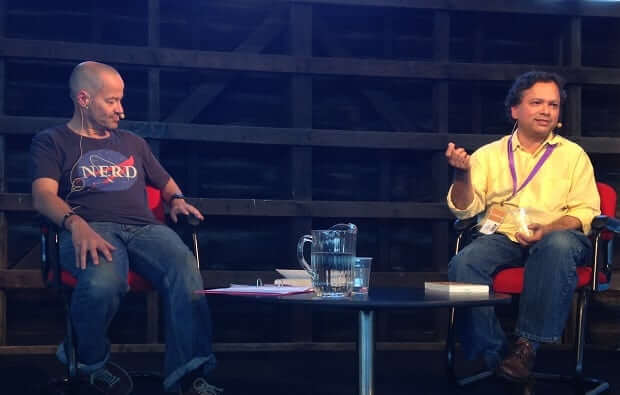
Novelist and coder Vikram Chandra spins a web of programmer’s yarn with fellow geek Adam Spencer at the Sydney Writers’ Festival

On an Indian summer’s day in Sydney there was a meeting between the geeks and the wordsmiths to hear their leader Vikram Chandra espouse words of wisdom. Fellow ‘nerd’ (as stated on his t-shirt) Adam Spencer was there to stir up the pot and make award-winning novelist and professional computer programmer choose a side: coder or craftsman?

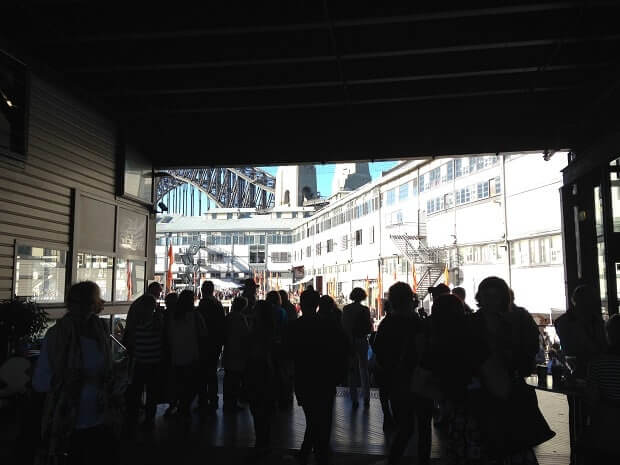
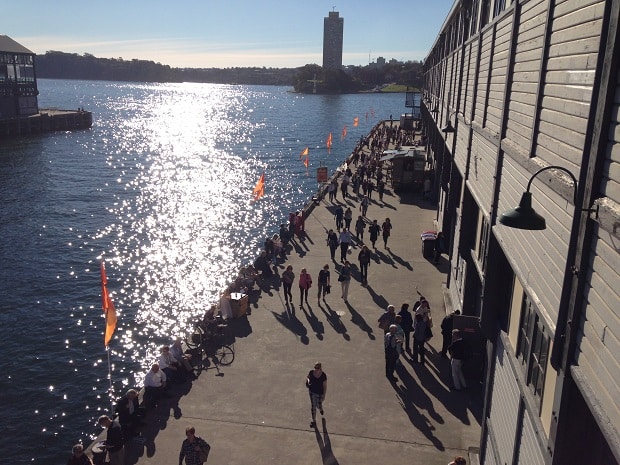
The event was ‘Vikram Chandra: Geek Sublime,’ and the space that these two (usually) disparate groups met was The Loft at Pier 2/3, Walsh Bay, at the Sydney Writer’s Festival in late May.

Chandra’s latest novel Geek Sublime (2014) looks at the connection between these two seemingly opposed words, art vstechnology. In it Chandra questions whether code can ever be called beautiful, notes how Sanskrit is similar to coding, and pontificates over why he is drawn to both prose as well as computers.

It’s not the first time that Chandra, born in New Delhi in 1961, has been a guest of the Sydney Writers’ Festival, and this time he shared his love of programming with Sydneysiders. Chandra first impressed the literary world with his debut novel Red Earth and Pouring Rain (1995); won the Commonwealth Writers’ Prize with his second one, Love and Longing in Bombay (1997)and then continued to woo reviewers with Sacred Games (2006).

And now there’s Chandra’s first work of non-fiction, Geek Sublime, or as it is published in India, Mirrored Mind: My Life in Letters and Code. The work is part memoir, part literary theory and part study of technology. And the tone, well, it’s also quite different from his previous works. He explores his two worlds in this novel, which is almost a series of essays. He writes:

My writing life and my life with computers, in spite of their differences, seem mirrored, twinned. Both are explorations of process, of the unfolding of connections. Both reward curiosity, dogged patience. And perhaps it is just the double presence that I cherish, of art and logic.

So where does this geeky side come from, Spencer asked the Indian author. Chandra explained that after he graduated from the University of California he moved to New York, where he became obsessed with playing with PCs. Not only did he enjoy it, he “lusted after” them, and their “big hard discs,” he cheekily stated. He even went so far as to describe the Apple II as the “sexiest computer,” with its functional elegance. And so Chandra was hooked.

According to Kirkus Reviews (USA) Geek Sublime is “an engaging exercise in interdisciplinary thought, both elegant and eloquent,” which is also how I would describe the festival discussion. Chandra and Spencer had the entire audience’s attention captured throughout the talk. The novel and the talk both delved into the history of coding, the stereotypes of geekdom, linguistics, the gender imbalance in Silicon Valley and more.

Chandra’s latest novel came about during a pause while he was writing his next piece of fiction after Sacred Games. Instead of waiting until the issue with his work of fiction to be resolved, he ended up writing 20 or 30 pages of an essay on the culture of programmers, and it grew from there.

Chandra described the act of writing as “not pleasant,” but for him “programming has worked as an escape from that”.

“In computers I can completely lose myself,” said Chandra.

In programming, the computer is the game, but with writing, Chandra quotes Robert Hass who said, “It’s hell writing, but it’s hell not writing. The only tolerable state is just having written”.

He went on to describe programming as having a different level of absorption.

“After a day of literary work, which is very ambiguous, when you are always searching for something and not entirely sure you got it, programming is very certain”. Once you write a code you get “that lovely moment when you run your test and get feedback; the green tick… but with prose you have no idea,” Chandra told Spencer.

With books, on the other hand, Chandra believes that “after it comes out, it disappears. There’s nothing certain about it”.

In Geek Sublime he furthers this idea:

Making software gave me a little jolt of joy each time a piece of code worked… the world fell away, my body vanished, time receded… you can slam this pleasure spoke into your vines again and again, and you want more, and more and more.

Adam Spencer asked Chandra, “Why is writing simple code so hard?”

“Because of the startling elegance of the simplicity of computers,” replied Chandra. “You can make logic gates out of even lego bricks,” but is very difficult to write coding with no bugs.

“You can have moments where a sentence crackles through” in fiction, which is beautiful, but with code the “clarity and expression of code is beautiful,” Chandra explained.

“The beauty in code,” he noted, comes from it being “concise, structured and linguistically flexible, and as such, many programmers see their work as a creative practice, akin to creating music or literature”.

“A line of code can be perfect, but prose can never be,” Adam Spencer noted on the topic.

There was also talk of the “architectural elegance of machines” by both Chandra and Spencer, who you might know from Triple J, ABC Radio and TV programs such as The Sleek Geeks. Chandra observed that while writing fiction, his “first draft will lack architectural coherence and shapeliness,” but that he has the same self-doubt when writing and programming.

However, he claimed, programming is never painful like writing is. While writing fiction, he feels a “fracture that leaves raw edges exposed”.

“All virtues one associates with writing can be applied to code,” Chandra mentioned to Spencer, as he described the process of both struggling through code or words, and the exact same rewriting process. “Some saybecause of hackers are the same as artists”.

And yes, he has the “same eureka moments in the middle of the night with programming and writing fiction”.

Programming is a “weird, macho, blokey environment” these days said Chandra, despite programming’s roots being a female secretary’s task. Interestingly, in the Sydney audience, the majority of those who identified themselves as being programmers were women.

At the end of the talk, during Q&A time, a female audience member echoed Chandra’s own dilemma of the culture of science and the arts, as she is a singer as well as a voice scientist. She asked Chandra, “Do you think this book resolves this dilemma?” Chandra answered by saying that the book was his desire to attempt to explain to his wife (Melanie) what he spends his time doing.

Another audience member who described herself as currently living in Bombay, described Chandra’s books as “a kind of code, going back and forth”. Chandra agreed with this and furthered explained that his interest in a wheel-like structure with repetition “is common in south east Asia”.

In his conclusion in Geek Sublime Chandra writes:

My fiction proliferates doubles, couplings, alter egos, layers within layers.

Wri­ters and programmers ultimately do very different things, and that’s part of the argument of the book,” said Chandra. All language is potentially suggestive,” Chandra believes. With coding ambiguity can be disastrous, however, with prose it can produce depth, or rasa (aesthetic pleasure). Chandra now codes as a hobby and is currently working on his next book, which was the one that was interrupted by writing Geek Sublime.

“Should everyone be taught code?” Spencer asked Chandra. Chandra replied, “Everyone should be provided the opportunity and tools to play with code and explore, but not everyone has to actually code”.

For most writers, computer programs are merely tools used to make work easier. Chandra describes fiction as his vocation, but coding as his obsession. He would rather code, but he describes not writing as not even an option. Without writing he becomes cranky, so his wife sends him off to write (for a while). So that answers Spencer’s question. Chandra is unable to choose just one, as they are both a part of him – one an obsession, and one essential.

Just as Chandra reaches a reconciliation between geek and literature, east and west, Iain Pears in his review published in The Telegraph(UK) writes:

The effect of code, like that of literature, goes beyond language to reconstruct consciousness itself. Formal elegance in both is almost secondary: it exists, no doubt, and can be analysed. Chandra persuasively suggests that the true beauty lies in what it does to us, allowing access to the unfathomably vast, and changing the world.

It is language that binds the two together; the language of computer coding and the language of prose. Chandra seems to be the master of both. And for Chandra to make both topics interesting at the Sydney Writers’ Festival is another feat he quite capably handles, with a little help from Spencer.

Curtains for “you’re,” and please don’t reply “your right”

0
Reading Time: 3 minutes

Curtains for “you’re,” and please don’t reply “your right” 

The managers of my office put up a sign saying: “Keep the door close”. Do they mean “closed,” or do they want me to take the door off its hinges and keep it close to me everywhere I go? Given their rationality levels, both are equally possible.

In my previous office, management put up a sign on the janitor’s office: “Cleaner room”. I glanced inside. It was cleaner than my room. But aren’t they all?

Some people get really upset about writing errors. A man angered by a misspelled sign outside a US government office tried to blow up the building with a hand-held bomb, a news report said last year. That’s crazy: You need a truck bomb.

Internet users frequently abuse me with the phrase “Your stupid”. I usually reply: “Yeah but at least I can spell you’re”.

This annoyed one correspondent recently into writing back: “Your a idiot”. I replied: “Yeah but at least I can spell an”. He replied: “Their’s different ways of spelling stuff moreon”. I replied: “Yeah but at least I can spell there’s and moron”. He hasn’t replied, no doubt because he is busy preparing a truck bomb to drive around to my office.

But frankly, it’s time to hold a funeral service for the word “you’re”. It went on my endangered list in 2007, when a US technology firm launched a major ad campaign with a two-word phrase: “Your on”. When you have a massive budget and just two words to handle, you’d think you’d get both of them right, but no. The same country saw the launch of an inn called the Your Welcome Inn, which suggests that three words is WAY too much.

By 2009, “your” was replacing “you’re” in about more than 50 percent of internet exchanges I monitored, and today “your” has triumphed almost completely. Modern dictionaries are governed by the “descriptive not proscriptive” principle, which means “your” will soon appear as a legitimate alternative for “you’re”.

A funeral should also be held for the phrase “every day”. When you write this as two words, it means “all the days”. When you write it as one word, it means “mundane”. So pop star Elvis Costello’s hit song Everyday I Write the Book means “Mundane I Write the Book”. The Coca-Cola Company’s slogan for Dasani bottled water describes it as a mundane drink, which is bang on target. One of the top songs sung in churches today is called Everyday which says all you need to know about modern Christian music.

As for punctuation, the saddest lost apostrophe of recent times must be the one in the photo a reader sent to me, showing a school in India owned by a certain Anu Sharma. The signmaker dropped the all-important apostrophe and thus the sign says ANUS ENGLISH ACADEMY. Sad but true.

I once had an online dispute with someone who told me: “Theirs nothing wrong with my Brian”. I congratulated her on her Brian’s health.

But, dear reader, let’s face facts. I propose that we, the last few people on earth to still use “you’re” should have a Save The Apostrophe meeting in a hotel or conference centre. But PLEASE, not at the Your Welcome Inn.


What’s the one grammar error that gets your goat? Let us know on our Facebook page.

Nury Vittachi


Curtains for “you’re,” and please don't reply “your right”

0
Reading Time: 3 minutes

Curtains for “you’re,” and please don’t reply “your right” 

The managers of my office put up a sign saying: “Keep the door close”. Do they mean “closed,” or do they want me to take the door off its hinges and keep it close to me everywhere I go? Given their rationality levels, both are equally possible.
In my previous office, management put up a sign on the janitor’s office: “Cleaner room”. I glanced inside. It was cleaner than my room. But aren’t they all?
Some people get really upset about writing errors. A man angered by a misspelled sign outside a US government office tried to blow up the building with a hand-held bomb, a news report said last year. That’s crazy: You need a truck bomb.
Internet users frequently abuse me with the phrase “Your stupid”. I usually reply: “Yeah but at least I can spell you’re”.
This annoyed one correspondent recently into writing back: “Your a idiot”. I replied: “Yeah but at least I can spell an”. He replied: “Their’s different ways of spelling stuff moreon”. I replied: “Yeah but at least I can spell there’s and moron”. He hasn’t replied, no doubt because he is busy preparing a truck bomb to drive around to my office.
But frankly, it’s time to hold a funeral service for the word “you’re”. It went on my endangered list in 2007, when a US technology firm launched a major ad campaign with a two-word phrase: “Your on”. When you have a massive budget and just two words to handle, you’d think you’d get both of them right, but no. The same country saw the launch of an inn called the Your Welcome Inn, which suggests that three words is WAY too much.
By 2009, “your” was replacing “you’re” in about more than 50 percent of internet exchanges I monitored, and today “your” has triumphed almost completely. Modern dictionaries are governed by the “descriptive not proscriptive” principle, which means “your” will soon appear as a legitimate alternative for “you’re”.
A funeral should also be held for the phrase “every day”. When you write this as two words, it means “all the days”. When you write it as one word, it means “mundane”. So pop star Elvis Costello’s hit song Everyday I Write the Book means “Mundane I Write the Book”. The Coca-Cola Company’s slogan for Dasani bottled water describes it as a mundane drink, which is bang on target. One of the top songs sung in churches today is called Everyday which says all you need to know about modern Christian music.
As for punctuation, the saddest lost apostrophe of recent times must be the one in the photo a reader sent to me, showing a school in India owned by a certain Anu Sharma. The signmaker dropped the all-important apostrophe and thus the sign says ANUS ENGLISH ACADEMY. Sad but true.
I once had an online dispute with someone who told me: “Theirs nothing wrong with my Brian”. I congratulated her on her Brian’s health.
But, dear reader, let’s face facts. I propose that we, the last few people on earth to still use “you’re” should have a Save The Apostrophe meeting in a hotel or conference centre. But PLEASE, not at the Your Welcome Inn.
 
What’s the one grammar error that gets your goat? Let us know on our Facebook page.
Nury Vittachi


Win a double pass to Siddarth

0
Reading Time: < 1 minute

We have a double pass to give away to Siddharth thanks to Sydney Film Festival

Details: Thursday 12th June 8:30PM – Dendy Opera Quays

How to win: like this post on our Facebook page and email  win@indianlink.com.au with Siddarth in the subject line and your name in the email. Simple! Good luck.

Winner announced on our Facebook post on the morning of Thursday 12th June

Magical Everest

0
Reading Time: 5 minutes

It is a harrowing but ultimately rewarding trek to Everest Base Camp


Whenever I see snow covered mountains it takes my breath away. After my trek to the Annapurna Dhaulagiri mountains in 2012 I knew I simply had to see the mountains in the Everest region – really close up. For this reason, in October 2013, at the age of 67, I signed up for the trek to Everest Base Camp (EBC) which is situated at a height of 5364m.

It was a daunting prospect, one that my family were not too happy with. It was going to be tough. I knew I had to step up my training routine. I could leave nothing to chance.

Our trek was to start at Lukla 2880m which is a 25min flight from Kathmandu. As it happens, Lukla airport is reputed to be the most dangerous airport in the world. The runway is very short and narrow and is remarkable being at an incline of 12 degrees with a large cliff-face at the end. Tiny planes fly in between mountain ranges just clearing the tree-tops. They bank left and land with a huge thud and immediately start the climb up the runway with the engines making a deafening screech and come to a stop just as the cliff-face is approaching.

After watching a few mind-blowing landings and take-offs at Lukla airport it was on with our wet weather gear as clouds were starting to close in. Our group of eight was led by a trek leader and included two guides who would walk with us and four porters who carried our kitbags containing all we needed for the entire trek. Directly from the airport we started our much-awaited trek bound for Phakding at 2610m, a better level for our bodies to get acclimatised to the altitude through the night.

Because of the bad weather at Lukla our departure from Kathmandu was delayed by a day. To make up for lost time, our walk from Phakding would be long and hard all the way to Namche Bazaar 3440m. This was not good news as we would be ascending 830m in one day. As is well-known, the risk to Acute Mountain Sickness (AMS) increases when a day’s climb exceeds 300m. The intermittent drizzle that had set in was going to make for a harder walk. Just as disappointing was the fact that all the low clouds had meant that we had no views of mountains. After a huge final climb we arrived at Namche Bazaar to find it spread out in a tight cluster of houses. It’s a delightful little town, boasting bakeries, a couple of pubs, many souvenir shops and lodges for trekkers. I bought a couple of post-cards and went along to what I thought would be the highest post-office in the world. To my surprise I learnt that the world’s highest post office at 4724m is in the Lahul Spiti district of Himachal Pradesh. Apart from being utterly exhausted I was pleased with myself as I was feeling quite well with no symptoms of AMS.

The next day was to be the first of two acclimatisation days. I had been looking forward to this that we would have a rest day in Namche. Not so. The idea of the acclimatisation day is to climb 400/500m up close to the altitude of the next destination, rest for a while and then come back down to the start.

The climb to Thyangboche (3860m) was a challenging one, with a final climb of 600m. This brought us to a delightful meadow which has a large Buddhist monastery. So far cloudy weather had denied us the views we should have had of many of the largest peaks. On waking the next morning we saw blue skies and found we were surrounded by wonderful panoramic views of some of the highest mountains in the world, including Lhotse, Nuptse, Ama Dablam and Mt Everest. I like to think it was the blessings of the solitary monk at prayer when I visited the monastery that gave us clear blue skies for most of the remaining days of our trek.

No longer were the tracks, which usually comprise rocks, stones, boulders or sections where we had to clamber up or down slipping and sliding, going to dampen our spirits. We saw many trains of yaks, mules and dzokyos (cross between a yak and cow). But it was the porters, bent double carrying heavy loads, that one really felt for.

Our route included many suspension bridges which were also used by the animals. These high bridges swayed and the noise from the raging streams below was deafening, so just to concentrate and walk with balance takes a fair amount of energy.

The trees were soon going to disappear, but we had walked through forests of rhododendron, pine, silver and red birch surrounded by snow-covered silver peaks set against the blue skies. As we went higher, the trees gave way to bushes and past Dingboche (4410m) we were in a barren, bleak landscape of stones, rocks and mountains. The ground around us was rugged and unforgiving as was the air which had now got quite thin and the cold was intense.

We were at the business end of the trek. Sunny, perfect weather meant mountains of pink and orange in the setting sun.

Next morning we watched the sun rise from behind the peak of Ama Dablam. So close were we to the peaks that we could see powdery snow being blown off the mountain tops.

We saw a Medi-Vac chopper land close to us and pick someone up. It must have been devastating to be so near EBC and to have to be evacuated most likely with AMS.

The thinner air made the sky go a very deep blue, making a dazzling contrast with the silver-white of the snow on the peaks. Before we arrived at Lobuje (4910m), we came to a ridge where memorial cairns of climbers and Sherpas who have lost their lives while climbing the mountains all around us have been placed. It was a sobering thought indeed and all trekkers spent a little time in reflection.

The peaks of Pumo Ri, Lingtren and Khumbutse became visible. As we walked in silence with the Khumbu Glacier on our right, we could hear several avalanches and saw one as it happened. It was an awesome sight. A little later we heard the deep-throated crackle and grinding sound of the glacier. The glacier had many interesting formations in ice and was covered with stones, rocks and boulders. It looked dirty and sad, like a massive sleeping giant. It was a stark contrast to the pristine peaks, all covered in snow and ice, looking majestic as they rose up into the deep blue sky.

Then there was Mt Everest, the king of mountains, in all its glory, with the Khumbu Glacier at its feet and blue skies above.

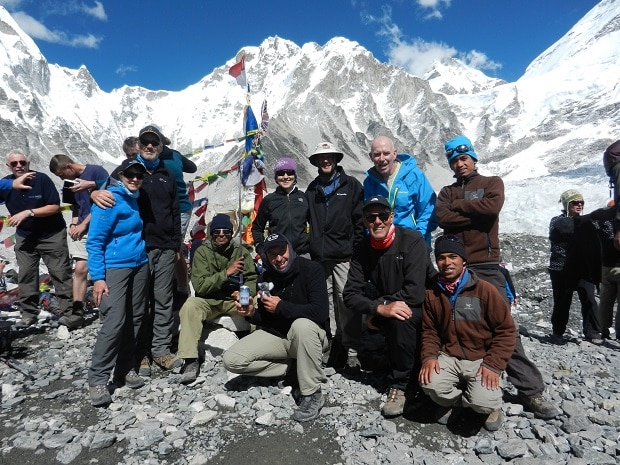
Our final day to EBC involved close to 9 hours of strenuous walking. We did it! There was laughter, happiness, back-slapping, group photos and a feeling of dreams come true. Magical moments are few in life but this was surely one of them.

I was reminded of one of the eight symbols of Buddhism, the Eternal Knot. It’s a representation of inter-twined lines that have no beginning and no end. There is a completeness, an inter-dependence, with everything in balance and in perfect harmony that cannot be bettered. Perhaps this is what I had witnessed in the beauty of these mountains.


In memory of the 16 Sherpas who gave their lives to Mt Everest on 18 April 2014

Ties that bind

0
Reading Time: 3 minutes

SALMA SHAH reviews Perth writer Suparna Chatterjee’s debut novel

Suparna Chatterjee’s book A Dozen Stories in a Tale, evokes the memories of migrants of their beloved homeland, left but not forgotten. The yearnings of these migrants flow not just for the land and place they have left, but also in their aspirations and hopes – and in trying to fill the void left in their lives from the episodes that created them in the first place.

Sugoto and Sharmila Mukherjee are living the NRI dream in Perth with their son Shohom. Sharmila, who was raised as an only child, sees no place for ancient rites and rituals in their lives, yet stubbornly follows those that she has created. Being born a girl in a village where female babies were routinely killed, Sharmila is spared this fate due to her grandfather’s adherence to justice and for doing right by his daughter. However, this same rigidity to justice which spared the life of Sharmila caused immeasurable pain and grief to Sharmila’s mother, Ambika, who followed the rules her father set for her by marrying a man she did not know and who ultimately betrayed her in the most unimaginable way possible. In this aspect, we see characters, although separated by time and place, bound through generations by ties and rules which flow through families and which are rarely questioned and accepted without voice.

Sharmila grows up and creates a family of her own with a sense of duty and obligation, but without the inherent, unyielding love that prevents her from understanding the yearnings of her husband for his homeland or the desire for love of her son Shohom. Sharmila lives for the future, aspiring for a utopia where the pain of her upbringing is rarely mentioned: her reality manifests in the structured and disciplined life she creates for her family.

Sugoto, on the other hand grew up in a much larger family, in a rural setting. For Sugoto, the contrast between him and Sharmila are profound and painfully obvious. He yearns for the homeland of the stories told to him, by people who were quick with their hospitality and with generosity of spirit. Sugoto surveys the insincere hypocrisy of his friends in Perth with a good-natured tolerance, looking inwards to acquire a better clarity of thought and his own motivations.

In this way, Sugoto reveals the prism with which many migrants view their adopted homeland – accepting their life as it is, but forever yearning for what is left behind.  And even during travels back to India, where changes continue to surprise Sugoto with their relentless pace, he is trapped in an imaginary place, the place of his forbears, Shonar Bangla.

In this way, both Sharmila and Suboto, while trying desperately hard to create a life in a new land, become reflections of their past, of being bound by traditions and a culture that drives their daily existence – at an ingrained, but wholly subconscious level.

Sugoto and Sharmila, both complex characters shaped by their distinct pasts, often come across as shallow, and perhaps more time could have been dedicated to teasing out the rich narrative of their backgrounds. How did Sharmila really feel about female infanticide? Did she ever decide to investigate this and make an attempt to learn more about this barbaric practice that nearly claimed her as a victim? Many more questions arise about the depth of the each character’s interest and desire in fully understanding their past. Both characters demonstrate a distinct lack of self-awareness – in particular, in relation to the episodes which shaped them. Consequently, we see characters who come across as superficial and facile.

While A Dozen Stories in A Tale raises more questions than it answers, it is a light read for a cold and rainy winter afternoon. The subcontinental reader will feel the familiar pull of warm memories of a land long left behind and will recognise in the characters the same behaviours and mannerisms of families held dear.


A Dozen Stories in A Tale is published by Patrabharati

Birds of peace

0
Sri Chinmoy painting
Reading Time: 3 minutes

A selection of Sri Chinmoy’s bird paintings comes to Perth, writes GRAHAK CUNNINGHAM

Sri Chinmoy painting

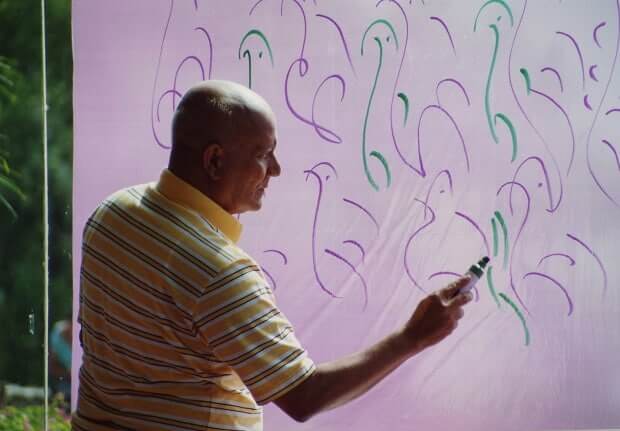
In celebration of Sri Chinmoy’s 50th anniversary of his arrival from his native India to the west via New York on April 13th 1964, a selection of his Soul Bird paintings was hosted by Western Australia’s Joondalup Gallery for the month of May. The art which is on loan from Sri Chinmoy’s New York collection, was framed locally in Western Australia and has been touring throughout Australia and New Zealand.

Sri Chinmoy (1931-2007) was most well known as a spiritual master, athlete, poet, musician and ambassador for world peace and but he was also a prolific painter.

He chose birds as his main artistic motif because of the inspiration they gave him.

“The caged bird,” he said, “is crying for freedom. The uncaged bird is striving for peace”.

Sri Chinmoy learnt to meditate for up to eight hours a day when he was still a child and he applied this skill when drawing and painting. His bird paintings were created in these meditative moments and aimed to distill a sense of inner peace in the viewer. He drew over 16 million in his lifetime and called them Soul Birds, in reference to the spiritual dimension of the birds which he appreciated so much.

Officially opened by Joondalup Mayor Troy Pickard and attended by the City of Wanneroo Mayor Tracey Roberts, the opening ceremony of the Soul Bird exhibition at Joondalup Gallery consisted of poetry, food, music and stirring speeches. “Sri Chinmoy’s art has previously been exhibited at Parliament House Canberra, the United Nations Headquarters in New York, Carousel De Louvre in Paris and now the Joondalup Gallery,” commented Mayor Pickard. “I commend the Joondalup Arts Community for securing such a prestigious exhibition”.

Mayor Tracey Roberts was equally moved by the exhibition and explained her love all art and the effects of this exhibit.

“I am sure everyone here has found that sense of peace. Looking at the artwork here today, the peace you feel in the Soul Birds is so important for all us when we live such hectic lifestyles. It is a very simple message. When you want to project a very clear message, a simple image is the most powerful”.

“It is wonderful to have two mayors here supporting uplifting art and the concept of peace” said curator Vidagdha Bennett who has been involved in several of Sri Chinmoy’s overseas exhibitions. “Sri Chinmoy always promoted the feeling of oneness in the world and the flocks of birds he painted represent this world family. World peace really depends on all of us”.

Many world leaders have commented on Sri Chinmoy’s art and even become unintentional owners of original bird drawings as Sri Chinmoy used to decorate letters of correspondence to his peace server friends with Soul Birds. Said Nelson Mandela, “Within each of us lies the power to build a world where we respect each other’s beliefs, understand each other’s culture and support each other’s values – a world where hatred, pain and suffering have no place. This is the great cause of world peace to which my dear friend Sri Chinmoy devoted his life and to which his paintings are dedicated”.

Saashwathi, emerging vocalist

0
Reading Time: 2 minutes

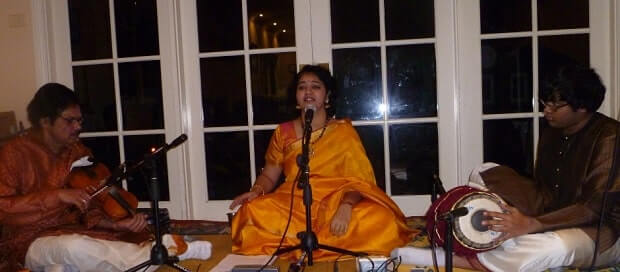
That Chennai-based vocalist Saashwathi Prabhu is an emerging force on the Carnatic scene was evident in a private concert she performed at while in Sydney recently.

From the very start one saw a smiling figure sing with great enthusiasm and much confidence. From the Varnama to the Thillana, there was clear-cut pronunciation, good diction and admirable voice control and modulation.

Saashwati captured the audience early on with her number Nee Iranga in raga Attana. Ragas Bahudari and Kalyani were elaborated with distinctive alapanas. In the alapana for Bahudari (a Brovabarama kriti) it was as if Saashwathi was bringing out some inner anguish. Several shades of the raga were revealed. The item was delivered in a gripping style with an intricate swaraprasthara.

This was followed by a swaying, ever popular, Nagumomu (in raga Abheri).

Raga Kalyani formed the item for the day. Again with a detailed Alapana, Saashwathi took the krithi Isha Pahimam for rendition. After a faster lap of the lyric, swaraprasthara followed. It was an effortless flow of imaginative swaras, which followed each other like a fountain.

Many items, pleasing and appealing, such as Venkatachala Nilayam, Eththnai Kodi, Ramanamame were also included. Ramaname was sung without the rhythmic accompaniment and was a treat.

Saashwathi was ably supported on the violin by AGA Gnanasundaram and on the mridangam by Sai-Navaeithan Ravichandhira of Melbourne. The latter provided an impressive thaniavrthanam after the Kalyani item.

Saashwathi is a disciple of the violin maestro the late Lalgudi Jayaraman. A touch of his style was evident in the concert.

SYDNEY SRINIVAS


India, sports underachievers

0
Reading Time: 4 minutes

Signs are that the sport scene in India is just beginning to take on a new look

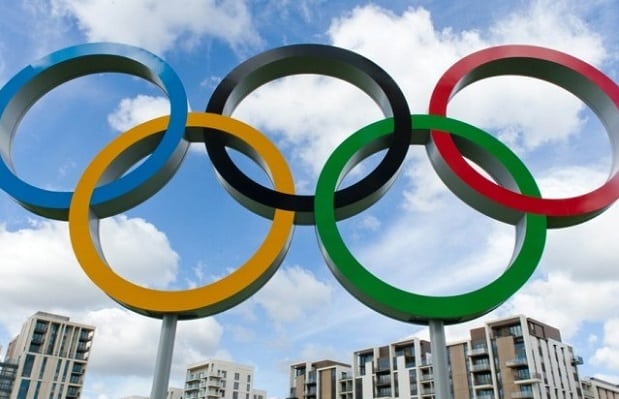
Words cannot describe the humiliation many in India would have felt as the world saw Shiva Keshavan, Nadeem Iqbal and Himanshu Thakur walk as independent Olympic participants behind the International Olympic Committee (IOC) flag at the Sochi 2014 winter Olympics instead of the Indian tri-colour. This is because the Indian Olympic Association (IOA) had been suspended by the IOC due to interference by the Indian government in the autonomy of the national Olympic committee. As it happens, Shiva Keshavan finished a disappointing 37 out of 39 competitors in the singles luge competition. So how should we react?

India has been a perennial under-performer at the Olympic Games for many years. The London 2012 Olympics were, in fact, the most successful ever for India but the 2 silver and 4 bronze medals was a very modest haul indeed for a country the size of India. In contrast China with a GDP per capita 4 times that of India had a medal tally of 14 with 88 medals in all. So where are we going wrong?

There was a golden era in hockey, lasting until around 1980, when India was on top of the world. Now we are ranked 10th from a list of some 71 participating countries. And in football, which is passionately followed in a few pockets around India, we languish at an inglorious 152 out of 207 participating counties. So how can this be?

It would be too easy to criticise Shiva Keshavan and our other athletes for poor performances. We might even say they lack skills, don’t train hard enough, are not committed and just don’t possess the winning instinct. But such criticism would be uncharitable in the extreme. I believe these young men and women are to be congratulated in following their passion. They have competed for their country, given of their best and deserve our thanks. Undoubtedly, they would have preferred better results. Have they really been helped in their endeavours? So what can we do for them?

There are, basically, two areas that hold our athletes back. Firstly, the funding. India spent close to $10m on 83 athletes ($120,000 per athlete) for the London 2012 Olympic Games. This contrasts with Australia’s funding of $310m for 410 athletes ($750,000 per athlete). A lower funding per athlete, even if all else is equal, equates to lower results. Theoretically, one way to overcome this is to reduce the contingent of athletes and target more funds to those most likely to succeed. This is easier said than done, unfortunately. The second main and over-riding problem in many Indian sports is the shambolic, dysfunctional administration. Greed, bureaucracy and the chance to shop in Oxford Street or the Champs-Elysees take over. So what’s the answer?


In 1983 India, with Kapil Dev’s memorable exploits, won the Cricket World Cup. This lit the flame for the cricket-crazy country that India is now. A major reason for this was the tough, private-enterprise led BCCI that ensured the greatest rewards for the players, the sport and everyone concerned. Since then the IPL has followed with the best cricketers wanting to be part of this extravaganza, thus lifting standards all around. What must not be forgotten is that it is a move away from government into private hands that is causing this lift in standards. More recently, since the IMG group and Reliance have got behind football there has been a 70% increase in TV audiences since 2010. Manchester United, Liverpool and other top football teams are now widely known throughout the country and the standard of football is set to improve dramatically. There isn’t a shadow of doubt that without government interference sport can prosper in private hands. So what has happened?

Unfortunately, what should have been the best model for the governance of sport has lost its gloss. BCCI has seen heads roll and is an entity that is feared, with a lot of power but with little credibility. And IPL franchises have been imploding for a variety of reasons. The saying that absolute power corrupts absolutely is not without foundation. Until controls are placed on power hungry institutions the roller-coaster that is Indian sport will continue. So what’s the latest?


Actor Abhishek Bachchan has just purchased the Jaipur franchise of the IPL style pro Kabbadi team. In a recent World Cup, 30 countries participated and India’s men’s and women’s teams came top. We can only hope that kabbadi will feature in the Olympics in the near future.

Our cricketing superstars are also starting to shake up the sports scene. We have legend Sachin Tendulkar turning into a sport impresario. He has recently purchased the Kochi franchise for football of the Indian Super League (ISL) and also a share in the Mumbai based tennis franchise of the International Tennis Premier League. Not to be outdone, Sourav (Dada) Ganguly, the recent fiery Indian cricket captain, has bought a share of the Kolkata franchise of the ISL.

A shake up is definitely taking place in Indian sports. Will interest in cricket start to wane and football increase in popularity? Will the new sports leagues be able to govern themselves without falling over? Will all this rub off on future Olympians? These are exciting times indeed for sport in India.