
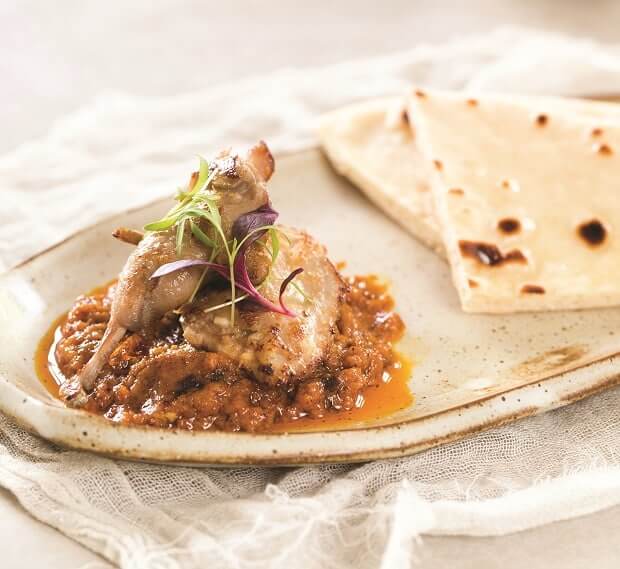
Quail requires a sauce that complements the game-like flavour of the meat but doesn’t overpower it. Measure carefully the quantity of spices used in this dish. Serve with buttered NaanBread to scoop up the sauce.

Serves: 1 / Preparation time: 30 minutes / Cooking time: 30 minutes
INGREDIENTS
3 teaspoons cumin seeds
3 teaspoons coriander seeds
6 garlic cloves, sliced
1 cm (3/8 in) piece of root ginger
Juice of 1 lemon
2 quails, deboned
250 g (9 oz) butter
1 large or 2 small onions, finely chopped
2 tomatoes, diced
1 tablespoon honey
¼ teaspoon ground cloves
¼ teaspoon ground cinnamon
¼ teaspoon ground nutmeg
1 teaspoon ground cayenne pepper
1 teaspoon chilli powder
1 teaspoon turmeric
50 ml (2 fl oz/¼ cup) thickened (double, heavy) cream
¼ teaspoon salt
Vegetable oil, to drizzle
Naan Bread (see recipe), to serve
METHOD
Heat a frying pan over medium heat, add the cumin and coriander seeds and dry fry for 1–2 minutes, or until fragrant. Crush in a mortar using a pestle. Set aside.
Make a paste by crushing 4 of the garlic cloves, the ginger, lemon juice, and half of the crushed cumin and coriander seeds in a blender.
Rub 1 tablespoon of the paste onto the quail, place in a ceramic bowl and refrigerate for 30 minutes to marinate.
Meanwhile, melt half the butter in a small pan over medium heat. Add the remaining paste and cook for about 1 minute, or until fragrant. Add the onions and remaining garlic cloves and cook for about 5 minutes, or until translucent. Add the tomatoes and honey, and cook for 5 minutes, or until they start to break down. Transfer to a blender with the remaining cumin and coriander, cloves, cinnamon, nutmeg, cayenne, chilli powder and turmeric, and blend to a puree. Preheat the oven to
180ºC/35ºF/Gas mark 4.
Melt 50 g (1 ¾ oz) of the butter in a pan over medium heat. Add the puree and simmer for about 5 minutes, until thickened. Strain through a fine sieve into a clean pan and place over medium heat. Slowly stir in 50 g (1 ¾ oz) of the butter and all the cream and cook for 5 minutes, stirring regularly. Season with salt. If the sauce separates, whisk in 1–2 tablespoons water until combined.
Place a chargrill pan over high heat. Drizzle the quail with oil. Cook for about 1–2 minutes on each side. Transfer to the oven and bake for 3–5 minutes. Cover loosely with foil, and set aside to rest for 5 minutes. To serve, spoon the sauce onto the plates, top with quail and serve with naan bread spread with the remaining butter.
Rishi Desai's Butter Quail recipe
A master cookbook
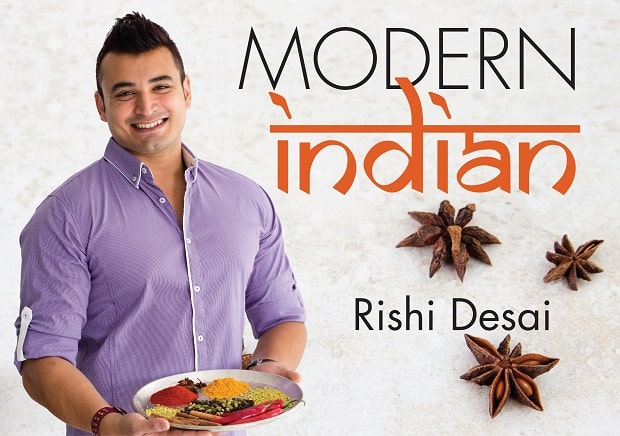
Rishi Desai’s food is essential Indian with a modern twist

Scallop bhel, anyone? How about a tandoori spiced tuna tataki? Or a hulianna risotto if you’re vegetarian? And for dessert, would you like a chai brulee or a mango panna cotta?
This fantasy menu that combines Indian with non-Indian, sounds like a work of imagination. Sort of like the cuisine in Harry Potter’s world – you know, butter beer, pumpkin juice, ton-tongue toffee, acid pops and cauldron cakes.
New-age chef Rishi Desai’s work could well be called a work of imagination, and it does involve a bit of magic along with cooking skill!
Of course you’ll find that name familiar, especially if you’re a Masterchef tragic. Participating in the 2013 series, he endeared himself to viewers, as well as the cast, not only with his food, but also his good looks, his sense of humour, and some may say, his philosophical attitude to it all.
When he left the show, there was talk of a cookbook. Rishi’s Modern Indian is now out, and is the most unusual Indian cookbook you’ll ever find, with its fascinating fusion elements.
Vegetable sliders with okra chips. Coconut milk poached salmon. Kulfi with apple crumble. As you leaf through the book, Rishi’s recipes make you wonder, why did I not think of that?
Talking to Indian Link, Rishi clarifies that his food is “not fusion”.
“It’s essentially Indian,” he states emphatically. “There are no new flavours. It’s just that the techniques are different, and modern”.
And so Rishi presents chaat in lettuce cups, and ‘nachofies’ pappadums by serving them with a dip. How’s that for simple innovation?
“I’m a true patriot,” Rishi laughs. “Indian food is so versatile, you don’t need to confine it. Why not try modifying it to suit the times?”
His pani puri is a case in point. It’s the classiest way possible of serving this delectable street food favourite (Go grab a copy for details).
In his own recipes, Rishi brings in texture, which Indian food typically lacks. So his palak paneer becomes a tiny slab of paneer, with a curried spinach puree on top, served on baguette crisps. Great as an entrée!
“As well, I think, we tend to hide our proteins,” he notes. “I make sure they come out”.
His hulianna, similarly, is much more than the traditional tamarind rice. It is prepared with arborio rice and vegetable stock, and though the cheese is kept out to stick to the traditional, it ends up with a lot more texture.
The novelty factor in Rishi’s work increases as he tackles main meals. Steak and lamb cutlets are served with purees made from smoked eggplant, cauliflower, or caramelised onions, and in one case, even with a methi-mutter-malai sauce. Rabbit is given an Indian treatment with root vegetables. Duck breast is served on a bed of mushy kali dal. Turkey is cooked into a korma. Sev and chivda find themselves in garnish.
In desserts, Rishi’s particular version of gulab jamun is an absolute must-try. In a unique presentation, he serves it up not as balls but as discs, accompanied with orange marmalade, vanilla ice cream and pistachio praline.
Which, of all his preparations, is Rishi’s own personal favourite? He shares with us here his butter quail recipe.
“It is inspired by the famous butter chicken. I made it on the show for my immunity pin, and Gary, who we know is a big fan of Indian food, loved it”.
The Kohlapuri goat curry (from his hometown) is another favourite, even though his version is a compete re-invention of the old.
Rishi is also partial to his coconut milk salmon. “It’s my take on fish curry and rice, but it is by far the most adventurous dish I have ever attempted. The salmon is poached on a low temperature of 43 degrees. To serve, I sit it in a bowl of spiced coconut veloute, and add a dollop of caramelised onion puree on top. Wild puffed rice makes up the garnish”.
No doubt presentation of the food is paramount for this creative cook.
“Our curries may taste great, but often they don’t look appetising. Food should be presented beautifully so that you feel like eating it right away! You should enjoy food with all your senses!”
And that’s where the unmistakable Heston Blumenthal link comes in. Working with him on Masterchef has left an indelible mark on Rishi. Check out his preparation ‘Vegetable Garden’, a fancy version of crudities and dip – it’s an edible garden diorama, complete with edible soil, a work of art.
And yet, even Rishi will tell you, with some Indian preparations, there is no need whatsoever to modernise – they are perfect as they are. For example, biryani. Have a look at Shoukat Chacha’s biryani in the book.
The book itself was a long time in the making. Rishi works as a public servant in Canberra, and the book was worked on after hours.
“I worked 16 hours a day, eight hours on each job,” Rishi laughs. “The hardest part was conceptualising the recipes. The easiest part, cooking of course!”
The filming and photography was all accomplished in four days – a mammoth task as Rishi cooked 16 recipes a day.
“We worked from 6am to 6pm, as I was keen to have natural light for all my photos. Plus, I had to go to the shops each morning as I only wanted the freshest of produce”.
It was just as much work as being on Masterchef.
“The show was hard,” Rishi recalls. “The combined physical and emotional stress gets to you. But it was a great five weeks”.
What does he have to say to the commentators who claim he was the most talented chef on the series?
“All I can say is that I did make mistakes, and they cost me”.
Today he is still in touch with others from the show, even visiting them in their cities. Besides of course being out and about presenting at events such as the Truffle Festival in early July, and talking about his book Modern Indian.
A restaurant is also on the cards. Having moved here in 2008 (“the year that Masterchef began”), Rishi feels ready to take the plunge, but will not divulge details.
“The restaurant could be in Sydney, or maybe Melbourne. Or who knows, somewhere in India!”
Regardless, he will make sure that the three greatest cooking influences in his life will be proud of his efforts – his mum, his wife, and surprise surprise, Tarla Dalal, the first lady of Indian cooking.
Looking for a fight
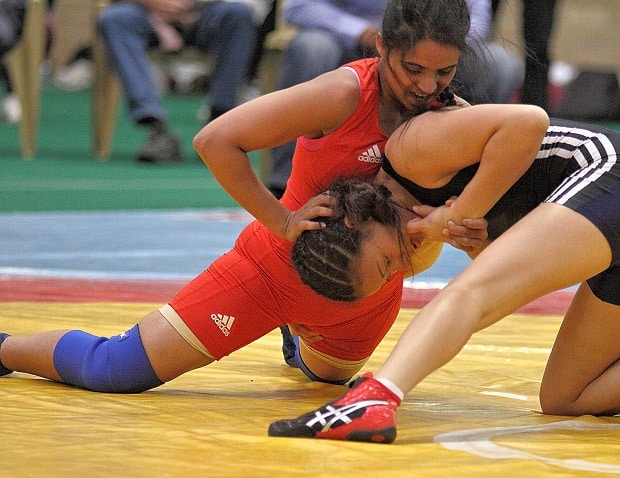
Rupinder Kaur is all set for Glasgow as part of Australia’s wrestling team

With only days to go before the big event, Rupinder Kaur is concentrating hard on her training.
For six days a week, it’s track and field in the day, and in the afternoon, club.
The 29-year-old wrestler is working hard indeed to make the most of the opportunity she has won, a spot on the Australian national team for the upcoming Commonwealth Games in Glasgow.
“Sote, jaagte, bas game, game, game ke bare mein soochti rehti hoon (All I think about in my waking hours and even in my sleep, is my game)” she tells Indian Link bursting with enthusiasm. “Most nights, I even dream about the game!”
In between training, she concentrates on her diet.
She’s just finished dinner as Indian Link speaks to her, a hearty Punjabi meal of wadi, plenty of vegetables, paneer, dal, yogurt and a massive bowl of fruit. As a vegetarian, she has to get the proteins in.
Plus, these days, she’s trying to gain some weight.
As someone who has always played in the 48 kg division, she was shocked when she weighed in at just over 49 kg before her selection. The gain in weight meant that she would be placed at the next level, the 53 kg division. With exactly a week to go, Rupinder worked hard to lose the extra kilo, but ultimately weighed in at 48.2 kg. She is now competing in the 53 kg division.
“Actually, I’m eating bananas by the dozen these days,” she says, laughing.
Wrestlers typically lose weight to compete in a lower division, but Rupinder feels she should be ok.
“Koshish to puri hai, baaki Bhagwan jo kare (I’m trying my hardest, the rest I leave to God),” she says with simplicity.
It’s been an interesting journey for Rupinder. She arrived here some seven years ago as a hospitality student, fully determined to continue wrestling which she started in India at school.
“I did not know a thing about wrestling in Australia, but I was hell bent on finding out”.
Seven months later, at a local Diwali function, a family member introduced her to Kuldip Singh Bassi, founder and president of the United Wrestling Club in Melbourne. Rupinder was back on the mat in no time. Before long, she was winning championships such as the Australia Cup.
To compete at the international level though, she had to wait for her citizenship to come through.
“My only regret in my wrestling career is that I left it so late with my citizenship”.
But now she is looking eagerly ahead. In Glasgow, she will catch up with her old mates from the Indian national team.
“I know most of the Indian team, yes,” she reveals. “My closest friend Navjyot Kaur will be there, competing in the 69 kg category. Navjyot and I are both from Hari Ke Patan near Tarn Taran in Punjab. We used to train together in the old days”.
Rupinder started her fight career in judo as a Year 6 student, following her sister Parminder. In Year 12 she was asked to give wrestling a try.
“Initially I felt a bit shy to put the costume on – with judo there were no costume issues. Mum was concerned about injuries. But Dad told us both to stop being silly! As an army man he wanted his children to try as many new experiences as possible. My first performance came good, and I have never looked back”.
So what’s in the future?
“Well, there’s talk about Rio already!” Rupinder says. “But whatever eventuates, I will be connected to wrestling all my life, that’s for sure”.
The young athlete is keen for her team to bring back as many medals as possible from Scotland.
“It will be a huge boost for the sport in this country. It is so little known. Plus we need more support, really. Currently, I’m paying my own club fees like all my other team mates. In India, as a member of the national team, my training was free”.
Rupinder follows fellow-Melbournian Sandeep Kumar, another Indian-origin wrestler, who represented Australia at the Beijing Olympics.
Oh, and we can’t let Rupinder go without asking an important question: does she know the words to the Australian national anthem, just in case?
Pat comes the reply, “Haanji, bilkul aata hai, ji (Yes of course!)”
Aussie, Aussie, Aussie! Oi, oi, oi!
Freedom without fear
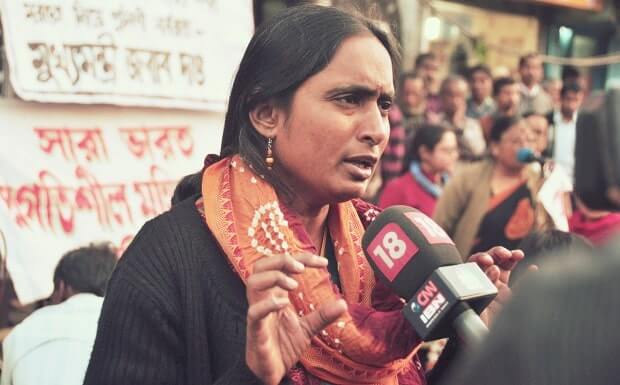
Kavita Krishnan talks in Oz on leading the charge against sexual violence in India

Bekhauf Azaadi! Freedom without fear! This chant reverberated in the streets of Delhi following the horrific gang rape in 2012 that shook India. Politician and activist Kavita Krishnan was one of the first to join the movement. Soft spoken and unassuming, she is the secretary of the All India Progressive Women’s Association (AIPWA) and a member of the Communist Party of India (Marxist-Leninist) (CPI-ML). In 2013 she responded to the prevalent victim blaming culture and accusations of victims’ ‘adventurous’ behaviour with a fiery speech: “Women have EVERY right to be adventurous! And we WILL be adventurous! Don’t tell us how to dress, what time of night or day is safe, how many people need to escort us. We shouldn’t need to take measures to protect ourselves (from rape). We want freedom without fear. Bekhauf azaadi”. The speech went viral. Kavita Krishnan toured Australia in June on a speaking tour on the movement against sexual violence in India. Indian Link caught up with her in Melbourne.
She begins by explaining the movement and AIPWA’s involvement. “There was huge anger amongst people,” she says. “Everyone was demanding the death penalty. People were getting sexist rubbish from politicians and self-righteous stuff about rapists being put to death. But there was something new; slogans against victim blaming: ‘Don’t tell me how to dress, tell them how not to rape’. We felt we could deepen and expand this conversation”. Of her speech that went viral she says, “people were looking for something like that”.
“We need to keep working on it,” says Kavita of the momentum of the movement. “There is no room for complacence”. She cites Muzzafarnagar in Uttar Pradesh and Dharmapuri in Tamil Nadu where right wing political parties have mobilised support demanding that Hindu women be protected from Muslim men and upper caste women be protected from Dalit men. “This is a political attempt to turn the awakening last year on its head,” she rues, “so that we start imagining that instead of safeguarding women’s right to be free, we need to safeguard them from certain communities like Dalits and Muslims”.
On what we can expect from Narendra Modi’s government, Kavita states, “It’s early days yet. Instead of predicting, let’s see what the government does”. She makes three demands of the government, the first one is to acknowledge and criminalise marital rape. The second demand is to remove the impunity that the armed forces enjoy against rape complaints. Third, decriminalise homosexuality. She goes on to talk about the impunity that organised right wing groups have in limiting the freedom of young people, especially women.
“The Bajrang Dal, a Sangh Parivar outfit close to BJP, and their student body ABVP very regularly attack young people on Valentine’s Day and threaten that they will force them to tie Rakhis,” she says. She hopes the government will rein them in. “Modi can’t say ‘good times for Indians’ if they are not democratic times,” she reflects.
Democratic or not, Modi’s popularity is unquestionable. “People are very glib,” says Kavita matter of factly, “in saying that the Supreme Court SIT (Special Investigation Team) didn’t find him guilty. But we must ask questions. Why were the dead bodies from the Godhra train fire allowed by Modi to be displayed in the procession by the Vishva Hindu Parisad (VHP)? On the next day, why did Modi mention the Hindus that were killed, but not the Muslims? He told the SIT that his police officers didn’t tell him. So why didn’t Modi take action against these police officers?”
Krishnan also talks about the Modi government in Gujarat conducting illegal surveillance on a young woman. “Was it Modi who is referred to as the ‘Sahib’ in the Snopegate tapes?” demands Kavita. “We deserve to know, but instead we are pretending none of this matters; which is very dangerous for the country.”
About the BJP’s popularity amongst the Indian diaspora, Kavita ventures that Indians overseas do not see and experience the social change in India, and hang onto a textbook version of Indian and Hindu culture.
“They don’t realise that the freedom they enjoy here wouldn’t be available to them in say, BJP ruled Karnataka when the Shri Ram Sene was around,” Kavita says. “Women in Mangalore have been attacked going to work with a male friend. If they (Indians overseas) were living in India, their perspective would be different”.
Kavita’s activism against gender violence, caste and communal politics has attracted vicious trolling. She was threatened with rape on a live chat about gender violence. “It’s crazy!” she exclaims and explains that trolling isn’t limited to social media, it also happens on live television. Politician Subramanian Swamy said she stands for ‘free sex’ during a debate on national TV. “It took me a while to develop a thick skin,” she says.
About how she copes, she says, “I read a lot of detective fiction! Ian Rankin, Sara Peretsky, Kate Ross. I also listen to Hindustani and Carnatak music. I love the veena!”
I mention that I do a bit of Carnatak singing and her eyes light up. “Have you read T.M. Krishna?” she asks enthusiastically. “I’m reading his book about how Brahminism is pervasive in Carnatak music. I’m hooked!” she laughs. We talk a bit more about music and I promise to send her a link to a folk rock rendition of Tyagaraja’s ‘Bantureethi’ by a band called Agam. “I’d love that,” she says warmly. “And you read T.M. Krishna,” she says with a conspiratorial smile. “His writings should be mandatory for (privileged) Indians everywhere”.
Preventing the radicalisation of our youth
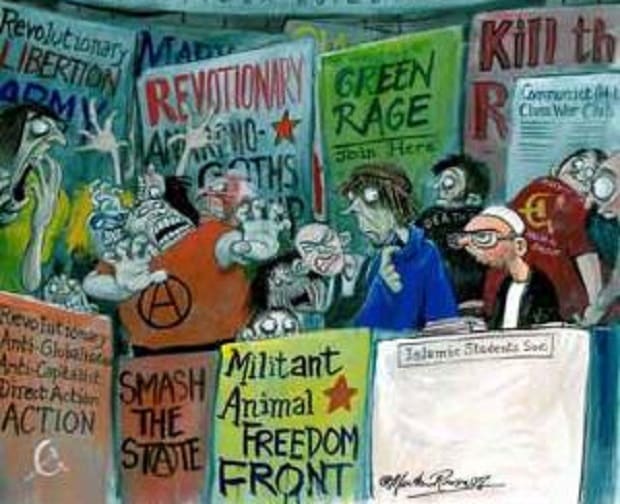
News that up to 150 Australians could be fighting in Syria and Iraq for the extreme radical militant group ISIS is indeed concerning for all Australians. The Australian government, law enforcement agencies and, more importantly, the community need to take steps to prevent further radicalisation of our youth.

The Federal Government has in the past set aside funds, such as up to $700,000 in 2013 for community programs, to tackle extremism. To an extent it seems to be working but it can be questioned if more can be done.
The challenge not only involves what needs to be done with those of Australian origin who are currently involved in these jihadist activities but there are also concerns of how to integrate them with society when they return rather than allow further proliferation of extremism in the country.
To combat such radicalisation both State and Federal governments need to move decisively.
An insight in meeting this challenge is given by Shahram Akbarzadeh in his 2013 article Investing in Mentoring and Educational Initiatives: The Limits of De-Radicalisation Programmes in Australia, which appeared in the Journal of Muslim Minority Affairs. He states here that state sponsorship of moderate Islam neglects the broader context of Muslim experiences, which is marked by socio-economic under-privilege and political alienation.
These experiences marginalise Australian Muslims and make them vulnerable to extremist ideas. This pattern is most evident among the youth, whose sense of self is still in flux, says Akbarzadeh.
Youth in our communities are still trying to find their place between the country of their parents’ birth and that of their own upbringing. The share of Indian-born Muslims is 2.1% according to the 2011 Census and 5.6% for Pakistani-born Muslims.
From the community point of view, it is important that we address these issues so as to educate and franchise our youth better.
While Australia is home to them, their sense of identity is still hyphenated as they are referred to as Indian-Australians, Sri Lankan-Australians or Pakistani-Australians. To the educated classes, these distinctions can blur with time. For those who may be from a less advantaged socio-economic background however and are on the fringes of religious marginalisation from the mainstream, there is more susceptibility to the pressures of the radicals within their society.
As the youth go searching for answers, those who can incite rather than excite them about life should answer their questions.
The 9/11 attacks, the London bombing, the Mumbai attacks and the Boston Marathon bombings are all examples of youth gone astray when their desire to believe is greater than their capacity to judge good from the bad.
Society needs to step in, and acceptance has to be the key. Media, both social and traditional, has to be more accepting of the differences between peoples. Political leaders need to allow for more inclusiveness in their policy programs rather than just make token gestures. Businesses have to step up the educational campaigns to convey the benefits of diversity.

In view of this, Attorney General George Brandis’ intention to repeal section 18c of the Racial Discrimination Act 1975 is clearly wrong. It is the right of individuals from all walks of life to feel free and protected from unfair discrimination based on race. The government needs to retain section 18c of the Act, which makes it unlawful for people to vilify others on racial grounds. Any repeal of this act can send our society backwards.
The Racial Discrimination Act helps create a fairer Australia for all, and stops individuals from offending, insulting, humiliating or intimidating another person or a group of people, based upon race, colour or national or ethnic origin.
The problem of marginalised youth in our migrant communities could pose serious security concerns and so needs to be handled sensitively.
Community acceptance and respect of each other will be an important platform in this endeavour.
Healthy eating on a budget

Tips on how to eat balanced meals and keep within your means
If you have a family to feed, balancing your monthly grocery budget can sometimes be a challenge. With the price of food soaring and healthy foods seeming to be even more expensive, it can be a monthly struggle to eat balanced meals within your means. But sometimes careful planning does help you to save money.

Plan your grocery list
- – Plan your meals a week ahead and then prepare your shopping list. The fewer trips you make to the supermarket, the less likely you are to be tempted to buy extra stuff. Also try to organise your shopping list according to the aisles in your local grocery store to avoid unnecessary moving around the aisles, wasting time and buying unnecessary things.
- – Avoid shopping on an empty stomach. Eat well before you shop. This prevents you from buying foods not on your list just because you’re hungry.
- – Be supermarket savvy and watch out for specials. Look at the latest catalogues before making your shopping list.
- – Use coupons if you have some. But, avoid buying unnecessary items just because you have a coupon or it is on special.
- – Try to shop alone and leave the kids at home if they are old enough, or there is someone to take care of them. Shopping alone reduces unnecessary purchasing.
Generic brands
- – Buy generic brands or local store brands for foods like rice, pasta, eggs, milk, cottage cheese and frozen fruits and veggies. They are just like brand name foods once you get used to the taste, but they’ll save you heaps of money.
- – Try not be taken in by the fancy packaging as this might cost you more money, and some of the foods in plain packing might be better.
Shop smart
- – Buy in-season fruits and vegetables. Food grown in-season tastes better and is cheaper. Also compare prices of frozen or canned fruits and veggies as sometimes these are cheaper and are a convenient alternative when you’re short on time. They are just as nutritious as the fresh variety, so be sure to keep some on hand in the freezer.
- – Compare prices of similar products by comparing the unit prices. The unit price will tell you how much an item costs per 100 grams or per piece or litre, which helps to better compare similar products.
- – Seafood doesn’t have to be expensive. Try buying canned tuna, salmon, or sardines – they store well and are a low cost option.
- – Substitute ingredients and use lentils and beans as a source of protein as these are less expensive than meat.
- – Buy block cheese and grate it yourself.
- – Eggs are affordable, and versatile and can be used in any meal.
- – Contrary to popular belief, healthy foods are not always expensive. A bowl of oats for breakfast will cost you less than a muesli bar full of sugar, or a muffin.
- – Try and buy low GI carbohydrates, even if these are sometimes a bit expensive, as these fill you up and you stay fuller for longer. These might turn out to be cheaper than processed foods and you end up eating smaller portions.
Bulk buy and cook
- – Buy in bulk – especially when there are promotions and specials. Foods like pasta, rice and oats are easy to stock as these do not spoil quickly. If they’re on sale, buy as much as you can afford and store.
- – To lower meat costs, buy the family-sized or value pack and make small packs and freeze what you don’t use.
- – You can cook extra serves and freeze these into small batches. This can save you a lot of money and time when you need to have meals in a hurry and prevent you from spending money on takeaways.
Limit takeaways and pre-packaged foods
- – Although takeaway food or ready meals can be convenient, there’s no doubt that home cooking is the cheaper option – plus it’s usually healthier too.
- – Preparing and taking your food with you is much cheaper than buying from school canteens or shops.
Limit junk foods
- – Try to limit junk foods and drinks to special occasions and small amounts.
- – Drink water instead of juice or sweetened drinks, it’s free and has no kilojoules.
- – Buy all the basic foods such as breads, dairy, fruit, vegetables, cereals and meats first before considering snack foods, lollies, sweetened drinks or other treats, which helps to keep your trolley full of healthy foods.
- – If you would really like to have treat foods, buy the smallest amount that will satisfy you.
Maintain a kitchen garden
- – Maintain a small kitchen garden or, if you have space, in your backyard, and grow some vegetables. This saves you money and adds freshness and flavour to your meals.
- – You can also grow some herbs and veggies in containers or small pots on your balcony or terrace.
With a little planning and awareness we can save a lot of money as well as enjoy a healthy diet.
Mighty Mohak

Despite the intense, and sometimes rough, nature of the game, one young athlete has taken to ice hockey like a duck to water

It’s the fastest and one of the most brutal sports in the world. The “ball” is frozen before play and frequently travels at over 160 km/h. The average professional player loses about three kilos during a game, while there’s a 68 per cent chance that they will lose at least one tooth during their career. During a regular season at the top level, blows to the head have resulted in up to 88 players missing 1697 games due to concussions. And did we mention that it’s all played on an unforgiving surface that often exacerbates injuries?
Ice hockey may not be the most common sport in Australia, but you should expect to see a lot more of it as the National Hockey League begins making its way onto television sets around the country. For 14-year-old Mohak Issar, though, ice hockey has already been his biggest passion for half his lifetime, and his recent selection in the NSW Under 15 State Ice Hockey team is only the latest in a string of exciting achievements for this talented athlete.
This month Mohak will be competing in the Kurt DeFris Ice Hockey Championships taking place from July 9-12 in Newcastle. He will be up against teams from all the Australian states. Having already represented NSW in 2013, Mohak has taken the achievement in his stride – but it does not mean he was any less thrilled about making the final cut of 20 players, after taking part in three separate tryouts.
“I was so excited. It’s a different, higher age group. I didn’t think I was going to make it and I was jumping with relief,” Mohak said. “My friends and family were really happy for me – my dad was so happy, it was all we could talk about for the next few days!”
Mohak began playing ice hockey after attending a family friend’s training session back in 2007. Asked by his father, Puneet, whether he was interested in taking up the sport, Mohak had no hesitation in saying yes. Although he began playing for fun, and only later began taking it more seriously, Mohak was always drawn to the nuances of the game.
“It’s a different kind of sport – not many sports are on ice. It’s the fastest sport in the world, and it gives me an adrenaline rush. It’s very unique”.
In 2013, Mohak competed in the 13th International Friendship Games in Canada, where he played almost daily for two weeks against teams such as Canada, Japan, South Korea, New Zealand and the United States. The NSW team placed third in the competition, and it ignited Mohak’s belief that he could play against bigger, stronger players at higher levels.
“Now that I’ve started playing ice hockey with contact (allowed between players), it’s gotten a lot rougher. Now that I’ve built up in age groups, there’s a lot more contact. The first year I played contact, I was pretty scared, but as the years progress, you get used to it and you don’t get as scared”.
It hasn’t been an easy road – Mohak trains at least six days a week, including sessions both on the ice and off the ice. By waking up early each morning, Mohak is able to maintain his studies at Patrician Brothers College, Blacktown, and improve his ice hockey skills.
“I get up in the morning, generally at around 5am, so it doesn’t clash with school. You should get up early if you want to become an athlete – in the morning generally you’re free, you can practice and train maybe one hour everyday”.
Along the way, Mohak has had plenty of support from his committed father, as well as his coach, Frankie, who trains with Mohak almost every morning.
Looking ahead, 14-year old Mohak, whose favourite NHL team is the Anaheim Ducks, is extremely ambitious and motivated.
“There are trials in October for the Under-18s youth Australian team. My goal is to get into that team either this year or next year”.
Indian Link wishes Mohak the very best in the upcoming state championships.
Running the distance
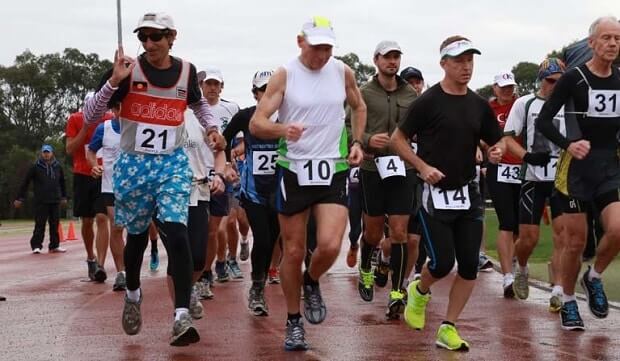
A unique 24-hour race has an unusual aim: self-improvement

Sydney’s Blacktown Sports Park hosted the annual Sri Chinmoy 12 and 24-Hour Race on June 14 and 15 and no, it is not a car rally, it is a running race.
Held around a 400-metre athletics track, the ultra-runners in the main event start at 10am on a Saturday and finish on 10am on Sunday.
With competitors facing exhaustion, bad weather, blisters, no prize money and considerable financial and time commitments just to participate, you might well ask: why would someone do this? Well, it is all done in the name of ‘self-transcendence,’ a term Indian running guru and race founder Sri Chinmoy used to describe going beyond one’s present capacities.
Runners are encouraged to set goals and compete with themselves. To try hard and dig deep. The distances competitors cover and the personal goals they set, forces them to overcome hurdles like doubt and discomfort, and at the end of the event they come out having achieved something momentous.
Spokesman for the Sri Chinmoy Marathon Team (SCMT), the volunteer group which conducts the Sydney 24-Hour event, Prachar Stegemann said, “When we challenge and improve ourselves, the world around us improves with us. Each step the runners take, if it is done in the right spirit, can add to the idea that each one of us can contribute to a better place”.
The SCMT is one of the largest conductors of fitness events in the world. Run entirely by volunteers, it was founded by Sri Chinmoy to promote running to the public. As a runner himself, he encouraged people from all ages and backgrounds to work on their fitness to maintain a balance between their inner and outer life.
“The inner life and the outer life must go together,” he said. “The body is like a temple and the soul or inner reality is like the shrine inside the body-temple. If the temple does not have a shrine, then we cannot appreciate the temple. Again, if we do not keep the temple in good condition, then how can we take proper care of the shrine?”
The Sydney 24-Hour, like all SCMT events, asks competitors to have a few moments’ silence before the start gun to contemplate going deeper within and to perhaps combine the activity of running and meditation.
This year, every competitor got into the spirit of trying their best. Some competed for the first time, others attempted to remain cheerful despite injuries or difficulties, many set personal bests and some re-wrote the record books.
Proving that age is no barrier, the open 24-Hour race was taken out by the sixty-one-year-old New Zealander Bryan McCorkingdale, running 223km in the allotted 24 hours. He won a close tussle from Wodonga athlete Kevin Muller (221km).
The female champion was Meredith Quinlan who ran 215 km, but it was in the 12-Hour that some of the most impressive results came.
West Australian psychologist Bernadette Benson travelled the long distance to Sydney and came into the race with a mission to run fast and take home some records. In a gritty and focused performance she covered a remarkable 133 kilometres. Amongst many others, she now holds Open Australian 12-hour, 24-hour, 100-mile, and 200-km records. “Her speech at the awards ceremony was memorable,” commented 24-Hour race director Martin Fryer.
“She brought all the runners into her victory, by explaining how she had watched others going through their own tough times and drawing on the strength and courage they all showed”.
“Runners band together to encourage each other,” mentions Bernadette on her blog. “Going past people, I’d get snippets of conversations where people were talking about their goals, their revised goals, and their challenges, and getting support from others who, in fact, were their competition! What other kind of race is like this?”
The event was certainly an inspiration to the many well-wishers, competitors and helpers who attended and it will all be happening again in 2015.
A picture of perfection
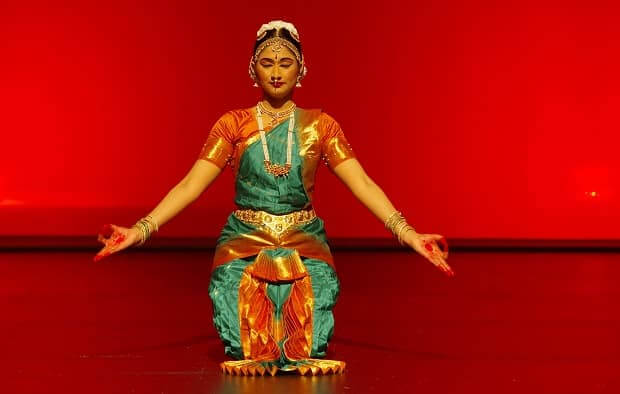
It’s an enchanting debut performance at Bharathi Sriram’s arrangetram

Introducing her niece and shishya Bharathi Sriram, Guru Hamsa Venkat noted that, like the graceful waves in the ocean, when the angam (physical self) ascends the arangam (stage), every danseuse seeks to attain antarangam (inner self).
Demonstrating maturity, prowess and devotion, Bharathi’s arrangetram (debut) at Gillian Moore Auditorium marked a new pinnacle in her artistic journey, experiencing its many nuances in the process.
“The journey has been physically and mentally exhilarating and I encourage my peers to undertake it,” she said. “The hard work, commitment and passion cannot be encompassed in a better way than to perform in front of a sea of audience whose eyes are focussed on you. Leading up to the performance, I could not even differentiate my nervousness from excitement because I was looking forward to it with so much joy and pleasure”.
“Knowing that I was able to dance a three-hour repertoire again and again without getting exhausted in the preceding weeks, had just made me realise how far I had come from day one of my lesson with my Guru when I was panting just after the Allaripu!” she added.
Rather than merely showcasing technical mastery, the subtle production focussed as much on thematic content as delivery and presentation, while strictly adhering to the traditional format, clearly hallmarks of a mature artiste.
Bharathi looked a picture of perfection with her tasteful makeup and costume selection. The experience both for the artiste and her audience therefore was pure bliss.

Saptha: The Power of Seven was the unifying theme for the evening and Bharathi delved into all aspects of this auspicious Hindu concept, laden with complex symbolism – from the seven colours of the rainbow, seven notes of music, seven sacred matrimonial steps around the fire, to the metaphysical concepts of rebirth, self-realisation and yogic power.
Exploring kundalini and seven chakras, or energy hubs, Bharathi’s innovative rendering of the Alarippu (the auspicious opening of every arrangetram) set the tone for the evening. What followed was the visual splendour of the jathiswaram in raagam Ranjanimaala with music for the piece especially composed by Sydney musicologist Mohan Ayyar.
Bharathi chose to represent the vibrant colours of the rainbow through portrayal of Lord Indra’s dhanush, interspersing energetic movements with sculpturesque postures.
The story of Rama, the seventh avatar of Lord Vishnu, formed the centrepiece (varnam) of the evening’s performance as Bharathi lovingly portrayed the various moods of the powerful epic through the classic Bhaavayami Raghuramam. This demanding piece clearly showed off her technical mastery, effectively reproducing a range of emotions from arrogance of Ravana to Rama’s humility, the vile machinations of Kuni to the utter humiliation of Soorpanakha, and the despondency of Sita’s captivity to the boundless energy of Hanuman. Particularly captivating was the swayamvara scene, eventually reaching crescendo with pattabhishekam.
The accompanying music provided the perfect backdrop. Sydney audiences have come to expect nothing but the best from Samskriti School of Dance and the artistes delivered yet again on high expectations. Krishna Ramarathinam, debutante Devika Krishnamurthy and Hamsa Venkat transported the audience to the realm of surreal with their vocal renditions, as Balaji Jaganathan (violin), Mohan Ayyar (synthesiser) and Pallavarajan Nagendran (mrudangam) provided expert instrumental support. Equally flawless was Bharathi’s behind-the-scenes support team, with sound and lighting effects adding depth and dimension to the performance.
The saptha thandavam, a dedication to Nataraja, the undisputed God of dance, demonstrated energetic movements contrasted by statuesque poses.
If Ananda Koothandina was an explosion of creative energy, the Sapthapadi allowed Bharathi to display her emotive repertoire through an elaborate delineation of love – from longing of the maiden to promise of holy matrimony.
In a special dedication to her paternal grandfather RM Sundaram, Bharathi explored the seven notes of music through a colourful portrayal of the story of Vel Murugan and his conquest of Surapadman.
As always, robust footwork and vibrant energy marked the thillana, the concluding piece of an arangetram, with Bharathi effortlessly exploring the complex themes of saptha janma (Hindu cycle of birth and death), transcending physical and eventually becoming one with the Supreme Being.
Finding inner bliss or antarangam, the capable danseuse paid her obeisance (mangalam) to her Mata, Pitha, Guru, Deivam through the Marathi hymn Omkara Swarupa Tuza Namo. As the curtains came down one last time on a memorable performance, the audience clearly went home exhilarated and uplifted by this experience of antarangam.
The golden age of Oz

Seniors nearing seventy set the new scenario

It is the year 2035 AD and Australia is now a Republic.
With the era of entitlement well and truly over, the country is full to the brim with pollies retired on the public purse.
A chosen few are elected every three years by mug punters fervently hoping to be governed better, rather than be bitterly disappointed.
With the old age pension pushed further to seventy, the national scene has taken on a new look.
The car parks at Geelong’s Ford and Adelaide’s Holden factories, that were once crammed with employees’ cars, are now full of their gophers.
The average age of assembly line workers is well past mid-60s. With trembling hands, they continue to assemble wheelchairs made from imported parts, for the mounting aged population.
Some of the workers themselves are in wheelchairs with their carers standing behind them to take them to the next task on the conveyor belt.
With the golden oldies still glued to their jobs, there is growing youth unemployment. So the government decides to implement the carers’ corps.
Friday farewells are the favourite moments for those turning seventy. Those who are a few years inside that milestone wish to grow older soon so they can pass through the pearly gates to pension paradise.
Since purchasing power has shifted to the elderly employed, retailers and boutiques have trained their sights on them.
Advertising gurus are the barometers of emerging trends. They now scout nursing homes for models with furrowed foreheads and crow’s feet for fashion magazines and TV commercials. The weather girl looks well and truly weathered.
The ‘old is gold’ wave has seen new acronyms coined. Like DOME (Don’t Overlook Matured Experience) of the 90s, DOSE (Don’t Overlook Senior Employees) is in vogue.
OWLS (Old Workers Love Serving) represent mainly white-collar workers and professionals like lawyers and doctors who get better with age and experience.
Pressure groups like SWAP (Senior Workers Awaiting Pension) and WOW (Worn Out Workers) vow to gain early entry to the pension portals.
To please them, the Industries Minister, on return from an Indian study tour, tells them how hard people work in India.
He cites the examples of Amitabh Bachchan and Rajnikanth, who even after turning one hundred, are still working as heroes in Bollywood, dancing with girls and fighting with thugs.
In order to ramp up employment while also facing an election, Prime Minister Gavin Reed orders wheelchair ramps and disabled toilets for every house, whether the resident is an infant or infirm.
In the rush to fix new flushing systems, some shonky operators employ inexperienced youth and as a result houses get flooded. A disaster that can be likened to the pink batt fires two decades ago.
The Opposition leader Sony Ascot promises to bring the boats back, the orange ones used years ago to return the refugees, since smart Sumatran smugglers now use them to ship refugees safely to our shores at a much higher price.
With an eye on votes from fringe groups, ‘green granny’ Rosa Hanson-Old rolls her big, beady eyes, while she opens basket weaving communes to up-skill the unemployed.
Education is now the nation’s primary export earner. Primary students from Shanghai and South Korea stream into our schools to escape their tiger mums and tough maths lessons, preferring the easy Aussie option.
After most of the minerals shipped out, the mines are a mega mirage. A portly coal magnate and politician plans to start Queensland Mirage-type resorts by filling the empty open-cut mines with sea water for tourists to swim and surf.
Some twenty years earlier, the editor of the April 2014 issue of Indian Link, advised young Indian migrants who came in their thousands to plan their financial future carefully since their chance of getting a pension is likened to India winning the Soccer World Cup. His words have become so prophetic.
Those same young migrants, skilled in IT and engineering, are now in their sixties, working as hard as ever plying their old (cleaning) carts in shopping malls and aged care homes.
It is 2035. The golden age of Oz has dawned.