Home Blog Page 943

Ask Auntiji

0
Reading Time: 4 minutes

Mind your own business!

Dear Auntyji,

I have been seeing this really nice boy for six months. About a month ago, I overhead his mother and aunt refer to him as adopted. I was shocked and amazed, but secretly I was not surprised because Ricky doesn’t look anything like his family members. So Ricky does not know this because I tried to ask him in a number of ways whether he was adopted but he very proudly told me he was his father and mother’s dulara. Yes, I know you’re probably wondering who uses that word anymore, but he picked it up from a movie we were watching called Anmol Rishta or something. So it turns out his Rishta with his parents are not so Anmol after all. I am thinking that in six weeks time, at a family gathering, I will ask Ricky’s mum about this and have her tell him to his face that he is not adopted and is her real son. I want to fully expose her for the liar she is. So, I thought I would ask for your feedback on this first, I don’t want Ricky to hate me after this, but I am doing him a favour. Please let me know your thoughts Auntyji?

Auntyji says

My goodness, how old are you? Five? Seven? 17? You couldn’t possibly be older than this because your total lack of common sense and empathy is indicative of a stupid bacchi, rather than a grown woman. Here is what is wrong with your nasamaj planning, you stupid kalaankani. How do you really know what Ricky’s mum and aunt were speaking about? Were you part of the conversation? How do you know they weren’t speaking about Ricky on Days on our Lives, because you do know that he was adopted right? Just after Bo and Hope got married. Wait, I am confusing myself there. In any case, your first mistake was to leap headlong into a conclusion with no basis. In doing that, it looks like you have yourself a concussion because your second mistake was to think, you horrid little besharam ladki that you can interfere in the lives of others. You have no right whatsoever to start making allegations about anything, and that too at a public forum. I mean, seriously, what were you thinking? All this is really none of your business and I would let sleeping dogs lie. Until you are told information first hand, you shouldn’t do anything with this. And second, it’s not your place to be the local grapevine. Having said all this, I’m beginning to think that Ricky deserves better than a churail like you, so by all means, go ahead with your plan. You will make it obvious to all that you don’t deserve to be in that family then you can go and find some other family to torment. Man, you really have been watching too much Zee TV. Honestly, don’t you have better things to do than to live a Zee TV serial of your own? And is your serial called, A busybody ki kahaani or ek nadaan, pagal si ladki.


Go live your life off Facebook

Dear Auntyji

On Facebook, my ex keeps posting pictures and comments about how much fun she is having with her new man, and she makes pointed references to how crap I was. Each time she posts something, something inside of me dies. I don’t want her back, but I wish she wouldn’t write such crazy stuff, you know what I mean? What should I do Auntyji? I have not done the full tit-for-tat kind of thing, but man, I am so tempted. I wish I could just find myself a supermodel and post pictures on Facebook with pithy comments about how fabulous my life is. Do you have some honest candid advice for me Auntyji? You know I really value what you have to say.

Auntyji says

Ah, yes, Facebook, the place where friendships go to die and where people’s spirits are slowly crushed. I have one very simple piece of advice for you. But first, I have a question. What the fudge are you doing on Facebook anyway? Why are you on there vicariously living everyone else’s meaningless and dull life? The only useful thing Facebook is good for is to help keep your self esteem down, where this one is getting promoted and that one is eating a fantastic meal and the other is living a lovey-dovey life with his or her otherwise really boring other half. So, unless you are going to say that you use Facebook to gather insights into human behaviour in order to predict the next big trend, I don’t see any reason for you to be on Facebook. Who cares what your friends are up to. I mean, do you really care that Amrita from grade 6 is now married and living in Denver with two ugly, but intelligent kids who get trophies for winning spelling contests? Do you really want to see narcissistic Ankhit posting picture after boring picture of his lovely-in-his eyes new wife Shila? And do you really, really care that Madhu ate aloo Sabzi for breakfast? Seriously, do you really want to know all this? No, you should want to know more important things in life, such as, how to eradicate poverty or malaria and how a pan Africa will help solve all of that sub continents problems and what is Modi’s five year strategy? So my advice is for you to get off Facebook, then you won’t have to care what your ex does with whom. Remember she is playing to an audience of one. Why give her the satisfaction? Obviously you did not give her satisfaction when you were together, but she is getting her satisfaction now. Oh, I do hope this delicious irony is not lost on you! In any case, get off Facebook, and live your own life. That’s my candid advice to you. Now take it and go. Live your life. But not on Facebook for Vishnu’s sake.


A million bucks for an elephant!

0
Reading Time: < 1 minute

Artist Bharti Kher’s sculpture gets just under a million pounds at Sotheby’s

A life-sized elephant in a crouched position by UK-born Indian sculptor Bharti Kher fetched over £900,000 at an auction by Sotheby’s in London Monday evening.
“The Skin Speaks a Language not its Own” is one of the most talked-about works by Kher, said the auction house which expected it to fetch between £700,000 and a million pounds.

It ultimately went for £993, 250, just short of the high end target, at the Sotheby’s Contemporary Art Evening Auction.

It took Kher 10 months to create. Zara Porter-Hill, director and head of Sotheby’s Indian Art Department, said: “Despite our familiarity with elephants, nothing prepares the viewer for the emotional experience of seeing Kher’s elephant, huge and incongruous in the gallery space. With her head resting on her front foot, she is brought down to our level and her glassy black eye entreats a communion and proximity rarely encountered in the wild.”

United we stand, divided we…

0
Reading Time: 3 minutes

Why the decision to welcome Telegana as India’s 29th state is wrong

My homeland has been divided yet again… on 2nd June 2014, India witnessed the formation of its 29th state, Telangana.

I believe in a democratic, secular and tolerant India and hence, I believe the decision to form this new state is entirely wrong; socially, economically, politically and democratically.

Socially, a common dissent (amongst many others) voiced by the citizens of Telangana who aspired for a new state is that linguistically, they spoke different languages from the other regions of Andhra Pradesh. To quote, “my Telugu accent has always been ridiculed by those from other parts as I spoke a different version of the language”. Our country was divided along the linguistic lines at the time of state formation post-Independence, but within a state, every village or district speaks with a different style or accent even today and all of us have at some point ridiculed or been ridiculed for our accent or language. But does this qualify for demanding a new state, a new division?

Economically, the citizens of Telangana celebrate as if the battle has been won. But the real battle is yet to begin! The new government is faced with the mammoth task of the economics of running a new state. A principal reason cited for needing a new state was the fact that most regions of Telangana were economically backward and not given the due attention by the former Andhra Pradesh government. With a total land area of 114,000 sq. km and a population over 35 million, the only prized asset Telangana can boast of is Hyderabad, the technology hub of India which the new government believes can contribute tremendously to the development of the new state. Though the city of Hyderabad has the economic potential to bring Telangana out of its financial and developmental doom, it is important to realise that the rest of the state remains backward with poor infrastructure, farming or irrigation facilities.

Water is another issue on which the two divided states will continue to lock heads with each other. On one hand, the revenue and resources that the new government will need to pump in to uplift the majority of Telangana is colossal and to the tune of several billions, a task that might not be easy to achieve in spite of getting Hyderabad which practically functions like a satellite city. And on the other hand is the cost and resources required for setting up a new government and related governmental agencies and administrative offices. The truth is that the elected government does not have a clear blue print to address any of the critical issues facing Telangana today.

Politically, the riots and struggles for a new state began in the early 1960s. Initially, it was a public outcry against the landlords of undivided Andhra who exploited the farmers and other working class of the Telangana regions. Soon, the politicians discovered this sense of injustice in the minds of the public was a good way to gain votes and soon the public disdain became a political outcry. The Telangana Rashtra Samithi (TRS) formed in 2001 was a result of this and the party chose to form an alliance with the Congress (which held the stronghold at that time) in the hopes of a new statehood. But the Congress party had no such inclinations and hunger strikes, riots and social unrest became the order of the day. When the date for the 2014 general elections was set and the Congress party realised that it could be wiped out from power, the decision for the new state of Telangana was pushed in a last minute attempt to gain a couple of votes from the region. A petty political miscalculation which cost the party dearly in the general elections.

Democratically, as we get closer to completing 68 years of independence, it is a saddening thought that we still follow the ‘divide and rule’ policy of the British Raj which destroyed our land. We did not need a separate state; we needed a sensitive government to understand the real plight of the people. We did not need to cut ourselves up on the basis of language and regional differences; we need less corrupt leaders who would direct funds in the right manner to promote growth and development. And above all, we need to exercise tolerance, a sense of unity and brotherhood, a trait in such short supply among Indians back home and around the globe.

We should have learnt from our past mistakes, the glaringly obvious ones like Jharkhand. It is going to be a lonely road for Telangana and Seemandhra, but here’s to hoping the new leaders can deliver the promises made. As well as hoping that the new government does not divide and cut up India again into Gorkhaland, Bodoland and Vidarbha for petty political interests.


Australian Telanganites celebrate statehood

0
Reading Time: 2 minutes

In June India celebrated the formation of its 29th state, Telangana. These celebrations extended to the Indian community in Australia as well, resulting in the formation of yet another Indian-Australian association.

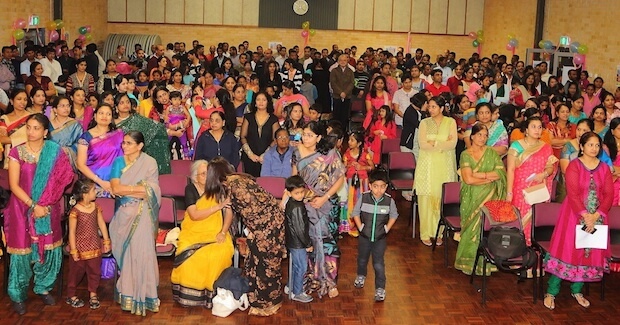
In Sydney, over 500 people gathered at Greystanes Community Centre to participate in Formation Day celebrations, organised by the Australia Telangana Forum (ATF).

A lamp was lit at the Telangana Thalli portrait, followed by prayer and a two-minute silent tribute dedicated to the martyrs that gave their lives to enable the formation of the new state.

Councillor Gurdeep Singh from Hornsby Council shared his happiness towards the new state, and stressed more communication and contribution towards the relationship between Australia and Telangana.

Members of the ATF, and other Telanganites and sponsors, who worked on collective initiative, venue arrangements, food arrangements, entertainment programs and the other logistics of the function, were thanked.

Telangana food was served to all participants, and the event was a grand success.

Also following the Formation Day celebrations was the inaugural function of the new Australia Telangana Association Incorporated (ATAI) in Melbourne.

Held in June at Hawthorn Arts Centre, the event gathered over 600 people and involved cultural acts including classical dances, skits and fashion shows based on Telangana culture and tradition.

The ATAI serves as a platform for cultural, educational, social and economic developmental activities. Its vision is to support and represent the Telangana community in Victoria and address issues facing the community such as education and health.

Their role involves catering to the needs of migrant students, preserving and promoting Telangana culture and identity and addressing issues of the growing population.

They hope to do this by conducting workshops, forums, info sessions and support groups to educate and raise awareness of issues facing the Telangana Australian community. They also hope to engage in developmental and charitable acts to support the state at home of which the majority of people live under the poverty line.

ATAI conducted a blood donation camp on 1 June and donated funds to an orphanage in Hyderabad in order to renovate their Sharadha Vidya Niketan school. They also took over a water purification plant in Koorkal village, where impure water is converted to mineral water. This has enabled the serving of 4,000 people with clean water.

Around 200 families have shown their support for the formation of ATAI.

“It is my hope that ATAI will fill the gap and fulfill the resident’s needs by conducting various programs to keep our culture and help the needy in Melbourne and Telangana state,” said ATAI Treasure Shyam Lingampalli.

Present at the inauguration was president of ATAI Raj Vulpala, and Vice-Councillor of the Indian Consulate Shri. M.C. Bhagath, who launched the ATAI’s official website.


The human condition in the Internet age

1
Reading Time: 4 minutes

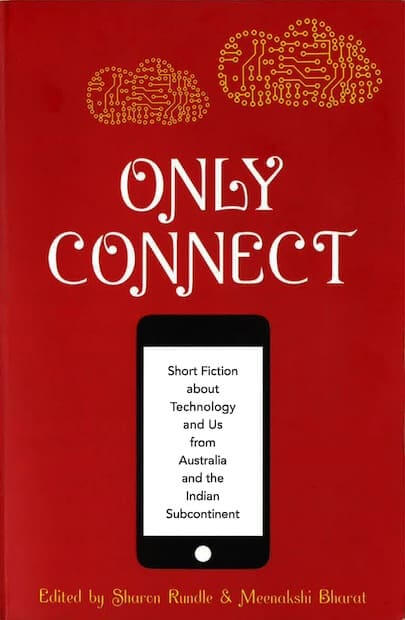
We might be robots, but robots have feelings too. SALMA SHAH reviews a newly released collection of short stories.


A new collection of short fiction by Australian and Indian writers, called Only Connect, is a rich and rewarding compilation that focuses on the ubiquity of technology in our lives. However, instead of technology being the key aspect, the stories are based on the different ways in which technology enhances human behaviour.

Each story highlights how human desires, emotions and instincts are transcendent through time, but are also shaped by technologies that allow them to manifest in newer, more creative ways.

The intelligent editing compiles a collection of diverse stories that create an overall narrative. The reader is moved forward through each tale by a rich palette of human emotions and actions without ever getting a sense of sameness between the stories.

A Software Sonata and Sneha, 25 expose a new way of the ritual of coupling. In the past, potential couples would meet and form relationships usually through relatives or friends. Now, the use of email and texts, and indeed, snooping software, allow individuals to pursue this already complicated game on their own.

Sneha, 25 demonstrates the perverse nature of the use of technology, and how when placed in the hands of someone with extensive technical expertise, can result in sinister behaviour.

However, despite the subtle undertones of danger, the reader still anticipates a safe ending.

Sneha, 25 brings to life what many readers fear about technology. At the end of this story, the author cleverly shows that while there may be reluctance or fear when playing the mating game online, technology can be just another way to fast track one’s dating objectives.

A Software Sonata, also a love story of sorts, is compelling, not because of the age-old narrative of boy-meets-girl, girl-contrives-situation-to-be-with-boy, but because of the particularly provocative and snappy dialogue between characters.

The author’s clever use of code switching heightens interest in the verbal interplay between the two friends, and potential lovers. The reader is left with little choice but to be fascinated and highly entertained by these two brilliant characters.

If A Software Sonata seduced with its prose, then Anu Kumar’s Two Women, delighted with its descriptiveness.

The story depicts the thoughts and emotions of two women, who are the same, but yet so different. Both women, abandoned by their husbands, are travelling alone while dealing with the grief of shattered lives.

The narrative conveys interest in the outsider.  While Malati only sees the foreigner Dorothy for her exotic appearance, and is interested in knowing more about her mainly to assuage her curiosity, others on the same bus see the sameness of the two.

Yet again, the language interplay between characters offers a tapestry of delights for the discerning reader, who will undoubtedly recognise and appreciate vernacular and the use of idiom.

The language techniques emphasise the depth of the characters and offer readers an insight into post-colonial thinking, where people are ready to judge foreigners based on what they see on television, but fail to see how foreigners are no different from themselves.

Then there are the two stories that, despite offering common themes of procreation, differ markedly in the story told.

B Wid U Soon by Meenakshi Bharat tells of the quiet desperation of a husband who, due to a series of events, is unable to be with his wife for the birth of their first child. This tale flows swiftly and the reader senses the palpable release of emotions almost at the same time that the new father does. Finally, when he sees a picture of his son for the first time, he lets his emotions flow freely.

In contrast, in Friending and Trending by Roanna Gonsalves, we meet a husband who is more interested in living his life through social media and technology, even as his young wife is unable to carry a baby to term.

Likewise, in each story, the characters become real and develop depth, not just because of what they say or do, but also through their interactions with technology. It is in these interactions that we see human frailties and strengths that are identifiable to the reader.

There are some who say that technology has changed us. However, it is arguable, as seen in each story of this delightfully entertaining read, that the human condition has not changed at all.

We still love and yearn and feel those same emotions we have always felt. What has changed is the forum with which we can express each of those human foibles. We still love, but we declare it using a new medium. We still betray those whom we seek to control, using the most efficient means available. And even if we are separated by distance, the connectedness enabled by technology does not overcome the tyranny of separation.

Only Connect is a thoroughly enjoyable read. This book will offer technology and social media addicts a respite from technology, and will allow such readers hopefully, to see some of themselves in each of the characters. When this happens, one hopes that self aware readers will see the constraints of living their lives within the technology, rather than the technology enabling the life they could be living.


Secrets of an online bodyguard

0
Reading Time: 3 minutes

In the wake of Stay Smart Online Week, Beenu Arora shares his passion for information security

The first week of June saw the celebration of the inaugural Stay Smart Online Week, formerly known as the National Cyber Security Awareness Week. This year, the theme of the event, “On the Go,” drew attention to safety and security while using mobile devices. Celebrations kicked off early for cyber security expert Beenu Arora, who was last month announced by AusCert as one of the top three Information Security experts in Australia.

The AusCert Information Security Awards recognise individual and organisational excellence in information security. Beenu, who has been working in the cyber security industry since 2006, was anonymously nominated for the 2014 Individual Excellence award.

He admits that being selected as a finalist was a pleasant surprise.

“It is an honour and I’m grateful to the AusCERT panel,” he told IndianLink.

“I have been in Australia nearly four years now, after I migrated from India in 2010, and this achievement is special from both a personal and professional perspective”.

Beenu studied software engineering in New Delhi at a time when cyber security was not a topical subject. He had developed an interest in cyber security before university when he would study open source software in order to find issues or gaps.

Beenu then progressed into ethical hacking, which attempted to exploit system vulnerabilities on behalf of system owners.

He now works as a cyber security professional at a highly-reputed professional services consulting firm in Melbourne, where his job involves assisting all types of organisations with various information security issues.

In his free time, Beenu also researches new variations of malicious software, or malware as it is called, and publishes his findings on his website.

Beenu believes that it is his ability to resolve complex problems through simple, innovative solutions and then providing these solutions to the open security community, that led him to the achievement.

However, like most high achievers, he has faced several challenges along the way.

Aside from the obvious difficulty of having to explain complex technical problems to both non-technical employees and customers alike, Beenu’s area of expertise is in a state of constant change. For example, he believes malware attacks were redefined after the Stuxnet virus that damaged Iran’s nuclear facility only four years ago.

“Stuxnet made people realise that physical systems can be successfully attacked from cyber space,” he said.

In addition, Beenu’s work spans across different industries, each with different levels of risk, and accordingly, different security requirements.

For instance, the security risks associated with a retail company are different from an energy sector organisation.

However, Beenu identifies common threats that apply to information security across all industries, including cyber-espionage, state-sponsored cyber attacks, inside threats, organised crime and activists.

Beenu’s talent of being constantly informed and aware of the latest malware trends was exemplified at the end of May, when he encountered a spam campaign that was targeting Australian users and email addresses. The emails purported to contain an energy bill from a utility company, providing victims with a link to download the “bill”.

Instead, however, the link downloaded ransomware, a type of malware which attempted to extort money from its victims either by refusing them access to their files and folders, or locking the computer altogether.

As part of his research into the scam, Beenu collated the behaviours of the malware in order to identify impacted machines, which is a critical step towards remediation.

Beenu has high hopes for the future of information security.

“There are challenging and exciting assignments in the pipeline,” he said.

“In the last couple of years, I have greatly expanded my horizon within the cyber security space and I’m looking forward to gaining more exposure and experience on this journey. I truly believe in the late Steve Jobs’ mantra, ‘Stay hungry, stay foolish’,” he stated.

For budding cyber security experts, Beenu has some clear advice.

“Have a firm focus; make sure you set clear direction and goals – this will fundamentally help to grow one’s career in any field, including cyber security. Cyber security is a rapidly changing domain and skill is the key. I’d encourage individuals to keep learning and refining their skills and align them to industry demand. My dad used to say, ‘Follow the challenge, success will follow you!’”

Success has indeed followed Beenu, and there’s no doubt it will continue following him in the years ahead.


Kicking up a storm

1
Reading Time: 7 minutes

Kicking up a storm

Salman Khan’s song Jumme ki raat, released recently as a teaser to his upcoming film Kick, has gone viral. Released appropriately on a Friday (jumma), the video shows a hunky Sallu romancing a ravishing Jacqueline Fernandes. It seems to have done its job, which was to whet the appetite of Salman fans across the diaspora eagerly waiting for the Eid release of the film.

The song sung by Mika and Palak Mucchal is composed by Himesh Reshammiya.

Of course you can’t help noticing the similarity to that other famous jumma number, Big B and Kimi Katkar’s Jumma chumma de de from Hum (1991).

Salman himself agrees the similarities are there. “I love Jumma chumma; every time it plays on TV I watch the whole number!”

But his number is filmed differently, he hastens to add.

Regardless, the song has definitely kicked up a storm, with nearly 8 million views on YouTube for the film’s trailer by the next morning. We wait to see if it translates to bums on seats, come Eid. A recent SRK-Kareena Kapoor pre-release of a song went similarly viral, but alas, did nothing for the film when it was eventually released.

Expectations from Salman and Kick are huge, especially since Salman’s last release Jai Ho under-performed at the box office.


Pretty Preity in Ness mess

Preity Zinta’s allegation of molestation against her former beau and business partner Ness Wadia has not got much reaction from the film fraternity. Many like director Tanuja Chandra feeling it’s better to wait for the legal process to move forward and “avoid playing judge and jury ourselves,” while Moon Moon Sen feels “it is entirely their business”.

Chandra, who directed Preity in author-backed film Sangharsh, says, “I imagine she must have thought a great deal about it and hasn’t done this on an impulse. Like all women in the country she has every right to approach authorities if she feels her individual space has been violated. We must wait for the legal process to move forward and avoid playing judge and jury ourselves”.

The outspoken Pooja Bedi has decided to sit on the fence.

She says: “Neither Ness nor Preity come across as a liar. Both are such lovely people. So it is just very unfortunate that it’s all turning out the way it is. Having said this I feel it is for the courts to pass a verdict, not us”.

Neetu Chandra feels the matter is personal. However, she also feels Preity is not the kind to raise a hue and cry unnecessarily.

“As far as I know, she is a no-nonsense person and leads her life with dignity. A break-up is never pleasant. Both the partners have to be very careful about preserving each other’s self-respect in public after the break-up, for the sake of what they shared in the past”.

Preity lodged a written complaint against Wadia with the Marine Drive police station on June 12. She accused Wadia, her former beau who co-owns the IPL team Kings XI Punjab with her, of grabbing her hand and abusing her during a cricket match in Wankhede Stadium in Mumbai on May 30. Wadia has denied the allegations, terming them “totally false and baseless”. His friends have suggested that Preity is jealous because Ness has moved on and is now in a new relationship.

Actress-parliamentarian Moon Moon Sen feels the two should sit and talk it out, even though she says she admires Preity’s courage here.

“Maybe there’s a history of abuse and now it has erupted in a public place to embarrass both of them. Surely the two can sit down and sort it out. No matter how we look at it, it is entirely their business”.

Movie guru Shailendra Singh finds the incident unfortunate.

“It’s unfortunate that a girlfriend-boyfriend fight has national importance. There are far more serious matters awaiting the nation’s attention”.


The battle of the newbies

Fresh-faced Armaan Jain will soon make his acting debut with fellow newcomer Deeksha Seth and first-time director Arif Ali, in Lekar Hum Deewana Dil.

The number of fresh faces continues to rise in Bollywood and Armaan Jain wishes them all the best of luck… or so he says.

“There are a lot of youngsters, around 10 to 15, of my age group doing the same genre of films,” he states.

“I believe in healthy competition. I hope we all work hard and have healthy competition. Hopefully, people accept my first film first and we all grow together”.

Yes you like healthy competition, we get it… but do we believe it?

Jain has worked with two former assistant directors Sidharth Malhotra and Varun Dhawan, who are now successful actors, and says that he bonded with them while assisting filmmaker Karan Johar on My Name Is Khan.

“I was an intern, joining towards the end of the schedule. I got to spend a little bit of time with Sidharth and Varun during shooting schedule. It was great bonding with them,” says Armaan.

While he feels he is too young to explore the filmmaking part of the industry, he is not against it.

“When I started assisting, I wasn’t aware of how films are made, what happens. Once I got involved with technicals, I started making short films. I used to try and get my hands into editing. I directed a short film to understand the craft practically also. My main concentration is to get this film right and act for now. Definitely at some point of time, I would love to direct a film. I love editing as well,” adds the former intern, assistant, editor and wannabe director.

Armaan is the cousin of actor Ranbir Kapoor, and has also shown interest in RK Films, the banner established by his late grandfather and actor-filmmaker Raj Kapoor.

“At some point, if my uncles or Ranbir do [revive the banner] and if they want to involve me in some way, I would be honoured to do so. If something comes up, then definitely,” says Armaan.

Lekar Hum Deewana Dil will release on July 4.


Lost in translation

Ukranian ballroom dance expert Maksim Chmerkovskiy is visiting India to be the first international judge of reality TV show Jhalak Dikhhla Jaa, the Indian version of Dancing with the Stars.

However, it seems that the housewarming was not so warm with reports claiming Maksim is already unhappy as a judge on the show as he cannot speak or follow Hindi.

Maksim was quick to deny the reports. “That’s not true. I am having a blast. It’s all good, don’t worry. It’s going really great. And that report is bull****,” he refutes.

“I am a very adaptable person. I am open to all kinds of experiences. I came to India and to Jhalak Dikhhla Jaa to embrace a new language and culture. I want to understand Bollywood dancing. This is a brilliant once-in-a-lifetime opportunity for me to get acquainted with a new culture. And I am enjoying every moment of it”.

Sounds legit. But he still can’t understand a word of what the contestants and fellow judges are saying, with his own statements being ticker-translated on screen.

Luckily, with a bit of help (and by a little, we mean an entire production team), the Ukrainian ballroom prodigy battles on.

“But I was prepared to face all of this. I had hoped that the production team would understand there would be difficulties. And everyone is helping out. The judges are constantly helping me out. I sit between Madhuri Dixit and Karan Johar. They’re constantly telling me what’s going on. The hosts are also helping me out all the time. It helps that the show is taped and doesn’t go on air live. So, they stop the shooting and explain what’s going on. The experience that I am getting here is not something you get in a classroom,” he affirms.

At least something is going his way, with Maksim claiming that Bollywood contestants have a lot more respect for the judges on Jhalak Dikhhla Jaa than on Dancing with the Stars.

“I’ve just begun to realise that Madhuri is a legendary figure. And Karan Johar has a track-record of successful films. I had come here for a new experience. I thought I’d be a good judge on the show. But now I’ve to be even better than just a good judge in order to live up to the standards on the show,” he says.

First step to being a better judge on Indian TV: Hindi lessons!


The key to a healthy relationship: Breaking box office records

Movie star Akshay Kumar’s latest film Holiday – A Soldier Is Never Off Duty has minted Rs.102.62 crores in three weeks at the domestic box office and producer Vipul Shah could not be happier.

The Shah-Kumar partnership has once again struck gold with this film adding to their collection of hits including Aankhen, Waqt – Race Against Time, Namastey London and Singh Is King.

However every relationship has its rough patches, for example the Action Replay fiasco.

“It has been a fantastic journey with Akshay,” Shah said, when talking about his partnership with the superstar.

Holiday is our sixth film together and four out of five films were successful. What is very important is that all films got a lot of credibility from the audience”.

Holiday is about terrorism, in which director A.R. Murugadoss focuses on sleeper cells and how quietly they merge into their target society before unleashing havoc.

The thrilling drama featured a new style of action directed by renowned British stuntman Greg Powell, known for his work in Hollywood’s super hit franchises such as Harry Potter and James Bond.

The filmmaker said the successes have helped them in winning a “good reputation”.

“My relationship with Akshay has reached that stage where we constantly want to do better work together. It has become stronger by the day,” said Shah.

We sincerely hope you’ve been buying him flowers. But we wonder, who pays for dinner?


No more Bipasha: Vashu Bhagnani

Producer Vashu Bhagnani is so upset with Bipasha Basu, one of the female leads in his just released Humshakals, that he has decided not to work with her again.

Directed by Sajid Khan, Humshakals, which also features Riteish Deshmukh, Saif Ali Khan, Ram Kapoor, Esha Gupta and Tammannaah Bhatia, hit the theatres in mid-June.

The dusky beauty, who was missing from all the promotional events of the film, stated that she was dissatisfied with the end result of her role in the film.

Bhagnani says that he never misled her about her role.

“I asked Sajid myself to cast Bipasha,” Vashu says. “She is a lovely lady. But I don’t know what her problem is. It’s not like we told her something and delivered something else”.

Is the feisty Bipasha too much of an alpha-woman for Bollywood’s misogynist ways?


Caption Contest

What’s the chitchat between Padmini Kohlapure and niece Sharddha Kapoor?

Send in your responses to win@indianlink.com.au and win a surprise prize.

LAST ISSUE CAPTION CONTEST WINNING ENTRY

What’s the chitchat between Priyanka Chopra and Katy Perry?

Katy (to herself): I’ve got to do a tuk-tuk ride… Brad and Ange did one too while they were here!

Priyanka (to herself): But for this firang, I wouldn’t be caught dead riding on a scooter like this.

Puneeta Sharma

Chipping Norton NSW

Puneeta wins a ticket to new Hindi release Holiday



Ready for some passion(fruit)?

0
Reading Time: 3 minutes

Add a tropical touch to your next sweet or savoury meal

Sweet and sharp aren’t usually words used to describe a piece of fruit. Especially when tropical is thrown into the mix. But that’s exactly what passionfruit are, and they’re the perfect addition to meals in winter.


“Weight is the most important feature in choosing passionfruit,” Tina McPherson, an Australian passionfruit grower, says. “Choose a fruit that feels rather heavy for its size. “It doesn’t matter whether the fruits skin is wrinkly as this is not an indicator of ripeness”.

Rich in antioxidants including vitamins A and C, potassium and dietary fibre (and low in calories), they’re great alongside pork, prawns, chucked into a smoothie or dessert.


MOROCCAN GLAZED BBQ PRAWNS

Serves 4

For the marinade/glaze:

6 passionfruit

½ bunch coriander (roots and stems)

2 cloves garlic

2 tbsp olive oil

2 tsp mild paprika powder

1 tsp ground cumin

2 tsp ground coriander

1 tsp ground cinammon

½ tsp ground ginger powder

½ tsp cardamom powder

Chilli powder, to taste

Salt and pepper

For the remaining dish:

24 peeled, deveined, raw prawns, tail on

16 bamboo skewers

2 passionfruit

½ bunch coriander (leaves, from above)

Green salad and crusty bread, to serve


Remove passionfruit pulp and place in a bowl, microwave for 30 seconds on high, then

strain through a fine sieve. Reserve the juice and

discard the seeds (optional).

Thoroughly wash coriander and pick leaves, set a

side for decoration. Chop the stems and roots and place in a mortar and pestle along with some salt. Grind to a paste, then mix in olive oil, all the spices, and passionfruit juice.

Place marinate and prawns in a bowl and mix thoroughly to coat. Allow to marinate for

at least 30 minutes. In the meantime, soak skewers in some cold water for at least 30

minutes to prevent burning.

Using 2 bamboo skewers at a time, thread three prawns onto each of the skewers so

that the prawns are semi straight and sit snugly together. Keep remaining marinade and

mix in the passionfruit and a little extra olive oil if you need to loosen it – this will be the

glaze.

Heat BBQ to a medium heat and place prawns on grill, baste constantly with the passionfruit glaze, turning every so often, and cook until the prawns are just cooked

through (you will see when they change colour).

Serve hot, garnished with coriander leaves and a side of crusty bread and green salad.


PASSIONFRUIT, WHITE CHOCOLATE AND CASHEW CHEESE-FAKE

Serves 4

Base:

¾ cup (110g) raw almonds

¼ cup (50g) pistachios

1 cup (90g) desiccated coconut

8 Medijool dates, (170g pitted)

1 vanilla bean, seeds only

3 tbsp of passionfruit seeds only

Pinch of salt

Cheesecake:

440g cashews, soaked over night

250g lemon and lime juice

250g honey, raw honey or agave

270g extra virgin coconut oil

2 vanilla beans, seeds only

½ tsp of salt

1 tbsp of lime zest

1 tbsp of lemon zest

1¾ cup passionfruit seedless pulp, (Approx. 6

passionfruit), reserve seeds for base

Garnish:

200g block of good quality white chocolate,

shaved (optional for lactose free)

2 small passionfruit, halved and placed on top

1 tbsp of lime zest

1 tbsp of lemon zest


Soak cashews overnight in water, or pour boiling water over cashews and soak for 2 hours.

Remove passionfruit pulp and place in a bowl, microwave for 30 seconds on high, then strain through a fine sieve. Reserve the juice and seeds. Zest and juice the lemons and limes, set aside.

Line the base of a 26cm spring form cake tin with baking paper.

To make the base place, almonds, pistachios, desiccated coconut, dates, vanilla, passionfruit seeds, and salt in a food processor. Process until the mixture resembles a fine crumb and comes together when pressed.

Place crumb into the cake tin and press down evenly to form the base. Chill in freezer.

Melt the coconut oil in the microwave at 10 second bursts until it becomes a liquid.

To make cheesecake layer, place drained soaked cashews, lemon and lime juice, honey, vanilla, salt, melted coconut oil and zest into the food processor. Blend until very smooth and well combined.

Pour half the mixture into the cake tin and tap to level out the filling. Place in freezer to set for 1 hour.

In the meantime blend the other half of filling with passionfruit pulp until well combined. Then pour over chilled first layer, and set in freezer for at least 2 hours.

Prepare the garnish, using a vegetable peeler shave white chocolate into ribbons. Cut

passionfruit into halves.

When cake is set remove from freezer, and with a wooden skewer release the edges of the cake before removing it. Scatter shaved white chocolate and zests around the center of the cake and top with halved passionfruit. Enjoy frozen or chilled.


All recipes and photos: Sammy and Bella Jakubiak (My Kitchen Rules 2011 winners) for Passionfruit Australia www.passionfruitaustralia.org.au

The perception of education

0
Reading Time: 3 minutes

Conflict can arise in schools when communication is not open

When dealing with schools, perceptions are important. Much conflict arises from the differences in perceptions of various parties. Such conflict can be between parents and their children, parents and teachers, teachers and students, parents and other parents and between students. In managing conflicts within schools and school communities, perceptions matter.

Perceptions arise in overt and also in non-obvious ways. Consider the following example. A teacher was taking a class where the students were reluctant to contribute verbally, for fear of being incorrect. The teacher said to the class by way of instruction:

I want you to write down an answer. If you get it wrong it does not matter. If you get it right – that’s great. The main thing is to write some response.

He was trying to encourage academic risk-taking.

He then asked the first question and each of the students wrote their responses down onto mini whiteboards that he had purchased for the students. He then asked the students to hold up their whiteboards. The teacher’s response to the answers, all of which were correct, was, “Brilliant!” “Awesome!” or “Excellent!” He then asked a second question but this time one of the responses was not correct. The teacher paused and slowly said, “o…k…a…y”.

If you get it wrong it does not matter. This stated position was not the practiced position. A student would perceive that correctness is more highly desired that a brave attempt that is incorrect.

In this way, the subtle nuances of what teacher’s value can be conveyed in mixed messages, an overt message of safety in academic risk-taking and a covert message of “rightness matters more than wrongness”.

Perceptions also affect how parents interact with schools. Perceptions in this regard arise from a combination of their direct and indirect experience of schools. This experience can come in the form of personal communications (face-to-face and electronic), the correspondence between school and home (through letters, newsletters, permission slips and the like), open days and through the comments made by their children and the comments made by other parents.

Perceptions can make parents feel excluded or included, as well as valued or devalued. Perception can therefore encourage parents to interact with staff and school administrators or perception can make them hesitant and defensive.

Parent perceptions can be influenced by the child and how their perceptions of school are conveyed to the parents. For example, a child with stomachaches every Monday can find school makes them feel anxious. This perception can arise from a feeling of uncertainty, insecurity or performance pressure. Since perceptions affect behavior, understanding the difference between words and feelings is crucial to understanding perceptions and managing conflicts.

It is important that teachers and parents mediate their first ‘responses’. That is, when children talk to teachers and parents there can be a tendency for the adult to complete the sentences of the child or to talk even before the child has finished. This second-guessing, or assumption about what will be said, denies the child a voice, but gives a perception to children that they are not worth being listened to. In this way many children can become frozen, in a world ‘other defined’.

It is not uncommon, for example, for a child to say, “Today I got in trouble for no reason”. The typical adult (parent or teacher) response to this is “What did you do?” In this response is the hint of blame, which can be perceived by the child as an attack. Their response will almost always be defensive. When children become defensive they become closed and the opportunity to become known, validated and understood diminishes. Instead, the child learns to not trust the world, to build walls and to become resentful.

Perceptions about schools are of concern to parents and they are also of concern to schools. This can be seen in the response to the MySchool website and the data it gives to parents. Similarly, school websites seek to create perceptions about value, the robustness of pedagogy and the wide-ranging opportunities available in schools. Despite this marketing aspect to perceptions in education, parents and communities develop perception based on their own experiences and through word-of-mouth. In this way, all the marketing spin in the world will be a waste of money if school administrators are not open to listening to the reasonable views of parents.

In this regard, schools should understand the legitimate role that parents and guardians play as advocates for the children in their care. A desire for more communication should be welcomed as an opportunity for partnership and growth, rather than as an attack on professional integrity.

Perception begs the question as to whether there is ever an objective truth or whether life is a series of versions of events. “Facts” are far more about personal experience and person interpretations and meaning.


Off the beaten track

1
Reading Time: 5 minutes

Kev was looking fatigued, exhausted even. That day, he’d rounded up 500 dohne merino sheep, and was sprawled out resting. Tony Smith, the owner of Rawnsley Park Station still had several sheep to shear that were waiting their turn in the pen. The prized fleece would be bundled up and turned into fine quality wool. Later that evening Tony would return to the homestead to welcome guests who had come to stay. These days, tourism has transformed homesteads in the Flinders Ranges and the way they operate.

The Flinders Ranges is named after Matthew Flinders who sighted the ranges from Spencer Gulf while circumnavigating Australia in 1802. The Adnyamathanha Aboriginal people roamed these lands for thousands of years. In 1853 William Pinkerton brought 7000 sheep along the eastern edge of the range followed by optimistic settlers drawn by government promises of wealth until drought and hardship drove them away. The stone ruins of cottages are the sad testimony to their fate. But it was the renowned Australian artist Hans Heysen who opened up the region to the imagination in the 1920’s with his landscape paintings of majestic ancient gum trees and dramatic cliff formations.

The Flinders Ranges represents one of the oldest landscapes in the world dating back between 600 and a billion years old. The ranges form a spine stretching 430 kilometres from Crystal Brook in the south to Arkaroola in the north, flanked on either side by two vast saltpans, Lake Torrens and Lake Frome. Characterised by quartzite gorges and steep saw toothed ridges that have been uplifted, buckled and fractured, the Flinders Ranges National Park measuring 95,000 hectares is vast. It encircles Wilpena Pound, an aboriginal word meaning bent fingers, that forms a natural amphitheatre of rugged mountain bluffs.

With no public transport and no licence to drive, I hitched a ride with Kym Tilbrook who leads walking tours at Rawnsley Park Station and has written several guidebooks on the Flinders Ranges. Leaving the well manicured gardens of Adelaide behind, we set off on the Horrocks Highway past rolling fields of wheat and barley, stopping at a winery in Leasingham, renowned for producing quality red and white wine. Passing place names such as Wild Dog Hill, you realise you’re approaching the outback where distances are long and vehicles far between.

Somewhat relieved to arrive at the 12,000 hectare Rawnsley Park Station, we were met by Tony and Julieanne Smith returning from taking their dogs Rusty, Horace, Jack and Kev for a stroll. First settled in 1851 Rawnsley Park Station was originally part of Arkaba Station until it became a separate property in 1953. Sited beneath Rawnsley Bluff, it is so named after HC Rawnsley who bluffed his way into the colony claiming to be a surveyor.

With spectacular views of Wilpena Pound, Rawnsley Park Station is the perfect base for exploring the Flinders Ranges with accommodation ranging from tents to luxurious eco-villas. And while I enjoyed the spectacle of the sunset that turns the range brilliant shades of red, I was late for dinner at the Woolshed Restaurant where I joined Tony, Julieanne, Kym and their friends from Adelaide.

“How about a walk?” asked Kym the next morning.

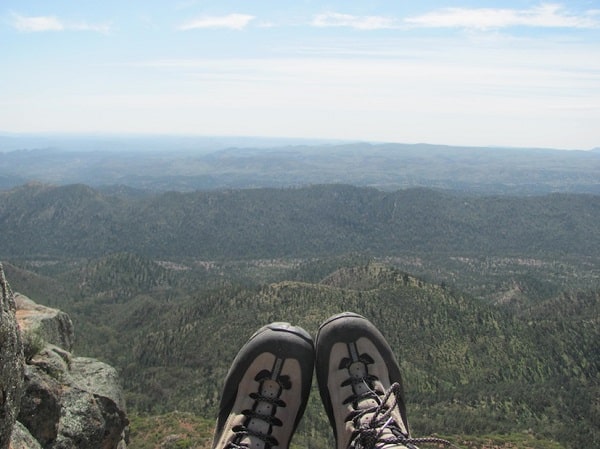
So wearing my new hiking boots we began our ascent of St Mary Peak at 1170 metres sited on the rim of Wilpena Pound. With the incline becoming progressively challenging, I queried how moderate the walk would be. I had conveyed the impression in my emails perhaps, that I was up to the most strenuous walks that South Australia could deliver, but once we reached Tanderra Saddle, the summit appeared vertical. I surveyed the Elder range, looked to the peak and admitted that heading down the other side to the floor of Wilpena Pound was a more appealing alternative. With a view towards Lake Torrens we sighted fossils embedded in rocks, walked along rocky creek beds, the arid landscape of salt bush and wildflowers. On the plains the landscape turned green with grasses, river red gums and native Callitris pines.

Next day we walked the infinitely easier Wilcolo-Bunyeroo circuit where we sighted much of the wildlife for which the region is renowned including emus, western grey kangaroos and euros or smallish kangaroos, skinks, bearded dragons, shingle back lizards with their stumpy tails, wedge tailed eagles, whistling kites, robins, corellas and the squawking galah. Kym was particularly adept at spotting them and he really came into his element with his knowledge of the wildflowers. Not an easy task since some plants had not been sighted for decades with the seeds lying dormant, germinating only after heavy rainfall. The walking track followed rugged red mountain bluffs, cool tree lined gorges and green banks along the creek before a gentle incline towards rolling hills with plants including wattle, curry bush and the curiously named dead finish, a hardy acacia. When it died, everything else was well and truly finished.

Kym also provided anecdotal information including how Blinman Pools got its name. Robert “Pegleg” Blinman worked as a shepherd until 1859 when he discovered a seam of copper. He went on to make a fortune.

Rawnsley Park Station may provide a chic retreat, an unlikely location for attracting sophisticated urbanites to enjoy South Australian wine and fine dining, but it’s the isolation that strikes you. After dinner I’d walk back to my eco-villa along a dirt road, in absolute stillness, with only the stars and moon to guide me. Few places in Australia capture the outback as definitively as these ragged ranges.

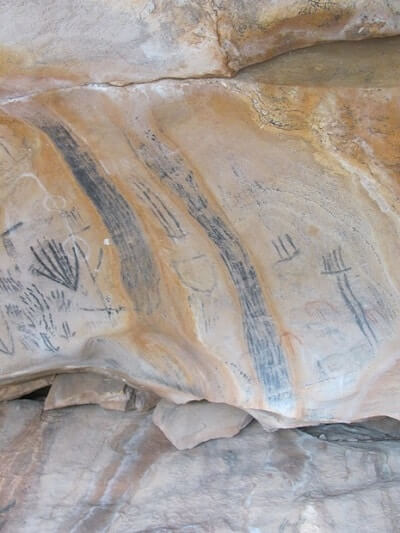
On our return drive to Adelaide we stopped at the historic ruins of Kanyaka station, a homestead with outhouses and shearers quarters. We visited the aboriginal paintings and etchings thought to be 40,000 years old at Yourambulla Caves. Town after town of charming heritage cottages, churches and stone buildings and the vibrant yellow of canola crops, this has to be one of the most scenic parts of Australia.

As much as I enjoyed the walks, the gourmet dinners and the spectacular scenery, above all else what I took away with me was the experience of genuine Australian hospitality, and if you do pass that way anytime soon, say hi to Kev.

Travel Notebook

Getting there
After flying to Adelaide, hire a vehicle and buy provisions. As roads are sealed you won’t need a 4WD unless you plan on heading further north. Drive time to Rawnsley Park Station takes 4.5 hours. Drive along the Horrocks Highway through Leasingham and Hawker and return through Quorn.

Where to stay
In Adelaide the Mercure Grosvenor Hotel is close to parklands, museums and Rundle Mall T: 61-8-84078888 W: www.mercuregrosvenorhotel.com.au E: stay@mercuregrosvenorhotel.com.au

For family friendly accommodation, the Adina Apartment Hotel Adelaide Treasury has spacious apartments W: www. Adinahotels.com.au 61-8-81120000 E: adelaide@adinahotels.com.au

Rawnsley Park Station offers accommodation to suit all budgets from a well-maintained camping site with cabins and bush camping, to units and eco-villas. The Woolshed Restaurant is first rate. T: 61-8-86480030 W: www.rawnsleypark.com.auE: info@rawnsleypark.com.au

Getting around
Rawnsley Park Station offers tours, mountain bikes and walking trails. Guided walks are highly recommended with Kym Tilbrook, who is a skilled hiker, and highly knowledgeable.

Climate
May to October are the best months to visit with days averaging 25 degrees during autumn and spring and 18 degrees in winter. Bring layered clothing, shorts and good hiking shoes. From December to March temperatures can reach 40 degrees.

More information
Contact the visitor information centre in Adelaide W: www.southaustralia.com