The Mordialloc-based AUMSAI Sansthan temple recently celebrated Guru Purnima – the festival dedicated to spiritual and academic teachers
AUMSAI devotees paid respect to their spiritual leader Shirdi Sai Baba on the occasion. Special prayers were held as a mark of respect and gratitude. The devotees marked the occasion by pouring milk on Baba’s idol and performing the Sai Satya Vrat. As part of the abhishekam ceremony the devotees conducted a procession of palanquin with fervour and piety whilst chanting Baba’s name.
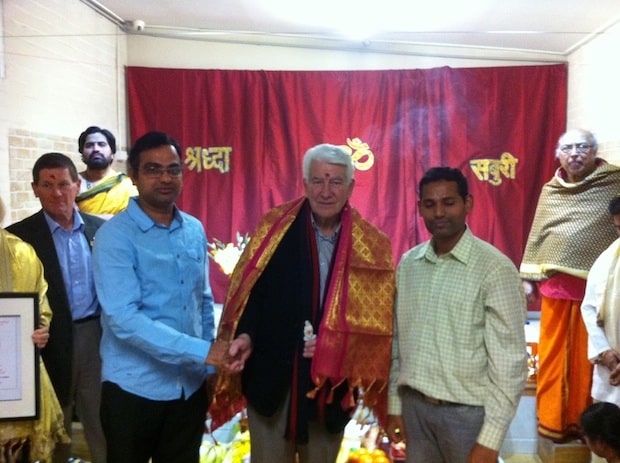
On the occasion Lorraine Wreford MP, (State Member for Mordialloc), congratulated AUMSAI for its progress in the past year and offered her best wishes to all the devotees celebrating Guru Purnima. Kingston City Councillors Geoff Gledhill and Ron Brownlees OAM also graced the occasion. The Victorian Multicultural Commission (VMC) supported the event and AUMSAI Committee members felicitated the guests with a traditional shawl and memento.
The ambience of the temple was enhanced with flower decorations and aromatic incense sticks. A sumptuous meal was served for the devotees after the completion of the traditional Shej Aarti.
AUMSAI Sansthan temple will celebrate its first anniversary from 6-9 August this year. To mark the occasion, Sri Venkateswara Swamy Thiru Kalyanam will take place on 9 August.
The city formerly known as Madras is traditional yet thirsting for change. Chennai remains a place of contradictions
The New York Times chose Chennai as one of the top 52 best destinations in its 2014 travel edition. It calls Chennai, quite aptly, “A national cultural capital”.
Chennai is home to several dance and music schools like Kalakshetra, and the Music Academy for Bharatanatyam and Carnatic music respectively, and literally hundreds of other ‘sabhas’ all regularly holding performances around town almost all year round, especially during the ‘music deason’. During the music festival – the largest of its kind anywhere in the world – the city is abuzz with performances from all over India including lecture demonstrations, seminars, talks and workshops on a whole gamut of cultural subjects.
The city is alive all year round with numismatic clubs, stamp clubs, philosophy, history, literary and book clubs galore, all with their own offerings, making it truly one of the most intellectually ‘connected’ cities in the world.
This writer, during her annual or biannual visits to the city has attended a stamp collectors’ monthly meet, the regular meetings of the group Tatvaloka, which holds talks on a range of subjects from Chola temples to theology; and attended a 10 day free course offered by the Samskrita Bharati and a swathe of volunteers who have dedicated their lives to promoting Sanskrit, conducting Sanskrit classes and camps throughout the city for free.
There are also historic temples aplenty, including the Kapaleeswarar Temple, built in the name of Lord Shiva, the ancient Parthasarathy Temple, the Kesava Perumal and the Madhava Perumal temples in Mylapore, the Marundeeswarar Temple in Tiruvanmiyur and other ancient temples like the ones in Tiruvottriyur, Vadapalani, Porur, Nazarethpettai. The list is too long to be mentioned here.
Then there is the historic ‘town’ area which grew up around Fort St George, the oldest British colonial settlement in India, built in 1640. There is the impressive 1000 Lights Mosque, the San Thome Church and other imposing Indo-Saracenic architecture like the University of Madras, the Museum, or the buildings on Pantheon Road, or the majestic colonial ones like the Ripon Building.
The city is rich in cultural, religious, gastronomic and sporting heritage and highlights include the largest classical music festival in the world, a remarkable array of cuisines, both native and imported, from the crisp dosa to spicy chicken 65; a passion for cricket, tennis and chess (the best tennis and chess players hail from this city), and the best filter coffee on the planet.
Besides its excellent handicraft outlets, temple jewellery and Kanchipuram silks, new sites and developments make this city especially enticing. There is a swathe of new and trendy clubs, boutiques, artists’ colonies, bookshops and restaurants.
The Annual Chennai Book Fair and its public libraries, especially the Connemara Public Library, cement Chennai’s claims as one of the most intellectually stimulating cities in India.
Looking at books about Chennai, one cannot go past S Muthiah’s Madras Discovered, first published in 1981 and later republished as Madras Rediscovered. This, together with Bishwanath Ghosh’s Tamarind City, gives a wonderful portrait of Madras and Chennai (as it started to be called after 1996). Ghosh points out that while in other big cities in India tradition stays mothballed in trunks, to be taken out during festivals and weddings, Chennai is both traditional and tech savvy at the same time – indeed these are two inseparable sides to Chennai.
Chennai is modern India’s oldest city: both Muthaiah and Ghosh (who has made Chennai his home) remind us that almost every modern institution in India – from the army and civil service, to the judiciary and the Congress,
city councils to engineering, and medicine – traces its roots to Madras’s Ford St George, the first British settlement in India.
The Madras Regiment, the first and oldest in the Indian Army, was founded by the East India Company traders to protect Fort St George in the 17th Century. Indeed, the seminal British victory at the Battle of Plassey was secured by the British largely with the help of this regiment, 80 per cent of whom were raised by Robert Clive in this southern city.
The surveys – precursors to the Survey of India department – began at this time; Charles Trevelyn, governor of Madras, founded the Indian Civil Service; the first municipality was founded in Madras in 1688; the first joint stock companies were founded in George Town in 1689, and soon afterwards, came the Bank of Madras. Most important of all, the Indian National Congress was born on the banks of the Adyar River in Madras when A.O. Hume mooted the idea at a meeting of the Theosophical Society.
Chennai, Not Madras (2006), by A R Venkatachalapathy, who is a Professor at the Madras Institute of Development Studies (and formerly from the National University of Singapore and JNU), is a slightly different account of the city. The author, an academic who has written widely in both English and Tamil, looks at the tension between the Madras of the colonial era and the Chennai of the 21st century world.
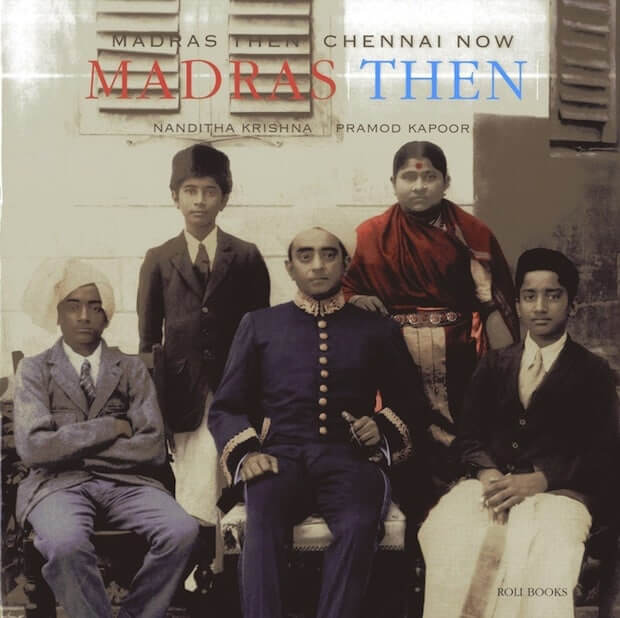
A similarly titled booked Madras Then, Chennai Now, by Nandita Krishna and Tishani Doshi, published this year, also describes the city as one of dualities: conservative yet irreverent, traditional yet forward thinking, steeped in nostalgia, yet thirsting for change. This is a beautifully published coffee table book packed with rarely seen photographs and painstakingly researched text. The photographs were sourced from public and private collections – from the British Library and from prominent families like the Mudaliyars and the CP Ramaswami clan. The book is divided into two halves – one featuring pictures from the British Raj era, and the other contemporary photos. Doshi, a poet and novelist, could have settled anywhere in the country but she chose Chennai, “the city where amazing people quietly do amazing things”.
Nirmala Lakshman’s Degree Coffee By the Yard is another attempt to bring together the Madras of yore and the Chennai of now. The two, she argues, are so intertwined that it is impossible to tell them apart. The history of the city is populated with fascinating characters: writers, builders, thinkers, British traders, luminaries and rogues, freedom fighters and political leaders who changed the city’s political milieu. In independent India, the political life of Madras was marked by battles for equality, the demolition of unjust caste structures and a remarkable spirit of secularism, all of which the author vividly brings to life.
Other novels located in Chennai include Tirumurti’s Chennaivasi. The most evocative passages in the book are those that lovingly recreate the sights, smells and sounds of Chennai past and present – the Madras Central Railway Station, waking up to the strains of Suprabhatham, putting together a kolu during Navratri, a visit to a Nadi astrologer. Chennaivasi brings out the paradox of Chennai’s Tam Brams (Tamil Brahmins) – their strange cocktail of professional modernity and personal traditionalism.
Then there is The Healing by Gita Aravamudan which was released by Harper Collins in 2008. It is a novel that spans several generations and seven tumultuous decades. The story swirls around Shanti Nivas a sprawling family property scheduled to be demolished and transformed into apartments. Past loves and unresolved conflicts clash with the reality of the present day as the various members of what was once a large family come to terms with their changing lives.
Priyamvada Purushottam’s The Purple Line, set in the 2000s, is both contemporary and nostalgic. Sumeetha’s The Perfect Groom and Mala Kumar’s The Paths of Marriage are set largely in Chennai – in Mylapore and the slums of Chennai respectively. In Srividya Natarajan’s book No Onions Nor Garlic – a hilarious Wodehousian tale set in Chennai – the city comes alive.
Abhimanyu Rajarajan’s IT romance and thriller When Shall We Meet Again encapsulates all that is uniquely Chennai; it has a software billionaire, a programming de-bugger and a Swamij (Chennai has produced quite a few). Chetan Bhagat’s Two States, also captures the zeitgeist of this very distinctive city.
There is no dearth of people who are fascinated by the sheer variety and vibrancy of India
Countless people around the world have been enamoured by all that is intriguing, beguiling and unexpected about India and its culture.
On the surface level there may be many westerners lapping up all things Indian, but dig a little and you will find many Indophiles who have engaged with India professionally, personally, and in many cases, passionately.
In this Indian Independence Day edition we profile Australians who have a relationship with India that goes beyond curiosity. Their love for India is more than a passing interest and surpasses geographical boundaries and ethnic or linguistic peripheries.
From the French/ Hungarian dancer who teaches and performs Bollywood style dance as a profession, to the music maestro who is equally at home playing sitar as he is with the tabla and dilruba, to an influential businessman who can articulate Hindi like a local, each person we interviewed has registered a deep fascination for the land of paradoxes.
Just dance!
Babushka Ferenczi Bollywood-style dancer
When French model Babushka Ferenczi launched her Bollywood dance group, Jalwa, at the Telstra Bollywood dance competition, as part of Indian Film Festival Melbourne 2014, the judges were more than impressed. After her performance, Indian actress and dancer Malaika Arora Khan, who is also a judge on India’s Got Talent, and Dhoom 3 director Vijay Krishna Acahrya praised Babushka for her dancing prowess and stage presence.
When someone in the audience asked the judges whether Babushka would do well because she resembled popular Bollywood actress Katrina Kaif, the Dhoom 3 director grabbed the mike and said, “Babushka does not need to look like Katrina Kaif to be famous. She will be famous for being Babushka and even Katrina Kaif may benefit from learning how to dance from her”.
Babushka laughed good-naturedly when she was reminded of the exchange.
“I have always wanted to be an actress in Bollywood and I have just been given an opportunity to do lead role in a Hindi film however I cannot disclose too many details at this stage,” she said.
“My favourite Bollywood number is ‘Maar Dala’from the blockbuster film Devdas. For me this is such a perfect routine, full of elegance, crystal clear facial expressions, and perfect dance technique. Madhuri Dixit is by far my favourite actress (Bollywood and Hollywood included); such grace, beauty and great acting skills. I absolutely loved her character in Gulaab Gang – that would be a dream role for me!” Babushka said, with a trace of French accent.
Babushka grew up in France and worked as a high school teacher but became entranced by Bollywood and India. “I mostly got interested in India after watching the film Slumdog Millionaire. The belly-dancing troupe I was part of in France started performing to Bollywood music around that time and I was introduced to the Bollywood culture by a lovely Pakistani couple who used to import our costumes and jewellery from India and Pakistan”.
”What I love most about Indians is how colourful and energetic they are and how dancing is such a present element of their culture, ” Babushka continued. “While we westerners tend to dance in a somewhat self-conscious way at parties and events, I find that Indians generally dance more freely and are constantly interacting with one another. Indian dancing is more dynamic as the dancers express themselves eloquently through their movement. I particularly like Bollywood dance as it tends to continuously evolve and is such an upbeat fusion of different genres and styles,” she said.
Once Babushka was hooked on Bollywood there was no looking back. She taught herself all the intricate moves with the help of DVDs and research on the internet, adopted the vibrant colours for her costumes, and rehearsed and fine-tuned her performance until she got it right.
She moved to Australia in 2011, after doing a stint in 2007, to be with her partner. She joined another Bollywood dance troupe and started performing with them. Her partnership with the group ceased and Babushka launched her own troupe Jalwa in May this year.
Jalwa comprises of dancers from various parts of the world unified in their love for Bollywood dancing. Besides performing at corporate and private events, Babushka has also started offering Bollywood dance classes and workshops.
“I am currently teaching myself Hindi but since I do it on my own (computer software), and due to my hectic schedule, it is taking quite a while. I have been meaning to learn Hindi for a long time, especially the script, since I find the symbols very beautiful. Lately it has become imperative that I learn the language to be able to communicate better. It will also help with my dancing and acting career,” Babushka said as she shared her plans for the future.
A universal language
Josh Bennett Musician
“Mujhe thoda Hindi aati hai,” claimed music virtuoso Josh Bennett with a smile that could warm hearts, just like his enthralling, almost subliminal music. Josh, who is one of Australia’s leading exponents of the Indian sitar, is also a multi-instrumentalist who can effortlessly trade the sitar for a tabla and the tabla for a dilruba or guitar.
Josh spent six years learning the sitar from Alan Posselt, who himself learned from Ustad Allaudin Khan and Sri Mohan Maitre. Josh then spent many months in Ahmedabad, India, studying Indian Classical music from Smt. Manju Mehta, a disciple of Pt. Ravi Shankar.
Josh is a regular on the Australian and global music festival circuit, performing solo or with a number of groups. He has also performed in the Saptak Classical Music Festival in India. Josh has toured extensively with Dya Singh World Music Group and is married to Dya Singh’s youngest daughter, Parvyn Kaur, who is an acclaimed singer and dancer.
So how did Josh’s love affair with Indian music begin? “I heard Indian music for the first time when I was young through it being added to western music such as The Beatles’ songs “Within You Without You”, “Norwegian Wood” and “The Inner Light”. When I was fifteen my guitar teacher Chris Finnen was playing in a band called Indian Pacific, which had a marvelous sitarist Michael Junius. That was my first live concert of Indian music. Why it was that Indian music specifically made my ears prick up initially is a mystery, but as soon as I heard it I wanted to be a part of it”.
For his 21st birthday Josh got a special left-handed sitar custom built from India. With comprehensive knowledge of ragas and a mastery over technique Josh continued to perform Indian music on a myriad of string instruments. He released a solo album Echoes of You and toured in collaboration with renowned musicians BluGuru, Sadhna and more recently with the group Bombay Royale. His musical journey comprises of blues, Celtic, Jazz, African and bluegrass, however his work has always had a strong Indian influence.
“The first thing that attracted me to India was the music, obviously, but as a result of following the path of learning the music I’ve discovered there is a lot to love about India: the food, the culture, the people. Music is my main passion in life however, and it is Indian music that continues to attract me the most,” Josh remarked.
With the shift in migration trends the Indian diaspora is now highly represented in Australia and there is increased interest and better exposure of Indian art, but does that make Josh’s musical choice sustainable from a commercial perspective? “I never looked at Indian music as my breadwinner. It is more of a passion for me rather than a skill,” Josh claimed.
Josh and his wife Parvyn run workshops in schools around Australia and New Zealand where they introduce Indian music, culture and dance to the students. They also teach Indian vocals to primary school children.
Sharing his opinion of Indian migrants to Australia, Josh said, “I’ve travelled enough to know people worldwide are all essentially the same. The place you are born does not define you any more than the brand of tea you drink. In my opinion, people can live wherever on the planet they choose. The Indians who I know that have come here have brought with them some wonderful attributes of Indian culture, and Australia is a better place for it”.
Nostalgia
Randolph Clements Victorian Chairman of Raine &Horne (Real Estate)
You could sense his wistfulness as Randolph related his experience of growing up in India surrounded by contradictions and contrasts. He was born in Agra, India, where his father was a high-ranking police officer and he spent most of his childhood enveloped by the wafting aromas and full tilt energy that makes India so incredible.
From being teased by local kids as a gora bandar (white monkey) due to his English descent, to learning Sanskrit Shlokas and being nicknamed White Pundit*, Randolph happily recounted memories of his childhood.
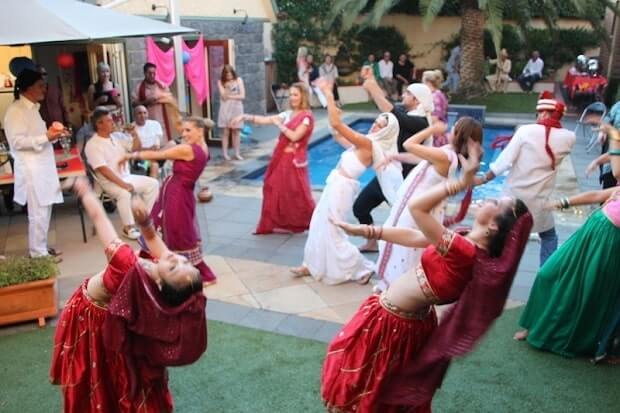
Randolph Clements and his wife at a surprise Bollywood-themed birthday party
“I remember the rickshaw wallahs plying the streets, the condiments and masalas in the bazaars, the trains passing through scenic villages and the ganne wallahs selling freshly squeezed sugarcane juice. I enjoyed the food sold by street vendors from kulfis and golgappas tothe best tasting lychees and Agra’s famous petha. I spent my childhood playing gilli danda (awooden stave and stick game) and kanche (marbles)with the local kids,” Randolph shared.
According to Randolph growing up in India was a very humbling and grounding experience and no matter how successful he becomes he will never change because of his upbringing.
“I was fascinated by everything about India and was attracted to most of the culture. In those days it could be disorganized and chaotic, and your senses could be overloaded with the colours, sounds, tastes, smells and sights of this wonderful country,” he said.
“India had beauty and despair, highs and lows, wealth and poverty all of it in unequal measures. Despite that I saw people who gained a sense of contentment from the simplest of pleasures,” he continued.
“I believe things have changed since my last trip to India in 1997 and India is getting more structured due to the rapid development and surge in economy. It will be a pity if in the process of westernisation we no longer have the chai wallahs on train stations or bhutte wallahs on the streets of India that are so unique and form such an integral part of the Indian experience,” Randolph said as he launched into a perfect impersonation of the Indian tea vendors in Hindi.
Randolph’s family moved to Australia when he was 19-years-old and he now lives in Melbourne with his wife Louisa and son Brandon. He commenced a dynamic and rewarding real estate career in 1975 and in 1996 took over state ownership and rights of Raine & Horne and became Master Franchisor of Raine & Horne Victoria.
“I think India is the best place to get training in sales and marketing, as Indians are great negotiators,” Randolph claimed. “I once took my son with me to Agra and showed him how to bargain. It was an experience he will never forget just as I will never forget the myriad facets of life in India”.
Randolph continues his association with India through his involvement with organisations like Disha, where he has conducted auctions for their charity fundraisers on several occasions.
More recently he was invited by Chairman Jagvinder Singh Virk to be part of the committee for the Sydney-based India Australia Strategic Alliance, an organisation committed to the fostering of goodwill between the people of India and Australia.
On a personal level he has several Indian friends with whom he continues to reminisce about his fond memories of India over cups of chai and pakodas.
*(Scholar who has mastered vedic script and is skilled in Sanskrit language)
Try it the Yoga way
Liz Coon
Yoga Practitioner
The practice of yoga has many physical, emotional and spiritual benefits. For yoga teacher Liz Coon, it is a lifestyle and a livelihood.
Liz has been practicing yoga for the past 40 years and is principal of the Harmony School of Yoga, which she founded in 1978 when she started teaching.
As a young child, Liz became ill with rheumatic fever which left her weak and without stamina. Her doctors predicted that she would be in a wheelchair before the age of 30.
At age 17 she discovered yoga from an exercise book and found that it was a physical activity she could do without getting too tired.
After moving to Melbourne in 1972, Liz began attending classes at the Eastern School of Yoga in Glen Waverley, and her passion became a way of life.
“As time went on I could see and feel the benefits of what I was doing and as a result, today I am stronger and healthier than in my early years,” she stated.
Her biggest mentor and influence was her yoga teacher, Margaret Segesman, who had established Australia’s first full-time yoga school called the Gita School of Yoga.
She says that Margaret not only taught her many skills in yoga, but also how to be tolerant and understanding in life.
“I spent 20 years with her,” Liz said. “It was the most wonderful soul connection and experience in my life”.
The Harmony School is now well established with over 300 registered students ranging in age from three to 78. There are day and evening classes, which vary from meditation sessions to workshops on relaxation and breathing, yoga philosophy and of course, the physical hatha yoga itself.
Liz also runs a teacher training program to help her students become qualified yoga teachers.
“I think my greatest challenge as a teacher is training others to teach yoga,” she said.
“I believe anyone can teach yoga, but to teach well and with integrity, and to teach selflessly is an ongoing challenge”.
In 1990, Liz travelled around India for six months. A particular highlight was her stay in a little town in the foothills of the Himalayas called Chilliyanaula.
“I didn’t learn more than I already knew about yoga,” she said, as she was taught intensely by good teachers before she went to India, “But it certainly broadened my knowledge and love for yoga”.
“I was also taught to meditate really well,” she added, emphasising the various styles of the different gurus and teachers of yoga in India, and their unique philosophies.
At the Harmony School, Liz runs private classes for students practicing yoga for healing, such as cancer sufferers. She also holds chair yoga classes for students who cannot walk.
“I get students from all walks of life. For many years, I used to teach terminal patients who would come for healing and meditation”.
However, recently she has found it too difficult to cope with losing her students and has pulled back a bit from this area of teaching.
“Although yoga is not a cure, it gives people the ability to cope with so much, and understand life,” she continued.
“It also keeps you strong, young, healthy and fit,” she added, mentioning the benefits of yoga in easing osteoporosis.
Liz’s ambition is to see hatha yoga and meditation being incorporated into the standard education curriculum.
“I view the school not so much as a business but as a centre,” she said, “a welcoming sanctuary which provides a way to a healthier lifestyle, a sense of wellbeing, acceptance and open friendliness to those who come through our doors”.
New Indian seniors support group, hot lunch and Bingo, quality entertainment and picnics…it is a good time to be old
—New beginnings
The City of Stonnington in the inner eastern region of Melbourne has long been interested in starting an Indian seniors social support group, as a large number of Indian seniors call the area home. Jaya Manchikanti, Cultural Diversity Planner at the Council, approached Anand Shome of SEWA International to help initiate the group.
The City allocated Phoenix Park Community Hall at 22 Rob Roy Road, Malvern East, for the purpose, and the group held its first meeting in June. About 40 seniors attended, and decided they would meet from 2 to 4 pm every second Saturday of the month.
The main intent of this group is to counter social isolation and make new friends in a culturally and linguistically sensitive manner and to share life experiences and stories over a cuppa and snacks.
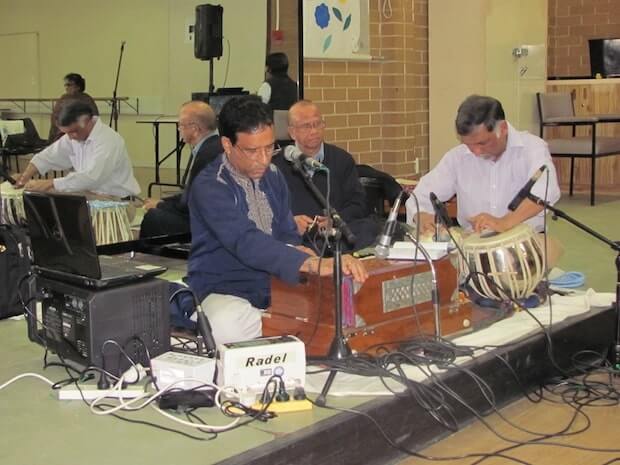
At the July meet, Sunil Tyagi of The Star of India restaurant, sang bhajans and Bollywood songs to entertain attendees. Especially poignant was his Manna De number Qasmen waade pyaaarwafa sab baaten hain, in memory of a great singer who passed away recently. Lunch provided by Arun Chauhan of Shiva Indian Restaurant in Prahran was very welcome, given the drizzly Melbourne 11 degree day! A picnic is on the cards as and when the weather improves.
Seniors of Indian origin, especially those who live in Stonnington, are welcome to join in and make new friends. For more info, call Jaya Manchikanti or Frances Rodrigo on 03 8290 3224.
* * * Bingo at ISCA
It is not so much the freeze that keeps Melbournians indoors during winter months as it is that irritating drizzle. Outdoors becomes deserted, and seniors would rather sit under electric blanket-induced warmth, a cuppa in hand. And so President Prem Phakey of the Indian Senior Citizens Association welcomed an astounding hundred plus who attended the July meet of ISCA, his smirky raised brows acknowledging their initiative. Bingo and a nice hot Indian lunch kept members happy.
ISCA boasts 350 plus members. In the month of August, as always, ISCA is holding a multicultural day, with Bollywood and Indian classical dances, and also dances by a Chinese group. $15.00 tickets are on sale now. ISCA meetings are conducted in the Library Hall directly opposite the Mt. Waverley railway station.
ISCA conducts a weekly Friday program from 12 noon until 3 pm at 21A Electra Avenue, Ashwood. Easily accessible by public transport (a ten minute walk from Jordanville station, and connected by 767 and 734 bus routes), this has fast become quite a success story. Experts Ashima Gupta and Subhash Chandra conduct ‘chair yoga’. A documentary or two, relating to India, are shown. Members mill around and share home-brought lunch.
For more info, call President Prem Phakey on 03 9803 3989.
* * * ISAW: Growing in numbers
Indian Seniors Association (West) had its monthly meet in their beautifully heated hall. Amitabh Singh and his wife Priya of Om Group entertained with their singing, and members enjoyed bingo and documentaries on India.
Seven new members have now joined ISAW, swelling the membership to a rather encouraging fifty. To promote local business, lunch was ordered from a nearby Indian restaurant.
For more info, email President Arjan Tuli at arjantuli@bigpond.com.
* * * Golden oldies at KISCA Thakur Bhim Singh takes his music very seriously
You may bet your last dollar that with Barbara Nagaya, a renowned Melbourne singer, as president, Kingston Indian Seniors Citizens Association (KISCA) will never lag on excellent music programs. The entertainment this month was Thakur Bhim Singh who, aided by his computerised systems, initiated the afternoon with a bhajan he composed, with Rajesh Gena on tabla. Then came a number of 1960s and 70s style entertainment, vastly more enchanting than today’s music and lyrics. Members sang along, including Krishna Arora, 85 years young. A new arrival from India, Inder Sharma also presented a few golden-oldies. Uncle Ram Vilas, Veena (from the recognised Das family of musicians from Fiji), secretary Mona Raju and Bangla Deshi Ateeq also entertained. KISCA gained many new members this month.
KISCA meets in the Community Hall at Marcus Road, Dingley Village from 2.00pm to 5.00pm on the third Sunday of the month.
For more info, call President Barbara Nagaya on 03 9893 3427.
* * *
A picnic for heart health!
Indian Seniors Forum members were brave enough to plan a picnic to Ballarat during winter months, but the Sun God had other plans! Co-ordinator Vinnie Rao came up with a novel idea: an ‘Indoor Picnic’, which she arranged right inside the Camberwell hall. A busload of members attended.
At their Clayton meet, Dr Vishnu Sharma held a comprehensive lecture on the functioning of the human heart, and concluded with a Q and A session.
This month, the Forum welcomed about twenty visitors and also gained many new members.
For more info, call Chief Coordinator A. K. Auplish on 03 9543 6615.
* * *
NRISA presents Energy Information
The Government of Victoria (www.switchon.vic.gov.au) has allocated Northern Region Indian Seniors Association (NRISA) see www.nrisa.org, a small grant to disseminate information on energy to help families and small businesses optimise their power bills.
An overview of this system was presented to the membership at their monthly function. Dr Nalin Sharda presented a comprehensive introduction to the Save Energy program.
Earlier, President Dr Santosh Kumar welcomed members. Guest Martin Ferguson, ex federal Minister, gave a rather informative talk on seniors’ rights. Member Pravin Vaghani presented a poem, and Sunita Sethi entertained with a few songs.
NRISA meets on the third Sunday of the month at Seniors Hall, 18-A Bent Street in Northcote (Mel Ref: 30 D7). The nearest railway station is Northcote, on Epping line, and tram stop for number 34 at High Street, on Bundoora line. Ample parking is available at the Northcote Shopping Plaza.
After meetings, Dr Sharda has offered to guide members on computer matters. Those interested must talk to him and bring their own laptops.
For more info, call President Santosh Kumar 0411 136 612, 03 9816 3401, or email Santosh.Kumarau@gmail.com
* * * And a 15th birthday!
Fijian Indian Senior Citizens Association (FISCA) will celebrate its 15th year of serving its members late this month. President Jerry Jeraj has a full day of Bollywood singing and dances, a delicious spread and gate prizes planned to celebrate the occasion.
For more info, email ljeraj@optusnet.com.au.
From Ellen DeGeneres at the Oscars, to Shahid Kapoor – these days everyone is indulging in the selfie trend
A lifestyle magazine recently featured a questionnaire designed to determine whether or not you are a narcissist. Sitting outside on a lazy Saturday, I started responding to the ten questions. I answered to the best of my ability and self-knowledge. My score was three out of 10. Not a strong narcissist, that score suggested.
Jassu (my wife), was sitting next to me and saw me chuckling. I informed her of my test result and that it suggested I was not overly “self-absorbed”. She refuted my findings immediately and urged me (strongly) to retake the test under her supervision. I reluctantly obliged. Strangely, this time the score ended up being nine out of 10.
I protested that the new score was strongly influenced by her views of me. “Well, I am your better half and technically I know you more than you do,” was her reply. In a minute I was branded an overt narcissist. No wonder I am not a fan of these ‘lifestyle columns’.
Anyway, this is not about me being a narcissist (a label which, by the way, I still disagree with). One of the questions used in the survey to determine one’s narcissist quotient related to our tendency to indulge in “selfies”. The advent of smartphones and social media has enhanced the narcissistic element in most of us. Who doesn’t love a selfie? Many have often plastered one on a social media platform. Some (yours truly included) do it more often than others.
In a restaurant, at a golf course, in your bedroom, on a holiday, in a cinema, on the operating table, in the maternity ward, at a night club, on a flight, in an airport lounge, in a sporting arena, at a birthday party, on the street, in the office, with family and friends, or just by yourself, it’s easy to take out your smartphone and go for a selfie. If the first one does not please you, just click a few more until you look dazzling in one of those!
Like any other trend, selfies have developed a certain benchmark and an etiquette too. Ladies at any gathering have to line up sideways for their selfie. There is no other way to do it. At least, I haven’t seen one. Girls, on the other hand, do it with their pronounced “pouts”. And often in a toilet (for some unknown reason). Guys (men and boys included), well like with any other thing, guys have no real selfie “etiquette”. Just huddle up and scream out loud.
The other good thing about selfies is that you don’t have to share one with the world until you get that perfect shot. The one that captures you without a flaw. It may take a few attempts to get that perfect selfie, but who’s going to find out. If, after a few clicks, you still struggle to look your best in those “untouched” selfies, load it onto Instagram or something similar and give it a bit of “nip and tuck”. Iron out a few wrinkles, light up the background, thin out the double chin, blur out the red eye – your perfect selfie is ready for you. Perhaps it will be your next profile picture for a few days.
Just remember, if you can’t find a better place than the toilet to click your snap – don’t forget to crop out the toilet roll in the background!
From Ellen DeGeneres at the Oscars, to Shahid Kapoor – these days everyone is indulging in the selfie trend
A lifestyle magazine recently featured a questionnaire designed to determine whether or not you are a narcissist. Sitting outside on a lazy Saturday, I started responding to the ten questions. I answered to the best of my ability and self-knowledge. My score was three out of 10. Not a strong narcissist, that score suggested.
Jassu (my wife), was sitting next to me and saw me chuckling. I informed her of my test result and that it suggested I was not overly “self-absorbed”. She refuted my findings immediately and urged me (strongly) to retake the test under her supervision. I reluctantly obliged. Strangely, this time the score ended up being nine out of 10.
I protested that the new score was strongly influenced by her views of me. “Well, I am your better half and technically I know you more than you do,” was her reply. In a minute I was branded an overt narcissist. No wonder I am not a fan of these ‘lifestyle columns’.
Anyway, this is not about me being a narcissist (a label which, by the way, I still disagree with). One of the questions used in the survey to determine one’s narcissist quotient related to our tendency to indulge in “selfies”. The advent of smartphones and social media has enhanced the narcissistic element in most of us. Who doesn’t love a selfie? Many have often plastered one on a social media platform. Some (yours truly included) do it more often than others.
In a restaurant, at a golf course, in your bedroom, on a holiday, in a cinema, on the operating table, in the maternity ward, at a night club, on a flight, in an airport lounge, in a sporting arena, at a birthday party, on the street, in the office, with family and friends, or just by yourself, it’s easy to take out your smartphone and go for a selfie. If the first one does not please you, just click a few more until you look dazzling in one of those!
Like any other trend, selfies have developed a certain benchmark and an etiquette too. Ladies at any gathering have to line up sideways for their selfie. There is no other way to do it. At least, I haven’t seen one. Girls, on the other hand, do it with their pronounced “pouts”. And often in a toilet (for some unknown reason). Guys (men and boys included), well like with any other thing, guys have no real selfie “etiquette”. Just huddle up and scream out loud.
The other good thing about selfies is that you don’t have to share one with the world until you get that perfect shot. The one that captures you without a flaw. It may take a few attempts to get that perfect selfie, but who’s going to find out. If, after a few clicks, you still struggle to look your best in those “untouched” selfies, load it onto Instagram or something similar and give it a bit of “nip and tuck”. Iron out a few wrinkles, light up the background, thin out the double chin, blur out the red eye – your perfect selfie is ready for you. Perhaps it will be your next profile picture for a few days.
Just remember, if you can’t find a better place than the toilet to click your snap – don’t forget to crop out the toilet roll in the background!
Sheetal Chail wins the Miss Global United with a combination of beauty, brains, confidence and talent
Sheetal Chail, from Melbourne, recently took the crown at Miss Global United 2014 in Minneapolis, Minnesota.
The pageant claims to seek contestants and titleholders who believe in the importance of community involvement. The scoring provides a 60 per cent weighting to the contestants’ personal attributes and what they do in their communities. The other part of the score is judged against interviews, eveningwear and the ability to answer set questions succinctly.
Sheetal, who is one of the youngest CPAs in Australia, came up trumps on all counts. Not only did she take the title, she also won the coveted Miss Talented and Miss Best Interview awards at the Global United Pageant.
Earlier this year, the 23-year-old took the crown at Miss India Global United, Melbourne and alongside this won the subtitle of beauty with brains – Miss Intelligent. She was then chosen to represent India at the global pageant in July.
Sheetal, who hails from Delhi, moved to Melbourne to study a Bachelor of Business at university. She then went on to complete the Certified Practicing Accountant program (CPA) with merit. Currently she works for Johnson and Johnson as a business analyst looking after the Asia-Pacific market.
The pageant proved to be a great experience for Sheetal as she enjoyed the day spas, pyjama parties, dress ups and shopping.
As part of the pageant community day, the contestants also visited the local hospital and spent the day organising activities for the patients. The Global United Pageant works to help raise funds for childhood cancer research and Sheetal is keen on using her win as a springboard to support this cause.
It certainly helped to be beautiful, but it was Sheetal’s brains that clinched the title. In what she termed a “gruelling session”, during the interview round the judges asked Sheetal how she could justify the expense of her trip. According to them, the amount she had spent to come to Minneapolis would have allowed someone such as Mother Teresa to have fed a large number of underprivileged people.
Sheetal was unfazed. In her response she outlined how the learning and experience she received by participating in this pageant had motivated her to further dedicate herself to community work. “Using this platform I intend to raise far more than I have spent in coming here – especially for children living with cancer. Irrespective of whether I win this title or not, I am now so inspired by the stories of my fellow participants that I will make every effort to help support these kids. You cannot put a price tag on the smiles that this will bring to their faces”.
Artists from India and Australia collaborate in a groundbreaking art exhibition
Art has been widely recognised in a plurality of ways as a vital and beneficial part of society. In particular, visual art can promote a culture of peace, dialogue, cultural cooperation or diplomacy, integration and social cohesion through community participation. An inspiring exemplar is the Australia India Institute’s Artists’ Retreat program that fosters intercultural dialogue.
First held in Red Hill, Victoria, in 2011, and then in Jaipur, 2013, the Australia India Institute’s Artists’ Retreat program has provided professional development opportunities for established Australian and Indian artists. Invited painters, photographers and sculptors collectively embarked upon a ten-day voyage to India’s historic city of Jaipur to create original artworks, namely a collaborative group piece and a new work by each artist. They also had the unique chance to participate in a series of curated sessions and visited sites of inspiration in India, such as the Amber Fort.
Rooted in the notion of a residency, an artists’ retreat enables an artist to experience the character of a locale in great depth, with the aim of enthusing a diverse range of rich and vibrant artistic interpretation. Such cultural immersion naturally facilitates the development of a deeper understanding of varied practices and perspectives, increases community involvement, empowers freedom of expression, fosters equality and enhances the creative process.
Held at the Victorian College of the Arts (VCA) in Melbourne, the inaugural AII exhibition was the vivacious result of contemporary art exchanges between renowned artists from India and Australia, including Jon Cattapan, Charles Green, Lynne Roberts-Goodwin, Fiona Hall, Lyndell Brown, Kate Dew, Hossein Valamanesh, Gigi Scaria and Mithu Sen. The selected artworks formed part of a larger permanent collection held by the Institute, comprising works produced during the Institute’s Artists’ Retreats.
The exhibition boasted a striking array of figurative and abstract art across a range of mediums including painting, photography, drawing, printmaking and mixed media.
“The artists were selected because they represented a national identity,” said Robert Johanson, Chairman of the Australia India Institute.
Certainly, when viewing the exhibition, it quickly became apparent that many of the artists chose to comment on issues pertinent to their local and global environment.
A monochromatic sprawling cityscape revealing the complex layers and stark contrasts of Delhi, is unmistakably the work of Delhi-based artist Gigi Scaria. His immersive photo-based mural, City Unclaimed (2012), was manipulated and stitched together from photographs he has taken around Delhi. The panorama illustrates an imaginary cityscape with an operational twelve-foot high fountain that signifies both a monument to a splendid past and a reminder of accelerating societal tension that is characteristic of Delhi; the differences in social and economic class, issues about scarcity, abundance and the allocation of resources in urban spaces.
Gigi Scaria – 2013 Artists Retreat, City Unclaimed
Similarly, Kashmiri-based artist Veer Munshi reflects his anguish at the situation in his home state. Through his artwork, Endangered (Hangul) (2013), Munshi communicates a fear that plagued many Kashmiris who were displaced to Delhi in 1990 and were forced, like the artist, to relinquish their home and heritage. The animals in Munshi’s artworks are symbolic of, and trapped in, a system of paranoid securitisation. Munshi highlights the increasingly narrow space that exists for culture and art in his state. However, he also celebrates the universal nature of art by participating in residencies on the international stage, believing that art plays a significant role in the resolution of the Kashmir situation.
“Some of the artworks are works of individuals, whereas in other works, two artists collaborated on a piece together,” Johanson said.
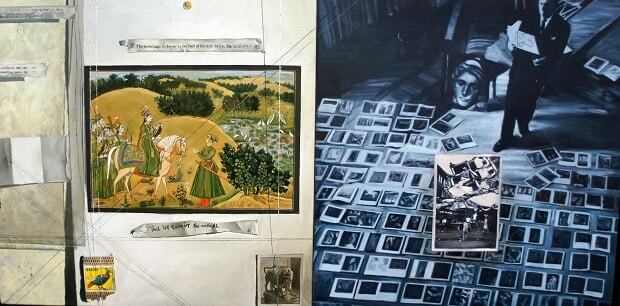
A prime example of collaboration is Lyndell Brown’s and Charles Green’s artwork, Nainsukh (2013). Created using paint, photography and digital technologies, the work is a juxtaposition between Indian miniature painting and contemporary photography. It invites contemplation concerning historical culture, emerging technologies and the dichotomy between dissimilar cultural periods and contexts. Akin to other artists in the exhibition, the artistic duo developed their uniquely recognisable styles and engaged with themes explored in their previous works. In particular, they explored illusory worlds that disrupt boundaries between past and present, fact and fiction.
Lyndell Brown & Charles Green, 2013 Artists Retreat, Nainsukh, 2013
The Artists’ Retreat enabled Indian and Australian artists to produce a dynamic environment where different views could be voiced openly and respectfully, and where ‘shared spaces’ for cultural exchanges were treasured.
In a reflection of his experience at the Artists’ Retreat, Australian artist Jon Cattapan stated, “It struck me when we were in Jaipur that marvelous things can happen when people work in an organic way, where they can talk to each other, and where there’s an easy cross cultural dialogue”.
Having lived and worked in many of the world’s metropolises including London, Seoul and New York, the artist expressed a special affinity with India, where he has also worked extensively and collaborated with Indian artists including Surendran Nair.
Being immersed in India’s vibrant colour palette influenced the aesthetic qualities of artworks made by several of the participating Australian artists. Cattapan’s painting Storm Experiment(Jaipur) (2013) for instance, depicts hues of luscious reds and green that bury visions of buildings and people, and instead, foregrounds a reflective psychological space through colour.
Australian artist, Jon Cattapan with his artwork from the 2013 Artists Retreat, Storm Experiment (Jaipur), 2013
“Whereas blue is deeply reflective, red for me is about life energy,” Cattapan said. This pictorial response is reminiscent of the artists’ experience of lively Indian marketplaces, festivals and urban landscapes. “These deeply saturated works came directly out of the experience of going to India,” Cattapan continued.
In another account of how prolonged visits to India can stimulate artistic inspiration, Australian artist Kate Daw said, “I am interested in decorative art and objects made by women. In the West, these are not usually considered to have the status of art that other objects have, but in India, there’s incredible respect for culture and decorative arts and that has really struck me”.
Kate Daw’s print Love, Work (detail, Rose Garden) (2013), is a reaction to the expansive and generic white walls that typify the Indian Art Fairs held in Delhi. The exhibited work was one of 800 floral prints that formed the wallpaper for the artists’ booth at the Indian Art Fair, which resulted in a sepia coloured rose garden. The artist took inspiration from both Islamic gardens and the flora in her Melbourne home, exemplifying cross-cultural inspirations.
When asked whether she would participate in future art residencies in India, Daw stated, “I want to have an ongoing relationship with India. I took my students to India and we’ve got another project in mind”.
Curatorial adviser Chaitanya Sambrani said engaging with artists from outside Australia is important as “cross-cultural interaction produces new kinds of dynamics for artistic practice”.
The process of mixing Australian and Indian artists together to converse, collaborate and produce works metaphorically became part of the paintings. Indeed, the enthusiasm, curiosity and interest between two groups of artists from different countries immediately pervaded the gallery. It was apparent that the focus of the exhibition was not solely on the art, but rather, centred upon relationships. As Australian artist Daw reinforced, “Meeting the artists and being involved in the conversations made the experience so wonderful”.
Importantly, art projects that promote intercultural dialogue not only benefit the cultural and artistic community, but also facilitate progressive cross-country interaction. Johanson noted, “The works provide a fantastic legacy for the collaborations and conversations between Australians and Indians”.
While politics and economics form the most pressing topics in Australia, culture has always been held as important in India and is at the forefront of the agenda within the Australia India Institute. The venture was conceived by Professor Amitabh Mattoo, Director of the Australia India Institute. Inspired by a similar project he conducted during his time as Vice Chancellor at the University of Jammu, Professor Mattoo capitalised upon the vast potential of art as a vehicle to improve ties with Australia’s South Asian neighbours. This project deserves to be further celebrated for the relationship it has formed with the Victorian College of the Arts, particularly for providing Australian academics, artists and students the ability to think interculturally.
Professor Amitabh Mattoo, Director of the Australia India Institute, at the inaugural exhibition of the Artists’ Retreat program
Melbourne film-maker Shweta Kishore puts India in the spotlight at MIFF
Puppeteers of New Delhi’s Kathputli Colony. The salt harvesters of Kutch. A Kolkata factory worker’s lone fight against big developers. Call centre operators. A Muslim woman who formed the first women’s Jamaat. Racial tensions in Mumbai. Kids who work the cremation sites along the Ganges.
The Melbourne International Film Festival (MIFF) presents India in focus this year and there is not a single fantasy musical number or Bollywood jhatka in sight.
Melbourne-based film-maker Shweta Kishore
Curated by Melbourne-based independent film-maker and researcher Shweta Kishore and presented by Monash University, the program titled India In Flux: Living Resistance aims to give viewers a feel for the problems associated with a society in transition.
The seven carefully picked documentary films, it is hoped, will influence the audience’s understanding of contemporary India. Or at the very least, give them an inkling of the tumultuous changes taking place in Indian society.
The human impact of rampant and unsustainable modernisation, for example, forms the core of Ranu Ghosh’s Quarter Number 4/11. Ashim Ahluwailia’s John & Jane takes us into the warped world of call centres, while in Tomorrow We Disappear we feel the devastating effects of larger economic development on an entire community of folk artistes.
As well, we are introduced to the particular conflicts that emerge when people see change but can’t participate in it, in Rajesh Jala’s Children of the Pyre.
Together, the films are a forceful statement of the power of the documentary film as a tool for social change.
The medium lends itself beautifully to social and political comment and its use seems to be on the rise in India.
“There’s a groundswell of documentary film making in India currently that is only just beginning to get known in the world,” Shweta Kishore told Indian Link. “As a new form of cultural expression, it is a different way of understanding India and its social culture. It’s a new kind of Indian screen culture that I was keen to bring to Australian audiences”.
As India’s film industry moves slowly beyond the Bollywood culture, documentaries are beginning to take the fancy of film-goers.
PVR Cinemas are now screening documentaries on a regular basis, Shweta noted, and even people in small towns such as Gorakhpur and Salimpur are showing interest.
“Documentaries are huge in India at the moment,” Shweta said. “Not only do they allow you to make a statement to the world, there’s also immediate and intimate feedback as the film-maker comes face-to-face with the audience. That dialogue can be very valuable”.
That face-to-face interaction will no doubt be interesting at MIFF this year, given that Deepa Dhanraj, women’s activist and film-maker, is one of the guests, and women’s issues have been at the forefront in India in recent months.
“Deepa’s film, Invoking Justice, again looks at how communities are changing,” Shweta said. “It is an interesting portrayal of resistance from within. Based in a small southern-Indian Muslim community, it tells the story of the tiny steps that are being taken at the grassroots level to effect change. Islam is often portrayed as oppressing women or giving them no voice; see this film to appreciate how even within it, change is being fostered”.
A still from Deepa Dhanraj’s film Invoking Justice
Another guest who loves the audience interaction after his screenings, is India’s leading documentary film-maker Anand Patwardhan. (“So often I have to take the government to court to ensure they screen my inconvenient films,” he once said at the Sydney Film Festival, to much amusement).
This year he brings to Melbourne his acclaimed Jai Bhim Comrade. The film deals with the powder-keg of race relations in Mumbai following the unprovoked police firing in which 10 unarmed Dalits lost their lives in Ramabai Nagar in 1997. The doco was ten years in the making.
Shweta admits to being in awe of Patwardhan. “I am inspired by his commitment and clear political stance and social values,” she revealed. “So are most documentary film-makers in India!”
Shweta Kishore has been involved with films for 15 years now. Having started with film school in Delhi, she is now pursuing her PhD, in contemporary Indian documentary film, at Monash University. She has a list of interesting Indian, as well as Australian, documentary films to her name. One of them, Open For (More Than) Business, is based on Indian-owned businesses in Melbourne.
Diaspora Indians don’t particularly care for the kind of films that film festivals generally feature, preferring the more ‘mainstream’ musicals of Bollywood. But the films in the India in Flux program are fascinating and thought-provoking, and must be seen, given the directions that Indian society is beginning to take.
“MIFF has taken a leap of faith to bring these films here,” Shweta observed. “I believe that as a community we have a responsibility to support such initiatives. Diaspora audiences don’t have many avenues to engage with the changes taking place in India, and this is a perfect opportunity to do so”.
The Melbourne International Film Festival runs from 31 July to 17 Aug 2014.
Details at www.miff.com.au
It was beauty, glamour, tradition, culture, arts – and plenty of laughs – at the Punjabi women’s festival Teeyan West Deeyan
With a title like that (‘Daughters of the west’), you would probably expect pioneering women of the western world.
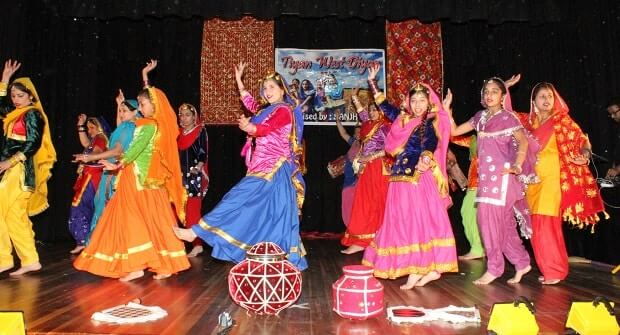
Well, there would be a tiny element of truth to that! Teeyan West Deeyan is the name given to the Teej (monsoon festival) celebrations organised by the Punjabi women of the western suburbs in Melbourne.
Some 700 women in the Wyndham area gathered at Mossfield Primary School at Hoppers Crossing for this women’s festival dressed in their brightest of brights, best of bling, and yes, lots of attitude!
There was singing and dancing galore as the giddha, bhangra and boliyan began, and the hearty Punjabans all ‘shook their bootys’ Rajasthani and Bollywood style. The theme skit (on dowry) and the comedy skit were perfect for the occasion, and Amrinder Kaur Toor’s mimicry and the “Bhand comedy” by Roop went down very well.
It was a cultural turn-back for everyone. And for special guest Joanne Ryan MP (Member for Lalor), it was a great introduction to some good old-fashioned Punjabi joi de vivre.
The age range of attendees was the proverbial “5 to 85”. The youngest dancer and shabad singer was indeed five, and an 85-year-old guest was honoured at the event.
Community achievers were felicitated, and awards announced for ‘Mrs Teeyan’, ‘Senior Mrs Teeyan’ and best-dressed child.
For organisers Shama Bhangu, Dolly Rai, Ruby Kaur and Navneet Kaur, the July 19 event turned out to be a fantastic success, and well worth the weeks of practice and organising.
“We started this because the main events were on the east side and a bit far for us to travel,” Shama Bhangu told Indian Link. “For only the third event, it was pretty satisfying”.
The gang of four already have plans for coming years.
“We’re looking at a bigger venue and perhaps inviting a well-known singer,” Shama revealed.







 New beginnings