

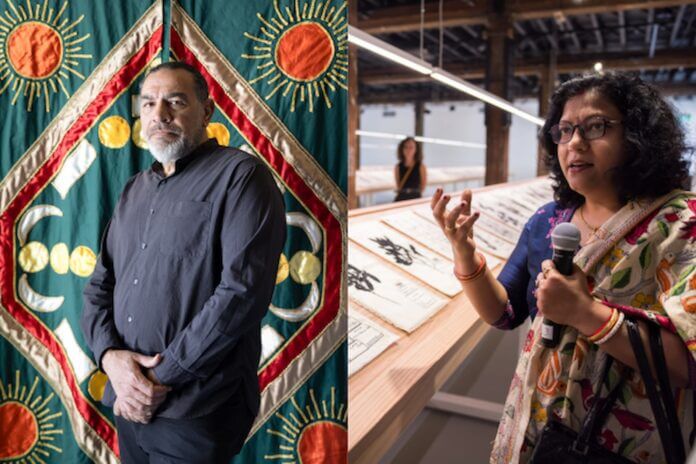
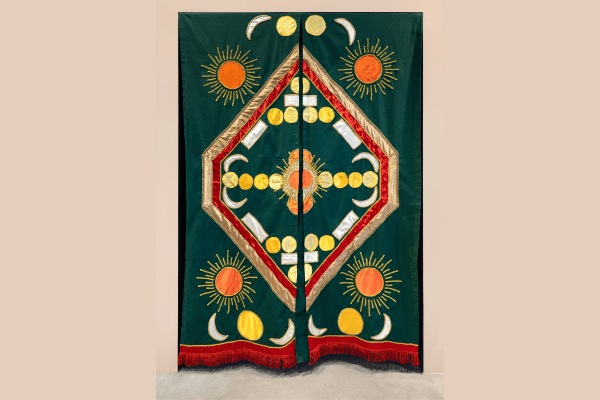
For months, Indian-born artisan Anamika sat hand-stitching circles, crescent moons, and ray motifs onto satin curtains destined for one of the world’s most prestigious art events — the 61st Venice Biennale.
But for the Bihar-born artist now based in Western Sydney, the work was never merely decorative.
“For me, working in any traditional art form whether painting, embroidery, or sewing is a form of meditation,” she told Indian Link. “It was not just embroidery for me; it was my way of expressing my love, respect, and pride for this traditional skill and craftsmanship.”
Anamika, alongside fellow embroiderer Shabnam Mukhi, contributed to Lebanese-Australian artist Khaled Sabsabi’s exhibition for the Australia Pavilion at the 61st Venice Biennale. Commissioned through Arts & Cultural Exchange (ACE), the pair spent five months appliquéing intricate motifs by hand onto four curtains designed by Sabsabi.
His exhibition in the Australian pavillion is titled, conference of one’s self.
View this post on Instagram
Weaving Heritage and Healing
The technique Anamika used – appliqué embroidery known as ‘Khatwa’ – originates in Bihar and carries a Geographical Indication (GI) tag.
“For me, it was a deeply meaningful experience, as I was representing my cultural heritage with every stitch,” she proudly shared.
The international recognition marks a remarkable journey for Anamika, who migrated to Australia in 2012 with her husband and children after completing a degree in Information Technology in India.
“As a child, I had never imagined that the skills I was learning would one day contribute to such a prestigious exhibition,” she reflected. “I feel deeply grateful to my parents for making the extra effort to pass these skills and traditions on to me.”
Much of that knowledge came from generations of women in her family. Raised in Bihar surrounded by Madhubani art, embroidery, gardening traditions, and natural remedies, Anamika says these practices were part of her daily life.
“In Bihar, cultural and traditional knowledge is generally passed down from mothers to their daughters,” she said. “Now, I truly appreciate that these skills are not just a form of craft, but an important part of our cultural identity and heritage.”
Her grandmother and father were passionate gardeners, her eldest sister became a plant scientist, and her mother treated common ailments using herbs and traditional remedies. Even today, Anamika grows Indian herbs in her Australian garden.
“For me, these traditions are not separate activities; they are naturally woven into my everyday routine and way of living,” she said.
That deeply personal relationship with craft became even more significant during the Biennale project. While working on the curtains last year, Anamika was grieving the loss of both her father and father-in-law.
“For me, the process was deeply meditative and worked as a great source of emotional relief and stress release,” she shared. “In many ways, this creative practice became a source of healing, comfort, and emotional balance for me.”
Art Unites Migrant Women anamika venice biennale
Alongside her artistic practice, Anamika also works closely with migrant women through ACE’s Multicultural Women’s Hub — a Western Sydney initiative supporting women from culturally and linguistically diverse communities through creative workshops and community-building programs.
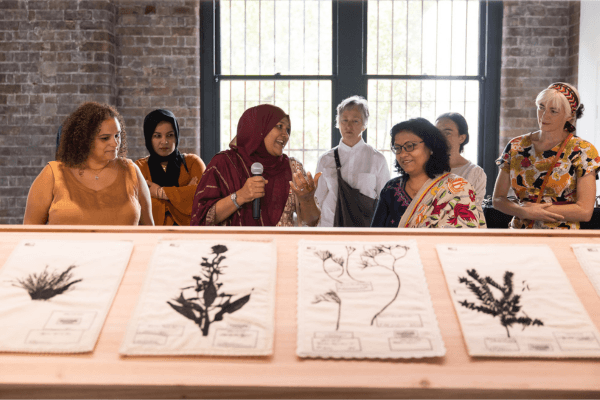
“As a migrant woman, I understand the importance of creative spaces more than most,” she said, continuing. “When we arrive in a new country, surrounded by a new language and without friends or family nearby, art becomes a powerful way to build connections and create a sense of belonging.”
She believes these spaces become emotional lifelines for many migrant women. anamika venice biennale
“We share our personal journeys, challenges, festivals, and cultural traditions with one another,” she explained. “Even though we come from different ethnic backgrounds, I feel that women everywhere often go through similar experiences and emotions.”
Anamika’s own journey into community arts emerged unexpectedly. Despite her IT qualifications, she says she never experienced true fulfillment until her traditional artistic skills began receiving recognition after moving to Australia.
“When I joined ACE with my two-year-old son and received recognition for my skills, I realised that this was the sense of fulfillment I had been searching for,” she recalled.
That realisation has also shaped her message to younger generations of Indian-Australian women.
“Please stay connected to traditional art forms,” she urged. “They are like the roots of a tree, while we are the branches. If we forget our roots, the beauty and richness of our traditional art forms may gradually fade away.”
Anamika and Shabnam have collaboratively delivered many programs for ACE, including their ongoing roles as co-facilitators of the Auburn Sewing Hub for Auburn Diversity Services. As well as sharing their skills with numerous women from culturally and linguistically diverse women in Western Sydney, both worked alongside leading First Nations artist Jonathan Jones on untitled (transcriptions of country), exhibited at the Palais de Tokyo, Paris (2021-22) and Artspace, Sydney (2023).
The 61st Venice Biennale runs from May 9 to November 22, 2026. Sabsabi’s exhibition in the Australian pavillion is titled, conference of one’s self.
READ ALSO: Biennale of Sydney 2026: all the South Asian links