Home Blog Page 932

Movement on the uranium front

0
Reading Time: 3 minutes

One of the flagship announcements by Prime Minister Tony Abbott on his September visit to India is likely to be the start of uranium export to India.

If this announcement is made, as expected, it will herald in an era of a closer relationship between the two countries. Australia controls about a third of the world’s uranium reserves, a resource India is desperately in need of to meet the energy needs of its large population.

The uranium chapter in the India-Australia relationship has seen a fair bit of ebb and flow. Labor policy has, for a considerable amount of time, been against, while the Liberals have been more favourable. Eventually Labor turned around too: former PM Julia Gillard’s ‘about-face’ on the matter in late 2011 was one of the many that dotted – some would say marred – her career as leader and PM.

A series of nuclear cooperation talks have taken place since then, the main concern by Australia being that the uranium supplied should be used for the generation of power rather than end up in defence use. That these concerns have been addressed and dealt with is indeed a credit to the talents of the diplomats involved in these discussions.

India has six power plants, with some 20-odd reactors. Nuclear power is the forth-largest source of electricity in India after thermal, hydro-electric and renewable sources. India’s collaborations in the field are spread across every continent so far except Australia – countries in Asia, Europe, Africa, North America and South America are now in bilateral programs with India in the peaceful use of nuclear energy.

That India has been able to argue its case and win nuclear cooperation with a number of countries indicates its stance of not signing the Nuclear Non-Proliferation Treaty was correct. The Nuclear Non-Proliferation Treaty while noble in intent was dividing the world into those who could have nuclear options and those who could not. It was designed to stop the testing of nuclear weapons, but had no restrictions on those who already had the know-how and wished to progress this further. India presented the case that it was its sovereign entitlement to work on its defence capability and refused to sign the treaty. Soundly criticised, it maintained its position regardless.

However, India now needs to focus on the responsibility of implementing procedures to separate its military and civilian nuclear programs, and to put safeguards in place to ensure that there is no leakage between the two. There have been questions raised on this issue by the International Atomic Energy Agency (IAEA). India will do well in ensuring transparency here with clear indications that it has enough internal supply to help it with its military requirements.

A 2012 report by the Indian auditor-general had found that the country’s nuclear safety regulator was weak and unable to appropriately monitor the industry. It also warned that the country could face a disaster like the ones seen in Fukushima or Chernobyl. The Indian government needs to adopt best practice in this area. Memories of Union Carbide’s Bhopal incident in 1974 – the mass casualties and the effects that continue to linger in new generations – are indeed still too fresh.

India plans to have at least 25 per cent of its electricity supplied by nuclear plants by the year 2050 and has a vision of becoming a world leader in nuclear technology. It needs to tread very carefully if it wants to keep the respect of the international community.

Love and confusion!

0
Reading Time: 4 minutes

It’s drama season in Sydney’s Bengali community, writes RAKA MITRA

As the city geared up for the recent City2Surf, the Bengali community of Sydney were rugging up to enjoy Natya Utsav, the Bengali Association of NSW’s annual drama evening. The event had the audience in stitches with two comedies, The Love Trap (Premer Phade) and Solution X.

The Love Trap was a comedy of errors, scripted by Sydney’s very talented Ashish Bhattacharya. Well-known for sculpting some truly magnificent Durga idols for the Bengali festive season, Ashish took time out for some theatre.

In The Love Trap, he reinvents an old classic by Gautam Ray, bringing it up to date with modern times and enhancing the plot, to appeal to a community audience where the actors were all friends and family.

The curtains opened to a young woman being rescued by a man from apparent suicide on railroad tracks, muttering something about love lost.

For her first time on stage, Shaila Rahman won over the audience with her vivacious character Anuradha, who’s in love with the concept of love and all things Bollywood. Her object of desire, Dr Rajeshwar Roy (played by Rana Banerjee), is a man nearly double her age. The plot thickens as the doctor lies about already being married, raising a predicament: he needs to find a wife! His ever faithful personal assistant Shobhna (played by Pratibha Banerjee), steps in and of course, she’s always had a secret love for the doctor as well!

The ladies sashay around the stage in different sarees, making costume changes appear effortless.

Meanwhile, Anuradha’s family are trying to find a groom for her. Her retired army father, played by the director himself, Swapan Trivedi, introduces Taranga (Neel Dey). Taranga, as an impatient young man who thinks it would be more efficient to get the honeymoon out of the way before going into wedding planning, brings in his own moments of comedy. Anuradha’s mother Hemnalini is played to perfection by the veteran Bengali stage mum Mita Majumdar – worried for her darling daughter’s future, the feisty wife bickering with her husband, and the dutiful daughter-in-law too, all with the air of sophistication appropriate for an army officer’s wife.

But it is Bhujanga, a very effeminate dental surgeon (played by Sandipan Ganguli) who has the audience in stitches. (Sandipan’s muse for his wonderful small act was none other than the late Rituporno Ghosh, who in many of his films played transgender roles. Sandipan found a unique solution to overcome a stage actor’s biggest dilemma i.e. what to do with one’s hands! He kept twirling the ends of his dupatta, an act not just amusing to watch, but also completely fitting with his character).

To further confound the situation, Anuradha’s rescuer Rudra (Saikat Das) now professes his love for Anuradha, through poetry, no less. It is a role for which Saikat is well cast, given he has made a name for himself in Bengali radio skits, his wonderful voice and perfect diction a testament to this.

Amid all the hilarious confusion, a family reunion, and a side-splitting dance sequence by the family help played by Ram Misra, elicited many catcalls from the audience!

The second play of the evening, Solution X was written by famous Bengali playwright the late Badal Sarkar and directed by Asim Das. The plot is centred on an eccentric scientist and his nine-year-old daughter Tutul played this time by mischievous debutante Heeya Mitra. Trouble starts when little Tutul mixes up a special concoction of potions in her father’s lab. “Solution X” has the effect of making people lose their inhibitions, making them feel years younger and also bringing out some underlying insecurities.

The actors portrayed their roles formidably with perfect comic timing. The scientist played by Srimanta Mukherjee had audiences laughing at his forgetfulness, akin to Einstein. Jhiki Roychoudhury who played the role of the scientist’s wife excelled in her role as she morphed back and forth between a grown woman and a young girl throwing many a tantrum under the influence of Solution X.

Supporting roles of the scientist’s colleagues played by Surja, Rupa Roy, Samya Mitra and Deepak Hor were all fantastically portrayed.

Taking time off work and family commitments requires people that are passionate about the art of drama and this group definitely was! The directors both wove their own creativity into their plays, whether via soundtracks, eccentric gesticulation or colourful set design, every detail adding to the success of the play.

A glorious tribute

0
Reading Time: 3 minutes


A diverse and splendid Kuchipudi performance was recently held in honour of Dr Vempati Chinna Satyam. DEEPA GOPINATH reports

It is a rare and special thing when a person’s influence over an art form reaches far across the globe and brings together artists from across generations. Dr Vempati Chinna Satyam held such influence over the South Indian classical dance form of Kuchipudi. Hailed as a visionary, he revolutionised the discipline in the mid-1900s and was instrumental in the recognition of Kuchipudi as a classical dance form. A dancer and a teacher, Dr Chinna Satyam choreographed almost 180 solo items and 15 entire dance dramas, many of which are still performed frequently the world over.

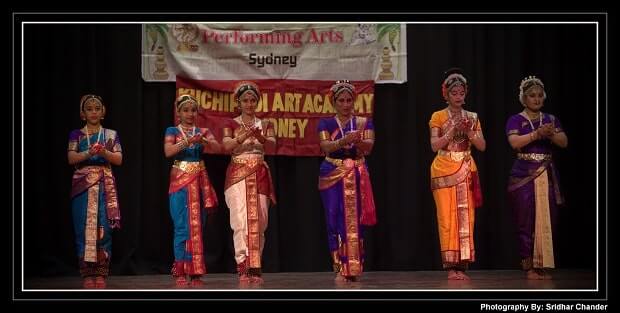
Recently, an inspired group of dancers came together to honour Dr Chinna Satyam in a way that would surely have made him proud, with a Kuchipudi recital they called Natya Sumanjali. Held at Marsden High School, the repertoire was diverse and consisted of performances from dancers who wished to celebrate his life, two years after his passing. Together, Shobhana Kambhammettu (who was also on the organisation team), Vanaja Dasika, Aruna Iyengar and the young and astonishingly talented students of Venkata Ramana, educated the Sydney audience a little more about Kuchipudi. Behind the scenes, it was the members of Kalabharathi Performing Arts and Kuchipudi Art Academy of Sydney who brought these dancers together to present this recital to a full auditorium. Entry to the show was free, and any proceeds were donated to the Sri Venkateshwara temple in Helensburgh.

In keeping with tradition, the first item was a tribute to Lord Ganesha, Gaja Vadana, presented by Shobhana and Vanaja. It was an excellent way to begin, both dancers talented and obviously passionate performers. Another standout piece was Vanaja’s Marakatha Manimaya in praise of Lord Krishna, and this is where the expressive dancer’s story-telling abilities really shone. Precariously balanced on a brass plate and relying solely on precise footwork to stay balanced, Vanaja beautifully displayed a form of dancing that is unique to Kuchipudi.

Shobhana too showed a flair for connecting with the audience, presenting the solo piece Bhama Kalapam in her refined, graceful manner. Young Aditi Gunturu, Saakshi Manevalil and Swetha Puthi were involved in Brahmanjali and Aditi and Saakshi in the Jathiswaram, displaying a finesse that was beyond their years.

Each item had been intricately choreographed by Dr Vempati Chinna Satyam. In her speech, Shobhana labelled the Guru’s choreography as something special, describing how her previous contact with him influenced her profoundly, changing the axis of her way of thinking. Guru Anandavalli, one of Sydney’s prominent classical dance figures, gave a heartfelt speech, sharing personal stories of Dr Chinna Satyam’s positive impact on her dancing and her life. It was at that moment that many audience members truly understood the effect that the great dancer and teacher had on the people whose lives he touched.

Indeed, Dr Chinna Satyam was a man who was widely loved and is deeply missed. Aside from the choreography, a common thread that ran through the recital was that almost every dancer had experienced the joy of either learning from, or meeting, Dr Chinna Satyam through their dance careers. This brought a deeply personal touch to the evening, and it was nothing if not from the heart.

The recital ended as all good classical recitals should, with a vibrant Thillana. Shobhana and Vanaja continued to pay tribute to one of their most influential teachers while farewelling the audience and completing the evening’s performance. Their pleasure in being able to partake in such a special tribute was evident and the evening concluded, as it should, on a joyously dynamic note.


Queensland feels like Indian tonight

0
Reading Time: 2 minutes

According to a recent article in the Courier Times, residents of Logan Village are among the highest spenders on takeaway food in the country, with Indian food being the “hot choice”.

A study of 15,000 Brisbane orders, conducted by online takeaway site Delivery Hero Australia concluded that Brisbane’s Northwest and Logan areas preferred Indian food, with Chinese and Thai not far behind.

“The people of Brisbane have become much more adventurous with spicy foods over the last few years,” Mohammad Ziaur Rahman of the Bengal Kitchen at Woolloongabba said to the Courier Times.

“It is common for us to pack up orders for over $100. That would give you about five or six curries and we have free rice. While butter chicken is a firm favourite we find that many Brisbane men love to test drive the hottest vindaloo curries”.

According to Menulog, butter chicken is Brisbane’s most preferred dish followed by other chicken, lamb or beef curries, and Pad Thai.

Julia Snabl from Menulog told the Courier Times that she was surprised by Australia’s culturally diverse range of food, which has contributed to the dramatic growth in takeaway orders in the country.

“There is a lot of competition in the inner city suburbs and customers are finding it cheaper to order takeaway then prepare their own meal,” she told the Courier Times.

Logan Village is also in the Top 10 Australian postcodes where an average spending of a hundred dollars a more per order is not uncommon.

Reimagining India

0
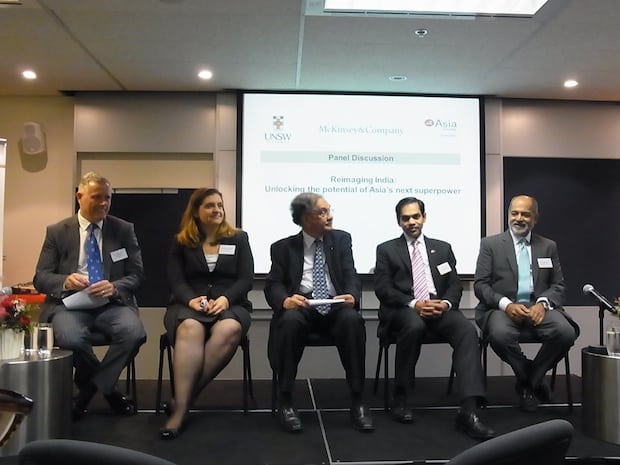
L to R: Graeme Barty (Austrade's General Manger of Growth and Emerging Markets), Deborah Hadwen (CEO of Tata Consultancy Services), Neville Roach (Patron of the Australia India Institute at UNSW), Consul-General of India Sunjay Sudhir, Adil Zainulbhai (Senior Adviser to McKinsey)
Reading Time: 4 minutes

A new essay collection explores the growth and potential of the world’s largest democracy

L to R: Graeme Barty (Austrade’s General Manger of Growth and Emerging Markets), Deborah Hadwen (CEO of Tata Consultancy Services), Neville Roach (Patron of the Australia India Institute at UNSW), Consul-General of India Sunjay Sudhir, Adil Zainulbhai (Senior Adviser to McKinsey)


What will India look like 20 years from now? What about 50 years into the future? A recent volume of essays, commissioned by McKinsey and Company, explores the future of India in the 21st century as one of the world’s emerging powerhouses.


Recently a group of key figures in the Indian and Australian business communities, including the Consul-General of India, Sunjay Sudhir, came together to discuss the challenges and opportunities facing India and its sizeable population.


The event, co-hosted by McKinsey and Company, Asia Society Australia and the University of New South Wales, marked the Australian launch of Reimagining India: Unlocking the Potential of Asia’s Next Superpower. The book is a collection of opinions and ideas from some of the world’s great thinkers. Each of the 65 essays explores different facets of India’s development, in terms of its rising economy and burgeoning middle class, and takes on everything that is right – and wrong – with the country. The articles also examine the fusion of modern and traditional cultural elements, and the changing nature of politics in the largest modern democracy.


Co-Editor of Reimagining India Adil Zainulbhai began the evening by outlining how India and its leaders must take a long-term perspective and explore the potential of India beyond pure economics.

Consul-General Sunjay Sudhir and Adil Zainulbhai


Senior Adviser to McKinsey and until recently Chairman of McKinsey India, Mr Zainulbhai continued by saying India will persist in improving the standard of living for its people and how the ubiquitous spread of technology is accelerating this process. With two-thirds of the population under 35, “the large number of young people coming into the workplace will have a huge impact on the economy and politics of India,” Zainulbhai said.

A featured panel discussion, moderated by UNSW Vice-Chancellor Professor Fred Hilmer, saw experts including Sunjay Sudhir, Consul-General of India, Neville Roach, the Patron of the Australia India Institute at UNSW, Deborah Hadwen, CEO of Tata Consultancy Services, and Graeme Barty, Austrade’s General Manger of Growth and Emerging Markets, considering the significant opportunities in India for Australian business and innovation.

Professor Fred Hilmer


India currently has the world’s best performing stock market and is earning a place alongside China as one of the world’s indispensible economies. As Consul-General Sunjay Sudhir said, the strength of the Indian economy lies in its resilience, entrepreneurship and being unafraid of risk taking.


India is the second largest source of overseas students to Australian universities, making it a key market. Neville Roach proposed that Australia further develop its relationships with India in the education and research sector in order to facilitate an exchange of knowledge and skills, and capitalise on new business opportunities. Professor Hilmer agreed, saying, “Education is a microcosm of the larger story of this book, which is the achievements of India, its potential and the unanswered questions”.


The rapidly changing demographics of India, along with its innovation in technology and increasing urbanisation, continue to make this country an exciting possibility for Australian industry and investors. Graeme Barty summarised how Australia can seize its comparative advantage in certain industries in order to create change. He suggested these areas include dairy services, coal mining, long haul freight rail, energy efficiency and the implementation of cultural precincts. He also outlined how Australia, a world leader in road safety, can assist India in reforming its urban infrastructure. “More Indians are killed in road accidents than from malaria and typhoid combined,” Mr Barty said.


As Neville Roach suggested, reimagining the state of India is about changing attitudes and aspirations. It is as much about social change as it is about the economy. This book provides a radical new vision of India where “Australia can turn for leadership and ideas in a relationship of mutual respect”.

Reimagining India includes contributions by influential thinkers from India and across the globe including businessmen, economists, cricketers, journalists and artists. High profile contributors include people such as Bill Gates, CNN’s Fareed Zakaria, businessman Anand Mahindra, and Google chairman Eric Schmidt. Each shares their unique insights into how India might forge a better future.


As one of the contributors to the book, Anand Mahindra, Chairman of the Mahindra Group wrote, “Much of the developing world faces the same challenges India does. The solutions developed (there) – the answers to the most metaphysical questions about how societies should work and grow – will have worldwide relevance”.


Hiking in the wilderness

0
Reading Time: 4 minutes

Beyond the Blue Mountains lies the wild, lush landscape of Wolgan Valley

When Emirates opened the swish Wolgan Valley Resort and Spa in 2009, many Sydneysiders wondered why. But the resort helped put Wolgan Valley on the tourist map and in my sights. Having spent $125 million on the resort’s construction, a price tag of $1950 per night was clearly pitching at a market well above mine. But there is an alternative way to get there. I booked a two day hiking trip, through Life’s An Adventure, with my 20 year old daughter Lauren.

At the western edge of the Blue Mountains, the area is renowned for being so remote that only recently a living fossil was discovered there dating back 150 million years to the Jurassic period. The Wollemi Pine lies in an isolated, deep gorge in the middle of 48 million hectares of bushland. The only trees like them were found in fossils deposited in prehistoric times, which links the history of Australia’s flora to the time before it became a continent.

Meeting at Katoomba Railway Station at 8.30 am was no problem for the five other hikers who had given thought to the need for sleep by staying there overnight, but for me and Lauren it meant catching a 5.48am train from Sydney’s Central Station. While a thermos of strong coffee got me going, Lauren fell sound asleep for the two hour trip.

With blue skies and a forecast of a possible shower, we hadn’t factored in the black clouds that came overhead, the heavens opening with a torrent of rain. Temperatures dropped and it became very cold. We opened our overnight bags and put on every layer we had.

The jeep with Timmo, who took care of driving, cooking and logistics, and guides Joel and Denis, was there to meet us, and after piling our gear onboard we drove along the Great Western Highway before turning off along a bumpy gravel road to Wollemi National Park.

Few people venture more than a few kilometres from the park’s boundaries and as a result there is a feeling of remoteness once you venture further into the interior. After lunch, a roll filled with tasty delights that had suffered from the bumps on the road and a slice of chocolate cake, we made our way through a glow worm tunnel – part of an old railway line that once serviced the area. Turning off our torches to adjust to the darkness, thousands of tiny glow worms lit up the tunnel like fairy lights. Emerging at the other end we entered a lush landscape of ancient tree ferns, some dating back many hundreds of years, and sheer cliffs rising 183 metres upwards.

“It may well snow tonight,” Denis remarked, something I hadn’t counted on, it was only autumn after all. We continued walking, viewing dramatic escarpments, rock formations and tall eucalyptus trees, before commencing our descent into the beautiful Wolgan Valley. Joel took out the necessary equipment from his backpack for making billy tea, which spurred us on as we followed a bush track that ran alongside a creek to our campsite at the historic ruins of Newnes. An atmospheric hotel filled with memorabilia, remains of coke ovens and piles of bricks are the only signs remaining of a time when a mining community lived here.

Timmo had set up our tents with spongy comfortable mattresses and had made a roaring fire. Great Australian wine, a gourmet cheese platter and hot showers all round, got us in good spirits ready to enjoy a delicious dinner that Timmo had miraculously produced featuring several curries, roasted vegetables, rice and fresh grilled snapper followed by a kiwi fruit pavlova with lashings of cream. Wearing seven layers, jeans and track pants on top, a beanie and gloves, my usual glamorous appearance had been dispensed with. The tent was surprisingly cosy and we all slept soundly with a few snores that Denis said could be attributed to a wombat.


When I woke the next morning and peered out of the tent, several kangaroos were grazing on the grass heavy with dew and Timmo had thankfully produced a pot of strong coffee. After refuelling with a breakfast selection that included fried eggs and bacon, yoghurt, muesli, fresh fruit and berries, we began a walk that began gently enough across open forest to the vast Capertree Valley, spotting more kangaroos and wallabies.

“Where are we heading?” I asked Denis, his arm reaching upwards in response. Scrambling over rocks and climbing steps, the final hard climb was rewarded with spectacular views of towering ochre-coloured sandstone cliffs, eucalyptus forests and the vast valley floor below us. Afterwards we explored the ruins of Glen Davis, now largely overgrown with vegetation. The town of Glen Davis had a school, shops and a brickyard but after several strikes and financial losses, the plant was closed down in 1927, the railway line was dismantled and the locomotives were sold as scrap.

Driving back towards Katoomba, we passed only a few cars on the road, the area still largely undiscovered. With scenery to rival the Blue Mountains, the Wolgan Valley is a remote part of Australia with Aboriginal rock engravings, abundant wildlife and the elusive Wollemi Pine, all only three hours from Sydney.

Travel Notebook

Getting there

Trains depart hourly from Central Station for the two hour trip to Katoomba (www.sydneytrains.info.com.au). If travelling by car, head for the Great Western Highway with fast access via the motorway. Access to Newnes is along Wolgan Valley Rd.

Climate

Temperatures are much cooler than in Sydney. Spring and autumn are the best seasons to hike here. Sturdy walking boots and layers of warm clothing are essential.

Getting around

The multi award winning Life’s An Adventure offers a variety of tours from day walks, biking or 4WD adventures to overnight trips with all meals included. (E: enquiries@lifesanadventure.com.au W: www.lifesanadventure.com.au)


Cultural clichés overcome with cosy comfort

0
Reading Time: 3 minutes

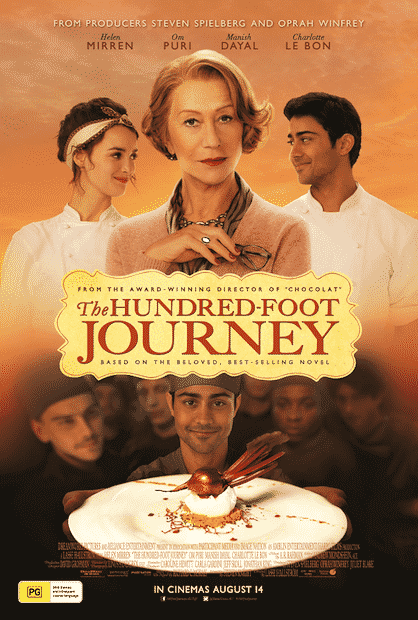
Film: The Hundred Foot Journey

Cast: Helen Mirren, Om Puri, Manish Dayal, Charlotte Le Bon

Director: Lasse Hallström

Rating: ***

Take one highly praised debut novel, add powerhouse producers and a director with a passion for culinary delights. Stir in beautiful countryside settings, a soundtrack from a Bollywood great, and an appealing cast, and you have the recipe for The Hundred Foot Journey.

Swedish director Lasse Hallström, who took chocolate lovers on a sensuous journey of delight in his film Chocolat, brings us a charming, if somewhat predictable, romantic comedy with a message about hope and learning to get along.

Taking some liberty with the narrative from the best-selling novel by Richard C. Morais, the movie is a culture clash between the chaotic, vibrant ethos of India and the prim, sometimes uptight, world of provincial France.

After the death of his wife, Mumbai restauranteur ‘Papa’ Kadam (Indian movie veteran Om Puri), uproots his family to Europe, where they eventually settle in a quaint little village in the south of France. The picturesque locale is the ideal place for the family to open their Indian restaurant, Maison Mumbai.

The venerable Helen Mirren plays Madame Mallory, the widowed proprietress of a highly-respected, Michelin star-winning classical French restaurant, Le Saule Pleureur. Her proper, gentrified world is rocked when the colourful, migrant Kadam family opens their distinct dining venue directly across the street – just 100 feet away.

The two restaurants are worlds apart and soon a war breaks out between a determined Papa Kadam and the formidable Madame Mallory. It’s a battle of wills where if you can’t handle the heat, you better get out of the kitchen!

Co-produced by Hollywood powerhouses Steven Spielberg and Oprah Winfrey, the film stars the enchanting Manish Dayal as Papa’s grown son, Hassan, who wants to further his culinary talents beyond the family’s Indian recipes.

As the clash between Papa Kadam and Madame Mallory escalates, so too does Hassan’s passion for French haute cuisine and his desire for Madame Mallory’s sous chef, Marguerite (Charlotte Le Bon).

Cinematographer Linus Sandgren works hard to make food another character in the story with lingering shots over chicken curries, beef bourguignon and other tasty delights.

The film is not ground-breaking, but each step of the way, despite the lack of suspense, you’re rewarded with a cheerful story, along with enough humour and beautiful scenery, to keep you satisfied.

The film does lose its way about halfway through, when the culinary creativity is backgrounded for the weaker, predictable romance plot between the younger characters, and there is some cultural stereotyping, but Mirren and Puri are pure joy to watch.

While admirably presenting a message that clashing cultures can find common ground and learn to live side by side, at times the film is a touch too sweet and lacks the balance of a well-seasoned dish.

But with a fantastic soundtrack by A.R. Rahman, and a heartfelt story about a migrant family coming together and building a life for themselves by relying on their hard work and talent, this film is undeniably charming.

Despite being a bit too long and treading a well-worn path, The Hundred Foot Journey is a movie full of heart. It reminds us of the comfort that food, family and friends can bring to our lives.

Kira Spucys-Tahar

When football enhances the quality of life

0
Reading Time: 3 minutes

Name: Mayur Parmar

Age: 20

Height: 174cm

Home town: Bandra, Mumbai

Home Team: Maharashtra Giants (Captain)

Debut: 2010

Position Played: Winger

AFL India Jersey: #4
One might call him Mr Congeniality of Team India, because he is universally liked, and because he has been a standout since he began in AFL. It is not his talent but his motivation in his heart for the game that makes him a stand out. He is proof that it is not our physical strength that moves us but it is our desire. And he has used this heart of his time and time again in his life, and what he has done in doing so, is give himself opportunity and the possibility of a unique life.

Someone may look at Mayur Parmar’s life, and see where he has come from, and think to themselves, what good luck he has had. But it was not like that at all. If chances were not there, if they did not come Mayur’s way, with a smile he’d look again, try again, he’d learn a little more, he’d do better, he’d keep at it. He has an incessant well-meaning heart which is how he plays football. He does not give up.

On top of this, as Mayur gains, he gives back, and already he has taken reigns of AFL football in Maharashtra and captained the Maharashtra Giants. He has also taken under his wing a multitude of youngsters in Dharavi Mumbai who are learning AFL now from him. So he has the next generation of AFL Maharashtra looked after as well.

So where is Mayur from? He has lived in and around the Bandra and Dharavi areas of Mumbai. Two suburbs side by side, with very different reputations. Bandra is known as the Queen of Mumbai and Dharavi suburb is known to be home to one of the largest slums in the world, and yes it is also prime real estate. Nonetheless, anyone who really does take the time to visit Dharavi would see there is so much more than this external perception. Its defining traits are its industrious, busy, creative, friendly and supportive nature, amongst a landscape of twisting and turning and overlapping corridors that lead between homes, schools, businesses and playgrounds throughout the suburb.

It was through Mayur’s connections in Dharavi that he got his first chance to play Australian Rules Football, on a day he remembers as ‘the day he discovered his passion’.

One opportunity led to another and finally they led here to Australia where he finds himself representing his country in AFL.

“In Dharavi, an NGO called ‘Reality Gives’ runs community based programs and activities, one of which I participated in,” Mayur tells Indian Link. “I joined a program of computer classes and completed the course in 3 months but continued to come, to keep learning, to lend a hand, to keep being part of the Reality Gives network”.

Finally his enthusiasm was rewarded, and Reality Tours, the fundraising arm of the NGO, gave the youngster a position as a caretaker, and then later on as a tour assistant. As a tour assistant Mayur was able to become fluent in English and meet many people from around the world.

Reality Tours runs activities in and around Dharavi Mumbai. It aims to break down negative perceptions people may have of less developed communities, to assist in generating social change, and to give back to the community and create opportunities.

“One day at work my boss called me into his office,” Mayur recounts. “Expecting some work to come my way, I was surprised when he told him to get my gym shoes, t-shirt and shorts and any friends interested. We are going to Shivaji Park, he said. Well then we must be going to play cricket, I thought, so of course I was interested”.

When they arrived what Mayur saw was not cricket but an “amusing game of people playing with a funny oval-shaped yellow ball”.

“‘I touched it, I felt it, I kicked it. Then I fell in love with it”.

Two years later and Mayur’s enthusiasm was rewarded again He became captain of the Maharashtra team. And a few years on again, he has been chosen to represent India at the AFL International Cup.

At such a young age, Mayur is considered a peer among his football mates, because he is motivated and focussed on improving and moving on up, but also he is focussed on helping those around him in also moving on up.


Check out more from Leanne Woodward’s AFL International Cup 2014 overview:

Aussie rules of the Indian kind

The Dosti Cup 2014

Sport for Healing

AFL India


AFL India

0
Reading Time: 2 minutes

AFL India is growing some firm roots as we speak, and that is largely thanks to Sudip Chakraborty, to those involved in the sport from Australia who love to share their knowledge, and to the infectious and inclusive nature of the sport. Indians are known for their love of some healthy rivalry and also passion for sport and this could be just the beginning of another love affair of those two things.

A Kolkata boy, Sudip Chakraborty obviously had a love for sport that goes back to his younger days. Now as a graduate of sports management and sports science, he has a desire to share that. With his curiosity and intrigue about sport, it was only a few years ago that he stumbled upon some footage of Australian Rules Football. Soon he would be turning this into an India-wide venture, introducing AFL and setting up the first leagues and competitions across the country.

Sudip leads this year’s AFL International India team as captain, fit and strong. In years to come, could he be drafted by a local team here? With the standard of some of the teams that have been put forward this year in AFL International, that is not a far off idea.

Talking with Pawan Luthra on Indian Link Radio, Sudip shared some details about the game in India.

“AFL started in India about five years ago. Today it’s spread across West Bengal, Kerala, Maharashtra, Jharkhand, Tamil Nadu. We’re working with the Australian Sports Commission to spread the game to the other states as well. We have a national tournament in November and December each year and a regular State tournament. We have great support from the Australian government and the Australian fans who know the sport is not yet big in India. We’re hoping to make Australian Football a recognised sport in India”.

Although rugby has been played in Mumbai and Kolkata for years, there are some 3000 kids of different age groups under 16 who are currently being initiated into AFL, he revealed.

“Our major focus is on Jharkhand, Maharashtra and Kerala. We’re hoping to add to this number and at the end of this year reach 5000 kids”.

What about the grounds in India?

“That’s a major challenge, finding grass grounds to play on – for tournaments and for practices. We work with underprivileged kids and to get the game into their communities and find access to grounds is a major challenge. We need green tops – especially with physical contact sports – it’s a challenge to get them. Sometimes we’ll find a small patch of green and have to go in first and clean it up, remove harmful objects, to make it safe for them to play on”.

And who are Sudip’s own AFL influences?

“He’s retired now, but Brett Kirk from the Sydney Swans. I spent two weeks with him in India when he toured and he was an inspiration. My favourite player is Jack Riewoldt from the Tigers. Richmond has had a real connection with AFL in India and is an official partner, so I’ve been backing Richmond from the beginning and they’re definitely my AFL heroes”.


Check out more from Leanne Woodward’s AFL International Cup 2014 overview:

Aussie rules of the Indian kind

The Dosti Cup 2014

Sport for Healing

When football enhances the quality of life

Sport for healing

0
Reading Time: 5 minutes

The world media giant CNN in 2013 released what they considered the world’s nine greatest rivalries. Rating right up there in that select group was the India and Pakistani ‘geopolitical athletic’ rivalry.

Surprisingly, but entirely understandable as well, also rating on that list was the Melbourne and Sydney ‘Top City’ rivalry.

And if you were to rate any rivalry in that list from Australian Rules Football, you might think of the ‘Collingwood and Essendon’ rivalry, and as a Collingwood supporter growing up in Essendon, I definitely understand this one.

Is it possible though that these rivalries could be trumped with a bigger one, by the Dosti Cup? An International Australian Rules Football Cup, India v Pakistan, a possible must do annual tradition?

Like many others, I love a bit of rivalry. It was instilled in me from birth. Along with being given a name, I was also ‘christened’ the same day with my football team.

Growing up, my biggest rival was my best friend. We had a love hate relationship, as she barracked for my least favourite team. However our opposing football allegiances actually made us closer, and to this day we are still best friends. Every year we both dread and at the same time are excited by that match, when our teams go to battle. Regardless of the standings of either of our teams, year after year, that match brings the adrenalin rush of a Grand Final and a do-or-die determination from the players. At the final siren you are either heart broken, or on cloud nine. When her team beats mine, we still go to the pub on the corner, and I might drown my sorrows and trash on the umpires, and she’ll sing the team song again and toast to all the awesome plays.

That’s my experience, but I’ve heard that the sporting rivalry between India and Pakistan is in another league altogether. Two countries where there is not a pub on every corner but a temple and where footy is not the unifying religion, cricket is. I’m not sure that after a match you would see India and Pakistan rivals heading down to the local temple together, one to give thanks for the win, and the other to pray for redemption. I’m not sure there would be any sharing of camps at all!

The rivalry has a lot to do with a number of devastating events shared in their past. It includes four wars, numerous terrorist attacks, and displacement of millions upon millions of innocent people from both countries alike.

Even as I write this, the news is that the latest round of peace talks have hit a stumbling block and have been called off.

It makes me wonder how healthy is this rivalry, especially with regard to their beloved game of cricket.

Sport can be unifying, competing under a set of rules on a level playing field, holding up the ideals of sport, respectful of the differences from where your opponent has come from in order to be able to meet you there on that field. When it comes to Pakistan and India though, along with all these important reasons for pursuing a rivalry, there must be in there something else incredibly significant, because only one thing has ever been able to put a stop to a cricket clash between the two countries, and that is the event of a real clash itself; during the wars between the two countries of 1947, 1965 and 1971 and also following on from the Mumbai terrorist attack of 2008.

So much trauma has been shared by the two countries since Britain withdrew in 1947. When Pakistan and India became independent states, Kashmir, being a princely state was caught in between, free to join with either state, or remain a separate entity. Geo-politicking, mismanagement, miscommunication, misinterpretation, misunderstandings, greed, pride, ego, loss of trust, desperation, survival, love and compassion are all elements that played roles in the countries’ shared journey since then.

These Pakistan V India sporting matches may hold a unique significance over and above rivalries seen between other countries. Behind this rivalry are memories and a great deal of emotion. The intense rivalry could the result of a united expression of anger and pain from their shared past and losses, and the match itself just an outlet for this.

Pakistan and India, over a billion people, individuals and societies, traumatised by past events, have learned to put barriers up, learned to build arms for protection, learned to mistrust, and have yet to get over that hurdle to move forward, working out how to listen and feel and ultimately understand and forgive to let go and move on to a positive future.

Healing takes time, and mourning is part of that healing. If sport aids in that progression between rivals, if it enables you to connect with people and communities, to build understanding, and respect, and peace, if it empowers you, motivates or inspires you, relaxes you, or makes you smile, it has served a worthwhile purpose.

The Australian Football League understands the concept of being a good sport. It is using practical programs with sport to educate about human rights principles and mutual respect, and showing how through sport these ideas can be brought to the world.

Brett Kirk, AFL International Ambassador and inspirational Swans player, spent a year travelling around the globe in efforts to do just that. He travelled to 23 different countries and cultures and customs, sharing many laughs and smiles, teaching and playing AFL, and supporting ventures in making International AFL possible. Brett’s adventure has been documented in a film that has just premiered in some cities, and is about to premiere in others around the country, to be shown at selected cinemas. The doco Aussie Rules the World stars many of the teams featuring in this year’s International AFL Cup competition, including players from India.

This year’s Indian International Australian Rules Football team is an exciting colourful mix of men from all over the country. Not all players speak the same language, each has a different background; all are thrown together to represent their country and to play men just like them, from all ranges of backgrounds and experience.

Professor Mick Dodson, co-chair of Reconciliation Australia, back in 2009 spoke about sport and AFL: “It doesn’t matter what your background is, your cultural upbringing, your language or colour or religion, or even who you barrack for. Everyone on the field is worthy of being there. Everybody is respected. Differences in culture or background fade into the turf, as it were. Success hinges on respectful relationships and relying on your team mates. Everybody has to help each other. Otherwise teams don’t work”.

These ideals of sport are in such stark contrast to the model of so many people’s lives, and because of this, the platform of sport has time and time again highlighted these major contrasts. And because sport is so universally loved, it can be a very effective social and political platform to make a statement.

For example, Jesse Owens’ win at the 1936 Berlin Olympics, challenged and weakened Adolf Hitler’s glorification of Nazism and white supremacy.

In the 1968 Olympics, the African American sprinters highlighted civil rights abuses in the USA, by the symbol of their gloved fists to the air.

In the 1980s, the many boycotts of sporting events, played a significant role in ending apartheid in South Africa.

In 1993, Nicky Winmar of St Kilda AFL football club, made a powerful stand against racial taunts, by pointing to his skin as he was cussed at by Collingwood fans in the crowd.

In 2008, the Australian Football League with the help of the Pares Centre of Peace in Israel put together a ‘Peace Team’ to compete in that year’s AFL International Cup amid slander from their home nations. The Peace Team was made up of Palestinian and Israeli men.

In 2014, numerous athletes attended the Sochi Winter Olympics as openly gay and aware of the warnings of Russia’s anti-gay legislation, a clear violation of the Olympic charter.

And in 2014 India met Pakistan in the International Australian Rules Football Cup in Melbourne for the ‘Dosti Cup’ an encouraging, peaceful, respectful, friendly, healing match.


Check out more from Leanne Woodward’s AFL International Cup 2014 overview:

Aussie rules of the Indian kind

The Dosti Cup 2014

AFL India

When football enhances the quality of life