
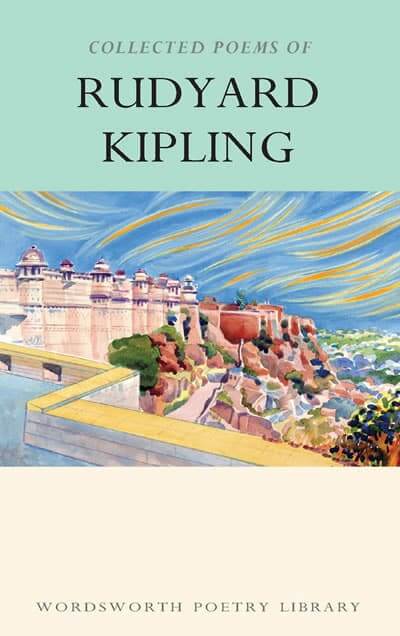
VIKAS DATTA explores the famed author’s works of soldiers, monarchs and revenue-raising

Gifted novelists have never been confined to a specific genre, or even to a form of literature, for they are adroit in weaving magic with words, using them in sentences of matchless prose or evoking their aesthetic and rhythmic aspects in verse. But somehow their poetic contribution is always overshadowed by their prose corpus. Sir Walter Scott, Hans Christian Andersen, Thomas Hardy, right down to Michael Ondaatje, Alice Walker, Russell Banks, John Updike, Vladimir Nabokov, Erica Jong and their ilk are not exactly more famous as poets. But there was one who strode both spheres with aplomb – and Rudyard Kipling’s art was recognised by conferment of the Nobel Prize for Literature – the first ever to an English writer.
Kipling’s (1865-1936) prose creations, not only the Irish boy drawn into the “Great Game” or the foundling who is raised in the jungle by a wolf-pack, but also from the wider animal kingdom like the faithful mongoose, the intrepid wolf, the wise bear, or the evil tiger, have achieved boundless fame, for which reader has not come across the names of Kim, Mowgli, Riki-Tiki-Tavi, Akayla, Baloo and Shere Khan?
But, he also penned enduring verse – about the old but brave water bearer Gunga Din, that solemn admonition of duty and stoicism “If”, the epic adventure in “The Ballad of East and West”, and the much-pilloried but as much misunderstood “The White Man’s Burden”.
Kipling’s poetry covered a wide range – history, both European and Indian, nature and the views of animals, and even clever parodies of medieval Persian poets like Omar Khayyam and his “Rubaiyyat” and Hafiz.
Some of his most effective poetry – that will strike a chord even today – is about the treatment of the ordinary soldier – active or retired.
“Tommy”, short for Tommy Atkins, a generic name for a British soldier, ends with a warning: “For it’s Tommy this, an’ Tommy that, an’ ‘Chuck him out, the brute!’/ But it’s ‘Saviour of ‘is country’ when the guns begin to shoot/An’ it’s Tommy this, an’ Tommy that, an’ anything you please/An’ Tommy ain’t a bloomin’ fool — you bet that Tommy sees!”
Equally distressing is the condition of the Charge of the Light Brigade’s survivors: “There were thirty million English who talked of England’s might/There were twenty broken troopers who lacked a bed for the night/They had neither food nor money, they had neither service nor trade/They were only shiftless soldiers, the last of the Light Brigade.”
A deputation goes to Lord Tennyson, who immortalised them in verse, and makes a plaintive request: “No, thank you, we don’t want food, sir; but couldn’t you take an’ write/A sort of ‘to be conbnued’ and ‘see next page’ o’the fight?/We think that someone has blundered, an’ couldn’t you tell’em how?/You wrote we were heroes once, sir. Please, write we are starving now.”
Kipling could as easily bring episodes of Indian history, real or apocryphal, to vivid life – as in “Akbar’s Bridge” when: “Jelaludin Muhammed Akbar, Guardian of Mankind,/Moved his standards out of Delhi to Jaunpore of lower Hind,/Where a mosque was to be builded, and a lovelier ne’er was planned….”
Wandering along the Gomti at dusk, the emperor tries to help an irate, stranded widow, ferrying her across the river but getting clawed by the woman who has now idea of who he is. He recounts his dolorous adventures to his Viceroy Munim Khan.
“And he ended, ‘Sire of Asses-Capon-Owl’s Own Uncle-know/I-most impotent of bunglers-1-this ox who cannot row-/I-Jelaludin Muhammed Akbar, Guardian of Mankind-/Bid thee build the hag her bridge and put our mosque from out thy mind.”
He could pen heartfelt tributes – as to the larger-than life US President (and hunter-conservationist, war hero, explorer, author, progressive politician and Nobel Peace Prize winner) Theodore Roosevelt in “Great-Heart”.
“….Hard-schooled by long power,/Yet most humble of mind/Where aught that he was Might advantage mankind./Leal servant, loved master,/ Rare comrade, sure guide…/Oh, our world is none the safer/ Now Great-Heart hath died!”
But Kipling is also an incomparable parodist, using the Rubaiyyat to portray travails of Auckland Colvin, the finance member (1883-87) in the council of Viceroys Ripon and Dufferin in raising resources in India.
“Now the New Year, reviving last Year’s Debt,/The Thoughtful Fisher casteth wide his Net;/ So I with begging Dish and ready Tongue/Assail all Men for all that I can get” and “Pay — and I promise by the Dust of Spring,/Retrenchment. If my promises can bring/Comfort, Ye have Them now a thousandfold-/By Allah! I will promise Anything!”
The sentiments will be well understood both by finance ministers – and tax payers!

Kipling's magical poetry
Victoria votes

Indian Link wants to know what YOU think! Take our quick 2-minute survey about the upcoming State elections in Victoria.
(Eligible voters only please). https://www.surveymonkey.com/s/58MW5QC

Papaya passion
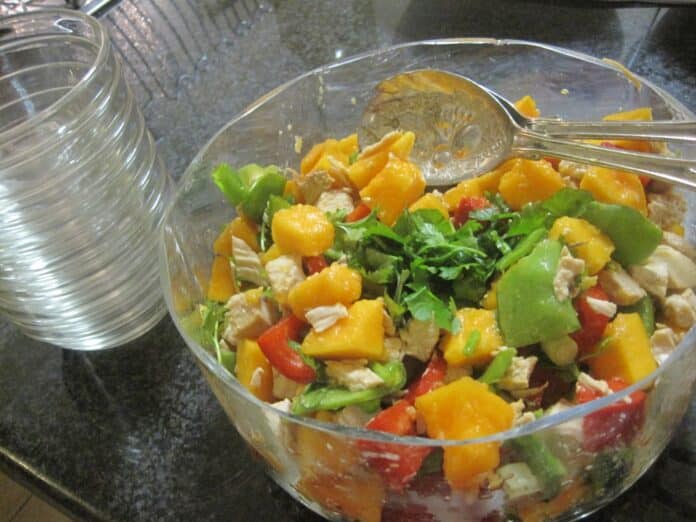
The nutritious papaya is a wonderful salad ingredient

Growing up in India, I once heard a story about how papad manufacturers cut corners – they use dried papaya seeds in place of black peppercorns. Ew.
Imagine my surprise when during a previous tour of the Tropical Fruit World near the Gold Coast, the tour guide told us of a wonderful use for papaya seeds – dry them and put them in your pepper mill, he said. (So the Marwari papad factories were fair dinkum, all this time!)
Papayas are currently in season and you could try making your own peppercorns (you’ll have to use a dehydrator apparently, whatever that is). If you can’t be bothered, you could just eat the fruit.
Personally, I think papayas (or pawpaws as they are called here) are best eaten fresh, and by themselves, because mixing them with other (sweeter) fruits can render them somewhat bland. But they are great in smoothies, or as I discovered recently, in salads and salsas.
Papayas are very high in nutrition. As a good source of fibre, they are best known as an aid in digestion, thanks to a proteolytic enzyme called papain. But did you know they also have 33% more vitamin C and 50% more potassium than oranges? They also have folate, vitamins A and E, and eye-saving carotenoids and lycopene (such as beta-carotene which gives it the orange colour).
The papaya plant is actually a large herb – and the fruit is actually a berry. Apparently it is easy to grow, because its seeds germinate very easily. (Anyone want to try this? Bury the seeds from a fully ripe fruit under some good composted soil. In warm weather, they should be sprouting in a week. Tell me how you go!)
Pawpaw Salad with Chicken
500g chicken breast fillets
1 litre chicken stock
Salt to taste
Red chilli powder to taste
1 medium pawpaw, peeled and diced
1/3 cup fresh coriander leaves
4 green shallots, sliced
50g snow pea sprouts
1 red capsicum
For dressing:
1 lime, juiced
60mls (1/4 cup) peanut oil
2 small fresh red chillies, deseeded, finely chopped
1 tbs brown sugar
Place chicken fillets in a frying pan. Pour chicken stock over. Cover and poach the chicken over medium-low heat for about 10 minutes or until cooked through.
Cool, and then cut into cubes. Put into a deep bowl and add pawpaw, snow peas, capsicum, coriander and green shallots
Meanwhile, combine ingredients for dressing in a screw-top jar. Shake until well combined.
Pour the dressing over the salad, season with salt and red chilli powder, and toss.
Pawpaw Salsa
½ red capsicum, deseeded, coarsely chopped
½ green capsicum, deseeded, coarsely chopped
½ medium pawpaw, diced
1 small Spanish onion, finely chopped
1 fresh red chilli, deseeded, finely chopped
2 garlic cloves, crushed
(1/3 cup) fresh lime juice
(1/4 cup) pineapple juice
Fresh coriander leaves, coarsely chopped
Salt to taste
Red chilli powder or black pepper to taste
Place the red and green capsicum, pawpaw, onion, chilli, garlic, lime juice, pineapple juice and coriander in a medium bowl and stir to combine. Taste and season with salt and chilli powder or pepper. Serve immediately.
Great as a barbecue side dish.
Pawpaw Salad with Spinach and Walnut
150 gm packet baby spinach leaves
1 punnet cherry tomatoes, halved
½ medium pawpaw, peeled, seeded and sliced
1 avocado, stoned, peeled and sliced
1 Spanish onion, thinly sliced
1/3 cup walnuts, chopped
For dressing:
1/4 cup orange juice
2 tbsp olive oil
2 tbsp balsamic vinegar
1 clove garlic, crushed
1 tsp brown sugar
Combine in a deep bowl spinach, tomatoes, pawpaw, avocado, onion and walnuts.
Make dressing by shaking ingredients in a screw-top jar. Pour over salad and toss gently.
Prawn Salad with Papaya
1 medium pawpaw, peeled, seeded, sliced into wedges
1kg cooked medium prawns, peeled, deveined, tails intact
2 avocados, peeled, sliced into wedges
¼ small iceberg lettuce, sliced into thin wedges
1/3 cup coriander leaves
Lime wedges, to serve
For dressing:
¼ cup lime juice
¼ cup light olive oil
1 tbsp sweet chilli sauce
1 tsp fish sauce
This salad looks great served in small glasses. Arrange avocado, papaya, lettuce, prawns and coriander in glasses. Make dressing by whisking all ingredients together.
Drizzle salad with dressing, and stick a lime wedge on side of glass before serving.
Fruit Juice with Pawpaw
1 cup pawpaw cubes
½ cup carrot cubes
1 cup orange juice
1 cup iced water
1 tbsp lime juice
Blend together papaya, carrots, orange juice and iced water. Pour into glass, add lime juice over and stir.
For a bit of fizz, you could add 50 ml lemonade into this juice.
Add any other fruit of choice, such as bananas, instead of carrots.
Pawpaw Smoothie 1
½ medium-sized ripe pawpaw, peeled, seeded and diced
½ cup orange juice
½ cup vanilla yogurt
1 tbsp mango jam
Blend all ingredients together until smooth.
Pawpaw Smoothie 2
1 pawpaw, peeled, seeded and diced
1 banana, peeled and sliced
1/2 cup sliced fresh strawberries
1/3 cup milk
1/4 cup sugar
10 ice cubes
Blend together papaya, banana, strawberries, milk, sugar, and ice cubes until smooth.
Fruity Breakfast Shake
½ cup skim milk
½ cup natural yogurt
½ cup fresh strawberries
¾ cup pawpaw, chopped
1 tbsp honey
1/3 cup crushed ice
Blend together skim milk, yogurt, strawberries, papaya and honey. With the blender running, add ice cubes, one at a time through the opening in lid. Blend till smooth. Pour into tall glasses; serve immediately.
Pawpaw Dressing for Salads
¾ cup ripe pawpaw cubes
2 tbsp fresh lime juice
1/2 tsp Dijon mustard
1 shallot, finely chopped
Salt to taste
Puree papaya in a blender. Add all remaining ingredients and blend until smooth. Pour over leafy green salad and toss through
Tropical Fruit Salad
1 cup pineapple pieces
1 cup melon or mango pieces
1 cup pawpaw pieces
2 cups vanilla yogurt
2 tbsp honey
1 cup strawberries
Mint leaves for garnish
Try making this salad inside a pineapple shell. Spread 1 cup yogurt at the base.
Toss through all fruit together in a separate bowl, and lay them out on yogurt base inside pineapple shell. Mix honey into remaining yogurt and pour over the fruit. Garnish with mint leaves.
Bindra shoots bronze in men’s 10m air rifle
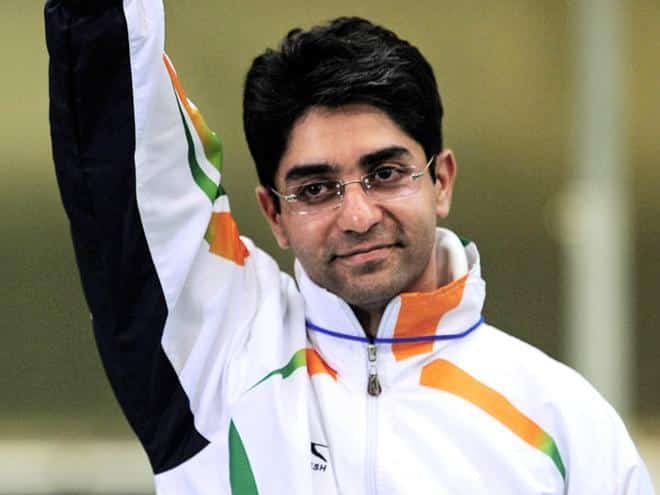
Abhinav Bindra ended his shooting career with his first Asian Games individual medal

Abhinav Bindra ended his shooting career with his first Asian Games individual medal, a bronze in the 10 metre air rifle event at the Ongnyeon International Shooting Range.
The 2008 Olympic champion Bindra, who recently tweeted that the Asian games will be his last professional competition, recorded a final score of 187.1 to take the third position. China finished one-two with Haoran Yang (209.6) clinching the gold medal and Yifel Cao (208.9) taking the silver.
Bindra looked like he would be finishing fourth till his penultimate round but Iran’s Pourya Norouziyan, who needed a 9.9 to ensure his progress after the 31-year-old Indian shot 10.5, scored a poor 9.6 to slip to the fourth spot and handed Bindra a podium finish.
Bindra scored 10.6 and 10.7 in his final two shots but it was not enough to stop the rampaging Chinese duo.
Earlier in the day, Bindra had also led India to the bronze medal in the 10 metre air rifle men’s team event.
Bindra’s individual bronze medal was India’s eighth medal in the Incheon Games and sixth from the shooting range. His bronze also marks the end of an illustrious career with an elusive Asian individual medal.
“Tomorrow will mark the end of my professional shooting life. I will, however, still shoot, compete as a hobby shooter, training twice a week,” tweeted Bindra earlier this week.
Bindra announced in July that the 2014 Glasgow Games would be his last Commonwealth Games and he finished it off in style by winning his maiden singles Commonwealth Games gold.
The former World Champion still hoped that he would participate at the Rio Olympics in 2016.
“And yes, I will still try to be at Rio and my bio is now most appropriate! Great times and am sure there will be a few more!” Bindra tweeted.
In 2006, Bindra became the first Indian shooter to become a World Champion and two years later he scripted history by winning the individual gold medal in the 10m air rifle event at the Beijing Olympics.
Bindra, who was the youngest participant at the 1998 Commonwealth Games, has four Commonwealth gold medals, and had won the team silver in the 2010 edition in Guangzhou.
Bindra shoots bronze in men's 10m air rifle
Abhinav Bindra ended his shooting career with his first Asian Games individual medal
Abhinav Bindra ended his shooting career with his first Asian Games individual medal, a bronze in the 10 metre air rifle event at the Ongnyeon International Shooting Range.
The 2008 Olympic champion Bindra, who recently tweeted that the Asian games will be his last professional competition, recorded a final score of 187.1 to take the third position. China finished one-two with Haoran Yang (209.6) clinching the gold medal and Yifel Cao (208.9) taking the silver.
Bindra looked like he would be finishing fourth till his penultimate round but Iran’s Pourya Norouziyan, who needed a 9.9 to ensure his progress after the 31-year-old Indian shot 10.5, scored a poor 9.6 to slip to the fourth spot and handed Bindra a podium finish.
Bindra scored 10.6 and 10.7 in his final two shots but it was not enough to stop the rampaging Chinese duo.
Earlier in the day, Bindra had also led India to the bronze medal in the 10 metre air rifle men’s team event.
Bindra’s individual bronze medal was India’s eighth medal in the Incheon Games and sixth from the shooting range. His bronze also marks the end of an illustrious career with an elusive Asian individual medal.
“Tomorrow will mark the end of my professional shooting life. I will, however, still shoot, compete as a hobby shooter, training twice a week,” tweeted Bindra earlier this week.
Bindra announced in July that the 2014 Glasgow Games would be his last Commonwealth Games and he finished it off in style by winning his maiden singles Commonwealth Games gold.
The former World Champion still hoped that he would participate at the Rio Olympics in 2016.
“And yes, I will still try to be at Rio and my bio is now most appropriate! Great times and am sure there will be a few more!” Bindra tweeted.
In 2006, Bindra became the first Indian shooter to become a World Champion and two years later he scripted history by winning the individual gold medal in the 10m air rifle event at the Beijing Olympics.
Bindra, who was the youngest participant at the 1998 Commonwealth Games, has four Commonwealth gold medals, and had won the team silver in the 2010 edition in Guangzhou.
Under-cooked biryani
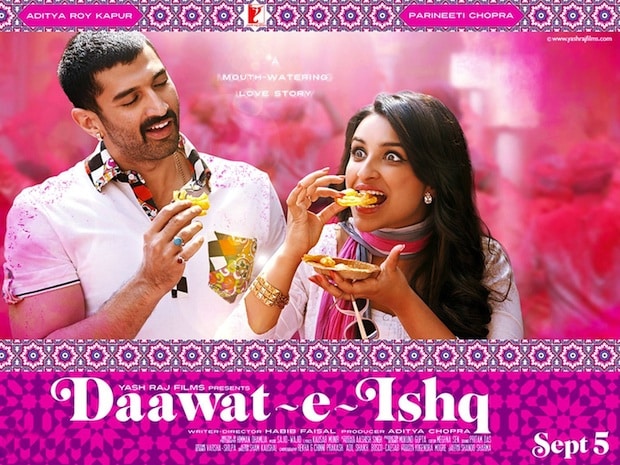
Film: Daawat-e-Ishq
Starring: Aditya Roy Kapoor, Parineeti Chopra and Anupam Kher
Director: Habib Faisal
Rating: ** 1/2 (two and a half stars)

There are two different films tucked away into this one big under-cooked biryani of a film.
Daawat-e-Ishq is not as inviting as the title suggests. Food is important to the plot, yes. And hats off to writer-director Habib Faisal for tempering the texture of the tale with a culinary flavour.
You wish food were the driving force in this freewheeling tale of love. But no, this film is more about a Muslim girl’s search for a life beyond finding a suitable match…
Faisal’s special gift as a filmmaker is to portray the Indian middle-class in all its squalid glory. He doesn’t sweep the murk under the threadbare carpet. He takes on the quirks guilt and the conflicts of the ‘muddle class’ headlong.
Till a certain point the narrative in Daawat-e-Ishq tells us some pungent home truths about the over-educated unmarried middle-class girl’s plight as she is forced to squeeze into an arranged marriage.
Anupam Kher and Parineeti Chopra are so convincing as father and daughter looking for a suitable groom that you tend to forgive the film’s aggressive indiscretions that prop up prominently and intrusively in the second-half.
Yes, there are two films here. The ‘Hyderabad’ film in the first-half is effusive and endearing. The second movement takes us to Lucknow where father and daughter put up a big con show to trap an unsuspecting dulha for Parineeti.
It is tragic to see the film’s early excellence fall apart piece by piece to reveal a plot with little substance accommodating characters with a big plot up their sleeve.
Everyone behaves as if they are part of a high school play based on H.S. Rawail’s Mere Mehboob. They run around exchanging giggles, kebabs and qawwalis.
Is Sajid-Wajid’s music homage to the sound of Laxmikant-Pyarelal in the 1970s or a straight rip-off?
The intention of doing a film that involves dowry and deception cannot be doubted. Faisal means well. Alas, his storytelling doesn’t convince us of his intentions.
Performance-wise Parineeti and Anupam are a delight. Parineeti again proves herself a natural-born scene-stealer. That’s relatively easy when your co-star is hell bent on being a caricature.
Aditya Roy Kapoor with his kohl-laden eyes and pseudo-Lucknowi drawl is a disaster. His painfully self-conscious performance reduces the film to a pantomime of good intentions.
I came away with the baap-beti relationship rather than the love story.
As for food, I craved for more.
Subhash K. Jha
This one would make Hrishida smile
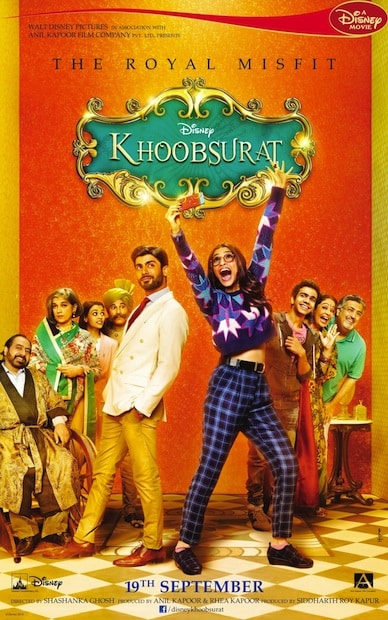
Film: Khubsoorat
Cast: Sonam Kapoor, Fawad Khan, Kirron Kher, Ratna Pathak Shah
Director: Shashanka Ghosh
Rating: ***

Meet Mili Chakravarty, the bindaas physiotherapist daughter of a Bengali father (played by an aptly nondescript actor) and a loudmouthed Punjabi mother (Kirron Kher), you know the kind Amrita Singh played in Two States recently?
“Everyone in my family has gone after my mother… even my father,” Mili happily informs her open-mouthed royal hosts. She has come to treat the patriarch’s inert limps. But here’s the thing. It’s the spirit she wants to massage into awakening.
So while busybody Mili takes care of the wheelchair-bound patriarch’s legs, she also has her eyes set on what lies between the royal heir-apparent’s legs… if you’ll pardon the bit of crassness, refreshingly missing from the film.
Khubsoorat, Shashanka Ghosh’s revisionist version of Hrishikesh Mukherjee’s 1980 comedy, is a decorous yet devilish take on the original material, while the Rathod family, where Mili storms in, is nothing like the upper middleclass parivaar of the original.
In the earlier film, the family suffered from a case of matriarchal tyranny. Here the problems in the royal family are much deeper.
Ghosh weaves across the royal pastiche tenderly cutting through Hrishida’s Arcadian concept of tyrannical discipline, as was represented by the very wonderful Dina Pathak in the older film.
Here the stiff-upper-lipped mother, interestingly played by Dina’s daughter Ratna Pathak Shah, has a serious problem with happiness. To laugh and enjoy makes her feel guilty for reasons that I’d rather not reveal.
In the original, Ashok Kumar was emotionally cramped by his wife’s autocratic attitude. In the new Khubsoorat, the very skilled theatre actor Aamir Raza Hussain is a helpless hedonistic slob on a wheelchair. He probably stopped using his legs so he could stop adaaoing his taang in his decorous wife’s governance.
Wisely, Ghosh has done away with the large joint family of brothers and their wives in the royal clan. The focus in the royal family is on the heir-apparent Vikram Rathod played with a jaunty flair by Fawad Khan.
Khan is unmistakably a prized discovery of the year. He plays a guy encumbered by his affinity to his mother’s brand of royal posturing but dying to get out of it.
Sonam Kapoor’s Mili provides just the excuse he’s looking for. Their scenes together are written in a rush of a mushy romance and sly sitcom.
The writing strives to be smart and slick and succeeds to a large degree. Very often the couple’s spoken words are accompanied by voiceovers suggesting lines that are left unspoken between them.
The texture of the togetherness between the Bengali-Punjabi girl and the Rajput royal prince is constantly perky. The wafer-thin storyline is kept vigilantly vibrant by the couple’s growing fondness. Class differences are brought out in handsomely mounted sensibly written scenes that are not over-anxious to involve us.
If Hrishikesh Mukherjee were alive, he would have surely chuckled at this winking wacky wallop of a homage.
Shashanka Ghosh is reverent of the original without being slavishly faithful. The end result is a hugely engaging melange of a classic’s rebirth and sassy mirth.
Sonam sheds all her inhibitions to deliver an unselfconscious performance as the rebel with a domestic cause. She seems to have so much fun with her part we just can’t stop partaking of her delight.
The pace is often languid, though. While Sonam Kapoor does very well in her romantic scenes, the moments where she takes on matriarchal tyranny don’t work as effectively as Rekha’s mutinous moments with Dina Pathak in the original.
The dinner-table tension is undermined by the absence of a dramatic density in the conflict between an unrelenting woman and a girl determined to break her rules.
At the end of the film, I found myself smiling and rooting for the couple’s inevitable reunion.
While Sonam comes into her own with a role that demands high-octane involvement from her on every level, Fawad is an ample royal foil. Kirron Kher as Sonam’s boisterous Punjabi mother is laugh-out-loud comfortable as the aggressive middleclass matriarchal bully.
Royalty or middleclass, this Khubsoorat is easily and serenely ensconced in worlds that are not only dissimilar but also irreconcilable.
Opposites don’t only attract they also attack the status quo. This remake tells us it’s okay to oppose draconian discipline. But we better ensure we have an alternative reality ready to take over our universe.
Hrishida won’t recognise this as his Khubsoorat. But he won’t disapprove of what has been done to his work.
Really, can anyone be miffed with Sonam Kapoor for too long?
Subhash K. Jha
Not your ordinary tea cart
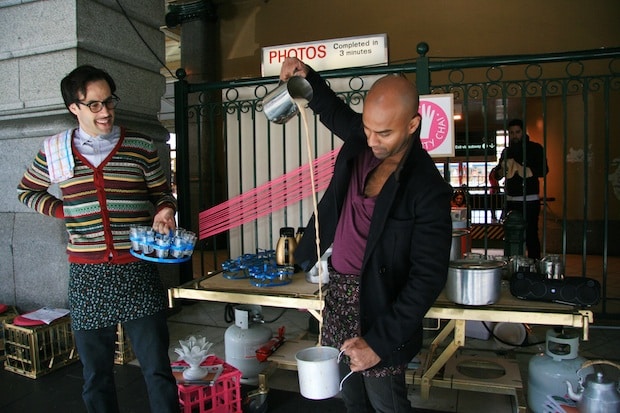
Kwality Chai, an extraordinary public live art performance, promotes Australia’s cross-cultural identity with the offer of tantalizing Indian chai

Amid the bustle of Melbourne’s iconic Flinders’ Street Station you could hear the calls: “Would you like some chai?”
These are not usually the words you hear every day when strolling along Melbourne’s streets. In fact, it seemed quite bizarre.
Three chatty chai wallahs (specialist Indian tea makers) and waiters are currently proffering passersby and commuters cups of tantalizing, freshly brewed, spicy Indian tea – for free. In return, they receive a curious glance or the occasional enthused customer who is lured by the fragrance and steam hissing from the pots stationed within the open-air tea cart. A bright pink sign hovering above the tea cart signals that this is ‘Kwality Chai.’ Pun intended.
For the adventurous passerby prepared to stop and drink some ‘quality’ tea, this promises to be a stirring experience. A team of dynamic performers (Sharon Johal, Luke D’Emannuelle, Dushan Philips and Jan DiPietro) playing chai wallahs and waiters, usher you to sit and relax with your cuppa on one of their cluster of comfortable stools. Of course, this isn’t a lone ‘drinking’ experience, but rather a very social one. The waiters and chai wallahs converse with you on topics ranging from politics to your plans for the day, sometimes speaking in an invented Australian-Indian language. Additionally, fellow customers may engage you in small talk. If you’re lucky, the performers might even offer you the specially published local newspaper to read, ‘Kwality Times.’ Old school Hindi songs play on the “New World” radio station, transporting you to times past. Above all, recorded sounds of India’s bustling streets – rickshaws, horns, motorists and traffic congestion, immerses you in roadside havoc. When you’ve finished your tea, a waiter bellows, “Have a karmic day!”
Everything about the experience is authentically Indian, from the delicious tea to the assembled tea cart, and the chirpy performers who stay in character throughout. As with all live art performances, you can expect a disparate world to unfold in front of your eyes. The participant realises they are in an alternate reality far removed from their immediate surroundings, yet so intertwined within it.

Situated at Flinders Street Station near Platform 1, Kwality Chai is a great representation of our transitory experiences and fast paced lives. It is an uncanny intervention into the every-day, drawing in an unsuspecting public as the audience to experience Australia’s cross-cultural identity through the making and serving of tea.
This live art performance comically replicates the chai wallahs in India who can be found serving tea boiled with spices, sugar and milk everywhere from busy urban street corners to hidden alleyways, at bus depots and railway platforms, walking through train carriages, along riversides and on footpaths that lead to religious pilgrimage sites. In India, chai is more than just a cup of tea to start the day. This thick, sweet drink is an integral part of the rhythm of life and social experiences. Moreover, chai carts are often family businesses spanning many generations.
Historically, tea was introduced by the British East India company in the 1800s. However, it was only in the 20th century that the British East India company and British tea merchants decided there was a big Indian domestic market for tea, leading them to cultivate Indian demand by serving free tea and milk at Indian railway stations.
Undeniably, over the past century, Indians have truly made tea their signature beverage, and the chai wallah has become a prevalent occupation in India. Being one of the few literate people in a village, chai wallahs would typically read a newspaper to all the other villagers who gather around at a chai stand to hear the daily news.

Being so rooted in Indian landscapes, stumbling upon a traditional Indian tea demonstration amid Melbourne’s streetscape can be surprising to many, but also riveting. Kwality Chai is a potent symbol of globalisation, highlighting that everything is constantly being influenced by something, or somewhere, else.
What better place to invite contemplation and participation in this site-specific installation than in Melbourne’s own Flinders Street Station. Bustling with busy commuters, this is where Melbournians transit from one place to another. There is a real sense of community, and opportunity to take a break, in order to learn about a different culture and lifestyle through the lens of a chai stand.
Indeed, producer and drama director, Shash Lal expresses one of the main aims of Kwality Chai is to encourage people to realise how exciting it can be to see a world different to that of their own, and also to eradicate the fear of immigration.

“People from all walks of life are encouraged to have chai, intermingle, embrace multiculturalism through a different lifestyle and also to show how this can have a very positive influence on others,” Lal said.
Conceived by Australian-Indian artist, Sapna Chandu, Kwality Chai is running in conjunction with the Melbourne Fringe Festival. Chandu works with site-specific installations and has a special interest in cross-cultural narratives. Having grown up in a small Indian community in Melbourne, she says she is “interested in the effect of mass migration on collective culture and how this creates a new language of communication and social exchange”.
Certainly, this performance kindles the audience?s imagination beyond fears of an enemy invasion. As Chandu reinforces, “It instills value upon the unique and playful exploration of the legacy of cultural imperialism in a distinctlyAustralian context.”

Kwality Chai is run in conjunction with the Melbourne Fringe Festival. The performance can be viewed at Flinders Street Station entrance to Platform 1, opposite Degraves Street, 18 September – 5 October 2014, Thurs – Sun, 10am – 2pm.

Because he’s Indian
Comedian Raj Moodley challenges stereotypes with his new stand-up comedy show

The stage goes dark and the audience goes quiet. Lively Bhangra music plays. Raj Moodley appears on stage, in character, auditioning for the role of a doctor. “Congratulations, it’s a boy!” he says loudly, with a warm smile. The unseen casting directors aren’t happy. Try again. “Congratulations, it’s a boy!” he says again, turning the enthusiasm up a notch. They’re still unimpressed. Exasperated, he throws on a colourful turban, puts on a heavy Indian accent, throws his arms out and while gesticulating wildly says, “Congratulations, it is a boy!”. He’s in.
The new comedy show ‘Is It Because I’m Indian’ explores the recurring theme of stereotyping throughout actor and writer Raj Moodley’s career. Poignant, funny and soul baring, the show charts Moodley’s life including his career path, and his close knit family coming together in the face of tragedy. The show follows Moodley’s discovery of a love of acting, to his struggling to find work as anything but the token Indian, being bullied at work, to taking a break to care for his terminally ill father, then coming back full circle to where he started, in line at an extras agency.
Born and raised in England, Raj Moodley moved to Australia with his family at 14, already knowing he wanted to be an actor. He was introduced to the theatre at a very young age by his musically and culturally inclined parents. At 11 he decided to become an actor when he won the school drama competition, which saw him getting his first standing ovation: with his father in the audience, standing and applauding enthusiastically while standing atop a chair. Decision made, Raj joined an acting school as soon as he was able to.
“Dad came to the interview, of course. He had to say if he approved or not!”

Getting work after he finished school proved harder. The only roles available to Raj seemed to be roles of the token Indian and nothing else.
“They would look at me and say, ‘we already have an Indian on our books’. I’d respond and say, ‘You have 200 to 300 white people on your books, but you can’t have two Indians?’ Agents would love my work but say they didn’t know how to market me.”
Dealing with such repetitive rejection was hard, but Raj never gave up hope. “You either fall in a heap, or you keep going. I kept going.”
Raj had always dabbled in poetry and writing, but the transition from actor to writer happened with ‘Swami Charlie’. He was writing the script for a voiceover when a friend suggested he write a play. Broke, and fresh from dealing with being rejected by yet another agent, he put his energy into ‘Swami Charlie’ which he staged in Carlton in 2003. His next play, ‘I Am What I Am’ was part of the Fringe Festival in 1995, and he got funding for ‘The Perfumed Garden’, which went to stage in 2004 and 2007.
The idea for ‘Is it Because I’m Indian’ happened during a phone conversation with a dear friend.
“I was telling her about a funny incident that happened to me, and she suggested I write about. ‘What is that catchphrase you always keep using? Is It Because I’m Indian? You should write about that’.”
And so Raj started writing. Imagined first as a short play, he Googled the Short + Sweet Festival and Sydney came up, with the deadline for 2014 three weeks away. He made the deadline, and was accepted to perform at the Festival. “I did five performances in February and they called me back for a Gala performance for 700 people.” After this success, he made it into the longer piece that features at the Melbourne Fringe.
Having been part of the performing arts scene for a long while, does Raj see any change?
“There are more Indians now so there are more roles, but they’re still stereotypical. In England you have the most colour blind casting than anywhere else. As much as my family disliked Thatcher, at least she introduced Affirmative Action where Indian or black people had to be portrayed in positive light. Thirty years later, we don’t have that here,” he laments. “But, you must follow your dream,” he says. “Otherwise it will eat you up. Train however you need to train, and just do it.“
It is that determination and will to survive that has helped Raj beat the odds. Rejection, family tragedy and bullying seem to have made him stronger. He explores all three in the show, including dealing with slurs such as ‘Curry Muncher’, a word he reclaims.
Detailed, candid, funny and emotional, the performance grabs the audience from the start . Raj’s energy and comic timing are highly engaging, and the insight into his life, both professional challenges and personal tragedies, make the performance believable and intimate.

‘Is It Because I’m Indian’ is running at the Melbourne Fringe Festival till the 28th of September. Tickets $23 / conc $18